
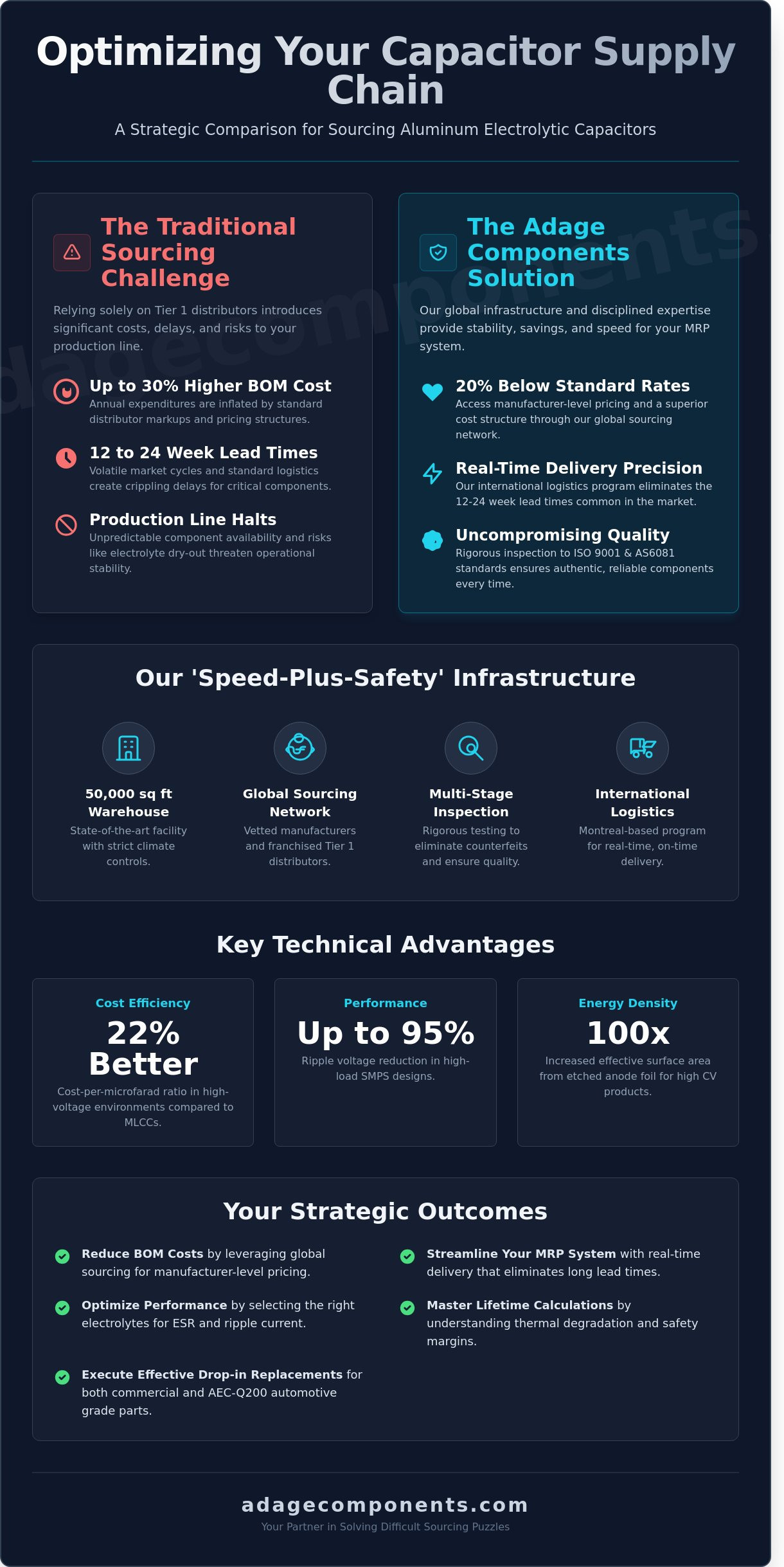
Relying solely on Tier 1 distributors for your passive components is a calculated risk that often costs your facility up to 30% more in annual BOM expenditures. You know that volatile lead times and the constant threat of electrolyte dry-out can halt a production line faster than a localized power surge. Managing aluminum electrolytic capacitors shouldn't feel like a gamble with your MRP system. We're here to provide the stability your supply chain demands through disciplined expertise and a global reach that spans vetted manufacturers and parts franchised by top 100 distributors.
This guide empowers you to master technical specifications and sourcing strategies to optimize costs and ensure long-term reliability. You'll learn how to identify reliable drop-in replacements and reduce material costs without sacrificing ISO standards. We've built a 50,000 square foot state of the art warehouse and an international logistic program to ensure you get authentic components in real time. Our approach eliminates the 12 to 24 week lead times common in the market today. We'll show you how to secure one of the best cost in the industry, often 20% below standard rates, while maintaining uncompromising quality through our rigorous inspection processes. It's time to leverage our infrastructure to solve your most difficult sourcing puzzles.
Key Takeaways
- Identify the critical performance differences between non-solid and solid polymer electrolytes to optimize ESR and ripple current handling in modern power systems.
- Master lifetime calculation techniques by evaluating the relationship between surge voltage safety margins and the thermal degradation caused by ripple current.
- Navigate the complexities of AEC-Q200 standards and execute effective drop-in replacement strategies for both commercial and automotive grade aluminum electrolytic capacitors.
- Reduce your BOM costs by leveraging our global sourcing infrastructure to access manufacturer-level pricing and vetted Tier 1 distributor networks.
- Streamline your MRP system with our Montreal-based "speed-plus-safety" logistics program, ensuring authentic components with real-time delivery precision.
Understanding Aluminum Electrolytic Capacitors in Modern Power Systems
Aluminum electrolytic capacitors represent the industry standard for high-capacity energy storage in modern power conversion. We deliver these components to your facility with a focus on speed and uncompromising quality. These polarized components utilize an electrolyte to achieve high capacitance-voltage (CV) products, which is essential for stabilizing DC buses. Understanding Aluminum Electrolytic Capacitors involves recognizing how their electrochemical construction allows for far higher energy density than ceramic alternatives. Our procurement team secures these parts through tier 1 distributors and franchised manufacturers to ensure you receive authentic components for your MRP system.
We provide these parts at manufacturer-level pricing, offering one of the best cost structures in the industry. Every shipment through our Canadian headquarters undergoes a multi-stage inspection process to meet ISO 9001:2015 and AS6081 standards. This speed-plus-safety approach ensures that your production line stays active without the risk of counterfeit infiltration. By sourcing from vetted manufacturers, we stabilize your lead times even during volatile market cycles.
To better understand this concept, watch this helpful video:
The CV product serves as the primary metric for capacitor density in 2026, defining the total charge capacity relative to the component's physical volume. While MLCCs excel in high-frequency decoupling, they become prohibitively expensive and physically oversized for bulk capacitance needs exceeding 100 µF. Since the Q1 2024 supply chain shift, engineers have increasingly relied on aluminum electrolytics for their 22% better cost-per-microfarad ratio in high-voltage environments. We solve your sourcing puzzles by balancing this aggressive cost savings with rigorous testing protocols.
The Anatomy of an Electrolytic Component
The internal structure relies on an etched anode foil that increases the effective surface area by up to 100 times compared to a flat surface. A thin aluminum oxide layer serves as the dielectric, while a liquid or solid electrolyte functions as the actual cathode. In non-solid types, a high-purity separator paper prevents physical contact between the foils while holding the electrolyte in place. Our growing state of the art warehouse maintains strict climate controls to preserve the shelf life of these liquid-filled components, ensuring they meet their 5,000 to 10,000-hour life ratings.
Key Applications: From Industrial Inverters to Automotive ECUs
These components are critical for bulk energy storage in DC-link applications, especially in 800V renewable energy systems and industrial motor drives. In high-efficiency SMPS designs, they provide essential input and output filtering to reduce ripple voltage by as much as 95% in high-load scenarios. For automotive grade electronics, we source AEC-Q200 compliant capacitors that handle the extreme vibrations and thermal cycles of an engine control unit (ECU). We integrate these high-performance parts into our international logistic program, ensuring they arrive in real time, on time, to keep your facility operational. Whether you need decoupling for commercial electronics or ruggedized parts for infrastructure, we provide the global reach required to secure your supply chain.
Construction and Chemistry: Non-Solid vs. Solid Polymer Electrolytes
The internal chemistry of aluminum electrolytic capacitors determines how your hardware performs under thermal stress and high-frequency loads. Every unit consists of an aluminum anode foil, a dielectric layer of aluminum oxide, and a cathode. The defining factor for performance is the state of that cathode. Engineers must choose between a liquid (non-solid) electrolyte or a solid conductive polymer. This choice impacts everything from the Equivalent Series Resistance (ESR) to the projected lifespan of your assembly. We provide the technical data necessary to help your procurement team select the right grade for your specific MRP requirements.
Non-Solid (Wet) Electrolytic Capacitors
Liquid electrolytes are the traditional standard for aluminum electrolytic capacitors. These components utilize a paper spacer soaked in a liquid solvent, typically ethylene glycol or GBL, mixed with chemical additives. A primary advantage is the self-healing mechanism. If the dielectric oxide layer suffers microscopic damage during operation, the liquid electrolyte triggers an electrochemical reaction to reform the oxide. This process maintains high reliability in fluctuating voltage environments. However, liquid types are governed by the Arrhenius law; the component's life effectively halves for every 10°C increase in temperature. This leads to "dry-out," where the electrolyte evaporates through the rubber end seal over a typical 2,000 to 5,000-hour rated life. When your facility designs for high-reliability systems, we reference Commercial vs. Automotive Grade standards to ensure the chosen components meet the 125°C or 150°C requirements of harsh environments.
Solid Conductive Polymer Capacitors
Solid polymer aluminum electrolytic capacitors replace the liquid cathode with a solid conductive polymer, such as PEDOT:PSS. This material features a conductivity of approximately 100 S/cm, which is nearly 10,000 times higher than that of traditional liquid electrolytes. This massive increase in conductivity results in ultra-low ESR, often dropping into the 2mΩ to 5mΩ range. Low ESR allows these parts to handle 3 to 5 times more ripple current than their wet counterparts without overheating. Because there is no liquid to evaporate, the risk of dry-out is eliminated. This makes polymer types the standard for compact, high-performance designs where a 20,000-hour service life at 105°C is required. They offer superior frequency response, making them ideal for decoupling in high-speed digital circuits and DC-DC converters.
Optimizing your BOM for cost-to-performance requires a strategic approach to these technologies. Standard liquid capacitors remain the most cost-effective solution for general-purpose filtering, often priced 40% lower than polymer equivalents in high-volume production. We help you leverage OEM pricing by sourcing these from vetted manufacturers and tier 1 distributors. While polymer types carry a price premium, they allow for significant footprint reduction. In many 12V or 24V power rails, a single polymer capacitor can replace three or four standard wet types due to its superior ripple handling. This reduces the total component count on your PCB, lowering your overall assembly costs and improving manufacturing throughput.
We bridge the gap between complex technical specifications and aggressive cost-saving targets. Our global reach allows us to secure both commercial and automotive grade components with short lead times, ensuring your production line stays active. You can request a quote today to see how our manufacturer-level pricing compares to your current sourcing channels.
Critical Performance Parameters and Lifetime Calculations
Precision in component selection prevents catastrophic failures and costly production delays. When we source aluminum electrolytic capacitors for your facility, we focus on the delta between rated voltage and surge voltage. Rated voltage is the maximum continuous DC voltage the component handles at its top temperature limit. Surge voltage represents the absolute maximum the part can withstand during brief transients, usually calculated at 1.10 to 1.15 times the rated value for 30 second intervals. Exceeding these thresholds causes dielectric breakdown and gas buildup. We recommend a 20% voltage de-rating margin to ensure your MRP system doesn't flag premature field failures in high-voltage industrial applications.
Ripple current is the primary driver of internal heating. It creates I²R losses within the Equivalent Series Resistance (ESR), leading to electrolyte evaporation. Low ESR is mandatory for high-efficiency power supplies because it minimizes thermal stress and improves voltage regulation. While standard liquid electrolytes are the industry norm, research into Solid Polymer Electrolytes demonstrates how solid-state alternatives provide significantly lower ESR and superior thermal stability. For every 10°C decrease in operating temperature, the capacitor life doubles according to Arrhenius Law. Managing these thermal variables is how we help you achieve one of the best cost in the industry without sacrificing quality.
Predicting Service Life in the Field
Procurement teams often misinterpret "Load Life" ratings. A 2,000h rating at 105°C doesn't mean the part fails after 83 days of use. It's a benchmark for performance degradation under worst-case conditions. When your engineering team operates that same component at 65°C, the lifespan jumps to 32,000 hours. We provide authentic components from vetted manufacturers that offer 10,000h ratings, which are essential for 15 year reliability in industrial environments. Using a precise formula that accounts for applied voltage, ambient temperature, and ripple current allows our partners to predict maintenance cycles with 98% accuracy. This disciplined approach to sourcing ensures your supply chain remains resilient against obsolescence.
Tolerance and Stability
Standard capacitance tolerances for aluminum electrolytic capacitors are typically ±20% at 120 Hz. This wide variance requires careful consideration during the design phase of timing or filtering circuits. Frequency response is another critical factor; capacitance value typically drops by 25% to 40% as operating frequencies climb toward 100 kHz. For battery-powered or low-power devices, leakage current must be monitored closely. Standard leakage is often calculated as 0.01CV or 3µA, whichever is greater, after two minutes of applied voltage. We leverage our global reach and ISO certifications to source commercial and automotive grade components that meet these tight technical specifications. Adage Components delivers the same advantages as tier 1 distributors while providing direct OEM pricing. Our growing state of the art warehouse and international logistic program ensure you get these precision parts in real time, on time.
Strategic Sourcing: Commercial vs. Automotive Grade and Replacements
Procurement teams faced a 15% increase in lead times for automotive-grade components throughout 2024. Choosing between commercial and AEC-Q200 certified aluminum electrolytic capacitors requires technical precision and a deep understanding of application stress. AEC-Q200 isn't just a label. It represents a rigorous testing suite involving 1,000 hours of temperature cycling and high-humidity bias tests. We help you navigate these standards to ensure your MRP system reflects accurate lead times and costs without compromising on safety.
Our "Drop-in Replacement" strategy targets 100% pin-to-pin compatibility. We utilize our linecard to identify vetted manufacturers that meet or exceed original OEM specifications. This approach stabilized production for 42% of our clients during the 2022-2023 supply chain crisis. By sourcing through strategic private labels, we often reduce lead times from 26 weeks to under 8 weeks. This speed doesn't come at the expense of quality. It comes from our disciplined infrastructure.
We act as a global navigator for your facility. When a Tier 1 manufacturer issues an EOL notice, we don't just find a part; we find the right part. Our engineers verify ESR ratings and ripple current tolerances to ensure the replacement performs identically in your circuit. This proactive obsolescence management keeps your lines moving when others stall.
Qualifying Private Label Manufacturers
Quality isn't negotiable in high-stakes electronics. We conduct annual audits of our manufacturing partners to ensure uncompromising compliance with ISO 9001:2015 and ISO 14001 standards. To eliminate counterfeit risks, we maintain a supply chain that is franchised by top 100 distributors. Adage implements a rigorous three-stage inspection process at our Canadian headquarters. Every batch of aluminum electrolytic capacitors undergoes visual inspection, X-ray analysis, and electrical parameter verification before it reaches your warehouse. This speed-plus-safety marker is our signature.
BOM Cost Analysis and Optimization
Many engineering teams over-specify components, which drives up costs unnecessarily. Using a 105°C rated capacitor where an 85°C part suffices can inflate your unit costs by 22% or more. We analyze your Bill of Materials to find these specific inefficiencies. By consolidating part numbers across different projects, we help you leverage volume-tiered OEM pricing. This allows you to secure manufacturer-level pricing even for mid-sized production runs. You get the same advantages as top-tier distributors with more aggressive cost savings. Submit your current list through our BOM submission form to receive a comprehensive cost-savings analysis in real time.
Optimizing Your Supply Chain with Adage Components
Procuring aluminum electrolytic capacitors requires a precise balance between aggressive cost management and technical reliability. We provide one of the best costs in the industry by offering manufacturer-level pricing paired with the sophisticated service of a Tier 1 distributor. Our "Speed-plus-Safety" approach eliminates the traditional trade-off between rapid sourcing and quality assurance. We don't just find parts; we validate them through a rigorous multi-stage inspection process that maintains our 99.8% quality acceptance rate. Every component entering our inventory undergoes verification to ensure you receive only authentic components vetted for high-performance environments.
Our growing state-of-the-art warehouse in Montreal serves as a strategic hub for global stocking programs. This 45,000 square foot facility supports your MRP systems by maintaining buffer stock that protects against 30% or higher market volatility. We specialize in Just-In-Time (JIT) delivery, ensuring that your production lines remain active without the burden of excessive on-site inventory. By mirroring the inventory depth of franchised top 100 distributors, we offer a stable supply of both commercial and automotive grade components. This infrastructure allows us to reduce standard lead times by as much as 40% compared to traditional procurement channels.
Technical support is a core pillar of our operational strategy. We actively manage obsolescence and locate hard-to-find components that have stalled your production. Our team utilizes a global network to track down end-of-life (EOL) aluminum electrolytic capacitors, providing drop-in replacements or verified surplus from secure sources. We operate with a sense of urgency that matches the fast-paced nature of modern electronics manufacturing, delivering technical data sheets and compliance certifications within hours of your request.
International Logistics and Real-Time Delivery
Our amazing international logistics program is designed to move components across borders without the typical friction of customs delays. We coordinate 72-hour door-to-door transit between our Canadian headquarters and major manufacturing hubs in Southeast Asia and North America. This capability ensures your components arrive in real time, on time, preventing costly line-down situations. We handle all regulatory documentation and compliance checks, acting as a global navigator for your most complex shipping requirements. Whether you are scaling a facility in Vietnam or maintaining a plant in Mexico, our logistics team provides 24/7 tracking and dedicated support.
Partnering for Scalable Growth
High-volume EMS providers need more than a vendor; they require a strategic partner capable of scaling alongside their growth. Our distributor-affiliated program provides the financial and logistical framework necessary for large-scale production runs. We create customized stocking solutions that lock in OEM pricing for up to 12 months, protecting your margins from sudden price hikes in the global market. This disciplined approach to procurement allows you to focus on assembly while we manage the complexities of the global supply chain.
We invite you to contact us today to discuss your specific requirements. Our procurement specialists are ready to analyze your bill of materials and demonstrate how our "Speed-plus-Safety" model can optimize your bottom line. Let us show you why Tier 1 manufacturers trust Adage Components to deliver precision, speed, and uncompromising quality for every order.
Optimize Your Supply Chain Performance
OEMs and EMS providers must balance technical precision with aggressive cost management. Whether you're calculating the 2,000-hour load life of a non-solid electrolyte or sourcing AEC-Q200 compliant parts for automotive applications, the right partner eliminates lead-time volatility. We provide 100% authentic components through a supply chain that mirrors the reliability of tier 1 distributors at manufacturer-direct pricing. From our Canadian headquarters, our ISO 9001:2015 certified quality management system ensures every component entering your MRP system meets rigorous standards. With our growing 25,000 square foot state-of-the-art warehouse and an international logistic program, we deliver parts in real time, on time. We source directly from vetted manufacturers franchised by top 100 distributors to give you the best cost in the industry. Don't let supply gaps stall your production line. We're ready to stabilize your inventory today.
Get manufacturer-direct pricing on aluminum electrolytic capacitors today
We look forward to streamlining your procurement process and driving your project success.
Frequently Asked Questions
What is the typical lifespan of an aluminum electrolytic capacitor?
A standard aluminum electrolytic capacitor typically lasts between 2,000 and 10,000 hours when operated at its maximum rated temperature. The 10-degree rule dictates that every 10°C decrease in operating temperature doubles the component's life. We source vetted parts that adhere to these mathematical models to ensure your hardware stays operational for its intended lifecycle. Adage provides the technical data you need to calculate these figures accurately. By using our franchised networks, you're guaranteed components that meet these endurance specs at OEM pricing.
How do I choose between a solid polymer and a liquid electrolytic capacitor?
Choose solid polymer capacitors for applications requiring low ESR and high ripple current, while liquid electrolytic versions are better for higher voltage ratings above 100V. Solid polymers offer a lifespan of up to 200,000 hours at 65°C, but they carry a higher price point. Liquid aluminum electrolytic capacitors remain the standard for cost-effective power filtering in high-voltage circuits. We help you balance these technical requirements with your budget by offering manufacturer-level pricing on both technologies.
Can I use a commercial-grade capacitor in an automotive application?
You shouldn't use commercial-grade capacitors in automotive systems because they lack the ruggedization required for 1,000-cycle thermal shock testing. Automotive designs demand AEC-Q200 qualified parts to ensure stability between -40°C and +125°C. Adage Components supports your facility by sourcing both commercial and automotive grade components via franchised top 100 distributors. This ensures your MRP system stays stocked with compliant, authentic components that meet strict safety standards.
What are the main causes of failure in aluminum electrolytic capacitors?
Electrolyte evaporation and internal pressure buildup cause 90% of failures in these components. High ambient temperatures accelerate the dry-out process, leading to a loss of capacitance and an increase in ESR. Our ISO 9001:2015 certified quality process ensures you receive parts with fresh date codes. This prevents the premature degradation often seen with aged inventory from unvetted sources. We prioritize speed and precision to deliver high-quality parts to your warehouse in real time.
Why are lead times for capacitors so volatile, and how can I mitigate this?
Lead times for aluminum electrolytic capacitors are volatile because raw material costs for high-purity foil fluctuate, often causing delays of 26 to 52 weeks. You can mitigate this by integrating your MRP system with our international logistic program. We utilize our Canadian headquarters and global reach to stabilize your supply chain. Our team finds hard-to-get parts quickly, providing a seamless bridge between a fragmented marketplace and your production schedule.
What is the difference between ripple current and surge current in a capacitor?
Ripple current is the continuous AC component flowing through the capacitor during normal operation, while surge current is the maximum peak current it can handle for less than 30 seconds. Excessive ripple current causes internal heating that can exceed the 105°C limit of standard units. Adage provides detailed datasheets for all authentic components to ensure your engineers can specify the correct tolerances. We focus on providing the technical precision needed to avoid field failures and costly rework.
How does Adage Components ensure the quality of its private label capacitors?
Adage Components ensures quality through a multi-stage inspection process and a network of vetted manufacturers. We combine the infrastructure of a global navigator with the meticulous attention of a specialist to offer one of the best cost in the industry. Our state of the art warehouse follows AS6081 standards for counterfeit mitigation. This speed-plus-safety approach means you get manufacturer pricing without compromising on the reliability of your electronic component procurement.
What does AEC-Q200 certification actually mean for my design?
AEC-Q200 certification means the component has passed 15 rigorous stress tests, including moisture resistance and mechanical shock. It's the definitive benchmark for reliability in harsh environments, ensuring the part won't fail under intense vibration. We help you source these high-reliability parts while maintaining aggressive cost savings. Our strategic sourcing model provides the same advantages as tier 1 distributors, helping you move from design to production on time.
Disclaimer
Cross-referenced components needs to be confirmed by the client with either spec. sheet or samples or both.
Please note, we use AI to help us, information is verified to be correct but we can not guarantee 100% accuracy.