

Your legacy product lines are bleeding margin, and your Tier 1 distributor just quoted you another 26-week lead time. The real problem isn't that lower-cost components don't exist; it's that presenting a BOM cost reduction proposal without a rigorous, data-driven framework is the fastest way to lose credibility with both your engineering team and your CFO simultaneously.
You already know the pressure. Procurement teams across the OEM space are caught between eroding margins on mature product lines and a genuine fear that chasing lower component costs means accepting counterfeit or sub-par quality. That tension is real, and it's costing you more than just dollars on a BOM spreadsheet.
This guide cuts through that friction. You'll get a structured framework for building a cost-reduction proposal that satisfies engineering's quality requirements, meets finance's margin targets, and protects your supply chain integrity from the first line item to the last. We'll cover strategic component substitution using vetted, manufacturer-direct alternatives, how to position a reliable supply partner with short lead times inside your MRP system, and exactly how to structure the business case that gets stakeholder sign-off in 2026.
Key Takeaways
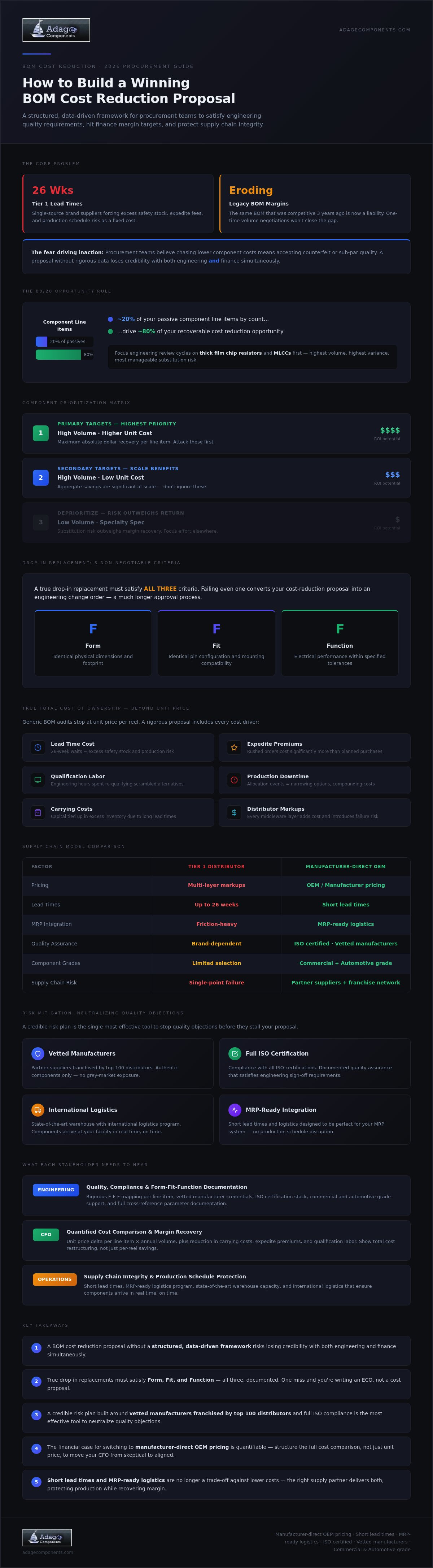
- Presenting a BOM cost reduction proposal without a structured, data-driven framework risks losing credibility with both engineering and finance simultaneously — this guide gives you the exact methodology to avoid that outcome.
- True drop-in replacements for passive components like resistors and capacitors must satisfy Form-Fit-Function requirements; learn how to map and document these criteria so your engineering team signs off with confidence.
- A credible risk mitigation plan — built around vetted manufacturers franchised by top 100 distributors and full ISO certification compliance — is the single most effective tool for neutralizing quality objections before they stall your proposal.
- The financial case for switching from Tier 1 distribution markups to manufacturer-direct OEM pricing is quantifiable; discover how to structure the cost comparison that moves your CFO from skeptical to aligned.
- Short lead times and MRP-ready logistics are no longer a trade-off against lower component costs — the right supply partner delivers both, protecting your production schedule while recovering margin on high-volume passives.
The 2026 Landscape: Why Generic BOM Audits No Longer Suffice
Global component pricing has shifted structurally, not cyclically. The brand premiums embedded in legacy distribution contracts were tolerable when lead times were predictable and margins were healthy. Neither condition holds in 2026. OEMs running mature product lines are discovering that the same bill of materials (BOM) that was competitive three years ago is now a liability, and a one-time volume negotiation with an incumbent supplier isn't going to close that gap.
The procurement teams winning this fight aren't auditing harder. They're auditing smarter, targeting the right component categories, quantifying the right cost drivers, and presenting a BOM cost reduction proposal that speaks the language of engineering and finance simultaneously.
The Hidden Costs of Legacy Distribution
Tier 1 distributor markups aren't just a line-item problem; they're a systemic one. Every layer of middleman friction between a manufacturer and your facility adds cost, extends lead times, and introduces a single point of failure into your supply chain. When your MRP system is built around a 26-week lead time from a single-source brand supplier, you're not just paying a price premium per reel. You're carrying excess safety stock, absorbing expedite fees, and accepting production schedule risk as a fixed cost of doing business.
The real exposure compounds when that single-source brand hits an allocation event. Your options narrow fast, and every alternative you scramble to qualify costs engineering hours you didn't budget for.
Targeting High-Impact Components for Substitution
Not all components offer equal return on optimization effort. Thick film chip resistors and multilayer ceramic capacitors (MLCCs) consistently deliver the highest ROI for cost reduction because they combine high usage volume with meaningful unit cost variance across equivalent-specification alternatives. These are commodity-grade passives where Form-Fit-Function compliance is well-documented and substitution risk is manageable with proper qualification protocols.
Prioritization is straightforward when you apply usage volume against unit cost systematically:
- High volume, higher unit cost: Primary targets; maximum absolute dollar recovery per line item
- High volume, low unit cost: Secondary targets; aggregate savings are significant at scale
- Low volume, specialty spec: Deprioritize; substitution risk outweighs margin recovery
In 2026 BOM analysis, the 80/20 rule holds precisely: roughly 20% of your passive component line items, by count, typically drive 80% of your recoverable cost reduction opportunity.
Defining Total Cost of Ownership beyond unit price per reel is where most generic audits fall short. Carrying costs, expedite premiums, qualification labor, and production downtime risk all belong in the calculation. A supplier offering manufacturer-direct OEM pricing with short lead times and MRP-ready logistics doesn't just reduce your per-unit spend; it restructures your cost base entirely.
Data-Driven Analysis: Identifying Drop-In Replacements
The phrase "drop-in replacement" gets used loosely in procurement conversations, and that imprecision is where proposals stall. A true drop-in replacement satisfies three non-negotiable criteria: identical form (physical dimensions and footprint), identical fit (pin configuration and mounting compatibility), and identical function (electrical performance within specified tolerances). Miss any one of those three, and you're not presenting a BOM cost reduction proposal anymore; you're presenting an engineering change order, which is a completely different conversation with a much longer approval timeline.
Rigorous Form-Fit-Function mapping is the analytical foundation that separates credible substitution proposals from the generic "find a similar part" approach that wastes engineering review cycles. For each target line item, document the full parameter set before you touch a cross-reference tool.
Technical Parameters for Seamless Substitution
For thick film chip resistors, the substitution checklist is precise. Resistance value and tolerance are the obvious starting points, but temperature coefficient of resistance (TCR) and power rating are where unqualified substitutions introduce field risk. A replacement rated at 100 ppm/°C TCR cannot substitute for a 50 ppm/°C spec without engineering sign-off, regardless of how the resistance value matches. Power rating must meet or exceed the original; never accept a downgrade. Footprint compatibility across standard case sizes, specifically 0402, 0603, and 0805, is non-negotiable. A footprint mismatch forces a PCB re-spin, and that cost eliminates any margin recovery the substitution was supposed to generate.
MLCC substitutions carry additional complexity. Dielectric material class matters significantly: Class I dielectrics (C0G/NP0) deliver stable capacitance across temperature and are not interchangeable with Class II materials (X5R, X7R) without functional review. Voltage rating must meet or exceed the original specification, and capacitance tolerance must align with the circuit's sensitivity requirements. Always verify the rated voltage against the application's actual working voltage with adequate derating margin built in.
Commercial vs. Automotive Grade Considerations
Grade selection is where over-specification quietly inflates BOM cost. AEC-Q200 qualified components are the correct choice for applications operating under automotive environmental stress conditions: extended temperature ranges, vibration profiles, and humidity exposure. For commercial-grade applications, specifying AEC-Q200 components adds cost without adding functional value.
The discipline here is matching grade to application requirement, not defaulting to the higher specification because it feels safer. We support both commercial and automotive grade components across our resistor and capacitor lines, so the selection is always driven by your actual application data, not availability constraints.
Cross-reference tools accelerate the identification process, but they require validation against the full parameter set described above, not just part number matching. Once alternatives are confirmed, integrating them into your MRP system with accurate lead time data and approved vendor list (AVL) status is what converts a spreadsheet exercise into an operational supply chain improvement. Review our full component linecard to map available alternatives against your current BOM line items.
Mitigating Risk: Quality Assurance in Your Proposal
Engineering's objection to component substitution is rarely irrational. It's institutional. Every quality escape your team has lived through gets baked into a skepticism that no spreadsheet alone will dissolve. When presenting a BOM cost reduction proposal, the risk mitigation section isn't a formality you append at the end. It's the document that determines whether your engineering director signs off or sends the whole package back for another review cycle.
The foundation of any credible risk mitigation plan is sourcing lineage. Components sourced from manufacturers franchised by top 100 distributors carry a verifiable chain of custody that independent brokers simply can't replicate. Franchise authorization means the manufacturer has met defined quality, traceability, and compliance thresholds set by the distributor. That relationship is auditable. It gives your engineering team something concrete to evaluate, not just a certificate downloaded from an unknown supplier's website.
ISO certification compliance is the baseline, not the differentiator. ISO 9001 confirms a quality management system is in place. For any component destined for automotive or high-reliability applications, IATF 16949 certification is the correct standard, covering process control, defect prevention, and continuous improvement requirements specific to the automotive supply chain. Verify both certifications are current and scope-specific to the manufacturing facility producing your components, not just the corporate entity. Certificates issued to a holding company don't cover a subcontracted production site.
Multi-stage incoming inspection closes the gap between paper compliance and physical reality. A robust inspection protocol for authentic components should include:
- Visual and dimensional inspection: Confirms marking integrity, package dimensions, and date code consistency against manufacturer specifications
- Electrical parametric testing: Verifies resistance, capacitance, and voltage ratings against the original specification, not just the label
- Counterfeit detection screening: Cross-checks physical characteristics against known-good reference samples
- Lot traceability documentation: Links every reel to a specific production run and facility
The Manufacturing Audit Framework
A factory audit worth presenting to your engineering team goes beyond a quality certificate. It traces raw material sourcing through to final electrical testing, documents process controls at each production stage, and establishes Golden Sample verification, where reference units from the approved lot are retained for future comparison. Traceability at this level means any field issue can be traced back to a specific production batch, which is exactly the accountability your quality team needs before they approve an alternative vendor. Learn about our Distributor Affiliated Program to understand how we structure manufacturer vetting within our supply network.
Technical Support and Lifecycle Management
Supplier evaluation can't stop at component quality. Your proposal needs to address what happens after the first purchase order. A qualified supply partner issues Product Change Notifications proactively, giving your engineering team advance warning of any specification, process, or material change before it reaches your production line. End-of-Life planning with a private label partner requires confirmed last-time-buy protocols and a clear roadmap for successor components. Field Application Engineers embedded in the transition process accelerate qualification timelines and resolve parametric edge cases before they become production stoppages. When presenting a BOM cost reduction proposal, this level of lifecycle documentation transforms a cost argument into a supply chain resilience argument, which is a considerably easier case to close.
Drafting the Proposal: A Step-by-Step Template for Buy-In
Analysis without structure is just data. The difference between a proposal that gets approved in one review cycle and one that dies in committee is almost always architectural, not analytical. Presenting a BOM cost reduction proposal to a multi-departmental team means engineering, finance, and operations are reading the same document with entirely different success criteria. Your proposal structure has to satisfy all three simultaneously, or it satisfies none.
Start with the Executive Summary, and make it margin-first. Finance needs to see the annualized savings figure before they engage with anything else. Engineering needs to see that quality and supply chain continuity are addressed, not footnoted. One paragraph each. The executive summary isn't where you prove your case; it's where you earn the attention to make it.
The Financial Breakdown follows immediately. Place current Tier 1 pricing against OEM manufacturer pricing side by side, line item by line item, for your top-volume passive components. Don't aggregate prematurely. Stakeholders trust itemized comparisons far more than a single blended savings number, because itemization signals that you've done the work rather than reverse-engineered a target.
The Technical Validation section is where you present the Form-Fit-Function documentation built in the analysis phase. Documented test results confirming parametric equivalence, footprint compatibility confirmations, and AVL-ready supplier credentials belong here. This section converts engineering skepticism into a structured review process rather than an open-ended objection.
Quantifying the Financial Impact
The core savings calculation is straightforward: annual usage volume multiplied by the per-unit price delta between your current source and the OEM alternative. Run this calculation at the line-item level, then aggregate. Beyond unit cost, account for logistics savings generated through a consolidated international program. Consolidating passive component procurement through a single supply partner with a global stocking program reduces freight events, simplifies customs documentation, and eliminates the administrative overhead of managing multiple vendor relationships. These are real cost reductions that belong in your financial model. Submit your BOM for a cost-reduction analysis to get an itemized price comparison built on actual OEM manufacturer pricing across your specific line items.
Addressing the Logistics 'Real-Time' Requirement
Short lead times aren't a secondary benefit; they're a core competitive advantage that directly reduces your working capital requirement. When your MRP system is built around predictable, compressed replenishment cycles rather than 26-week buffers, your safety stock calculation changes fundamentally. A state-of-the-art warehouse with a global stocking program means components arrive at your facility in real time, on time, reducing the safety stock you're required to carry against supply uncertainty. We've structured our international logistics program specifically to integrate with existing MRP systems, so onboarding a new supply line doesn't require a systems overhaul; it requires an approved vendor entry and a confirmed lead time parameter.
Close the proposal with a clear implementation timeline: AVL approval milestone, first purchase order date, and a 90-day review checkpoint for savings verification. Stakeholders approve proposals with defined endpoints, not open-ended commitments. Review our full component linecard to confirm coverage across your target BOM line items before you finalize the financial breakdown.
Adage Components: Your Partner for Manufacturer-Direct Pricing
Successful execution of the strategies outlined in this guide depends on moving beyond traditional distribution channels. Adage Components functions as that critical bridge. We provide one of the best costs in the industry by operating as a private label manufacturer rather than a standard reseller. When you are presenting a BOM cost reduction proposal to your executive team, the strength of your case rests on the ability to deliver Tier 1 advantages—quality, scale, and reliability—at OEM pricing that traditional distributors cannot match due to their multi-layered overhead.
Middleman markups are a relic of a less transparent supply chain era. We operate as a sophisticated, global entity that combines the massive infrastructure required for international scale with the meticulous attention to detail necessary for individual component authenticity. This model allows us to bypass standard distribution friction, delivering manufacturer pricing directly to your facility without compromising the technical integrity of your resistors, capacitors, or diodes.
Beyond Distribution: A Strategic Partnership
Moving from transactional purchasing to a strategic supply agreement is the final step in securing your margins. We don't just sell parts; we integrate with your facility to provide authentic components from vetted manufacturers in real time. Many of our partner suppliers are franchised by top 100 distributors, ensuring that our private label offerings meet or exceed the standards of the name-brand components they replace. Whether you require commercial or automotive grade components, our Canada-based expertise acts as your bridge to global manufacturing excellence, ensuring compliance with all ISO certifications. Turn Your BOM Analysis Into Approved Savings in 2026
Presenting a BOM cost reduction proposal that wins simultaneous sign-off from engineering, finance, and operations isn't a matter of working harder on your spreadsheets. It's a matter of building the right structure: rigorous Form-Fit-Function documentation, a credible risk mitigation framework backed by ISO-compliant, vetted manufacturers, and a financial model that captures total cost of ownership rather than unit price alone. The competitive advantage in 2026 belongs to procurement teams who've stopped accepting legacy distribution overhead as a fixed cost. Manufacturer-direct OEM pricing, short lead times through a state-of-the-art global warehouse, and MRP-ready logistics aren't trade-offs against quality. They're proof that the right supply partner delivers all three simultaneously. Your next step is straightforward. Get a line-item cost comparison built on actual manufacturer pricing across your specific passive component categories. Explore our full component linecard and request your BOM cost analysis from Adage Components today, and give your proposal the data it needs to close. The two risks that kill proposals fastest are insufficient technical documentation and an incomplete total cost of ownership model. If your Form-Fit-Function mapping has gaps, engineering will reject the substitution outright. If your financial model only captures unit price delta without accounting for qualification labor, safety stock reduction, and logistics consolidation, finance won't trust the savings number. Both outcomes send you back to square one. A third risk is sourcing lineage. Presenting components without a verifiable chain of custody from vetted manufacturers franchised by top 100 distributors gives quality teams a legitimate reason to block approval. Build sourcing traceability into the proposal from the start, not as an afterthought. Proof requires documented parametric equivalence across every specification that matters to the circuit: resistance value, tolerance, TCR, power rating, and footprint for resistors; capacitance, voltage rating, dielectric class, and tolerance for MLCCs. Cross-reference tools identify candidates, but they don't constitute proof. You need electrical test data confirming performance against the original specification, plus dimensional confirmation that the package is footprint-compatible with your existing PCB layout. Lot traceability documentation and Golden Sample retention from the approved production run give your engineering team the audit trail they need to sign off with confidence. When presenting a BOM cost reduction proposal, this documentation package is what converts a cost argument into a technically defensible substitution. Yes. We supply both commercial and automotive grade components across our resistor and capacitor lines, including AEC-Q200 qualified parts for applications operating under automotive environmental stress conditions. Grade selection should always be driven by your application's actual operating requirements, not availability constraints or a default preference for the higher specification. The key discipline is matching grade to application data. Specifying AEC-Q200 components for a commercial-grade application adds cost without adding functional value. Our team can support that grade selection analysis against your specific operating parameters. Lead times through manufacturer-direct channels are significantly compressed compared to the 26-week windows common in Tier 1 distribution. Exact lead times depend on the specific component category, volume, and stocking position, but our international logistics program and global stocking infrastructure are structured to deliver in real time, on time, in a way that integrates directly with standard MRP replenishment cycles. The operational implication is concrete: shorter, predictable replenishment cycles reduce the safety stock you're required to carry against supply uncertainty. That working capital recovery belongs in your total cost of ownership model alongside the unit price savings. The primary MRP parameters affected are lead time and safety stock quantity. When you replace a 26-week lead time entry with an accurate, compressed replenishment cycle from a manufacturer-direct source, your system's safety stock calculation adjusts downward automatically, reducing carrying costs without increasing supply risk. The transition doesn't require a systems overhaul; it requires an approved vendor entry and updated lead time parameters for each affected line item. We've structured our logistics program specifically to be MRP-ready. Onboarding a new supply line through Adage Components means your procurement team gets confirmed lead time data and consistent replenishment performance, so the MRP model reflects operational reality rather than worst-case buffer assumptions. Yes, provided you verify that certifications are current and scope-specific to the manufacturing facility producing your components. ISO 9001 confirms a quality management system is in place. For automotive and high-reliability applications, IATF 16949 is the correct standard. Our partner suppliers comply with all relevant ISO certifications, and we source exclusively from vetted manufacturers to ensure that compliance is facility-level, not just corporate-entity-level. The verification step matters. A certificate issued to a holding company doesn't cover a subcontracted production site. Confirm the certification scope before you include any supplier in your approved vendor list. A credible BOM cost analysis report requires itemized line-by-line pricing comparisons between your current source and the OEM alternative, annual usage volumes for each target component, and a total savings calculation that aggregates both unit cost delta and logistics cost reduction. Parametric equivalence documentation for each substitution candidate must accompany the pricing data so engineering can review technical compliance in the same document that finance reviews the financial case. Supplier qualification data, including sourcing lineage, ISO certification status, and incoming inspection protocols, completes the report. Submit your BOM through our cost analysis process to receive an itemized price comparison built on actual manufacturer pricing across your specific passive component line items. Logistics cost reduction operates on two levels beyond unit price. First, consolidating passive component procurement through a single supply partner with a global stocking program reduces freight events, simplifies customs documentation, and eliminates the administrative overhead of managing multiple vendor relationships. Each of those reductions is quantifiable and belongs in your financial model. Second, consistent, short replenishment cycles reduce the expedite fees and premium freight charges that accumulate when a single-source supplier hits an allocation event. Our international logistics program is built to deliver both. The infrastructure supports high-volume passive component programs across resistors, capacitors, and diodes, with stocking positions that keep replenishment predictable and your production schedule protected. Cross-referenced components needs to be confirmed by the client with either spec. sheet or samples or both.Frequently Asked Questions
What are the primary risks when presenting a BOM cost reduction proposal?
How do I prove that a private label component is a true drop-in replacement?
Can I get automotive-grade components through a private label manufacturer?
What is the typical lead time for manufacturer-direct resistors and capacitors in 2026?
How does switching to OEM pricing affect my MRP system settings?
Do private label components meet the same ISO certifications as Tier 1 brands?
What data must be included in a BOM cost analysis report?
How can an international logistics program further reduce my BOM costs?
Disclaimer
Please note, we use AI to help us, information is verified to be correct but we can not guarantee 100% accuracy.


