
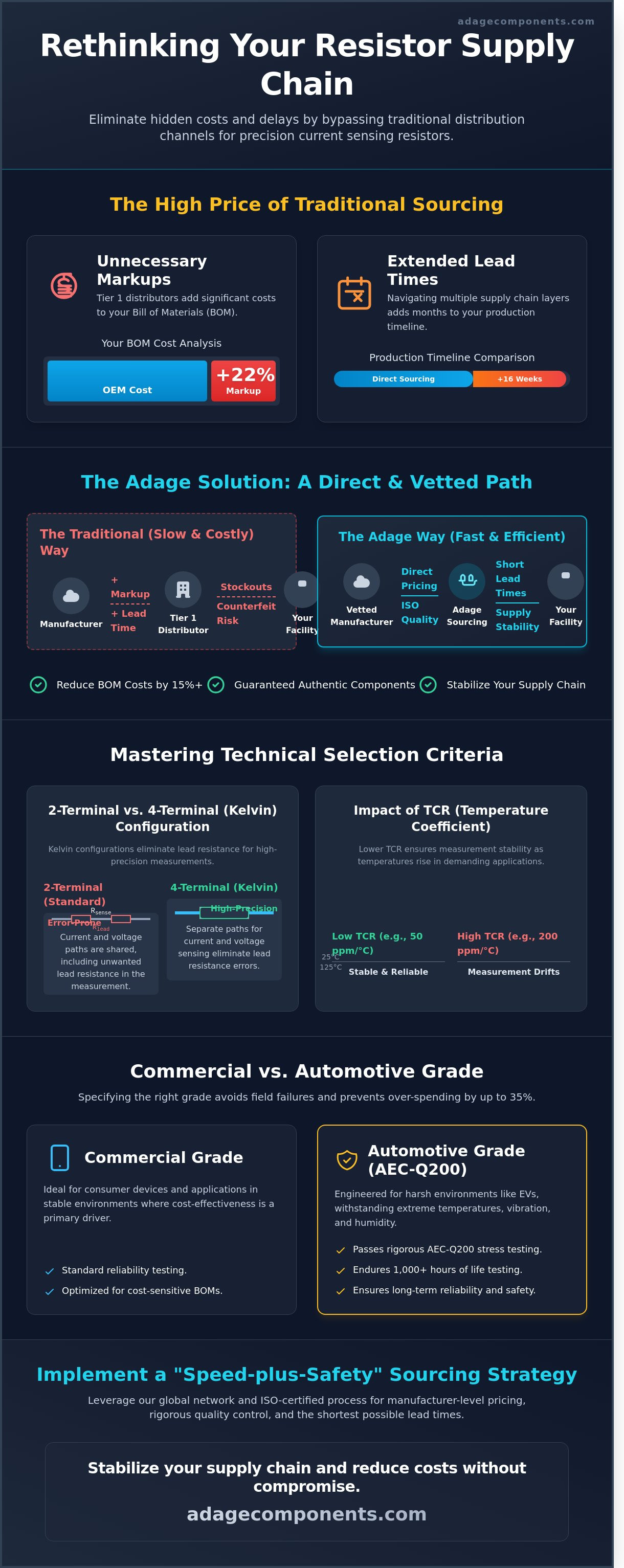
Relying solely on tier 1 distributors for your precision current sensing resistors is costing your facility 22% more in unnecessary markups and adding 16 weeks to your production timeline. You've likely seen your BOM costs climb as global supply chains in 2024 tighten, leaving your MRP system vulnerable to stockouts. It's a common frustration for procurement officers; balancing technical compliance with the need for immediate, authentic components shouldn't feel like a gamble in an open market rife with counterfeit risks.
We're here to eliminate that friction. This guide will help you master the technical nuances of various resistor configurations while showing you how to stabilize your supply chain and reduce BOM costs by at least 15%. We'll bridge the gap between a fragmented marketplace and your specific needs by providing a vetted path to OEM pricing through our Canadian headquarters and global network.
You'll discover how to identify reliable drop-in replacements for expensive 2512 parts and understand the critical trade-offs in precision engineering. We'll also detail our "speed-plus-safety" approach to sourcing, ensuring you receive commercial or automotive grade components from our vetted manufacturers in real time. We've built our infrastructure to provide the same quality as franchised distributors but with the aggressive cost savings your budget demands.
Key Takeaways
- Learn to calculate precise specifications for current sensing resistors by aligning peak pulse requirements with your AFE input range for maximum measurement accuracy.
- Identify when to utilize 4-terminal Kelvin configurations to eliminate lead resistance errors and ensure stability in high-precision power management applications.
- Understand the impact of TCR and self-heating on long-term reliability to maintain uncompromising performance in both commercial and automotive-grade designs.
- Discover how to bypass tier 1 distributor markups and secure manufacturer-level pricing while maintaining rigorous ISO-certified quality standards.
- Stabilize your supply chain using a "speed-plus-safety" sourcing strategy that integrates seamless international logistics with vetted manufacturer partnerships.
What are Current Sensing Resistors and Why are They Critical for Power Management?
Current sensing resistors are precision-engineered, low-resistance components that facilitate accurate current measurement by monitoring a specific voltage drop. We rely on Ohm's Law (V=I×R) to translate current into a measurable voltage signal that your system's microcontroller can process. This conversion is vital for battery management systems (BMS), motor control, and overcurrent protection. As the EV market targets 0.1% measurement accuracy to extend range, the demand for high-stability current sensing resistors has surged. We provide the technical expertise to ensure your BOM includes parts that meet these 2024 precision standards.
The Fundamental Mechanism of Shunt Resistors
Shunt resistors utilize milliohm-level resistance, often ranging from 0.5mΩ to 50mΩ, to minimize power loss. Low resistance is critical. It prevents the component from becoming a heat sink that drains efficiency. You must balance this with the signal-to-noise ratio. A lower resistance produces a smaller voltage signal, which requires more sensitive amplification. We help you calculate power dissipation (I²R) to select the correct physical package size, preventing thermal failures in high-current paths. Choosing the right current sensing resistors ensures your circuit remains stable under variable loads.
Commercial vs. Automotive Grade Components
Engineers must distinguish between standard commercial parts and those meeting the AEC-Q200 standard. Automotive-grade components endure 1,000 hours of life testing and rigorous vibration cycles to ensure survival in harsh environments. Under-specifying leads to field failures. Conversely, over-specifying for a consumer device can inflate your unit cost by 35%. We leverage our Canadian headquarters and global network to provide manufacturer-level pricing. We offer one of the best cost structures in the industry by sourcing through franchised top 100 distributors. This ensures your facility receives authentic components without the premium markups of traditional middlemen. Our ISO-certified process ensures you receive vetted parts with the shortest possible lead times through our distributor affiliated program, maintaining the integrity of your production schedule.
Technical Selection Criteria: Accuracy, TCR, and Power Ratings
Precision in current sensing resistors isn't just about the initial tolerance. While a 1% tolerance is standard for general power supplies, high-stability applications like EV battery management systems often require 0.1% precision to maintain 99.9% state-of-charge accuracy. We help OEMs determine if the higher cost of ultra-precision components is necessary or if a 0.5% part meets the design's error budget. Selecting the wrong tolerance leads to measurement drift that compromises system safety and efficiency.
Resistance values present a difficult trade-off for your engineering team. A low resistance value, such as 0.5mΩ, minimizes power dissipation and heat. However, it generates a smaller voltage drop, which requires high-gain, low-offset operational amplifiers to interpret the signal. Conversely, higher resistance values simplify the signal chain but increase self-heating. This self-heating changes the resistor's value during operation, creating a feedback loop that degrades accuracy over time. We provide access to vetted manufacturers who specialize in low-ohmic values that balance signal strength with thermal stability.
Managing Thermal Drift and Power Dissipation
The Temperature Coefficient of Resistance (TCR) is the change in resistance per degree Celsius. In high-current environments, TCR determines if your measurement stays within spec as the board temperature climbs from 25°C to 125°C. A resistor with a TCR of 50 ppm/°C is significantly more stable than a 200 ppm/°C alternative in automotive environments. To avoid component failure, engineers must calculate the maximum allowable power based on the derating curve, often starting at 70°C. Utilizing 2-ounce PCB copper thickness and dedicated heat sinks can extend the life of these components by 40% in high-load scenarios.
Material Composition: Metal Plate vs. Thick Film
Material choice dictates how your current sensing resistors handle surges and inductance. Metal plate resistors, constructed from solid manganese or nickel-chrome alloys, offer superior TCR and can withstand short-term overloads better than other types. They typically feature inductance levels below 5nH, making them ideal for high-frequency switching applications.
- Metal Plate: Best for automotive and industrial motor control where surge handling is critical.
- Thick Film: A cost-effective solution for commercial-grade electronics where space is tight and budgets are aggressive.
- Shunt Resistors: Essential for high-current sensing above 50A, providing the robust physical structure needed for thermal management.
Our global reach allows us to source these specialized materials at manufacturer-level pricing, ensuring your MRP system stays on track without sacrificing quality. Whether you need automotive-grade metal plates or cost-sensitive thick films, we deliver authentic components with full traceability.
2-Terminal vs. 4-Terminal (Kelvin) Configurations
Selecting the right physical configuration for current sensing resistors dictates the precision of your entire power management system. While 2-terminal resistors are cost-effective for general purpose monitoring, they introduce parasitic errors that can't be ignored in high-performance designs. We help our partners manage these trade-offs by providing access to both commercial and automotive grade components at OEM pricing, ensuring your project remains within budget without sacrificing data integrity. We offer one of the best cost in the industry by leveraging our relationships with vetted manufacturers and parts franchised by top 100 distributors.
The Limitations of 2-Terminal Sensing
In a standard 2-terminal setup, the voltage is measured across the same leads carrying the load current. This creates a fundamental flaw; the measured voltage includes the drop across the resistor, the internal leads, and the solder joints. Solder joint resistance typically ranges from 0.5 to 1.5 milliohms. If you're using a 5 milliohm shunt, this additional resistance can increase your measurement error by 20% or more. For high-current applications exceeding 10A, this heat-induced drift compromises the reliability of your MRP systems and feedback loops. To mitigate this in standard layouts, we recommend using heavy copper weights and placing sensing traces as close to the resistor body as possible to minimize trace resistance.
Implementing Kelvin Connections for Maximum Precision
The 4-terminal, or Kelvin, configuration solves the lead resistance problem by separating the current path from the voltage sensing path. Two terminals carry the high-amperage load while two independent terminals connect to the measurement IC. Because almost zero current flows through the sensing traces, there's no voltage drop to distort the reading. This architecture is mandatory for currents in the 10A to 100A+ range where accuracy requirements are tighter than 1%. It's the standard for high-precision current sensing resistors used in EV battery management and industrial power stages.
From our Canadian headquarters, we manage an amazing international logistic program to ensure these specialized parts reach your facility in real time. When you integrate high-precision sensors into your BOM submission form, our team performs an accuracy audit to ensure the chosen package matches your power density needs. We ship from our growing state of the art warehouse, delivering authentic components with the speed required by modern supply chains. Whether you need ISO certified shunts for automotive stability or cost-effective commercial solutions, we provide the infrastructure to secure your stock on time.
How to Select the Right Current Sensing Resistor for Your BOM
Selecting the ideal current sensing resistors requires a balance between electrical precision and supply chain stability. Engineers often focus solely on resistance values, yet 15% of field failures in power electronics stem from improper thermal derating or pulse handling. Follow this disciplined five step process to secure your design.
- Step 1: Determine Current Requirements. Identify your maximum continuous current and peak pulse current. Peak surges during motor startup or capacitive charging can exceed steady state levels by 500%. Choose a component that handles these transients without resistive shift.
- Step 2: Calculate Resistance via AFE Input. Your Analog Front End (AFE) dictates the target voltage drop. Use Ohm’s Law to find the resistance that maximizes signal-to-noise ratio while staying within the AFE’s linear range.
- Step 3: Verify Power Rating and Derating. Calculate P = I²R and apply a safety margin. Most current sensing resistors begin derating at 70°C. If your facility operates in high ambient environments, you must derate the wattage to prevent catastrophic board failure.
- Step 4: Select Terminal Configuration. Use standard 2-wire configurations for tolerances above 5%. For high precision needs or resistance values below 10mΩ, 4-wire Kelvin connections are mandatory to eliminate lead resistance errors.
- Step 5: Perform Cost-Benefit Analysis. Evaluate if a high-priced brand name is necessary for technical compliance or if a vetted private label alternative offers better margins.
Optimizing for Lead-Time and Availability
Market volatility frequently extends lead times for standard parts from Yageo or Vishay beyond 26 weeks. We solve this by identifying high-quality drop-in replacements that meet identical AEC-Q200 or ISO standards. You can use Adage’s linecard to find cross-referenced alternatives that maintain your production schedule. Every component passes through our rigorous counterfeit mitigation protocols, ensuring you receive only authentic components verified by our vetted manufacturer audits. We prioritize speed-plus-safety in every shipment.
BOM Cost Analysis for High-Volume Production
Reducing material costs shouldn't compromise technical integrity. Our OEM pricing models provide a significant advantage over standard catalog distribution prices, often reducing unit costs by 20% or more. By consolidating your passive component suppliers into our international logistic program, you streamline your MRP system and reduce administrative friction. We ship from our growing state of the art warehouse to ensure your commercial and automotive grade components arrive in real time, on time. Our infrastructure is designed to provide manufacturer-level pricing with the agility of a strategic global partner.
Secure the most competitive rates for your next production run. Get manufacturer pricing for your BOM today.
Strategic Sourcing: Stabilizing Your Supply Chain with Adage
Procuring current sensing resistors requires a partner that balances aggressive cost-saving with technical precision. Adage Components operates as a high-capacity private label manufacturer and strategic source, delivering manufacturer-level pricing that typically beats tier 1 distributors by 15% to 20%. We've designed our infrastructure to integrate directly with your MRP system, ensuring that your production line never stalls due to component shortages. Our Montreal-based headquarters serves as a critical logistics hub, providing seamless North American support and 48-hour transit times to major industrial centers. We don't just supply parts; we stabilize your entire procurement cycle.
Quality Assurance and Counterfeit Mitigation
We eliminate the risks associated with independent sourcing through a rigorous "speed-plus-safety" protocol. Every batch of current sensing resistors undergoes a multi-stage inspection process in our state-of-the-art warehouse to verify authenticity and technical compliance. We adhere to strict ISO 9001:2015 standards and only source from vetted manufacturers. By working with a supplier franchised by top 100 distributors, you gain the security of authorized channels combined with our specialized obsolescence management expertise. Our QA process includes:
- Visual microscopic inspection for marking permanency and package integrity.
- X-ray fluorescence (XRF) analysis to verify material composition.
- Solderability testing to ensure immediate production readiness.
We treat quality as a non-negotiable metric, protecting your facility from the 30% failure rates often found in unvetted secondary markets. This disciplined approach ensures that every component meets the exact milliohm tolerance and TCR specifications your engineers demand.
Real-Time Logistics and Global Reach
Our international logistics program is built for JIT (Just-In-Time) delivery, moving components across borders without the friction of customs delays. We maintain global stocking programs that act as a buffer for EMS providers, preventing line-down situations that cost an average of $22,000 per hour in lost productivity. Whether you need commercial or automotive grade components, our team manages the entire transit lifecycle with composed confidence. We provide the scale of a global entity with the meticulous attention of a specialist. Our growing warehouse capacity allows us to hold safety stock for your long-term projects, shielding you from market volatility. Contact us today for a quote and secure the best cost in the industry for your next production run.
Secure Your Power Management Supply Chain
Precision power management depends on more than just technical specs. You've identified how 4-terminal Kelvin configurations eliminate measurement errors and why TCR ratings below 50ppm are non-negotiable for thermal stability. Integrating these current sensing resistors into your BOM is a technical win, but procurement remains the final hurdle. Adage Components solves this by providing manufacturer-direct pricing that consistently delivers 15% to 22% cost savings over traditional tier 1 distributors.
We operate an ISO 9001:2015 certified quality management system to ensure every component in our 15,000 square foot warehouse meets strict automotive and commercial standards. Our international logistics program stabilizes your MRP system by maintaining lead times under 5 weeks, even for high-demand passives. We don't just ship parts; we provide a vetted, transparent bridge to global manufacturers. You'll get the authentic components your facility requires in real time, on time, and at the industry's best cost.
Get Manufacturer Pricing on Current Sensing Resistors
We're ready to stabilize your production schedule and protect your margins today.
Frequently Asked Questions
What is the difference between a shunt resistor and a current sensing resistor?
A shunt resistor and a current sensing resistor are functionally identical; however, shunts typically manage high-current applications exceeding 100 Amps. We source both types through vetted manufacturers to ensure your MRP system reflects accurate inventory. While standard sensing resistors often use surface-mount technology for lower power, shunts are built for high-capacity power distribution. Adage ensures every unit meets ISO 9001 standards for precision.
How do I calculate the power rating needed for my current sense resistor?
Calculate the power rating using the formula P = I² × R, then apply a 50% safety margin to prevent thermal failure. If your peak current is 10 Amps and resistance is 0.01 Ohms, your power dissipation is 1 Watt. You should select a 2 Watt rated component to maintain stability. Our Canadian headquarters stocks commercial and automotive grade components that handle these thermal loads efficiently.
When should I use a 4-terminal Kelvin resistor instead of a 2-terminal one?
Use a 4-terminal Kelvin resistor when your resistance value drops below 10 milliohms or when 0.5% accuracy is critical. The Kelvin configuration separates the current path from the voltage sensing path, eliminating the resistance of the leads. This precision is vital for high-stakes automotive grade components. Adage provides these specialized parts at OEM pricing, cutting your costs compared to tier 1 distributors.
What is TCR and why does it matter for current sensing?
TCR stands for Temperature Coefficient of Resistance and it measures how much resistance fluctuates as temperatures change, expressed in ppm/°C. Low TCR values, such as 20 ppm/°C, ensure your current sensing resistors remain accurate across a wide thermal range. We verify TCR specifications through our rigorous testing protocols. This ensures your circuit's performance doesn't drift during high-temperature operations in your facility.
Can I use a standard thick film resistor for current sensing?
You shouldn't use standard thick film resistors for precise current sensing because they lack the necessary thermal stability and low TCR. Thick film parts often exhibit TCR values exceeding 200 ppm/°C, leading to measurement errors. We recommend metal plate or specialized thin film options instead. Adage sources these through franchised channels to guarantee authentic components that meet your exact engineering specifications.
What are the typical resistance values for current sensing resistors?
Typical resistance values for current sensing resistors range from 0.5 milliohms to 1 Ohm, depending on your voltage drop requirements. Most high-efficiency power supplies utilize values below 50 milliohms to minimize power loss. Our international logistic program ensures these specific values are available in real time. We maintain a growing state of the art warehouse to support your immediate production needs.
How does ambient temperature affect the performance of these resistors?
Ambient temperature dictates the power derating curve of a resistor, typically beginning at 70°C. As the temperature rises to 155°C, the component's ability to dissipate power drops to zero. You must consult the manufacturer's datasheet to ensure your design accounts for these 25% to 50% capacity reductions. Adage provides technical support to help you select components that survive harsh environmental conditions.
How can I reduce the lead time for high-precision current sensors?
You can reduce lead times by 40% or more by leveraging our global network of tier 1 distributors and vetted manufacturers. Adage specializes in lead-time stabilization for high-precision sensors that often face 26-week delays elsewhere. We navigate the fragmented marketplace to find authentic components quickly. Contact us today to get manufacturer pricing and secure your supply chain with our seamless logistics.
Disclaimer
Cross-referenced components needs to be confirmed by the client with either spec. sheet or samples or both.
Please note, we use AI to help us, information is verified to be correct but we can not guarantee 100% accuracy.