

The global Darlington Transistor Array market reached a valuation of USD 1.66 billion in 2025, proving that this high-gain architecture remains a staple in modern industrial automation. You've likely encountered the limitations of standard BJTs when trying to drive heavy loads from low-power microcontrollers; the power dissipation and insufficient gain create unnecessary design friction. This guide details how the darlington transistor maximizes current gain through its unique paired configuration. We'll also explain how to navigate the critical July 21, 2026 RoHS exemption expirations to keep your supply chain compliant.
Adage Components delivers the strategic sourcing you need to bypass Tier 1 distributor markups while maintaining uncompromising quality through rigorous testing. Discover how to calculate the β gain formula and identify the ideal applications for these pairs. We also outline how our state-of-the-art warehouse and international logistics program ensure you get authentic components at manufacturer pricing on time. From managing the 251 substances on the REACH SVHC list to stabilizing lead times, we act as your global navigator for high-integrity semiconductors.
Key Takeaways
- Master the mechanics of cascaded gain to drive high-power loads efficiently from low-current signals.
- Evaluate performance trade-offs in thermal efficiency and switching speed to determine if a darlington transistor is the optimal solution for your design.
- Identify high-impact industrial applications, including motor control and solenoid drivers, where high-gain pairs provide maximum reliability.
- Access manufacturer pricing and lead-time stabilization through Adage Components’ state-of-the-art warehouse and international logistics infrastructure.
- Maintain uncompromising supply chain integrity with ISO-certified components sourced from vetted manufacturers franchised by top distributors.
What is a Darlington Transistor? Definition and Core Principles
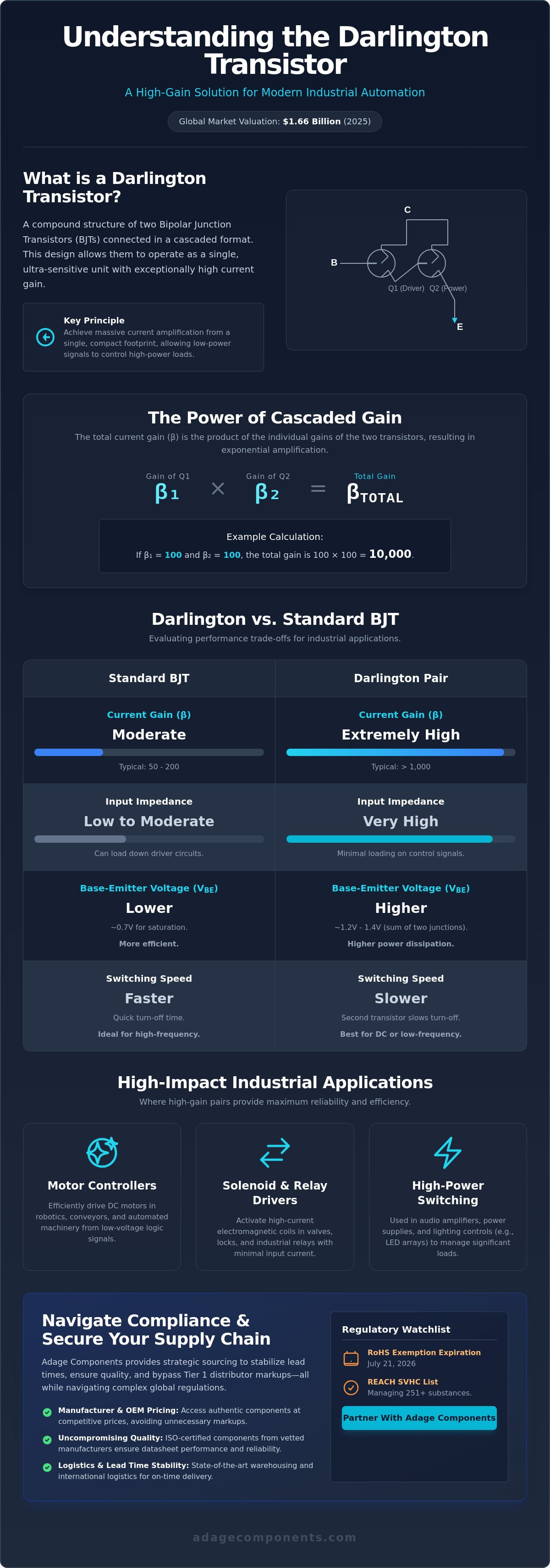
A Darlington transistor is a high-gain compound structure consisting of two bipolar junction transistors (BJTs) connected in a cascaded format. Sidney Darlington patented this configuration in 1953 while working at Bell Laboratories. His design solved a critical engineering challenge: achieving massive current amplification within a single, compact footprint. By integrating two transistors so the emitter of the first stage feeds the base of the second, the device operates as a single unit with a total gain significantly higher than any individual component. Adage Components provides these specialized semiconductors to OEMs who require high-density power management without the footprint of multiple discrete stages.
The primary objective of this configuration is to provide extreme current sensitivity. This allows a very small input current from a microcontroller or sensor to switch a much larger load current. We see this most often in industrial automation where low-power logic must interface with heavy-duty solenoids or motors. While discrete Darlington transistors are common for power regulation, integrated IC arrays like the ULN2003 series are often used for multi-channel switching. Adage Components stocks both commercial and automotive grade options in our growing state-of-the-art warehouse. Our amazing international logistic program ensures you get product at your facility in real time, on time, making our sourcing model perfect for your MRP system.
The Darlington Configuration Explained
This design effectively "piggy-backs" two BJTs to create a three-terminal device with a shared collector. The base of the first transistor, known as the driver, receives the input signal. Its emitter then directly drives the base of the second transistor, the power stage. Because the total current gain is the product of the individual gains (β1 x β2), the resulting amplification can exceed 1,000 or even 10,000. This exponential increase is what makes the Darlington pair indispensable for high-current switching. We ensure all our Darlington components come from vetted manufacturers to guarantee these gain specifications are met without compromise.
NPN vs. PNP Darlington Pairs
Engineers select the specific polarity based on the logic requirements of the circuit. NPN Darlington pairs are the standard for low-side switching, where the load sits between the positive supply and the collector. PNP versions are utilized for high-side switching applications. You'll find industry-standard part numbers like the TIP120 (NPN) and TIP125 (PNP) across our linecard. Adage Components is compliant with all ISO certifications, providing the same advantages as buying from tier 1 distributors but at a more competitive price point. We offer manufacturer pricing and OEM pricing to help you maintain significant cost savings while stabilizing your supply chain against market volatility.
How Darlington Transistors Work: Mechanics of Cascaded Gain
The mechanics of a darlington transistor rely on a two-stage cascaded amplification process. In this setup, the first BJT acts as a precision driver, receiving a microampere-level signal at its base. This driver transistor amplifies the signal and passes its emitter current directly into the base of the second, larger power transistor. Because the second stage treats the already amplified current as its input, the resulting total gain (β) is roughly the product of the two individual gains. If each BJT has a gain of 100, the compound gain reaches 10,000. This exponential scaling allows low-power integrated circuits to control high-amperage industrial loads without requiring complex buffer stages.
Adage Components understands that maintaining this level of performance requires strictly vetted silicon. We utilize a growing state-of-the-art warehouse to manage inventory and ensure every Darlington Transistor configuration meets its datasheet specifications. This cascaded structure also significantly increases input impedance. High input impedance prevents "loading down" the preceding control circuit, which is critical for maintaining signal integrity in sensitive sensor interfaces. Our amazing international logistic program delivers these high-performance parts to your facility in real time, on time, supporting your MRP system with uncompromising efficiency.
The Voltage Drop Trade-off ($V_{BE}$)
Standard BJTs typically require a 0.7V base-emitter voltage to switch on. A darlington transistor doubles this requirement because the two base-emitter junctions are in series. This results in a total $V_{BE}$ drop of 1.2V to 1.4V. While this is negligible in 24V industrial systems, it creates efficiency challenges in 3.3V or battery-powered devices. Adage Components helps OEMs mitigate these trade-offs by providing BOM cost analysis to identify where Darlington pairs are most effective versus where a single BJT or MOSFET might be required. We ensure all components are compliant with ISO certifications to maintain the highest standards of reliability in your power stages.
The Sziklai Pair (Complementary Darlington)
The Sziklai pair, or complementary Darlington, uses one NPN and one PNP transistor. This configuration offers a significant advantage: it only requires a single 0.7V $V_{BE}$ drop to activate. It also provides superior thermal stability, making it a preferred choice for high-fidelity audio stages and precision power regulation. When your design requires the high gain of a Darlington but demands lower saturation voltage, specifying a Sziklai pair in your BOM is the strategic move. We offer OEM pricing for these specialized configurations, ensuring you receive the same advantages as buying from tier 1 distributors at a more competitive price point. Explore our full range of semiconductor options to find the right fit for your next production run.
Darlington vs. Standard BJT: Performance and Industrial Trade-offs
Choosing between a standard BJT and a Darlington Transistor requires a rigorous evaluation of gain requirements versus thermal efficiency. While MOSFETs dominate high-frequency switching, the Darlington remains a cost-effective powerhouse for high-current DC loads and low-frequency switching. The primary advantage is a current gain that can exceed 1,000, whereas a standard BJT often plateaus at 100. However, this gain comes with a "saturation penalty." A standard BJT can achieve a collector-emitter saturation voltage ($V_{CE(sat)}$) as low as 0.2V. In contrast, a Darlington pair rarely drops below 0.7V to 1.1V. This higher voltage drop across the device leads to increased power dissipation, especially in high-current industrial circuits.
Switching speed is another critical trade-off. Standard BJTs switch faster because they don't suffer from the cumulative base charge storage found in cascaded configurations. In a Darlington, the first transistor cannot fully turn off until the base charge of the second transistor has dissipated. This delay typically limits the device to switching frequencies below 100 kHz. Adage Components helps you mitigate these performance risks by providing comprehensive BOM cost analysis. We ensure you specify the right semiconductor for your application's frequency and thermal envelope while maintaining manufacturer pricing.
Thermal Management Considerations
Higher saturation voltages directly translate to heat. For a load of 5A, a 1V saturation drop results in 5W of waste heat, which is significantly higher than a modern MOSFET with low RDS(on). To maintain reliability in your designs, integrating heat sinks is often mandatory. Adage Components supports both commercial and automotive grade components, ensuring our partner manufacturers provide parts that withstand these thermal stresses. We offer OEM pricing that rivals tier 1 distributors, helping you manage both your thermal and financial budgets without sacrificing quality.
Input Impedance and Sensitivity
The high input impedance of a Darlington pair allows it to interface directly with low-power microcontrollers. This sensitivity is ideal for sensor-driven relays where signal current is limited to a few microamps. One risk is the amplification of leakage currents, which can cause the device to stay partially on. We recommend using base-emitter resistors to bleed off this leakage and stabilize the circuit. Our amazing international logistic program ensures these and other critical components reach your facility on time, every time, maintaining the integrity of your MRP system with vetted, authentic parts.
Industrial Applications and Selection Criteria for OEMs
The darlington transistor serves as the backbone for high-load industrial interfaces. While simple BJTs struggle with the 500mA to 5A requirements of industrial solenoids and DC motors, the Darlington configuration handles these loads with minimal base current. This capability is critical in factory automation where logic controllers must drive heavy inductive loads. We see significant adoption in stepper motor drivers, particularly through integrated Darlington arrays like the ULN2003. These arrays consolidate seven Darlington pairs into a single package, saving 60% of PCB real estate compared to discrete alternatives. Adage Components provides these integrated solutions at manufacturer pricing, ensuring your production costs remain competitive.
Beyond switching, these components are essential for audio amplifier output stages and linear power regulation. Their ultra-high sensitivity also makes them the preferred choice for light and touch sensors where input signals are often in the nanoampere range. Adage Components maintains a growing state-of-the-art warehouse to ensure these critical parts are available for your production schedule. Our amazing international logistic program is designed to get product at your facility in real time, on time, making our services perfect for your MRP system.
Key Specifications for Your BOM
- Maximum Collector Current ($I_C$): Ensure the device can handle the peak surge current of inductive loads.
- Collector-Emitter Voltage ($V_{CEO}$): Standard industrial parts often range from 40V to 100V.
- DC Current Gain ($h_{FE}$): Look for minimum gain values at your specific operating current to ensure reliable switching.
- Package Types: Selection ranges from TO-92 for signal processing to TO-3 or TO-220 for high-power thermal management.
Qualifying Components for Automotive and Commercial Grade
Automotive applications demand a higher level of scrutiny, specifically compliance with AEC-Q101 standards. These parts undergo rigorous stress testing to ensure performance under extreme temperature cycles and vibration. Adage Components is compliant with all ISO certifications and supports both commercial and automotive grade components. We mitigate supply chain volatility by sourcing exclusively from vetted manufacturers, many of whom are franchised by top 100 distributors. This strategy provides the same advantages as buying from tier 1 distributors but at a more competitive price point. Our expertise in obsolescence management ensures that your long-lifecycle industrial products remain in production without costly redesigns. Explore our full semiconductor offerings on our linecard today.
Sourcing Darlington Transistors: Adage Components’ Supply Chain Solution
Sourcing a darlington transistor requires more than just technical specifications; it demands a resilient and transparent supply chain. Adage Components acts as your strategic problem solver in a volatile global market. We leverage our position as a leading private label manufacturer headquartered in Canada to deliver significant cost savings to our partners. By providing OEM pricing directly to our clients, we eliminate the unnecessary markups typically associated with traditional distribution layers. Our model gives you the same advantages as buying from tier 1 distributors but at a more competitive price point.
Our "speed-plus-safety" approach ensures that rapid procurement never comes at the expense of component integrity. Every darlington transistor we source undergoes a multi-stage inspection process to guarantee authenticity and performance. We also specialize in providing high-quality drop-in replacements for Tier 1 semiconductor brands. This capability allows you to maintain production continuity even when specialized semiconductor markets face supply chain volatility. We don't just find parts; we secure your production timeline with disciplined expertise.
Global Logistics and MRP Integration
Our amazing international logistic program stabilizes your lead times by navigating a fragmented global marketplace with precision. We utilize our growing state-of-the-art warehouse to manage inventory in real time. This infrastructure allows you to get product at your facility in real time, on time, ensuring our services are perfect for your MRP system. We manage global stocking programs that mitigate the risks of lead-time stabilization and obsolescence. This proactive approach allows your team to focus on manufacturing rather than solving procurement puzzles.
Quality Assurance and ISO Compliance
Quality remains our uncompromising standard. Adage Components is compliant with all ISO certifications, supporting both commercial and automotive grade components for high-stakes applications. We maintain the integrity of your supply chain by sourcing exclusively from vetted manufacturers, many of whom are franchised by top 100 distributors. This meticulous attention to detail prevents counterfeit parts from entering your production line. Our global reach and commitment to safety ensure every chip meets your specific standards. Ready to optimize your procurement and reduce your BOM costs? Request a quote today via our BOM submission form to begin a seamless partnership.
Optimize Your Industrial Power Stages
Success in high-current switching requires a technical balance between massive current gain and rigorous thermal management. We've detailed how the darlington transistor provides the sensitivity needed for sensor interfaces while highlighting the saturation trade-offs that engineers must mitigate. As industrial automation demand grows at a 5.1% CAGR through 2026, securing a reliable supply of authentic semiconductors is a competitive necessity. Adage Components eliminates procurement friction by offering an ISO-compliant supply chain that bridges the gap between fragmented global markets and your production floor.
Our growing state-of-the-art warehouse and amazing international logistic program ensure you get product at your facility in real time, on time. We provide the same advantages as buying from tier 1 distributors but at manufacturer pricing; this helps you maintain significant cost savings on every BOM. Our team is ready to stabilize your lead times and provide vetted, high-performance components that are perfect for your MRP system. Don't let supply chain volatility disrupt your operations. Request a Quote for OEM Darlington Transistors and experience a partnership defined by speed, safety, and uncompromising quality. We look forward to supporting your next industrial innovation.
Frequently Asked Questions
What is the main advantage of a Darlington transistor over a single BJT?
The primary advantage is an exceptionally high current gain that often exceeds 1,000. This allows a darlington transistor to switch high-current loads using only microamperes of input signal. It eliminates the need for multi-stage pre-amplifiers in industrial control circuits. Adage Components provides these high-gain components at OEM pricing to ensure your BOM remains cost-effective without sacrificing switching performance or quality.
Why does a Darlington transistor have a higher base-emitter voltage drop?
The higher voltage drop occurs because the two base-emitter junctions are connected in series. This configuration requires a minimum of 1.2V to 1.4V to turn on; this is double the 0.7V required by a standard BJT. We help engineers manage these trade-offs by providing detailed technical data and ISO-certified parts that meet precise voltage specifications for your power stages.
Can I use a Darlington transistor for high-frequency switching?
Darlington transistors are generally unsuitable for high-frequency switching above 100 kHz. The cascaded structure causes base charge storage in the first transistor, which prevents the second transistor from turning off quickly. This slow turn-off time leads to switching losses. For high-speed applications, explore our linecard for MOSFETs or Schottky diodes that offer faster response times and improved efficiency.
Is a Sziklai pair better than a Darlington pair?
A Sziklai pair offers better thermal stability and a lower turn-on voltage of 0.7V compared to a Darlington. It's often preferred for audio power amplifiers and precision regulation. However, the standard Darlington remains the industry choice for high-current switching due to its simpler architecture and lower cost. We source both configurations from vetted manufacturers franchised by top 100 distributors.
How do I calculate the total current gain of a Darlington pair?
You calculate the total current gain by multiplying the gain of the first transistor by the gain of the second. The formula is approximately βTotal = β1 x β2. In practice, this can reach values up to 10,000 or higher. Adage Components ensures gain consistency through rigorous testing in our state-of-the-art warehouse; this prevents gain mismatch in high-volume production runs.
What happens if the leakage current in a Darlington transistor is too high?
High leakage current can cause false triggering or thermal runaway in sensitive circuits. Because the gain is so high, the leakage from the first stage is amplified by the second. Engineers mitigate this by placing a resistor between the base and emitter of the second transistor to bleed off excess charge. We provide BOM cost analysis to help you select the right resistors for these stabilization tasks.
Where can I find reliable drop-in replacements for obsolete Darlington parts?
Adage Components specializes in sourcing high-quality drop-in replacements for obsolete or hard-to-get Darlington parts. We utilize an amazing international logistic program to find authentic components across a global network of audited suppliers. Our speed-plus-safety model ensures you receive ISO-certified parts on time; this makes us the perfect partner for your MRP system and long-term obsolescence management.
Are Darlington transistors still used in modern power electronics?
Yes, they remain critical for industrial automation and automotive loads, with the global market valued at USD 1.66 billion in 2025. They're indispensable for driving solenoids and motors where cost-efficiency and high current gain are prioritized over switching speed. Adage Components supports these legacy and modern designs with manufacturer pricing and a supply chain built on uncompromising integrity.
Disclaimer
Cross-referenced components needs to be confirmed by the client with either spec. sheet or samples or both.
Please note, we use AI to help us, information is verified to be correct but we can not guarantee 100% accuracy.