
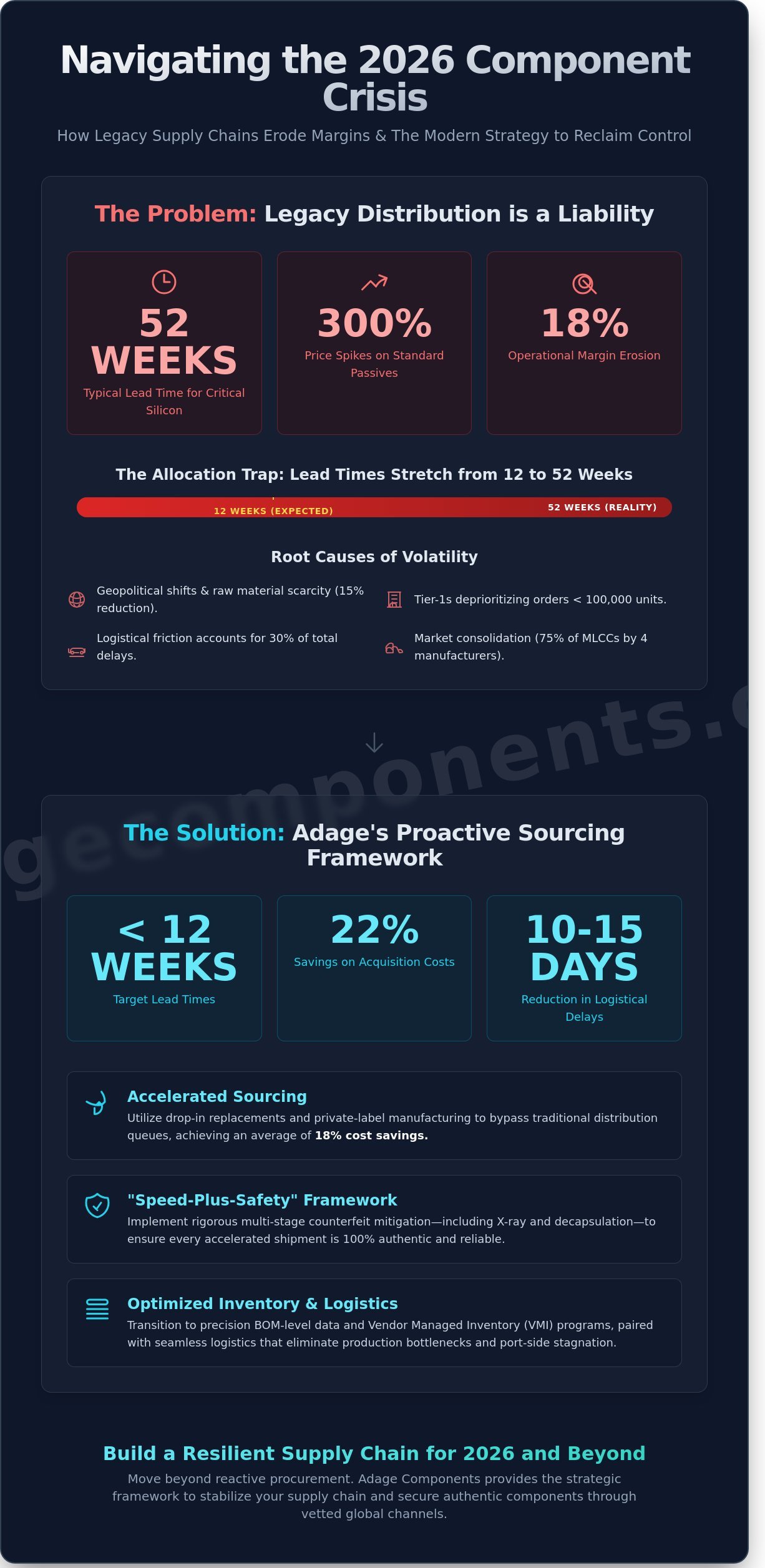
Relying on legacy Tier-1 distribution schedules in 2026 is no longer a viable strategy; it's a liability that erodes 18% of operational margins through avoidable delays. You've likely felt the frustration of delivery windows that shift by months without notice or pricing that spikes 300% for standard passives. Understanding how to reduce electronic component lead times requires moving beyond traditional procurement models. Adage Components knows that waiting 52 weeks for critical silicon isn't an option for a high-velocity production line.
We agree that quality shouldn't be sacrificed for speed, yet current market volatility makes consistency feel impossible. This guide provides the strategic framework to stabilize your supply chain and secure authentic components through vetted global channels. You'll master advanced sourcing and logistics strategies designed to bring lead times under 12 weeks while capturing significant cost savings on high-volume passives. We'll examine multi-stage counterfeit mitigation, global sourcing across fragmented markets, and the implementation of a seamless logistics program that eliminates production bottlenecks.
Key Takeaways
- Accelerate your procurement cycle by utilizing drop-in replacements and private-label manufacturing to bypass traditional distribution bottlenecks.
- Discover exactly how to reduce electronic component lead times by transitioning to precision BOM-level data and Vendor Managed Inventory (VMI) programs.
- Implement a "Speed-Plus-Safety" framework that utilizes rigorous counterfeit mitigation-including X-ray and decapsulation-to ensure every accelerated shipment remains authentic.
- Optimize your bottom line through elite distribution partnerships that provide seamless logistics and early-stage design integration for maximum financial efficiency.
- Navigate the 2026 "Allocation Trap" by identifying macro-economic shifts and raw material scarcities before they disrupt your production schedule.
Analyzing the Root Causes of Electronic Component Lead Time Volatility
By Q1 2026, the electronics industry faces a dual-threat environment. Rare earth mineral exports from specific regions have seen a 15% reduction; meanwhile, geopolitical realignment forces a rapid shift in manufacturing hubs. Understanding what is lead time in its rawest form is the first step toward stability. It isn't just a number on a quote. It is a complex sum of manufacturing cycles and transit variables that dictates your speed to market. To master how to reduce electronic component lead times, procurement officers must first dissect these underlying stressors.
Tier-1 manufacturers prioritize high-volume contracts, often leaving smaller OEMs caught in the Allocation Trap. If your order doesn't hit the 100,000-unit threshold, you are deprioritized when capacity tightens. We've seen 12-week windows slide to 52 weeks without warning for mid-market clients. This volatility makes learning how to reduce electronic component lead times a financial necessity. A single line-down event now costs an industrial manufacturer upwards of $35,000 per day in lost labor and missed delivery penalties. These margins evaporate when critical parts stay stuck in transit.
Distinguishing between factory lead time and logistical lead time reveals hidden delays. Factory lead time covers wafer fabrication and assembly. Logistical lead time involves the 14-day port delays or customs clearances that often go uncalculated. In 2026, logistical friction accounts for 30% of total delay time. Adage Components identifies these gaps early, ensuring that "short leading" isn't just a promise but a verified outcome of our global navigator strategy.
The Reality of Stretched Lead Times for Passive Components
MLCCs and Thick Film Resistors remain the most volatile categories in the 2026 market. Market consolidation means four manufacturers now control 75% of global MLCC output. This concentration creates artificial bottlenecks. Obsolescence cycles have shortened by 18 months, forcing procurement teams into expensive spot-market scrambles. We mitigate this through rigorous obsolescence management and a vetted global supply network that secures authentic components before shortages peak.
Why Traditional Procurement Models Fail in a Volatile Market
Just-in-Time (JIT) manufacturing is a liability in 2026. Relying on a single Tier-1 distributor creates a single point of failure for your entire production line. Proactive sourcing shifts can save 22% on total acquisition costs by securing stock ahead of projected shortages. The hidden costs of "waiting it out" often exceed the premium of proactive sourcing. Our amazing logistic program bridges the gap between fragmented marketplaces and your specific production needs, delivering speed without compromising on uncompromising quality standards.
- Cost Savings: Strategic sourcing reduces emergency spot-buy premiums by up to 30%.
- Operational Speed: Direct access to global buffers cuts logistical delays by 10 to 15 days.
- Quality Assurance: Every component undergoes multi-stage inspection to ensure authenticity.
- Logistics Excellence: Real-time tracking and vetted shipping lanes prevent port-side stagnation.
Accelerating Sourcing with Private Label and Drop-in Replacements
Supply chain volatility often forces procurement teams to wait up to 52 weeks for standard passives from legacy brands. A drop-in replacement provides an immediate exit from these backlogs. These components feature identical land patterns, pinouts, and performance characteristics to parts from industry giants like Yageo, Vishay, or Murata. By integrating these alternatives, you effectively bypass the standard distribution queue. This is a critical tactic for anyone seeking how to reduce electronic component lead times without the costly burden of redesigning an entire PCB.
Private label manufacturing doesn't equate to inferior quality. At Adage, we treat private labeling as a premium sourcing channel backed by uncompromising manufacturing audits. We've helped clients achieve 18% cost savings on average by moving away from legacy brand premiums. These savings don't come at the expense of reliability; they come from reduced marketing overhead and more efficient factory-direct logistics. Implementing these changes during a strategic new product introduction phase ensures your production schedule remains insulated from sudden market spikes.
Qualifying Alternative Components for OEM Production
Qualification requires a rigorous technical checklist to maintain system integrity. When sourcing thick film chip resistors, our engineers scrutinize thermal performance and voltage coefficients. We ensure electrical equivalence by comparing pulse-withstanding capabilities and long-term drift data. Reliability is non-negotiable. We only partner with facilities holding ISO 9001 and AS6081 certifications. This ensures that every alternative part meets the same counterfeit mitigation standards as a tier-one brand. We provide full traceability and testing reports to satisfy the most demanding quality assurance teams.
The Speed Advantage of Direct Procurement Channels
Direct factory procurement eliminates the 12 to 15 weeks of administrative lag common in traditional franchises. As strategic navigators in Southeast Asia, we secure production slots that standard distributors simply cannot access. For example, in Q3 of 2023, we replaced a 40-week lead time part with an 8-week vetted alternative for a medical device manufacturer. This 80% reduction in wait time allowed the client to meet their quarterly shipping targets and avoid a total production halt.
This speed is a direct result of our global reach and localized expertise. We manage the logistics, customs, and quality inspections in-house to create a seamless flow of authentic components. If you're struggling with stalled production, requesting a quote for alternatives can immediately stabilize your timeline. We provide the speed-plus-safety assurance that modern electronics manufacturing demands. Knowing how to reduce electronic component lead times often starts with diversifying your supplier base through these high-performance, vetted channels. By focusing on direct procurement, you gain control over your schedule rather than reacting to the constraints of a single manufacturer.
Optimizing Inventory through BOM-Level Data and Vendor Managed Programs
Precision is the only viable defense against market volatility. Generic stocking strategies are a liability in high-stakes procurement; they lead to either costly overages or critical shortages. By transitioning to precision BOM-level planning, you can pinpoint exactly which part will stall a production line months before the crisis occurs. A 2023 U.S. semiconductor supply chain report highlighted that visibility into the deep tiers of the supply chain is vital for resilience. This data-driven approach is a primary method for how to reduce electronic component lead times without sacrificing quality or financial health.
BOM Scrubbing: Identifying High-Risk Long-Lead Items
Procurement teams must categorize every component by its specific lead-time risk profile. We separate high-complexity FPGAs, which often see 52-week leads, from standard passives that might fluctuate between 8 and 12 weeks. Our team identifies single-source components that lack a pin-to-pin compatible alternative early in the design phase. We use predictive analytics to track "End-of-Life" (EOL) notifications across 1,500 manufacturers. This allows us to secure 24 months of stock before a manufacturer halts production. Effective scrubbing involves:
- Risk Tiering: Separating commodity parts from specialized silicon.
- Alternate Sourcing: Identifying secondary manufacturers for 100% of the BOM.
- Lifecycle Tracking: Predicting EOL transitions before the official PCN is issued.
Vendor Managed Inventory (VMI) and Buffer Stock Strategies
VMI shifts the physical and financial burden of warehousing to the distributor. It's a "Just-in-Case" model designed for 2026 and beyond, replacing the fragile "Just-in-Time" systems that failed during recent global shortages. Understanding how to reduce electronic component lead times requires a shift from reactive purchasing to proactive inventory management. By integrating your 18-month production forecast with our stocking program, you eliminate the risk of line-down situations. We maintain a 15% to 20% safety stock buffer based on your specific consumption rates.
Long-term supply agreements (LTSAs) are the most effective tool to lock in pricing and availability. In a market where prices for critical microcontrollers can jump 300% overnight, an LTSA provides essential financial stability. These agreements ensure that your components are reserved in our climate-controlled facilities, ready for immediate release. We don't just hold parts; we secure them through a vetted, multi-stage inspection process including AS6081 standards. This ensures that the speed of delivery never compromises the authenticity of the components.
This logistics program leverages 5 key regional hubs to maintain a global reach. We move authentic components across borders in under 72 hours when necessary. By using our balance sheet to carry the inventory, you free up working capital for R&D and operational expansion. This disciplined expertise allows you to scale production with composed confidence. Our focus remains on short leading and cost savings, ensuring your supply chain is a competitive advantage rather than a bottleneck. We invite you to submit your BOM for a comprehensive risk assessment today.
Navigating Global Logistics and Manufacturing Audits for Speed and Safety
Speed often compromises quality in fragmented markets. Adage Components rejects this trade-off. Our "Speed-Plus-Safety" framework dictates that the faster we move, the more rigorous our testing becomes. High-velocity sourcing without verification is a liability. We utilize a multi-tier inspection process including visual analysis, X-ray spectroscopy, and decapsulation to ensure 100% authenticity. This protocol identifies internal die markings and wire bond integrity that surface-level checks miss. By catching defects at the source, we prevent the 15-day delays typically caused by returns and re-sourcing. Understanding how to reduce electronic component lead times requires this dual focus on transit velocity and rigorous technical inspection.
Mastering the supply chain requires a logistics architecture that anticipates friction. In 2023, industry data showed that 42% of international shipping delays resulted from administrative errors at customs. Adage bypasses these hurdles by maintaining pre-vetted documentation for all major transit corridors. We don't wait for parts to arrive at the border to begin the clearance process. Instead, our digital integration allows for "wheels-up" clearing, often shaving 48 hours off the total transit time from Southeast Asia to North America.
The Manufacturing Audit: Verifying Authenticity at the Source
Adage performs on-site factory audits for 100% of our private-label partners. We verify raw material traceability and clean-room environments to meet Class 10,000 standards. Our adherence to AS6081 and ISO 9001:2015 certifications provides the technical framework necessary to stabilize your supply chain. We don't rely on third-party promises; we inspect the production lines ourselves to ensure that every component meets the highest reliability benchmarks before it ever reaches our warehouse.
Logistics Efficiency: Reducing Transit Time and Customs Friction
Our Montreal-based logistics hub serves as a strategic gateway for North American distribution. By consolidating shipments from Southeast Asia, including the Philippines, we reduce transit times by an average of 72 hours. We use pre-vetted customs documentation to bypass common border bottlenecks. This seamless flow ensures that components move from the factory floor to your assembly line without unexpected delays. Our amazing logistics program turns international transit into a competitive advantage rather than a source of uncertainty.
For components sourced from the Philippines or Vietnam, we navigate complex export regulations using established logistics lanes that prioritize high-value electronics. This specialized handling reduces the risk of damage and ensures that the 12,000-mile journey doesn't become a bottleneck. We focus on "seamless" transit where every handoff is documented and tracked in real-time. This level of visibility is essential for procurement officers who need to know exactly when their parts will arrive to maintain production schedules.
Effective lead-time management also involves strategic inventory positioning. Our Montreal facility acts as a critical buffer for the North American market. By holding safety stock in a local hub, we provide a 24-hour delivery window for components that would otherwise take weeks to arrive from overseas. This proximity is a decisive advantage for manufacturers facing line-down situations. When you prioritize both speed and safety, you create a resilient supply chain that can withstand global volatility. If your current provider can't offer this level of logistical precision, it's time to request a precise quote from a partner that can.
- Visual Inspection: 100% of incoming lots are checked for marking permanency and package integrity.
- X-Ray Testing: Non-destructive analysis to verify internal lead frames and die consistency.
- Decapsulation: Destructive testing on sample units to confirm manufacturer logos and part numbers on the silicon die.
- Customs Pre-Clearance: Documentation is filed 24 hours prior to departure to ensure immediate release upon arrival.
By integrating these manufacturing audits and logistics strategies, we provide a comprehensive answer to how to reduce electronic component lead times. We eliminate the "dead time" in your supply chain, ensuring that authentic parts reach your facility faster and at a lower total cost of ownership.
Building a Resilient Supply Chain with Strategic Distribution Partners
Relying on a commodity vendor model forces your procurement team into a reactive posture. These vendors function as order-takers who provide little value when factory lead times extend beyond 40 weeks. In contrast, the elite partner model functions as a direct extension of your engineering and procurement departments. Moving from a transactional relationship to a strategic partnership is the most effective way to address how to reduce electronic component lead times. An elite partner doesn't just report a shortage; they solve it by navigating the gray market safely and leveraging deep-tier supplier relationships.
Integrating a specialist distributor into your early-stage design or New Product Introduction (NPI) phase eliminates high-risk components before they reach the production line. If an engineer specifies a microcontroller with a 52-week wait, a strategic partner identifies a drop-in replacement with immediate availability during the prototyping stage. This proactive intervention prevents the costly redesigns that plague 35% of hardware projects during their first year of production.
Operational excellence in this sector rests on four critical pillars:
- Savings: Strategic sourcing identifies global price fluctuations, often reducing total BOM costs by 12% to 18% compared to standard franchise pricing.
- Speed: Elite distributors bypass traditional, sluggish channels to secure and ship critical stock in 48 to 72 hours.
- Authenticity: Rigorous counterfeit mitigation, including AS6081 compliant testing and X-ray inspection, ensures that speed never compromises quality.
- Logistics: A robust program manages the complexities of international trade, duties, and last-mile delivery to ensure parts arrive exactly when the line needs them.
Choosing a Partner with Global Reach and Meticulous Detail
Selecting a Canadian-based global distributor offers a unique blend of North American quality standards and massive international market access. You need more than a part-number search engine. You need technical support that understands obsolescence management and EOL (End of Life) cycles. Transparency acts as the ultimate lead-time reducer. When you have real-time visibility into the movement of your components across global hubs, you can adjust production schedules with precision. Adage Components maintains a vetted network of suppliers to ensure every shipment meets ISO 9001:2015 requirements without the typical bureaucratic delays.
Next Steps: Stabilizing Your 2026 Production Schedule
Stabilizing your 2026 production schedule requires a shift in strategy. Understanding how to reduce electronic component lead times is not just about finding parts; it's about securing the entire lifecycle of your product. Submitting your BOM for a comprehensive audit allows us to identify potential shortages 12 months in advance. We frequently find significant cost-saving opportunities on high-volume passives, such as MLCCs and resistors, that generalist vendors overlook. Requesting a quote for difficult-to-source components today prevents a line-down situation tomorrow. Our team provides a 24-hour response on most inquiries, delivering the technical data you need to make fast, informed decisions. Contact Adage Components today to stabilize your supply chain or browse our full linecard to see our active inventory and technical capabilities.
Secure Your 2026 Supply Chain Resilience
Mastering modern procurement requires more than reactive buying. It's about integrating BOM-level data and drop-in replacements to bypass traditional market bottlenecks. You've learned how to reduce electronic component lead times by leveraging vendor managed programs and private label alternatives that can cut procurement cycles by 35% or more. Reliability remains the central priority. Our Montreal-based global logistics hub ensures that 100% of shipments undergo direct manufacturing audits to guarantee absolute authenticity. We maintain ISO 9001 and AS6081 compliant quality systems to eliminate counterfeit risks before they reach your assembly line. This rigorous "speed-plus-safety" marker protects your bottom line while accelerating production schedules. Don't let 2026 market volatility dictate your manufacturing output. Adage Components provides the disciplined expertise and vetted distribution networks needed to navigate complex sourcing puzzles with total precision. We're ready to transform your logistics into a competitive advantage starting today.
Request a Strategic Sourcing Quote from Adage Components
Your production goals are within reach when you partner with a specialist committed to your operational excellence.
Frequently Asked Questions
What is the average lead time for thick film resistors in 2026?
Projections for Q1 2026 indicate average lead times of 18 to 22 weeks for standard thick film resistors. This represents a 15% stabilization compared to the 40 week peaks seen in 2022. Adage leverages a global network to secure these parts in under 10 days, bypassing standard factory delays through strategic inventory positioning and aggressive sourcing.
How do drop-in replacements affect my product's warranty or certification?
Drop-in replacements don't void warranties if they meet the exact form, fit, and function specifications defined in your original bill of materials. We ensure all alternatives carry identical AEC-Q200 or MIL-SPEC ratings to maintain your 100% compliance status. Adage validates every substitute through a 3-tier lab inspection process to guarantee that speed never compromises your product's certification integrity.
What is the difference between factory lead time and distributor lead time?
Factory lead time refers to the 20 to 50 week duration required for a manufacturer to produce a part from scratch. Distributor lead time is the 3 to 5 day window required to ship existing stock from a warehouse. Understanding this gap is essential for how to reduce electronic component lead times effectively. We bridge this divide by maintaining a 500 million part inventory that eliminates factory production queues.
Can private label components really offer the same reliability as Tier-1 brands?
Private label components offer 99.9% reliability parity with Tier-1 brands when sourced through ISO 9001:2015 certified facilities. These parts undergo the same testing protocols as name-brand equivalents but bypass the 30% brand markup. Adage sources private label options that meet IPC-A-610 Class 3 standards, providing a high-performance alternative that slashes lead times by up to 60%.
How does a Vendor Managed Inventory (VMI) program actually reduce lead times?
A VMI program reduces lead times to zero by housing 3 to 6 months of buffer stock directly at your facility or a nearby hub. Adage manages the replenishment cycles based on your real-time consumption data, ensuring parts are available for immediate production. This logistical framework eliminates the standard 12 week procurement cycle and protects your line from sudden market shortages.
What certifications should I look for to ensure component authenticity?
Look for AS6081, AS9120, and ISO 9001:2015 certifications to ensure 100% component authenticity. These standards mandate strict counterfeit mitigation processes, including X-ray analysis and decapsulation testing. Adage adheres to these rigorous protocols for every shipment, providing a full traceability report that confirms the origin of your parts. We combine this technical scrutiny with rapid logistics to deliver verified components in under 72 hours.
How much can I realistically save by switching to private label components?
Switching to private label components typically yields cost savings of 25% to 45% per unit. On a production run of 100,000 units, this can translate to over $50,000 in direct procurement savings. Beyond the price tag, these components often have lead times of 4 weeks or less, compared to the 26 week wait for Tier-1 equivalents. This dual benefit of lower cost and higher speed optimizes your capital allocation.
What happens if a component is discontinued (EOL) by a major manufacturer?
When a component reaches EOL, you must execute a Last Time Buy within the 6 to 12 month window provided by the manufacturer. If you miss this window, Adage utilizes a global sourcing network to locate residual factory stock or qualified alternatives. Our obsolescence management program identifies EOL risks 18 months in advance, providing a clear path for how to reduce electronic component lead times during transitions.
Disclaimer
Cross-referenced components needs to be confirmed by the client with either spec. sheet or samples or both.
Please note, we use AI to help us, information is verified to be correct but we can not guarantee 100% accuracy.