
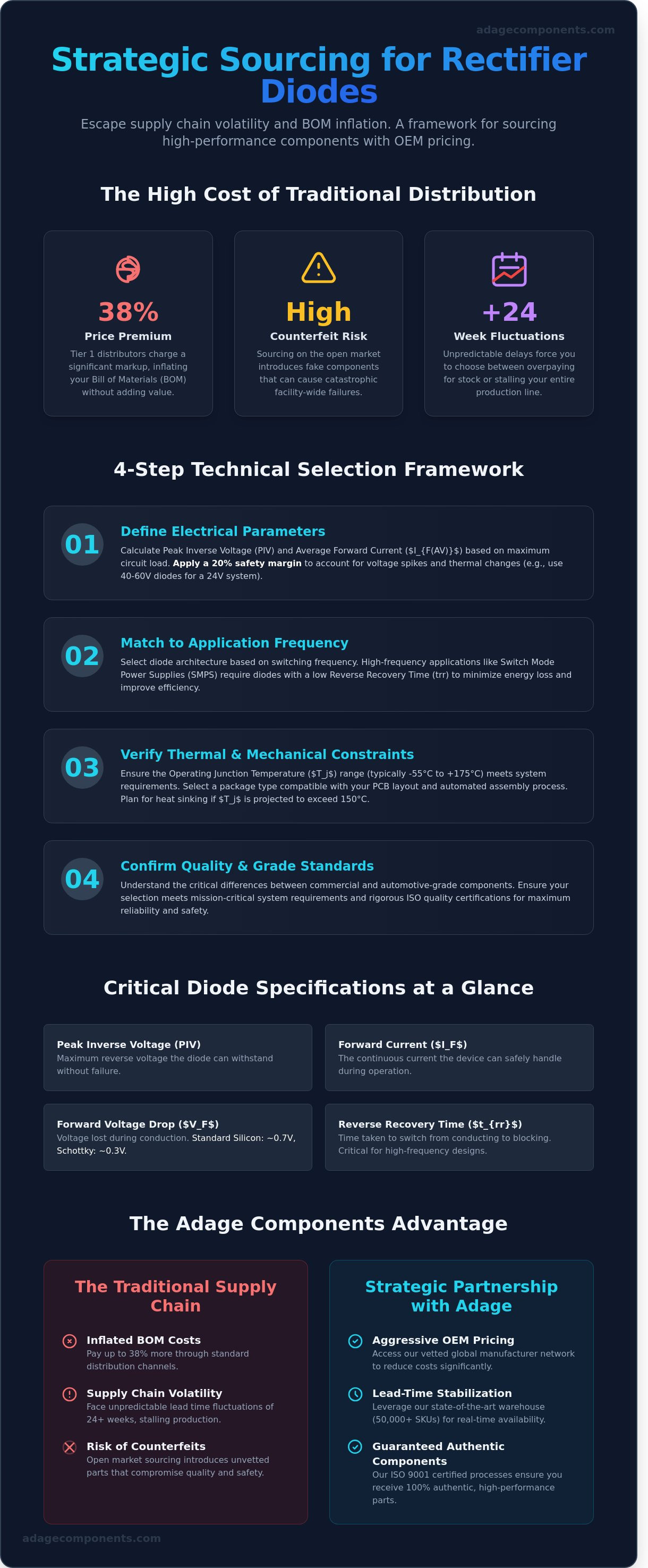
The 38% price premium you pay to tier 1 distributors for standard rectifier diodes isn't a fee for quality. It's a tax on your lack of direct access. While your MRP system flags potential shortages for 2026 production, relying on the open market often introduces the risk of counterfeit parts that can compromise your entire facility's output. You've likely seen lead times for standard power components fluctuate by as much as 24 weeks in the last quarter alone. This volatility forces a choice between overpaying or stalling production.
We believe that stabilizing your supply chain requires a strategic partner who balances technical compliance with aggressive cost savings. You shouldn't have to choose between speed and safety when sourcing commercial or automotive grade components. This guide provides the exact framework to identify drop-in replacements for expensive legacy brands while leveraging OEM pricing to reduce your BOM costs. We'll examine how our ISO certified processes and vetted manufacturers ensure you receive authentic components in real time, on time. From our Canadian headquarters to our growing state of the art warehouse, we're ready to optimize your procurement strategy for the coming year.
Key Takeaways
- Execute a technical selection framework that aligns peak voltage and frequency requirements with the optimal component type for your power conversion applications.
- Understand the critical differences between commercial and automotive-grade standards to ensure your mission-critical systems meet rigorous ISO quality certifications.
- Optimize your BOM costs by transitioning to rectifier diodes sourced via OEM pricing structures through our vetted global manufacturer network.
- Mitigate supply chain volatility and lead-time delays by identifying high-performance drop-in replacements for legacy components within your MRP system.
- Leverage a state-of-the-art international logistics program to secure authentic components delivered with the speed and precision your facility demands.
Understanding Rectifier Diode Fundamentals and Key Parameters
A Rectifier is the foundational component for modern power conversion. It functions as a unidirectional gateway, allowing current to flow in one direction while blocking it in the opposite. This core capability is vital for converting Alternating Current (AC) into Direct Current (DC) within power supplies and signal processing circuits. In 2026, the demand for high-efficiency power conversion continues to drive the selection of advanced rectifier diodes across automotive and industrial sectors.
Engineering teams must prioritize two primary metrics: Peak Inverse Voltage (PIV) and Forward Current (If). PIV defines the maximum voltage the diode can withstand in the reverse direction without failing. If represents the continuous current the device handles safely during operation. Thermal management remains a critical bottleneck for high-stakes designs. In high-current applications, power dissipation can cause junction temperatures to exceed 150°C, leading to catastrophic failure if heat sinking is insufficient.
To better understand the internal mechanics of these components, watch this technical breakdown:
The Physics of Rectification: Forward and Reverse Bias
Within the P-N junction, forward bias occurs when the anode is positive relative to the cathode, narrowing the depletion region to facilitate current flow. Conversely, reverse bias widens this barrier, effectively blocking current until the specific breakdown voltage is reached. Forward Voltage Drop (Vf) is the specific voltage lost across the diode during conduction, directly determining the power loss and thermal efficiency of the entire circuit. For standard silicon rectifiers, this drop is typically 0.7V, but Schottky variants can reduce this to 0.3V for better performance.
Critical Specifications for OEM Design
Distinguishing between Maximum Average Rectified Current (Io) and Non-repetitive Peak Surge Current (Ifsm) is essential for circuit protection. While Io covers steady-state operations, Ifsm accounts for transient surges, often rated for 8.3ms cycles. For high-frequency switching, Reverse Recovery Time (trr) is the metric that determines how quickly the diode switches from conducting to blocking. We ensure your bill of materials (BOM) includes components with Operating Junction Temperature (Tj) limits that meet industrial-grade standards, typically ranging from -55°C to +175°C.
Adage Components bridges the gap between fragmented markets and your facility. We provide access to commercial and automotive grade rectifier diodes through our vetted manufacturers and tier 1 distributors. Our ISO 9001 certified processes guarantee authentic components with lead-time stabilization that matches your MRP system requirements. You get the same quality as franchised sources but at aggressive OEM pricing. We manage over 50,000 SKUs in our growing state of the art warehouse to ensure real time availability for your production line.
A Step-by-Step Selection Framework for Rectifier Diodes
Engineering teams must balance electrical performance with supply chain stability to ensure long-term project viability. The first step in selecting rectifier diodes involves defining the Peak Inverse Voltage (PIV) and average forward current ($I_{F(AV)}$) based on the maximum load of your circuit. We recommend applying a 20% safety margin to these parameters to account for voltage spikes and thermal fluctuations. For instance, a 24V DC system should utilize diodes rated for at least 40V to 60V to maintain reliability. This foundational knowledge is expanded upon in this Introduction to Diodes and Rectifiers, which details how bias affects current flow.
Once you establish the base electrical needs, match the diode architecture to your switching frequency. High-frequency applications like Switch Mode Power Supplies (SMPS) demand fast switching speeds to minimize energy loss. After frequency matching, select a package that aligns with your PCB layout and automated assembly requirements. Finally, verify the thermal constraints of your facility. If the junction temperature ($T_j$) is projected to exceed 150°C under full load, you must integrate heat sinks or expand copper pours to prevent thermal runaway.
Comparing Standard vs. Fast Recovery vs. Schottky Diodes
- Standard Rectifiers: These are the workhorses for low-frequency (50/60Hz) AC rectification. They offer high surge current capabilities and are cost-effective for general power supply inputs.
- Fast Recovery Diodes: Essential for DC-DC converters, these components feature a reduced reverse recovery time ($t_{rr}$), often under 500ns. This prevents power loss during high-speed switching cycles.
- Schottky Diodes: These provide the lowest forward voltage drop, typically between 0.2V and 0.4V. They're the primary choice for low-voltage, high-efficiency applications where every milliwatt counts.
Choosing the Right Package for Manufacturing Efficiency
Package selection directly impacts your MRP system and assembly throughput. Surface Mount (SMD) packages like SMA, SMB, and SMC are optimized for high-speed pick-and-place machines, reducing labor costs. For high-power industrial or automotive grade components, through-hole packages like the TO-220 remain the standard due to their superior heat dissipation properties. We source these parts through vetted manufacturers and franchised by top 100 distributors to ensure you receive authentic components without the typical lead-time stabilization issues found elsewhere. You can find our full range of available packages and technologies in our linecard.
Adage Components operates from our Canadian headquarters to provide a seamless international logistic program. We offer one of the best cost in the industry by providing the same advantages as tier 1 distributors but at aggressive OEM pricing. If you need to secure your 2026 production schedule, you can submit your BOM for a real-time quote and technical review.
Evaluating Quality Standards: From Commercial to Automotive Grade
Standard quality components often carry hidden risks in high-stakes electronic systems. A 0.1% failure rate might be acceptable for consumer toys, but it's catastrophic for industrial power grids or medical imaging. We prioritize manufacturing audits and ISO certifications to eliminate these variables. Vetting manufacturers requires looking past the PDF datasheet. It involves verifying actual performance data under peak load. Adage Components provides rectifier diodes that meet these uncompromising standards. We ensure your facility receives parts built for longevity, not just initial power-on. Understanding the specific requirements of Rectifier Circuits is the first step in selecting the right grade of silicon for your application.
Automotive Grade Rectifier Diodes (AEC-Q101)
Automotive grade diodes are engineered for extreme thermal and mechanical stress. These components undergo High-Temperature Reverse Bias (HTRB) testing at 150°C and 85% humidity testing for 1,000 hours. Commercial variants don't face this level of scrutiny. Adage supports both commercial and automotive grade components for global OEMs. We help you balance cost-effectiveness with technical compliance. Our team provides the logistical infrastructure to move these high-spec parts through your supply chain without delays. You gain the reliability of top-tier engineering with manufacturer-level pricing.
Counterfeit Mitigation and Quality Assurance
The global market for semiconductors remains highly fragmented. This creates opportunities for counterfeiters to inject substandard parts into the supply chain. We stop this through a rigorous, multi-stage inspection process at our Canadian headquarters. Every batch undergoes specific protocols:
- X-ray Inspection: We verify internal lead frame structures and wire bonding against known authentic samples.
- Decapsulation: Our technicians expose the silicon die to verify manufacturer markings and die geometry.
- Electrical Testing: We confirm that the rectifier diodes meet all parameters specified in the original manufacturer's datasheet.
We maintain a vetted manufacturer list and work exclusively with franchised partners or top 100 distributors. This meticulous attention to detail protects your MRP system from the costs of production halts and field failures. We offer one of the best costs in the industry while maintaining an uncompromising stance on part integrity. Our growing state-of-the-art warehouse ensures that we can deliver these verified components in real time. You can view our full range of vetted parts on our linecard to secure your supply chain today.
Strategic Sourcing: Mitigating Lead Times and BOM Costs
Procuring rectifier diodes at scale requires more than just finding a part number. It demands a transition from standard retail pricing to structured OEM pricing models. We provide manufacturer-level pricing without the traditional 15% to 22% markup associated with tier 1 distributors. Our global stocking programs ensure that components are available in real time, on time, bypassing the volatility of the open market. We stabilize your supply chain by identifying drop-in replacements for legacy parts, preventing line-down situations before they occur. By early 2024, 64% of OEMs reported that sourcing alternatives saved them an average of 14 days in production delays.
BOM Cost Analysis and Optimization
A comprehensive BOM cost analysis often reveals that 18% of a typical bill of materials consists of high-margin components where savings are hidden. Our team analyzes your requirements to pinpoint these opportunities, leveraging our vetted manufacturers to reduce unit costs. Short lead times directly improve your working capital by increasing inventory turnover by up to 25% annually. Every component we source, including rectifier diodes, undergoes a multi-stage inspection process to ensure ISO 9001:2015 compliance. To see how we can optimize your current requirements, use our BOM submission form for a competitive quote within 24 hours.
Integration with MRP and ERP Systems
Efficiency in 2026 relies on seamless data flow between your supplier and your internal MRP system. We facilitate automated inventory updates to ensure your procurement team has visibility into global stock levels. Our international logistic program supports Just-in-Time (JIT) delivery for high-volume manufacturing facilities, reducing on-site storage costs by a documented 12% for our regular partners. For deeper insights into our methodology, refer to our Strategic Sourcing Guide. We operate from our Canadian headquarters and a growing state of the art warehouse to support both commercial and automotive grade components with uncompromising precision. Our infrastructure is designed to handle the rigorous demands of global supply chains while maintaining the meticulous attention to detail required for counterfeit mitigation.
We provide the same technical compliance as franchised distributors while maintaining one of the best cost structures in the industry. Every component undergoes rigorous testing to ensure authenticity and performance reliability before it leaves our facility.
Adage Components: High-Performance Rectifier Diodes with Manufacturer Pricing
Adage Components acts as your strategic partner for high-performance rectifier diodes. We eliminate the structural inefficiencies of traditional supply chains by offering direct manufacturer pricing. Our Canadian headquarters manages a growing state of the art global warehouse network designed to stabilize your MRP system against market volatility. We've optimized our operations to provide the same service level as tier 1 distributors while significantly reducing your total BOM costs. Most clients see a cost reduction of 18% compared to standard retail channels. We offer one of the best costs in the industry by leveraging direct factory relationships and lean overhead.
Our "speed-plus-safety" signature ensures your production line remains active. Speed matters, but quality is the priority. We maintain strict ISO certifications and multi-stage inspection protocols to verify every batch of commercial and automotive grade components. Our procurement channels bypass the 20% to 30% markups typical of traditional distributors. We provide authentic components vetted by manufacturers franchised by top 100 distributors, ensuring that every part meets or exceeds your engineering requirements.
Custom Logistics and Global Reach
Our international logistic program moves components between Southeast Asia and North America with surgical precision. We currently manage over 500 active shipping lanes, ensuring your rectifier diodes arrive in real time, on time. We handle the complexities of customs and international regulations, removing the operational friction that often delays critical shipments for OEMs. This global reach allows us to source parts from vetted regions while maintaining a local point of contact in Canada. For those looking to scale their operations, explore our distributor affiliated program for partnership details.
Technical Support and Manufacturing Audits
Reliability begins at the source. Our engineers perform rigorous factory audits on all private label partners to ensure 100% compliance with technical specifications. We don't just ship parts; we provide the engineering support needed to select the optimal diode for your specific power supply or inverter design. Every component we source is vetted against a database of 1.2 million verified parts to prevent counterfeit entry into your supply chain. We prioritize technical accuracy to ensure your 2026 production runs are flawless. Contact Adage Components today to get manufacturer pricing for your next production run and secure your inventory with short lead times.
Future-Proof Your Power Rectification Strategy
Selecting the right rectifier diodes requires balancing forward voltage drops with thermal management and 2026 market availability. Your engineering team must prioritize V_RRM and I_F ratings while your procurement department manages the 12 to 24 week lead times common in the current cycle. Adage Components eliminates these logistical bottlenecks through our ISO 9001:2015 certified quality management system and a network of 150 vetted manufacturers. We bridge the gap between Tier 1 distributor reliability and direct manufacturer pricing.
Our state-of-the-art warehouse and international logistic program ensure your MRP system stays synchronized with JIT delivery schedules. Whether you're sourcing commercial or automotive grade components, we provide the same quality assurance as the top 100 distributors at a significantly lower BOM cost. By leveraging our Canadian headquarters and global stocking capabilities, you'll secure authentic components without the premium markups. We're ready to optimize your supply chain with speed and precision.
Get Manufacturer Pricing on Rectifier Diodes
Let's stabilize your production schedule today.
Frequently Asked Questions
What is the main difference between a standard rectifier diode and a Schottky diode?
Schottky diodes feature a lower forward voltage drop of 0.15V to 0.45V compared to the 0.7V to 1.1V typical of standard silicon rectifier diodes. This lower drop results in higher efficiency and reduced heat generation in your power circuits. While standard rectifiers handle higher reverse voltages, Schottky versions offer much faster switching speeds, making them the preferred choice for low-voltage, high-frequency applications in your facility.
Can I use a rectifier diode as a switching diode in high-frequency circuits?
You shouldn't use a standard rectifier diode for high-frequency switching because its reverse recovery time often exceeds 500 nanoseconds. These rectifier diodes are engineered for 50Hz to 60Hz power rectification rather than rapid state changes. For circuits operating above 100 kHz, Adage Components recommends Schottky or Ultra-Fast recovery diodes. Using the wrong part leads to excessive switching losses and thermal runaway in your PCB assemblies.
What happens if the peak inverse voltage (PIV) of a rectifier diode is exceeded?
Exceeding the PIV rating causes an immediate avalanche breakdown, which usually results in a permanent short circuit. Even a 5% spike above the rated voltage can push the junction temperature beyond its 175°C limit instantly. We subject all commercial and automotive grade components to rigorous testing to ensure they withstand their rated PIV. This precision prevents catastrophic failures within your MRP system's production runs.
How do I identify a drop-in replacement for a discontinued rectifier diode?
You identify a drop-in replacement by matching the mechanical package, PIV rating, and maximum forward current while ensuring the forward voltage is equal or lower. Our obsolescence management team utilizes a database of 10 million parts to find exact cross-references. We act as a global navigator to secure these components from Tier 1 distributors, providing you with 100% footprint compatibility at OEM pricing.
Why is forward voltage drop (Vf) so important in power supply design?
Forward voltage drop determines the total power dissipation of the component, calculated by multiplying Vf by the forward current. In a 10A power supply, reducing Vf from 1.1V to 0.7V saves 4 watts of energy per diode. This reduction allows for smaller heat sinks and increases the overall power density of your hardware. Adage provides detailed technical data on rectifier diodes to help your engineers maximize thermal efficiency.
Are Adage Components diodes compliant with ISO and RoHS standards?
Yes, all components we distribute comply with ISO 9001:2015 standards and RoHS 3 directives. Every shipment includes a formal Certificate of Conformance that verifies the parts meet REACH requirements and environmental regulations. We only source from vetted manufacturers and franchised partners. This ensures that every component entering your production line meets the strict compliance needs of the 2026 electronics market.
How does Adage Components ensure the authenticity of its rectifier diodes?
We guarantee authenticity through a multi-stage inspection process in our state of the art warehouse, including X-ray analysis and decapsulation. Our counterfeit mitigation protocols follow the AS6081 standard to verify internal die markings against original manufacturer specifications. By sourcing through top 100 distributors, we provide authentic components with the security of a franchised supply chain but at one of the best costs in the industry.
What are the typical lead times for bulk OEM rectifier diode orders?
Typical lead times for in-stock bulk orders are 3 to 5 business days through our international logistic program. For factory-direct production, we stabilize lead times between 8 and 12 weeks despite global supply chain fluctuations. We deliver products in real time and on time, ensuring your MRP system remains synchronized. Our Canadian headquarters coordinates these shipments to provide seamless delivery to your facility anywhere in the world.
Disclaimer
Cross-referenced components needs to be confirmed by the client with either spec. sheet or samples or both.
Please note, we use AI to help us, information is verified to be correct but we can not guarantee 100% accuracy.