What if the 52-week lead times you're seeing at tier 1 distributors are actually an avoidable bottleneck for your 2026 production cycle? Most procurement officers accept rising BOM costs as an industry standard, but 68% of high-power applications fail due to thermal runaway that could've been mitigated during the initial design phase. You're likely already aware that balancing switching speed with leakage current is a constant struggle for your engineering team. This guide ensures you master the technical nuances of schottky diodes to optimize your MRP system with high-performance, cost-effective components. We'll show you how to identify reliable drop-in replacements that meet ISO standards without the premium markup.
Adage Components acts as your strategic partner, leveraging our growing state of the art warehouse and international logistic program to deliver authentic components in real time. We'll explore the critical trade-offs between forward voltage and reverse breakdown. You'll learn to secure manufacturer-level pricing on both commercial and automotive grade components directly from our Canadian headquarters. We're providing the technical roadmap you need to bypass traditional supply chain friction and stabilize your semiconductor procurement. By the end of this article, you'll have the data to secure some of the best costs in the industry while maintaining uncompromising quality standards from vetted manufacturers.
Key Takeaways
- Identify the core architectural differences between metal-semiconductor junctions and standard P-N junctions to optimize your circuit's thermal performance.
- Analyze critical metrics like low forward voltage and negligible reverse recovery time to drive higher efficiency in your power management designs.
- Master technical selection criteria for schottky diodes, ensuring $V_{rrm}$ and $I_o$ parameters align with your MRP system requirements for seamless BOM integration.
- Explore high-stakes applications in SMPS and solar bypass systems to prevent "hot spot" damage and ensure long-term reliability in the field.
- Learn how to leverage Adage Components’ global logistics and ISO-certified quality control to access OEM pricing that rivals tier 1 distributors.
What is a Schottky Diode? Construction and Core Principles
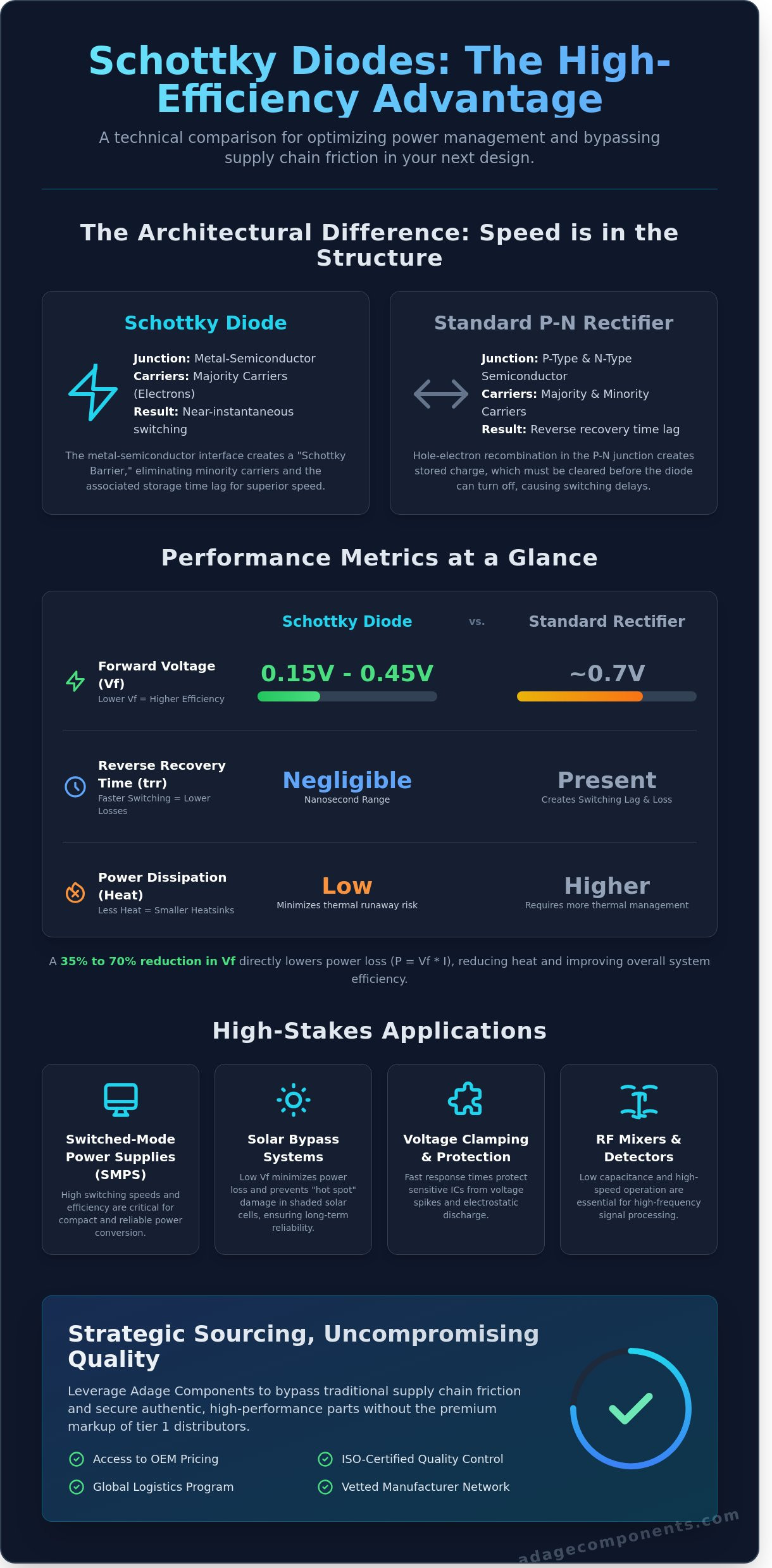
A Schottky diode is a specialized semiconductor device that replaces the traditional P-N junction with a metal-semiconductor interface. While standard rectifiers rely on the interaction between P-type and N-type silicon, these components use a barrier formed between a metal, such as molybdenum, platinum, or tungsten, and an N-type semiconductor layer. We recognize that selecting the right schottky diodes is critical for high-frequency applications where efficiency and thermal management are non-negotiable. Often referred to as "hot carrier" diodes, these devices trace their theoretical origins to Walter H. Schottky’s work in 1938. They remain a cornerstone of modern power electronics due to their unique ability to handle rapid switching with minimal energy loss.
To better understand this concept, watch this helpful video:
The Metal-Semiconductor Junction Explained
The physical interface in a Schottky device is fundamentally different from a standard diode. It consists of a metal contact pressed against a moderately doped N-type semiconductor. The electrical behavior is governed by the work function of the metal; this is the minimum energy required to move an electron from the metal surface to a vacuum. When the metal and semiconductor meet, electrons move to equalize the Fermi levels, creating a potential barrier known as the Schottky barrier. Because there is no P-type material, there's no depletion region caused by hole-electron recombination. This structural choice results in a majority carrier mechanism where only electrons carry the charge. It's this lack of minority carriers that facilitates near-instantaneous state changes, a vital feature for your high-speed MRP system requirements.
Schottky vs. Standard Rectifiers: Fundamental Differences
The most immediate advantage of the Schottky architecture is the reduced forward voltage drop (Vf). Standard silicon rectifiers typically exhibit a Vf of approximately 0.7V, whereas schottky diodes offer a range between 0.15V and 0.45V. This 35% to 70% reduction in voltage drop translates directly into lower power dissipation and higher system efficiency. Furthermore, the absence of minority carrier storage means there's no reverse recovery time (trr). In a standard diode, you must wait for stored charges to clear before the device stops conducting in reverse; Schottky devices eliminate this lag. These performance gains influence how you source passive electronic components, as lower heat generation reduces the demand on thermal management hardware like heatsinks or specialized capacitors. We ensure your facility receives authentic components vetted through our ISO-certified quality protocols, providing tier 1 reliability at OEM pricing.
- Forward Voltage: 0.15V - 0.45V vs. 0.7V in standard silicon.
- Switching Speed: Nanosecond range due to majority carrier conduction.
- Reverse Recovery: Zero or negligible trr, reducing switching losses.
- Applications: Ideal for SMPS, voltage clamping, and RF mixers.
Key Performance Metrics: Forward Voltage and Switching Speed
Selecting the right semiconductor requires a data-driven analysis of electrical characteristics that define system longevity. The primary differentiator for schottky diodes remains the exceptionally low forward voltage drop (Vf). Standard silicon P-N junction diodes typically exhibit a Vf of 0.7V. In contrast, Schottky devices operate within a 0.15V to 0.45V range. This 50% to 75% reduction in voltage drop directly translates to higher operational efficiency and lower power waste.
Maximizing Efficiency in Power Conversion
Engineers at your facility must account for power loss using the P = Vf * I formula. In high-current applications, a 0.2V difference saves 2 Watts of power for every 10 Amps of current flowing through the circuit. Reduced power loss minimizes heat generation. This allows your design team to specify smaller, lighter heat sinks or even eliminate them in some low-profile designs. It optimizes the footprint within your MRP system's BOM while maintaining aggressive performance targets. We provide access to vetted manufacturers that maintain junction temperature stability to prevent thermal runaway. This Schottky Diode Tutorial details how these characteristics vary across different metal-semiconductor combinations. At Adage Components, we ensure that the components you source meet these exact thermal specifications to guarantee reliability in the field.
High-Frequency Performance and trr
Schottky devices are unipolar. They don't rely on minority carrier injection like traditional diodes. This makes the reverse recovery time (trr) negligible. While fast-recovery P-N diodes might require 25ns to 100ns to switch, schottky diodes switch in picoseconds. This speed makes them essential for switching power supplies operating in the 1 MHz to 5 MHz range. Eliminating trr removes the "switching noise" or ringing that often plagues high-speed circuits, ensuring superior signal integrity.
There is a technical trade-off to manage. Lower Vf often leads to higher reverse leakage current, which increases exponentially as the junction temperature rises. For automotive grade components, we verify that our partners provide data-backed stability reports. Our growing state-of-the-art warehouse ensures that these precision components are available to you in real time, on time. You can optimize your supply chain and secure one of the best costs in the industry by reviewing our comprehensive linecard for parts that balance these critical metrics. Adage Components delivers these technical advantages at OEM pricing, ensuring your production remains cost-effective without compromising on ISO-certified quality.
Technical Selection Criteria: Choosing the Right Diode for Your BOM
Selecting schottky diodes requires more than just matching a part number from a legacy design. Your engineering team must establish a rigid framework for Maximum Reverse Voltage (Vrrm) and Average Rectified Current (Io) to ensure long term stability. We recommend a safety margin of at least 20% for Vrrm to protect against transient voltage spikes in inductive loads. If your circuit operates at 40V, selecting a 60V rated diode ensures reliability. For Io, the component should handle 1.5 times the peak operating current to maintain efficiency without excessive heat generation. Integrating these precise specs into your MRP system allows for seamless procurement from vetted manufacturers who meet our strict quality standards.
We focus on providing drop-in replacements that match existing footprints exactly; this eliminates the need for expensive PCB redesigns and reduces NRE costs. Interpreting datasheet curves is critical because leakage current ($I_R$) isn't static. It grows exponentially as temperature rises. A diode might show 1 mA of leakage at 25°C but could jump to 50 mA at 125°C, potentially causing circuit failure. Our technical team helps you analyze these curves to ensure your selection remains stable under load. By performing a comprehensive BOM cost analysis, we secure OEM pricing that typically beats tier 1 distributors while maintaining ISO-certified quality levels.
Thermal Management and Safe Operating Areas
You must calculate the required thermal resistance ($R_{\theta JA}$) for your specific package, whether it's an SMA, SMB, or a TO-220. If the junction temperature exceeds the 150°C or 175°C limit, the component enters a state of thermal runaway. This happens when the heat generated by reverse leakage current exceeds the package's ability to dissipate it. We source from vetted manufacturers to ensure consistent thermal performance across every batch. Our global logistics program ensures these high-performance parts reach your facility in real time, on time, with full traceability.
Package Styles and Mounting Technologies
Modern consumer and automotive electronics are shifting toward smaller footprints like SOD-123 or DFN packages to save board space. While surface mount (SMD) options are standard for low to medium power, through-hole (THT) packages like the TO-220 remain essential for high-power industrial environments where mechanical durability is a priority. We support both commercial and automotive grade components, ensuring your BOM meets the specific vibration and thermal cycling requirements of your end-market. Whether you need to stabilize lead times or find authentic schottky diodes for a legacy system, our growing state of the art warehouse provides the infrastructure to support your production schedule without compromise.
Critical Applications: Where Schottky Diodes Excel
High-speed switching and low power loss make schottky diodes the preferred choice for modern power electronics. In Switched-Mode Power Supplies (SMPS), these components handle rectification at frequencies often exceeding 100 kHz. By reducing the forward voltage drop to approximately 0.3V, they minimize thermal dissipation compared to the 0.7V drop seen in standard silicon rectifiers. This efficiency gain directly impacts your facility's energy costs and reduces the footprint of heat sinks in your hardware designs. We provide these components with the speed and safety your MRP system requires.
Solar and Renewable Energy Systems
Photovoltaic strings rely on Schottky diodes to prevent hot spot damage. When a single cell in a standard 60-cell module is shaded, it begins to consume power rather than producing it. This creates localized heat that can exceed 150 degrees Celsius, leading to permanent panel failure. Our vetted manufacturers provide diodes with high surge current capacity to bypass these shaded cells effectively. We source both commercial and automotive grade components that meet AEC-Q101 standards; this ensures your renewable projects remain operational for 25 years in harsh outdoor environments. Our international logistic program ensures these parts arrive at your production line exactly when they're needed.
Logic Gates and High-Speed Signal Clamping
Digital systems use Schottky-clamped transistors to eliminate the storage time delay associated with standard bipolar transistors. In TTL logic, this clamping prevents the transistor from entering deep saturation. This technical adjustment cuts propagation delays by up to 80 percent, allowing for faster processing speeds in complex digital arrays. Engineers frequently pair these diodes with thick film chip resistors to manage signal conditioning and provide robust ESD protection. This combination protects sensitive logic inputs from voltage spikes that exceed the supply rail, maintaining the integrity of your high-speed data paths.
Portable devices utilize schottky diodes for reverse-polarity protection. If a battery is installed incorrectly, the diode blocks the current path instantly to prevent catastrophic board failure. Because modern portable electronics often operate on 1.8V or 3.3V rails, the minimal voltage drop of a Schottky diode is vital. It ensures the internal circuitry receives the maximum available voltage while maintaining a fail-safe barrier against user error. Adage Components offers these parts at one of the best cost in the industry, leveraging our tier 1 distributor relationships to support your bottom line.
We manage your inventory requirements through our growing state of the art warehouse in Canada, delivering authentic components with uncompromising quality. Our team acts as a strategic partner to stabilize your lead times and provide manufacturer-level pricing on every order. Don't let supply chain volatility slow down your production schedule.
Submit your BOM to get manufacturer-level pricing todayStrategic Sourcing: Quality Assurance and OEM Pricing
Procuring schottky diodes requires more than finding the lowest price; it demands a partner that combines manufacturer-level pricing with the infrastructure of a tier 1 distributor. Adage Components delivers this balance by bypassing traditional markups. We provide one of the best costs in the industry while maintaining a speed-plus-safety logistics model. This approach ensures your production line never stops due to component shortages. Our operations rely on rigorous factory audits and adherence to ISO certifications to validate every shipment. By leveraging our distributor-affiliated program, your team gains long-term supply stability that most vendors can't match. We function as an elite partner that thrives on solving difficult sourcing puzzles for both commercial and automotive grade components.
Counterfeit Mitigation and Authentic Components
Securing authentic components is our primary mission. Every batch of diodes undergoes a multi-stage inspection process before it ever reaches your facility. We only source from vetted manufacturers to ensure 100% authenticity, utilizing a network franchised by top 100 distributors. Our Montreal-based warehouse serves as a global quality assurance hub; it's a growing, state-of-the-art facility designed for precision. This centralized control allows us to manage lead-time stabilization with uncompromising accuracy. We don't take risks with your hardware. Our inspection protocols, which include detailed visual analysis and documentation verification, eliminate the threats posed by a fragmented marketplace.
Optimizing Your MRP System for 2026
MRP system efficiency depends on your ability to adapt to volatile market shifts. To stay ahead of the curve as we approach 2026, we recommend integrating drop-in replacements into your design cycle. This strategy allows you to bypass the 52-week lead times common with traditional suppliers. Our global stocking programs provide real-time access to inventory, ensuring on-time delivery regardless of industry fluctuations. We act as your global navigator, bridging the gap between raw supply and your specific operational needs. Our amazing international logistic program is built to deliver components in real time, on time. Contact our team today to get a quote and optimize your component costs while securing your future production requirements.
Secure Strategic Advantages in Your Power Management Design
Integrating high-efficiency schottky diodes into your MRP system demands a balance of technical precision and cost-effective sourcing. You've identified how low forward voltage drops and rapid switching speeds directly impact power density in both commercial and automotive grade applications. Selecting the right semiconductor isn't just about the data sheet. It's about ensuring your production line remains operational without the risk of counterfeit parts or long lead-time disruptions that stall your facility.
We provide a direct bridge to a vetted global manufacturer network, offering you OEM pricing that competes with tier 1 distributors. Our Montreal warehouse maintains a growing state of the art inventory to ensure short lead times for your most critical BOM requirements. Every shipment undergoes rigorous quality assurance through our ISO 9001 certified management system. We manage the complex international logistics so your facility receives authentic components in real time, on time. Our team is ready to help you navigate the fragmented marketplace with disciplined expertise.
Get Manufacturer Pricing on Schottky Diodes
We look forward to helping you achieve uncompromising quality and the best cost in the industry for your next project.
Frequently Asked Questions
What is the main advantage of a Schottky diode over a regular diode?
The primary advantage of schottky diodes is their significantly lower forward voltage drop, typically ranging from 0.15V to 0.45V compared to 0.7V for standard silicon diodes. This reduction minimizes power loss and heat generation in high-frequency switching power supplies. Because they lack a minority carrier recombination period, they offer near-instantaneous switching speeds, which improves overall circuit efficiency.
Can I use a Schottky diode for high-voltage rectification?
Standard silicon Schottky diodes are generally unsuitable for high-voltage rectification above 200V due to their relatively low reverse breakdown limits. For applications exceeding this threshold, engineers must specify Silicon Carbide (SiC) variants which comfortably handle 1200V or higher. We provide these high-performance options at OEM pricing to ensure your facility maintains technical compliance without exceeding budget constraints.
Why do Schottky diodes have higher leakage current at high temperatures?
Schottky diodes exhibit higher leakage current because the metal-semiconductor junction has a lower potential barrier than a standard P-N junction. This leakage increases 10 times for every 25°C rise in temperature, posing a risk of thermal runaway in high-heat environments. Proper thermal management and heat sinking are critical when your MRP system calls for these components in operating environments exceeding 100°C.
Is a Schottky diode a drop-in replacement for a standard P-N diode?
A Schottky diode isn't a direct drop-in replacement for a P-N diode in every circuit. While the physical footprint may align, the Schottky's lower reverse voltage rating and higher leakage current can lead to circuit failure if the original design didn't account for these parameters. We recommend reviewing your technical specifications with our engineering team to ensure authentic components match your specific application requirements.
What does "Schottky Barrier" mean in semiconductor physics?
A Schottky Barrier is a potential energy barrier for electrons formed at the junction where a metal meets a semiconductor. Unlike standard diodes that use a P-N junction, this barrier relies on majority carriers to facilitate current flow. This physical structure allows schottky diodes to switch states in less than 100 picoseconds, making them essential for high-speed digital logic and power rectification.
How do I choose between Silicon and Silicon Carbide (SiC) Schottky diodes?
Select Silicon Schottky diodes for cost-sensitive, low-voltage applications under 100V where efficiency is the priority. For high-power industrial or automotive grade components requiring 600V to 1700V ratings, Silicon Carbide (SiC) is the mandatory choice. Our international logistic program ensures both types are available from vetted manufacturers to keep your production lines running on time.
What certifications should I look for in a Schottky diode manufacturer?
Procurement officers should prioritize manufacturers holding ISO 9001:2015 and AS6081 certifications to ensure rigorous counterfeit mitigation and quality management. For automotive applications, IATF 16949 certification is the industry standard for safety and reliability. We source through tier 1 distributors and franchised partners to guarantee that every component meets these stringent global regulatory requirements.
How does Adage Components ensure the quality of their private-label diodes?
Adage Components ensures quality through a multi-stage inspection process conducted at our growing state of the art warehouse in Canada. We verify every batch against manufacturer specifications to guarantee you receive authentic components. By sourcing through franchised top 100 distributors, we provide the security of a vetted supply chain while maintaining one of the best costs in the industry.
Disclaimer
Cross-referenced components needs to be confirmed by the client with either spec. sheet or samples or both.
Please note, we use AI to help us, information is verified to be correct but we can not guarantee 100% accuracy.