

Selecting thin film for its precision seems like the safest bet for high-end circuitry, but over-specifying your components can inflate BOM costs by five to ten times without providing a measurable performance gain. We understand that procurement professionals are currently squeezed by unpredictable lead times from Tier 1 distributors and the pressure to maintain quality across both commercial and automotive grade components. This thick film vs thin film resistor technology comparison serves as your 2026 strategic guide to navigating these critical technical and economic trade-offs.
At Adage Components, we provide the manufacturer pricing and logistical excellence required to keep your production lines moving in real time. You'll learn how to distinguish between these technologies based on the latest AEC-Q200 standards and upcoming regulatory shifts like the August 2026 EU AI Act. We provide a clear selection framework for various industries, ensuring your component choice supports both your technical specifications and your MRP system requirements. This briefing gives you the data needed to secure authentic, ISO-certified parts from our vetted manufacturers while achieving the best cost in the industry.
Key Takeaways
- Identify the critical manufacturing and material differences that dictate precision, stability, and thermal drift in your circuit designs.
- Perform a strategic thick film vs thin film resistor technology comparison to optimize your BOM and eliminate unnecessary costs from over-specified components.
- Learn to balance AEC-Q200 compliance requirements for automotive grade hardware with the high-volume efficiency of general-purpose commercial resistors.
- Discover how Adage Components provides manufacturer pricing and streamlined international logistics to bypass the lead times of Tier 1 distributors.
- Ensure long-term supply chain reliability by integrating vetted, ISO-certified sourcing directly into your existing MRP system.
Understanding Film Resistor Fundamentals: Thick vs. Thin Film
Modern surface-mount technology (SMT) relies almost exclusively on film resistors. This shift occurred because carbon composition resistors lacked the stability and miniaturization capabilities required for today's dense PCB layouts. Film technology involves depositing a resistive layer onto a high-purity ceramic substrate, usually Alumina (Al2O3). This process ensures better reliability across varied environmental conditions. For a deep dive into the historical and technical evolution of these components, Understanding Film Resistor Fundamentals provides a detailed encyclopedic context.
We provide both technologies through our state-of-the-art warehouse in Canada. Adage Components acts as a bridge between high-stakes industrial procurement and reliable manufacturing. By offering manufacturer pricing on authentic, ISO-certified components, we eliminate the inflated costs often associated with franchised distributors. Our linecard includes both commercial and automotive grade options to fit your specific MRP system requirements.
To better understand how these resistive layers perform compared to older technologies, watch this helpful comparison:
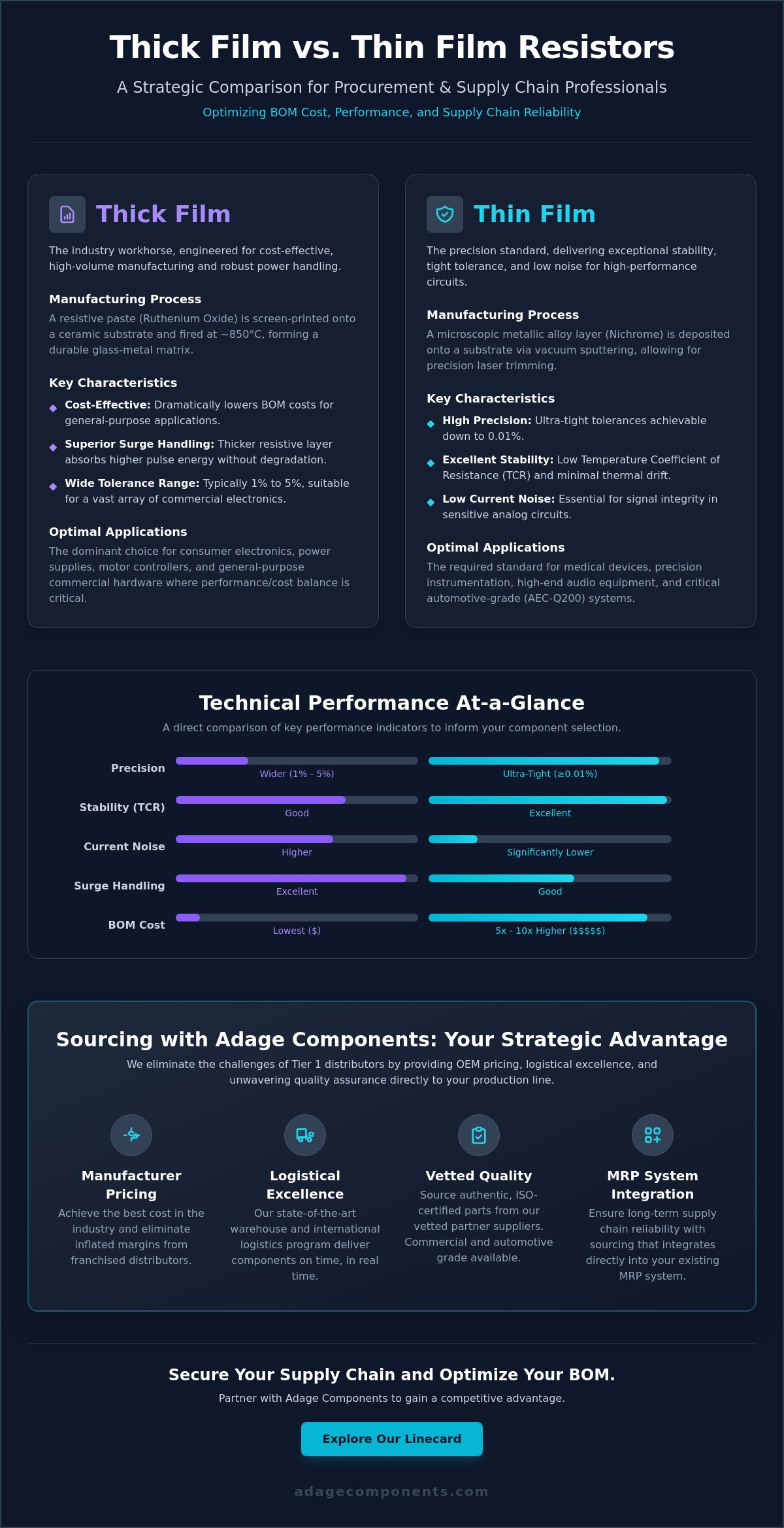
The core of any thick film vs thin film resistor technology comparison lies in the deposition method and the resulting layer thickness. Thick film layers are typically thousands of times thicker than thin film layers. This physical difference isn't just about size. It dictates the component's tolerance, temperature coefficient, and long-term stability under load.
What is Thick Film Technology?
Thick film resistors are the workhorses of the electronics industry. Manufacturers create these by screen-printing a resistive paste, often containing ruthenium oxide, onto the ceramic base. The substrate then undergoes firing at temperatures near 850°C. This process forms a glass-metal matrix. These components offer excellent power handling and are highly cost-effective for general-purpose applications. While they generally have wider tolerances (1% to 5%), they remain the dominant choice for consumer electronics because they balance performance with significant cost savings.
What is Thin Film Technology?
Thin film resistors prioritize precision. The manufacturing involves a vacuum deposition process known as sputtering. This method places a microscopic layer of metallic alloy, usually Nichrome (Nickel-Chromium), onto the substrate. Because the layer is so thin and uniform, we can use laser trimming to achieve ultra-tight tolerances as low as 0.01%. This precision makes thin film the standard for medical devices, high-end audio, and precision instrumentation. While the manufacturing process is more complex, the stability it provides is essential for high-performance circuits.
Technical Performance Comparison: Precision, TCR, and Stability
A rigorous thick film vs thin film resistor technology comparison must move beyond manufacturing methods to evaluate how these components behave under operational stress. For procurement officers, understanding these metrics is the difference between a reliable assembly and a costly field failure. While thick film resistors are the standard for general-purpose applications, their performance limits are reached quickly in high-precision environments.
Thin film resistors excel in signal integrity because they exhibit significantly lower current noise. This makes them indispensable for sensitive audio paths and medical instrumentation where signal clarity is non-negotiable. Conversely, thick film technology takes the lead in surge handling. The thicker resistive layer can absorb higher pulse energies without degrading; this makes it the preferred choice for power supplies and motor controllers. Adage Components maintains a deep inventory of both, ensuring your BOM is optimized for both cost and capability.
The Impact of TCR on Circuit Reliability
The Temperature Coefficient of Resistance (TCR) measures how much a resistor's value changes as the operating temperature fluctuates. In outdoor telecommunications or automotive engine control units, thermal drift can compromise system accuracy. Thin film resistors typically offer a TCR between 5ppm/°C and 25ppm/°C. Thick film alternatives often exceed 100ppm/°C. When your design operates across a wide temperature range, a high TCR can cause the resistance value to drift outside of the circuit's functional window. We ensure all our automotive grade components meet rigorous thermal standards, providing the stability required for mission-critical hardware. You can review our full range of high-stability options in our comprehensive linecard.
Tolerance and Precision Engineering
Tolerance defines the maximum deviation from the nominal resistance value. Thin film technology achieves tolerances as tight as 0.01% through precise laser trimming. Thick film usually stays within the 1% to 5% range. For many commercial applications, a 1% tolerance is more than sufficient and offers a better cost-to-performance ratio. However, measurement equipment and precision sensors require a tighter error budget. Over-specifying a 0.1% resistor when a 1% part suffices leads to inflated BOM costs. We help procurement teams perform a detailed cost analysis to determine where precision is mandatory and where thick film can save budget. Our state-of-the-art warehouse facilitates rapid delivery of these authentic components, helping you integrate high-precision parts into your MRP system without the typical lead times of Tier 1 distributors.
Manufacturing Processes and Material Science
The material science behind a thick film vs thin film resistor technology comparison begins with the substrate foundation. Both technologies rely on high-purity Alumina (Al2O3) ceramic to provide mechanical strength and electrical insulation. However, the resistive materials applied to this base differ significantly. Thick film resistors utilize a paste composed of ruthenium oxide and glass frit. In contrast, thin film resistors use metallic alloys, typically nickel-chromium. We ensure every component we source uses these high-grade materials to guarantee long-term reliability in your MRP system.
Sputtering vs. Screen Printing
The manufacturing workflow directly dictates lead times and OEM pricing. Thick film production uses a screen-printing process where the resistive paste is applied through a mesh and fired at high temperatures. This method is optimized for massive throughput, allowing us to offer the best cost in the industry for high-volume commercial orders. It's the standard for cost-sensitive projects that don't require extreme precision.
Thin film production is more complex. It requires a vacuum deposition cycle known as sputtering. In this state-of-the-art process, ions strike a target material, causing atoms to eject and settle onto the ceramic substrate in a uniform, microscopic layer. While this provides superior precision, the process is slower. Adage Components mitigates this by maintaining a strategic inventory in our state-of-the-art warehouse, providing short lead times that franchised distributors often can't match.
Ensuring Component Authenticity
In a volatile global market, the risk of counterfeit parts is a constant threat to your supply chain. A technical thick film vs thin film resistor technology comparison is meaningless if the parts aren't authentic. We don't just act as a vendor; we're a strategic partner that conducts rigorous manufacturing audits. Every component in our catalog comes from vetted manufacturers and partner suppliers who maintain full compliance with all ISO certifications.
We protect the resistive element from moisture and mechanical damage using multi-stage environmental protection, including glass passivation and specialized epoxy coatings. This meticulous attention to detail ensures that whether you're sourcing commercial or automotive grade components, they'll arrive at your facility in real time, on time. By bypassing the traditional markups of Tier 1 distributors, we provide the same quality standards at manufacturer pricing. You can access these high-standard parts through our comprehensive linecard.
Strategic Selection Guide: Which Technology Fits Your BOM?
Choosing between technologies isn't just a technical exercise; it's a strategic procurement decision. A comprehensive thick film vs thin film resistor technology comparison reveals that while thin film offers superior precision, thick film remains the standard for cost-effective, high-volume production. We help you navigate these choices to ensure your MRP system remains balanced between performance and profitability. Our role as a strategic problem solver is to provide the data required to optimize your component selection for both the lab and the bottom line.
Consumer electronics manufacturers typically prioritize thick film solutions for their unmatched cost-to-performance ratio. In contrast, the automotive sector requires a careful balance. Components must meet AEC-Q200 standards and maintain thermal stability in engine control units where heat cycles are frequent and intense. Industrial power applications often favor thick film's ability to manage high surge and pulse loads, as the glass-metal matrix handles energy spikes more effectively than delicate metallic alloys. For medical and aerospace projects, the zero-compromise requirement for precision makes thin film resistors the only viable option. To get a professional assessment of your current requirements, utilize our BOM submission form for a comprehensive cost analysis.
Cost-Optimization for High-Volume Manufacturing
Over-specifying components is a common cause of inflated BOM costs. Many engineers default to 0.1% tolerance thin film resistors when a 1% thick film alternative would suffice for the circuit's function. We identify these discrepancies to reduce your material costs without sacrificing reliability. Many procurement teams don't realize they are paying a premium for brand names that offer no technical advantage over our vetted manufacturer partners. Switching from Tier 1 brands to our high-quality private label alternatives allows you to capture manufacturer pricing while maintaining the same quality standards as franchised distributors. We offer volume-tiered contracts that secure your margins and protect your supply chain from the unpredictable lead times of the global market.
Application-Specific Requirements
Signal integrity at high frequencies requires the low-noise characteristics of thin film. However, harsh environments demand specific protection. For applications exposed to high humidity or sulfur, we provide resistors with specialized coatings that prevent silver sulfide formation. We ensure every part is a drop-in compatible replacement for your existing designs, facilitating a seamless transition in your supply chain. Our amazing international logistics program delivers these authentic, ISO-certified components to your facility on time, every time. You can view our full range of commercial and automotive grade components in our current linecard.
Sourcing with Adage Components: Your Strategic Partner
Finalizing your thick film vs thin film resistor technology comparison is only half the battle for a procurement professional. The real challenge lies in securing a supply chain that balances technical precision with economic reality. Adage Components acts as an elite partner for industrial procurement, offering a steady hand in a volatile global marketplace. We provide the same quality advantages as Tier 1 distributors but deliver them at manufacturer pricing. This approach allows you to maintain high standards for your assemblies while significantly reducing BOM costs.
Our state-of-the-art warehouse in Canada serves as the hub for our amazing international logistics program. We understand that in supply chain management, time is a critical resource. We don't just ship parts; we ensure they arrive at your facility in real time, on time. Our systems are built to integrate seamlessly with your existing MRP system, reducing the cognitive load on your team and ensuring lifecycle management is handled with disciplined expertise. With the global resistor market valued at USD 10.76 billion in 2026, the scale of our infrastructure ensures we can solve even the most difficult sourcing puzzles.
Our Wholesale and Private Label Capabilities
Our comprehensive linecard showcases a product range that supports both commercial and automotive grade components. Whether your project requires the rugged surge handling of thick film or the ultra-tight tolerances of thin film, we have the inventory ready for immediate operational engagement. We offer custom stocking programs designed to mitigate global supply chain risks, such as the shifting regulatory requirements of the 2026 EU AI Act. By sourcing from vetted manufacturers and partner suppliers, we guarantee that every component is authentic and compliant with all ISO certifications. This focus on reliability positions us as a superior alternative to franchised distributors who often struggle with unpredictable lead times.
Initiate Your Sourcing Strategy
Moving from a technical thick film vs thin film resistor technology comparison to a transactional inquiry is a streamlined process with our team. We provide full technical documentation and multi-stage inspection reports to establish professional credibility before a single reel leaves our facility. For organizations looking to expand their reach, our distributor affiliated program offers a strategic pathway to leverage our massive infrastructure and manufacturer pricing. We are perpetually ready to assist with your next production run. Contact our procurement specialists today to receive a definitive solution for your sourcing challenges and secure the best cost in the industry.
Optimize Your 2026 Resistor Procurement Strategy
Optimizing your electronic assemblies requires a disciplined approach to component selection. Executing a precise thick film vs thin film resistor technology comparison ensures your design meets rigorous technical specifications while maximizing your bottom line. You've seen how thin film precision supports sensitive signal paths and how thick film surge handling provides robustness for industrial power. Adage Components serves as your strategic bridge, offering ISO 9001 certified quality management and global logistics programs that Tier 1 distributors often cannot match.
We deliver authentic, vetted components at manufacturer pricing, allowing you to bypass the inflated margins of franchised distributors. Our state-of-the-art warehouse operations ensure that whether you need commercial or automotive grade parts, they reach your facility on time and in real time. This combination of speed and rigorous testing provides the stability your supply chain demands in a volatile marketplace. Request a Quote for Manufacturer-Direct Resistors and take control of your procurement strategy today. We're ready to integrate with your MRP system and solve your most complex sourcing puzzles.
Frequently Asked Questions
Is thin film always better than thick film for precision?
Thin film is technically superior for precision because it achieves tolerances as tight as 0.01% through a controlled vacuum deposition process. While thick film is generally limited to the 1% to 5% range, it remains the better choice for high-surge applications. We recommend thin film for measurement equipment but suggest thick film for power supplies where pulse handling is more critical than absolute precision.
Why is thick film technology more cost-effective for high-volume orders?
Thick film technology is more cost-effective due to its high-speed screen-printing manufacturing process. This method allows for massive throughput on standard ceramic substrates, which significantly reduces the labor and equipment time required per unit. By leveraging this manufacturing efficiency, Adage Components provides the best cost in the industry for high-volume commercial orders compared to franchised distributors.
Can I use a thick film resistor as a drop-in replacement for a thin film one?
You can only use a thick film resistor as a drop-in replacement if your circuit's error budget can accommodate a 1% to 5% tolerance and higher thermal drift. Because thick film resistors exhibit more current noise and a higher temperature coefficient, they are often unsuitable for high-frequency signal paths. We suggest a technical thick film vs thin film resistor technology comparison of your specific schematic before making any substitutions.
What are the typical lead times for private label film resistors?
Our typical lead times for private label film resistors are significantly shorter than the industry averages offered by Tier 1 distributors. By utilizing our state-of-the-art warehouse in Canada and an amazing international logistics program, we get authentic components to your facility on time. This rapid fulfillment is a core benefit of our thick film vs thin film resistor technology comparison and sourcing strategy, ensuring your MRP system remains operational.
Are Adage Components' resistors AEC-Q200 compliant for automotive use?
Yes, we provide a wide range of AEC-Q200 compliant resistors specifically designed for the rigorous demands of automotive hardware. These components undergo multi-stage stress testing to ensure reliability in harsh environments, including high vibration and extreme temperature cycles. Our automotive grade resistors are sourced from vetted manufacturers, ensuring they meet the same quality standards as Tier 1 brands but at manufacturer pricing.
How does TCR affect the performance of my electronic system over time?
TCR affects performance by causing the resistance value to shift as the system's operating temperature fluctuations occur. Over time, high thermal drift in thick film resistors can lead to circuit inaccuracies or calibration errors in precision instrumentation. By selecting thin film resistors with a TCR as low as 5ppm/°C, you ensure long-term stability and consistent performance across a wide range of environmental conditions.
What is the difference between Nichrome and Ruthenium oxide in resistor construction?
The primary difference lies in the material's physical properties and the resulting precision of the resistive layer. Nichrome is a metallic alloy used in thin film sputtering to create precise, uniform microscopic layers. Ruthenium oxide is a thick film paste that, when fired, creates a glass-metal matrix. This matrix is less precise than Nichrome but provides the ruggedness needed to handle high-voltage surges effectively.
How do I submit a BOM for cost analysis to Adage Components?
You can submit your BOM for a comprehensive cost analysis directly through our website's submission form. Our procurement specialists will review your requirements to identify over-specified components and suggest cost-effective alternatives from our partner suppliers. This process helps you achieve significant cost savings while ensuring every part is authentic, ISO-certified, and compatible with your existing design and MRP system.
Disclaimer
Cross-referenced components needs to be confirmed by the client with either spec. sheet or samples or both.
Please note, we use AI to help us, information is verified to be correct but we can not guarantee 100% accuracy.


