

An aluminum electrolytic capacitor can meet its printed ripple-current rating and still run too hot in your circuit. The aluminum electrolytic capacitor ripple current rating is tied to stated test conditions, including frequency and temperature. Your circuit’s current may also be a complex waveform rather than a simple sine wave, so comparing it directly with the datasheet value can miss the actual thermal load.
If datasheet ratings don’t map neatly to real operating conditions, that concern is justified. Ripple current generates heat through the capacitor’s internal losses, so selecting a part depends on more than its headline rating. Interpret the rating in context, estimate the circuit’s RMS ripple current, and assess the resulting temperature rise.
This guide explains how to use frequency and temperature correction factors, evaluate nonsinusoidal ripple, and check whether a capacitor has adequate thermal margin. You’ll also learn how to turn those findings into clear component requirements for selection and sourcing. A disciplined assessment helps prevent a part that looks suitable on paper from becoming a reliability risk in operation.
Key Takeaways
- Interpret an aluminum electrolytic capacitor ripple current rating using the datasheet’s stated frequency, temperature, and measurement conditions.
- Compare the rating with your circuit’s waveform and RMS ripple current. The nominal value alone doesn’t establish suitability.
- Assess ripple-current heating alongside operating temperature, voltage, and lifetime requirements to evaluate thermal margin.
- Apply manufacturer-recommended corrections and derating for your actual operating conditions before finalizing a component.
- Document verified electrical requirements to support accurate sourcing of authentic components through vetted manufacturers and partner suppliers.
What Does an Aluminum Electrolytic Capacitor Ripple Current Rating Mean?
An aluminum electrolytic capacitor ripple current rating specifies the maximum alternating current the capacitor can carry under stated datasheet conditions. Ripple current matters because current flowing through the capacitor’s impedance produces internal heat, which can affect its operating temperature and service life. The rating is not a general measure of the capacitor’s overall capacity or suitability.
The rating depends on the manufacturer’s specified test conditions, including frequency and temperature. It’s distinct from capacitance, which describes the capacitor’s ability to store charge, and rated voltage, which sets its voltage limit. Average load current is a separate circuit quantity. At steady state, the capacitor mainly carries changing current associated with ripple and transients, rather than the load’s average current.
For a visual explanation of measuring capacitor ripple current with an oscilloscope, see this tutorial:
What the ripple-current rating tells an engineer
The rating is a manufacturer-stated limit tied to defined operating conditions, not a universal current threshold. A higher-rated part isn’t automatically a better fit: the design must also satisfy capacitance, rated voltage, temperature limits, and other application requirements. For a broader overview of aluminum electrolytic capacitors, including ESR and internal heat generation, see the linked reference.
Ripple current, ripple voltage, and capacitor heating
Ripple current is the alternating current flowing through the capacitor. Ripple voltage is the resulting variation in voltage across it. Their relationship depends on the capacitor’s impedance, which varies with frequency and includes equivalent series resistance (ESR). ESR contributes to internal power dissipation as current passes through the capacitor.
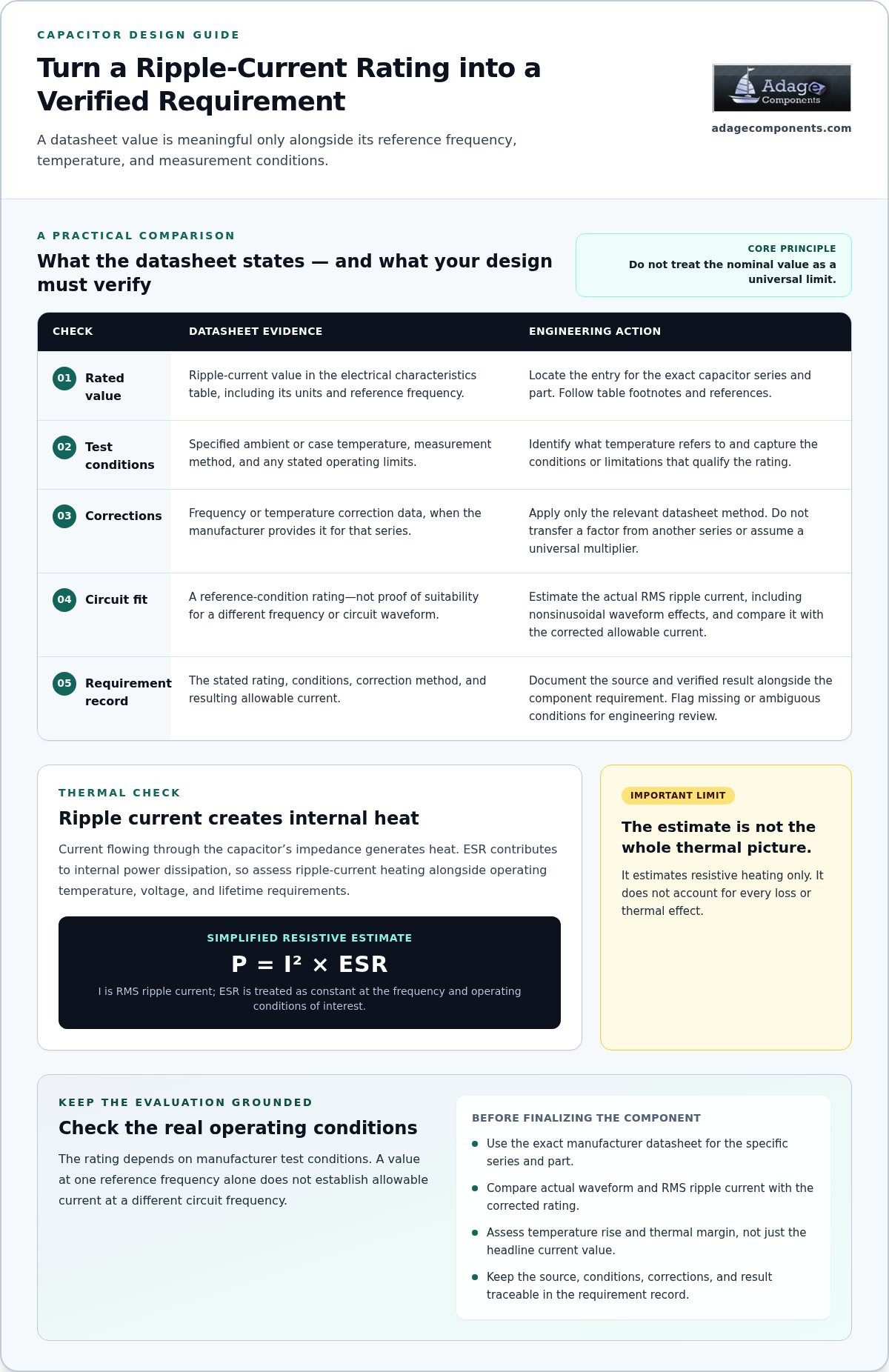
For a simplified resistive estimate, use P = I² × ESR, where I is the RMS ripple current and ESR is treated as constant at the frequency and operating conditions of interest. This estimates resistive heating only; it doesn’t account for every loss or thermal effect. The practical takeaway is to judge the rating alongside actual operating conditions, not as an isolated datasheet number.
How to Read the Ripple-Current Rating in an Aluminum Electrolytic Capacitor Datasheet
A ripple-current value is useful only when you know the conditions under which the manufacturer specifies it. A ripple-current rating is meaningful only alongside its stated frequency, temperature, and measurement conditions. Use the exact manufacturer datasheet for the specific capacitor series and part. Ratings and correction methods can differ across series, even within one manufacturer’s portfolio.
Use this four-step method to turn the published value into a traceable design requirement:
- Locate the rating. Find the ripple-current value in the electrical characteristics table and note its units and reference frequency.
- Identify the test conditions. Check the specified ambient or case temperature, measurement method, and any stated operating limits.
- Apply corrections. Use frequency or temperature correction data only when the relevant datasheet provides it for that series.
- Document the result. Record the source, conditions, corrections, and resulting allowable current alongside the component requirement.
Find the conditions behind the rated value
Start with the table entry, then follow its footnotes and references. A rating may apply at a specific frequency and temperature rather than across the full operating range. Check whether temperature refers to ambient air, the capacitor case, or another defined point. Capture test methods and limitations that qualify the value. These details prevent a reference rating from being treated as an unconditional circuit limit.
For example, if a datasheet states ripple current at one reference frequency, that value alone doesn’t establish the allowable current at a different circuit frequency. The reference frequency is part of the rating, not optional context.
Apply frequency and temperature corrections carefully
Some manufacturers provide frequency correction factors for particular capacitor series. Locate the applicable table or formula, confirm its conditions, and apply only the method stated in that datasheet. Don’t transfer a factor from another series or assume one universal multiplier applies to all aluminum electrolytic capacitors.
Temperature also affects how you interpret the rating. Compare the datasheet’s stated reference condition with the expected operating condition, and follow any manufacturer-provided correction guidance. If a condition is missing or ambiguous, flag it for engineering review rather than filling the gap with an assumed value. This keeps the aluminum electrolytic capacitor ripple current rating tied to documented evidence.
Once the electrical requirement is documented, use Adage Components’ component line card as a sourcing reference for aluminum electrolytic capacitors.
How to Compare Rated Ripple Current with Actual Circuit Conditions
The nominal rating alone doesn’t prove that an aluminum electrolytic capacitor is suitable for your circuit. A datasheet value applies under stated reference conditions; actual frequency, temperature, and waveform can affect both the current the capacitor carries and the heat it generates. Compare those conditions directly before treating the part as acceptable.
| Datasheet condition | Circuit condition | Check required | Evidence source |
|---|---|---|---|
| Reference frequency | Fundamental switching frequency and significant ripple components | Use the series-specific frequency guidance; account for relevant components | Manufacturer datasheet and circuit analysis |
| Specified temperature | Expected ambient, case, or local operating temperature | Compare like-for-like temperature conditions and assess thermal margin | Datasheet and thermal assessment |
| Test waveform or method | Actual current waveform and operating modes | Determine RMS current, including relevant ripple contributors | Validated simulation or measurement |
Estimate the capacitor’s RMS ripple current
First identify the operating modes and sources of ripple current, such as switching stages and load changes. Use circuit analysis or validated simulation to estimate the current through the capacitor, rather than relying on the supply’s average load current. For a nonsinusoidal waveform, calculate true RMS over a representative operating interval. If analyzing frequency components, combine their RMS contributions appropriately and account for how ESR varies with frequency.
State the assumptions behind the estimate, including operating mode and measurement interval. Don’t treat a simplified waveform or illustrative calculation as a universal design limit. Confirm that the analysis reflects the conditions the capacitor will actually experience.
Assess ESR heating and operating temperature
Use RMS current to estimate resistive heating with P ≈ IRMS2 × ESR. This is a simplified estimate. For a waveform with multiple frequency components, ESR can differ at each frequency, so a more useful approximation sums each component’s squared RMS current multiplied by ESR at that frequency. Check the relevant ESR data and follow the manufacturer’s thermal evaluation guidance.
Finally, consider where the capacitor sits in the assembly. Nearby heat sources, airflow, and enclosure conditions can affect its operating temperature. Compare the thermal assessment with the datasheet conditions and limits. This circuit-level check turns the aluminum electrolytic capacitor ripple current rating into a design decision supported by operating evidence, not a number viewed in isolation. Such thermal margins are particularly critical in high-demand power electronics; for organizations seeking to explore C&I BESS solutions, rigorous component qualification ensures energy storage infrastructure operates reliably under continuous cycle demands.
How to Select and Validate a Ripple-Current Rating for Your Design
Selecting a capacitor is a design review, not a search for the largest ripple-current number. Confirm that the part’s documented limits fit the circuit’s electrical and thermal conditions, then validate the assumptions before design release.
Use this checklist to keep the review complete:
- Waveform: Identify the ripple-current waveform and relevant operating modes.
- RMS current: Estimate the capacitor current using circuit analysis, validated simulation, or measurement.
- Frequency: Account for the operating frequency and applicable manufacturer correction guidance.
- Temperature: Evaluate expected ambient and capacitor operating temperatures, including nearby heat sources and enclosure conditions.
- Voltage: Check the applied voltage against the selected part’s rated voltage and other datasheet limits.
- Lifetime: Include the application’s service-life requirement and the manufacturer’s guidance for evaluating it.
Document selection assumptions and operating margins
Record the selected part, datasheet revision, ripple-current rating conditions, correction method, and calculation assumptions. Document the engineering margin separately from the manufacturer’s stated rating. A margin is a design choice; it doesn’t change the published rating or create a manufacturer-guaranteed performance claim. Reassess the selection if operating frequency, ambient conditions, or circuit behavior changes.
Derating should reflect the application and the manufacturer’s recommendations. Avoid applying a generic margin or correction factor without a technical basis. In demanding hardware environments—such as high-density compute platforms deployed by E-Circles LLC—maintaining rigorous thermal and electrical margins is essential to guarantee uptime under continuous processing loads. The aluminum electrolytic capacitor ripple current rating is a sound selection criterion only when the conditions behind the rating align with the design review.
Validate the selected capacitor in the application
Use simulation or measurement under representative operating conditions to verify ripple current and temperature. Check relevant operating modes and confirm that the measurement method captures the waveform the capacitor experiences. Compare the results with applicable manufacturer limits and the design’s documented voltage, thermal, and lifetime requirements. If results differ from the analysis, resolve the discrepancy before approval.
Once the requirement is qualified, Adage Components supports OEM and EMS procurement of aluminum electrolytic capacitors, connecting documented requirements with authentic components from vetted manufacturers and partner suppliers. For a passive component sourcing strategy, review our line card for available component categories.
Source Aluminum Electrolytic Capacitors Against a Verified Ripple-Current Requirement
A qualified component requirement should move from engineering review into procurement without losing the conditions that made the selection valid. Specify the aluminum electrolytic capacitor ripple current rating alongside its operating assumptions so sourcing and quality teams can identify the required component accurately.
Turn engineering criteria into a procurement-ready requirement
Document the complete electrical and application criteria, not just the nominal ripple-current value. Include:
- Capacitance and rated voltage.
- Required ripple current, including relevant frequency, temperature, and waveform conditions.
- Operating environment and lifetime requirements.
- Applicable qualification needs.
- Approved manufacturer, part identification, and engineering-approved alternatives.
List alternatives only after engineering has approved their electrical and mechanical criteria. This prevents a substitution from appearing equivalent based on capacitance or voltage alone when its ripple-current conditions differ. Use the electronic component line card to connect the completed requirement with aluminum electrolytic capacitors for sourcing.
Connect component sourcing with quality and delivery planning
Adage Components supports OEM and EMS procurement with authentic components sourced through vetted manufacturers and partner suppliers. Our technical support, manufacturing audits, and quality processes help align components with documented requirements.
We use direct procurement channels and global stocking programs to help customers manage material costs and lead times. Our international logistics coordination supports cross-border component sourcing and supply-chain planning. When sharing your requirement with procurement, include the verified part criteria and any engineering-approved alternatives so those details carry through to sourcing.
Move your verified requirement into sourcing. Review the electronic component line card for aluminum electrolytic capacitors that align with your documented ripple-current needs.
Make Your Capacitor Requirement Ready for Sourcing
A reliable selection starts with more than a headline current value. Interpret the aluminum electrolytic capacitor ripple current rating under its stated frequency and temperature conditions, then compare it with the circuit’s waveform, RMS current, and thermal demands. Validate those assumptions and document the approved part, operating limits, and acceptable alternatives before procurement.
Clear specifications help engineering and procurement stay aligned. Adage Components supplies aluminum electrolytic capacitors and supports OEM and EMS procurement with authentic components sourced through vetted manufacturers and partner suppliers. Direct procurement and global stocking programs help businesses manage component costs and lead times.
Turn your verified electrical requirements into a sourcing-ready specification. Review the electronic component line card to explore aluminum electrolytic capacitors for your requirements.
Frequently Asked Questions
What is the ripple-current rating of an aluminum electrolytic capacitor?
The ripple-current rating is the maximum alternating current a capacitor can carry under the manufacturer’s stated conditions. Those conditions may include frequency, temperature, and a defined measurement method. The aluminum electrolytic capacitor ripple current rating is not a universal limit for every circuit. Compare its reference conditions with the component’s actual operating environment and follow any series-specific correction guidance in the datasheet.
How do you calculate ripple current in a capacitor?
Calculate the RMS current flowing through the capacitor over a representative operating interval. For a sampled waveform, square each current sample, average the squares, then take the square root. Include relevant switching ripple and operating modes, using circuit analysis, validated simulation, or measurement. Don’t substitute average load current for capacitor ripple current. Document waveform assumptions and compare the result with the datasheet rating under applicable conditions.
Does ripple-current rating depend on frequency?
Yes. Manufacturers may specify a rating at a reference frequency and provide frequency correction data for a particular capacitor series. ESR also varies with frequency, affecting internal losses. Check the exact datasheet for the selected part and apply only its stated correction method. A rating at one frequency doesn’t automatically establish suitability at another, especially when the circuit waveform contains significant components beyond its fundamental switching frequency.
How does ESR affect aluminum electrolytic capacitor ripple current?
Equivalent series resistance (ESR) contributes to heat as ripple current flows through the capacitor. A simplified estimate is P = IRMS2 × ESR, with ESR evaluated at relevant operating conditions. For waveforms with multiple frequency components, ESR can differ across frequencies, so a single value may not fully represent losses. ESR also contributes to voltage ripple, but current and voltage ripple are separate quantities.
Can a capacitor operate above its rated ripple current?
Don’t assume it’s acceptable. Exceeding the stated ripple-current rating can increase internal heating and affect reliability or service life. Treat the datasheet limit as applicable under its specified conditions, and don’t rely on a generic overload allowance. If your calculated current exceeds the rating, review the design and component choice against the manufacturer’s guidance. Any exception must be explicitly supported by the manufacturer’s specifications for that part and condition.
How does temperature affect an aluminum electrolytic capacitor’s ripple-current rating?
Temperature is part of the conditions behind a ripple-current rating, and the datasheet may state ambient, case, or another reference temperature. Ripple-current losses add heat inside the capacitor, while nearby heat sources and enclosure conditions influence operating temperature. Compare the circuit environment with the manufacturer’s stated conditions and correction guidance. Don’t apply an assumed temperature factor; use the exact datasheet for the selected series.
Is ripple-current rating the same as ripple-voltage rating?
No. Ripple-current rating describes the allowable alternating current through the capacitor under specified conditions. Ripple voltage is the varying voltage measured across it. The two are related through the capacitor’s frequency-dependent impedance, which includes ESR, but they aren’t interchangeable ratings. Assess current against the ripple-current specification, and check voltage variation against the circuit’s voltage requirements and the manufacturer’s applicable limits.
Disclaimer
Cross-referenced components needs to be confirmed by the client with either spec. sheet or samples or both.
Please note, we use AI to help us, information is verified to be correct but we can not guarantee 100% accuracy.


