Over-specifying for Tier 1 capacitors to avoid thermal runaway isn't a safety strategy. It's a drain on your bottom line that suggests a lack of technical precision in your sourcing process. Many engineers default to the most expensive brands because they haven't fully mastered capacitor ESR and its importance in high-ripple industrial applications. This caution is understandable when you consider that the ESR of an aluminum electrolytic capacitor can increase up to three times its initial value as it ages, leading to unexplained heat and premature system failure.
At Adage Components, we understand that you need components that integrate into your MRP system without the "Tier 1" markup. You shouldn't have to choose between technical reliability and manufacturer pricing. This guide provides the framework you need to master the economic impact of Equivalent Series Resistance to optimize circuit performance and reduce BOM costs. We'll analyze ESR mechanisms across various technologies and offer a clear method for selecting commercial or automotive grade components that meet your rigorous standards. You will learn how to source from vetted manufacturers to achieve the same advantages as leading distributors at a fraction of the cost.
Key Takeaways
- Identify how internal resistance impacts real-world performance by distinguishing between ideal and practical capacitor models to prevent power dissipation.
- Mitigate thermal failure and output noise in DC-DC converters by mastering the relationship between ESR and localized heating.
- Compare MLCC, Tantalum, and Aluminum technologies to determine the optimal component for high-frequency decoupling and ripple current handling.
- Understand the technical nuances of capacitor ESR and its importance to ensure long-term system reliability across varying frequencies and temperatures.
- Optimize your procurement strategy by transitioning from Tier 1 distributors to manufacturer pricing for authentic, ISO-certified components.
What is Capacitor ESR? Understanding the Non-Ideal Component
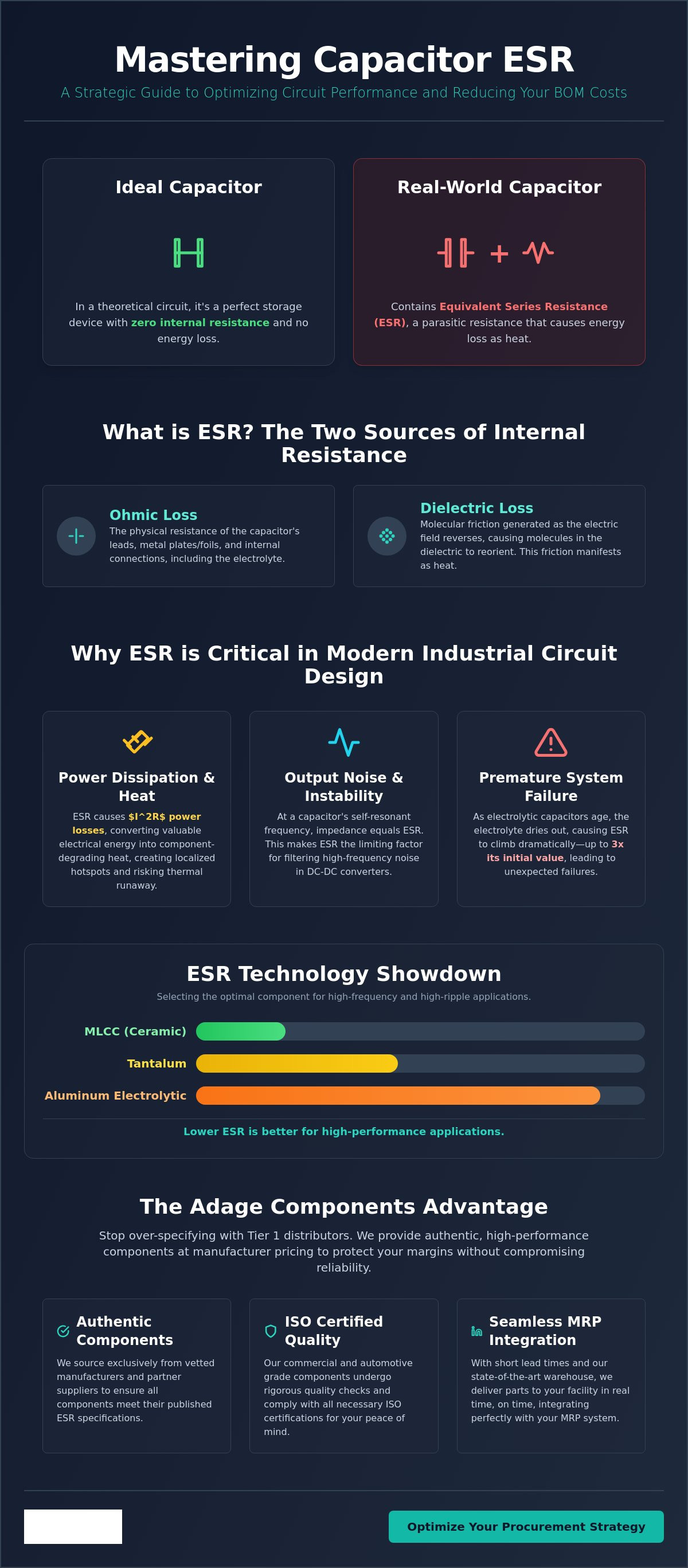
In a theoretical circuit, an ideal capacitor is a perfect storage device with zero internal resistance. It charges and discharges without energy loss. Real-world components are far more complex. Every practical capacitor possesses a specific amount of resistance in series with its capacitive element. This is known as Equivalent Series Resistance (ESR). Understanding capacitor ESR and its importance is critical for engineers who need to manage heat and signal integrity in high-performance systems. When resistance is high, the capacitor behaves less like a storage device and more like a resistor, leading to energy loss and thermal stress.
Adage Components emphasizes the need for authentic ESR ratings because "near-equivalent" parts often hide variations in internal construction. We source only from vetted manufacturers to ensure that the components you integrate into your MRP system meet their published specifications. Relying on unverified data can lead to circuit instability or catastrophic failure in the field. Our inventory of MLCCs and electrolytic capacitors undergoes rigorous quality checks to confirm that ESR values remain within tolerance for both commercial and automotive grade applications. We provide the same reliability as Tier 1 distributors but at OEM pricing that protects your margins.
The Components of ESR: Dielectric and Ohmic Losses
ESR isn't a single physical point of resistance; it's the sum of several internal factors that impede current flow. These losses generally fall into two categories:
- Ohmic Loss: This is the physical resistance of the leads, the metal plates or foils, and the internal connections. In aluminum electrolytic capacitors, the conductivity of the liquid electrolyte plays a massive role in this value.
- Dielectric Loss: This occurs at the molecular level. As the electric field reverses, the molecules within the dielectric material must reorient themselves. This molecular friction generates heat, which manifests as resistance.
As capacitors age, especially electrolytic types, the electrolyte can dry out. This increases the ohmic resistance and causes the ESR to climb. It's a primary reason why we prioritize lifecycle management and sourcing from partner suppliers who guarantee fresh, high-quality stock.
ESR vs. Impedance: Clearing the Confusion
It's common to confuse ESR with total impedance (Z), but they aren't the same. Impedance is the total opposition to AC current and is calculated using the formula: $Z = \sqrt{ESR^2 + (X_L - X_C)^2}$. While reactance changes with frequency, ESR remains a significant factor across the spectrum. At the self-resonant frequency (SRF), the inductive and capacitive reactances cancel each other out. At this specific point, the total impedance of the capacitor is equal to its ESR. This makes ESR the limiting factor for how well a capacitor can filter noise or bypass high-frequency signals. ESR acts as a parasitic barrier that converts potential electrical energy into wasted thermal energy, directly reducing the overall efficiency of power delivery within a circuit.
Why ESR is Critical in Modern Industrial Circuit Design
Ignoring capacitor ESR and its importance often results in more than just minor signal noise. It leads to systemic hardware failure and inflated maintenance cycles. In modern industrial circuits, every milliohm of resistance contributes to $I^2R$ losses. This energy doesn't just vanish; it converts into heat. For high-power applications like DC-DC converters, this heat creates localized hotspots that degrade surrounding components. By focusing on precision ESR specifications, you can optimize thermal management and significantly extend the Mean Time Between Failures (MTBF) of your equipment.
Strategic sourcing allows you to manage these technical requirements without the high markups associated with Tier 1 distributors. Adage Components provides manufacturer pricing on high-performance parts, ensuring you don't overpay for the low-ESR characteristics your design demands. Our state-of-the-art warehouse in Canada stocks both commercial and automotive grade components that meet rigorous ISO certifications. This allows you to maintain technical excellence while reducing your overall BOM costs. You can explore our full range of available parts through our comprehensive linecard to find the exact match for your MRP system requirements.
Ripple Current and Self-Heating
Ripple current capacity is fundamentally limited by a capacitor's ESR. When high-frequency current passes through the resistance of the capacitor, it generates internal heat. This is where the Arrhenius Law becomes a critical factor for procurement and engineering teams. A mere 10°C rise in core temperature can halve the operational life of an aluminum electrolytic capacitor. We vet our partner suppliers to ensure their components maintain stable ESR profiles even under heavy ripple loads. This reliability prevents the "unexplained" field failures that often plague low-quality sourcing streams.
Stability in Switching Power Supplies (SMPS)
Switching regulators and Low Dropout (LDO) regulators rely on the capacitor's ESR to maintain control loop stability and phase margin. If the ESR is too high, the output voltage ripple becomes excessive and interferes with sensitive downstream components. However, there is also a danger in "too low" ESR. Some older LDO designs require a specific ESR range to avoid oscillation. If you swap an electrolytic for a ceramic capacitor without verifying the circuit's requirements, you risk systemic instability. By integrating precise ESR data into your MRP system, you can ensure that your supply chain remains resilient and your designs remain stable throughout the product lifecycle.
ESR Characteristics Across Different Capacitor Technologies
Selecting the correct dielectric is a balancing act between physical volume, total capacitance, and impedance. Understanding capacitor ESR and its importance across different materials allows engineers to replace over-specified components with more cost-effective alternatives. While a Tier 1 distributor might default to a premium Tantalum solution, we often help clients identify where an MLCC or a polymer aluminum capacitor provides superior performance at a lower price point. You can consult the Adage Components linecard to find specific drop-in replacements that meet your technical requirements without the franchised distributor markup. Engineers who master capacitor ESR and its importance can design more efficient power paths while procurement teams benefit from reduced component counts.
Multilayer Ceramic Capacitors (MLCCs) and Low-ESR Performance
Multilayer Ceramic Capacitors (MLCCs) represent the gold standard for low-ESR performance. Their monolithic structure allows for resistance values in the single-digit milliohm range. This makes them indispensable for high-frequency decoupling where performance must remain stable from kHz into the GHz range. Unlike electrolytic types, MLCCs don't rely on a chemical electrolyte, which eliminates the risk of drying out over time. Their parasitic inductance is also minimal, which is why they dominate in high-speed digital filtering. We maintain a significant inventory of both commercial and automotive grade MLCCs in our state-of-the-art warehouse. These parts are sourced from vetted manufacturers to ensure they survive the high-vibration and high-temperature environments typical of industrial applications. Our international logistics program ensures these critical parts reach your facility on time, every time, supporting your real-time production needs.
Tantalum vs. Aluminum Electrolytic: The ESR Debate
Tantalum capacitors are prized for their volumetric efficiency and stable ESR across wide temperature ranges. However, they are notoriously sensitive to surge currents and can fail catastrophically if not properly derated. In contrast, standard aluminum electrolytic capacitors offer high capacitance at a low cost but suffer from high ESR that increases as the liquid electrolyte dries. When reviewing your BOM, consider that Tantalum ESR is relatively flat across temperature, while aluminum ESR can spike in cold-weather applications. This temperature coefficient is a major factor in industrial sensor reliability.
Polymer technology has bridged this gap. Conductive polymer aluminum solid electrolytic capacitors offer significantly lower ESR than their liquid counterparts and maintain stability better than Tantalum in high-ripple environments. We recommend using a BOM cost analysis to identify where Tantalum is over-specified in your design. Often, a polymer aluminum or high-capacitance MLCC can deliver the same reliability at a much better cost. Integrating these alternatives into your MRP system ensures long-term availability and logistical excellence while maintaining compliance with all ISO certifications.
Measuring and Managing ESR for Long-Term Reliability
ESR values are not fixed constants. They are snapshots taken under specific laboratory conditions. Understanding capacitor ESR and its importance requires looking beyond a single datasheet number to see how the component performs across its entire operational lifecycle. At Adage Components, we ensure that every part in our state-of-the-art warehouse meets authentic performance metrics through rigorous manufacturing audits. We don't just act as a distributor. We are a strategic partner that vets manufacturers to guarantee that your commercial and automotive grade components survive the most demanding thermal cycles without the high markups of Tier 1 distributors.
Standard Measurement Frequencies for Data Sheets
Most datasheets provide ESR at either 120Hz or 100kHz. While 120Hz is relevant for bulk filtering in mains power, 100kHz has become the industry standard for modern switching applications. As frequency increases, the capacitive reactance drops, and the ESR eventually dominates the impedance. It's vital to interpret these plots carefully. A capacitor with low ESR at 120Hz might have a parasitic profile that makes it useless at 1MHz. For peak system performance, ESR should be measured under actual circuit operating conditions to account for the specific harmonics of your switching frequency. Our team provides the technical support needed to ensure your MRP system reflects the correct specifications for your application.
The Impact of Temperature on ESR Stability
Temperature is the most aggressive variable in ESR management. In aluminum electrolytic capacitors, the electrolyte's viscosity increases as it cools. This causes a "Cold Start" problem where high ESR prevents the power supply from regulating correctly at startup. This is why automotive-grade components require much tighter ESR tolerances across the -40°C to +125°C range. We manage this risk through an amazing international logistics program. This ensures all components are stored in climate-controlled environments before they reach your facility in real time, on time. Our commitment to ISO certifications means you receive authentic parts that maintain stability in the field.
As components age, ESR naturally climbs. In electrolytic caps, this is due to the gradual evaporation of the electrolyte. In ceramic caps, mechanical stress can cause micro-fractures that increase resistance over thousands of hours of operation. Our BOM cost analysis helps you identify where high-reliability parts are needed to prevent field failures. By sourcing directly through us, you gain access to manufacturer pricing and OEM pricing that rivals franchised distributors. We bridge the gap between a fragmented marketplace and your specific production needs. Review our complete linecard of low-ESR capacitors to secure reliable parts for your next production run.
Strategic Sourcing: Balancing ESR Performance and BOM Costs
Strategic sourcing is the final piece of the puzzle. While engineering defines the technical requirements, procurement must execute a strategy that secures these parts without eroding project margins. Mastering capacitor ESR and its importance allows your team to move beyond the high-overhead model of Tier 1 distributors. Adage Components provides a direct path to manufacturer pricing, offering the same technical advantages for commercial and automotive grade components at a fraction of the traditional cost. We act as your elite partner, solving sourcing puzzles by leveraging our massive infrastructure and global network of vetted manufacturers.
Our approach removes the friction from the procurement process. By focusing on technical specifications rather than brand-name premiums, we help you maintain circuit reliability while significantly lowering your total cost of ownership. We understand that in a volatile global market, you need a steady and meticulous partner. Our state-of-the-art warehouse in Canada serves as a hub for quality assurance, where we retain the meticulous attention to detail necessary to inspect individual components for authenticity. This disciplined expertise ensures that your supply chain remains resilient against both technical failures and market fluctuations.
Bypassing Tier 1 Markups Without Quality Loss
Many professionals mistakenly believe that a premium brand name is the only guarantee of low ESR. This assumption often leads to over-specifying and unnecessary BOM inflation. In standard MLCCs and resistors, the physical performance is dictated by material science and ISO-certified manufacturing processes, not marketing budgets. We bridge the gap between high-quality partner suppliers and your production floor. By utilizing our BOM cost analysis, you can identify specific areas where private label manufacturing for high-volume capacitors can replace expensive franchised distributor stock. Every batch we source undergoes a multi-stage inspection process to ensure 100% authenticity and compliance with your technical requirements.
Seamless Integration with Your MRP System
Efficiency in the supply chain is just as critical as efficiency in the circuit. Our amazing international logistics program is designed to integrate seamlessly with your existing MRP system, providing short lead times and just-in-time delivery. We maintain rigorous compliance with all ISO certifications to ensure every component meets industry-standard quality audits. We don't just ship parts; we provide a reliable bridge to a stable global supply. Our infrastructure allows us to get products to your facility in real time, on time, regardless of market volatility. Contact Adage Components today to initiate a strategic sourcing partnership and secure the best cost in the industry for your low-ESR requirements.
Optimize Your Supply Chain for Precision and Profit
Mastering capacitor ESR and its importance allows your engineering and procurement teams to move beyond the high-overhead model of Tier 1 distributors. You've seen how precise ESR management prevents thermal failure and stabilizes power delivery in industrial circuits. By transitioning to a model that prioritizes technical specifications over brand-name premiums, you can secure manufacturer pricing without sacrificing reliability. Adage Components acts as your steady partner in a volatile market, providing access to our state-of-the-art warehouse and vetted manufacturer network.
Our ISO-certified quality management system ensures that every component is authentic and ready for immediate operational engagement. We pair this technical rigor with an amazing international logistics program to deliver parts to your facility in real time, on time. It's time to integrate these efficiencies into your MRP system and reduce your total BOM costs. Submit your BOM for a cost-saving analysis today and experience the advantages of a direct manufacturing partnership. We are ready to solve your most difficult sourcing puzzles.
Frequently Asked Questions
What is the main difference between ESR and resistance?
ESR is the sum of all internal resistive losses in an AC circuit, while standard resistance typically refers to the DC ohmic path. It includes losses from the dielectric material and the physical connections. Understanding capacitor ESR and its importance is vital because ESR generates heat under ripple current, whereas DC resistance is often negligible once a capacitor is fully charged.
Can a capacitor have too low of an ESR?
Yes, a capacitor can have an ESR that is too low for specific circuit architectures. Low Dropout (LDO) regulators often rely on the capacitor ESR to provide a "zero" in the control loop for stability. Replacing an electrolytic with a ceramic capacitor can cause high-frequency oscillation if the ESR falls below the regulator's minimum stability threshold. Engineers must verify the phase margin requirements before switching technologies.
How does frequency affect the ESR of a capacitor?
Frequency has a non-linear effect on ESR. It typically drops as frequency rises due to dielectric behavior, reaching a minimum at the self-resonant frequency. Beyond this point, parasitic inductance begins to dominate the component's total impedance. Engineers should consult frequency-response plots to ensure the part performs within the required parameters of their specific switching frequency. We provide these technical insights to help you integrate the right parts into your MRP system.
Why do aluminum electrolytic capacitors have higher ESR than ceramic ones?
Aluminum electrolytic capacitors use a liquid or polymer electrolyte that has inherently higher resistivity than the solid ceramic material in MLCCs. The physical construction of electrolytic foils and leads also adds more ohmic resistance. Adage Components sources high-performance polymer versions for clients who need the capacitance of an electrolytic with the lower ESR profile required for high-ripple environments. This allows you to maintain technical excellence while benefiting from manufacturer pricing.
Does ESR change as a capacitor ages?
ESR increases significantly as a capacitor ages, particularly in electrolytic designs. The liquid electrolyte gradually dries out over thousands of hours, which raises internal resistance and heat generation. This aging process is a primary cause of system failure in industrial power supplies. We recommend sourcing authentic, fresh components from vetted manufacturers to ensure your lifecycle management data remains accurate and reliable.
How can I measure ESR without a specialized meter?
You can measure ESR using a function generator and an oscilloscope by creating a voltage divider with a known resistor. By applying a high-frequency square wave and measuring the instantaneous voltage step across the capacitor, you can calculate the resistance. For high-stakes industrial applications, however, we suggest relying on our ISO-certified quality management and rigorous batch testing protocols. This ensures your components meet the exact specifications required for your production run.
Is ESR more important in AC or DC circuits?
ESR is fundamentally more important in AC and switching circuits. In pure DC applications, the capacitor acts as an open circuit once charged, so internal resistance has little effect on performance. In AC applications, such as power supply filtering, the capacitor is constantly charging and discharging. This movement of current through the ESR creates the $I^2R$ losses that lead to thermal stress, directly impacting capacitor ESR and its importance in long-term system reliability.
Disclaimer
Cross-referenced components needs to be confirmed by the client with either spec. sheet or samples or both.
Please note, we use AI to help us, information is verified to be correct but we can not guarantee 100% accuracy.