

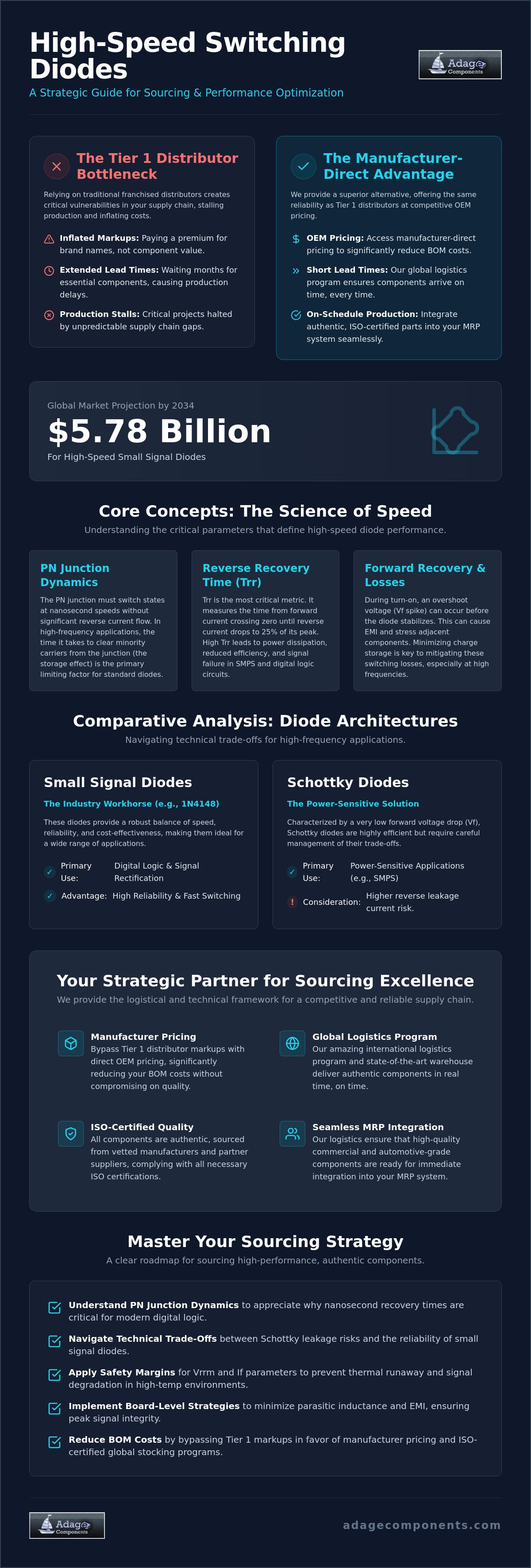
By 2034, the global market for high-speed small signal diodes is projected to reach $5.78 billion, yet many procurement teams still struggle with Tier 1 lead time bottlenecks that stall critical production. You likely agree that relying on franchised distributors often results in paying inflated markups for brand names while waiting months for essential components. This high speed switching diode selection guide provides the technical framework to break that cycle by mastering Trr vs. Vf trade-offs and identifying ISO-certified, manufacturer-direct alternatives.
We know that optimizing circuit performance requires more than just reading a datasheet; it demands a supply chain that responds in real time. This article covers how to mitigate thermal runaway in high-temp environments and maintain signal integrity despite junction capacitance challenges. You'll learn to leverage our international logistics program to secure automotive-grade parts that comply with the July 2026 RoHS updates. We'll preview the strategies needed to integrate high-quality switching diodes into your MRP system at OEM pricing, ensuring your BOM remains competitive and your production stays on schedule. By the end of this guide, you will have a clear roadmap for sourcing authentic, high-performance components that meet rigorous industrial standards.
Key Takeaways
- Learn how PN junction dynamics influence high-frequency rectification and why nanosecond recovery times are critical for modern digital logic.
- Utilize this high speed switching diode selection guide to navigate technical trade-offs between Schottky leakage risks and the reliability of small signal workhorses.
- Master the application of safety margins for Vrrm and If parameters to prevent thermal runaway and signal degradation in high-ambient temperature environments.
- Identify board-level implementation strategies to minimize parasitic inductance and EMI, ensuring peak signal integrity in high-frequency switching circuits.
- Discover how to reduce BOM costs by bypassing Tier 1 distributor markups in favor of manufacturer pricing and ISO-certified global stocking programs.
High-Speed Switching Diodes: Understanding the Switching Mechanism
High-speed switching diodes are specialized semiconductor devices engineered to handle rapid transitions between "on" and "off" states at nanosecond speeds. Unlike general-purpose rectifiers, these components maintain circuit integrity in high-frequency environments by minimizing the time spent in the transition region. This high speed switching diode selection guide serves as a technical baseline for engineers who require precision and procurement officers who demand cost efficiency.
The core of this technology lies in the PN junction. In high-frequency signal rectification and digital logic, the junction must switch states without allowing significant reverse current flow. A standard semiconductor diode often fails in these applications due to the storage effect. When a diode is forward-biased, minority carriers accumulate in the junction; if the voltage reverses suddenly, these carriers must be removed before the device can block current. This delay causes standard rectifiers to leak during high-speed transitions, leading to overheating and signal failure.
To better understand this concept, watch this helpful video:
Adage Components approaches this challenge by focusing on the origin of the part. Reliability starts with vetted wafer fabrication. We partner only with manufacturers that utilize advanced doping techniques to reduce carrier lifetime without compromising forward voltage. By sourcing directly from vetted partner suppliers, we provide OEM pricing and short lead times that franchised distributors often can't match. Our state-of-the-art warehouse operations ensure that these authentic components are ready for immediate integration into your MRP system.
Reverse Recovery Time (Trr) Explained
Trr is the critical metric for any high-speed application. We define Trr as the interval between the forward current zero-crossing and the point where reverse current drops to 25% of its peak. In Switch-Mode Power Supplies (SMPS), a high Trr leads to excessive power dissipation and reduced efficiency. Our switching diodes are characterized by nanosecond-level recovery. This ensures that transitions remain crisp and energy losses stay within strict 2026 engineering tolerances.
Forward Recovery and Switching Losses
While Trr is the primary focus, forward recovery also impacts system performance. During the turn-on transition, a diode may experience an overshoot voltage before settling into its steady-state forward voltage (Vf). This spike can trigger electromagnetic interference (EMI) or stress adjacent sensitive components. Adage Components offers diodes optimized for minimal charge storage to mitigate these switching losses. As frequency increases, the cumulative effect of these transitions becomes the dominant factor in thermal management. We help clients manage these trade-offs through a detailed BOM cost analysis, ensuring you get the best cost in the industry without sacrificing ISO-certified quality. This high speed switching diode selection guide aims to simplify these complex procurement decisions by prioritizing both performance and logistics.
Comparative Analysis: Diode Types for High-Frequency Applications
Selecting the correct diode architecture is a decision that impacts both signal integrity and the bottom line. This high speed switching diode selection guide focuses on three primary categories that dominate 2026 engineering standards: small signal silicon diodes, Schottky diodes, and fast recovery devices. Small signal diodes, such as 1N4148 equivalents, remain the industry workhorses for digital logic and low-current signal rectification. They provide a robust balance of speed and reliability that Tier 1 distributors often overprice. For power-sensitive applications, Schottky diodes offer a lower forward voltage (Vf), yet engineers must account for their higher leakage risks, especially in high-temperature environments.
We distinguish between commercial and automotive grade components based on environmental stress. Automotive grade parts undergo more rigorous testing to survive extreme thermal cycling and vibration. Adage Components supports both grades, ensuring your design meets ISO-certified quality standards while maintaining manufacturer pricing. Our global stocking programs eliminate lead time volatility, allowing you to source authentic components for your MRP system without the typical franchised distributor delays.
- Small Signal Switching Diodes: Ideal for low-current signal processing and high-speed logic.
- Schottky Diodes: Best for low Vf requirements, but prone to thermal runaway if leakage isn't managed.
- Fast Recovery Diodes (FRD): Necessary for high-voltage applications where speed is still a priority.
- Ultra-Fast Recovery Diodes: Optimized for minimal Trr in high-frequency power conversion.
Schottky vs. Silicon Switching Diodes
Schottky diodes are majority carrier devices. This means they don't have the reverse recovery time (Trr) delays inherent in minority carrier silicon diodes. This physics-level advantage makes them exceptionally fast for high-frequency switching. However, the trade-off is the leakage current. As ambient temperatures rise, Schottky leakage increases significantly; this can trigger thermal runaway in tightly packed enclosures. Silicon switching diodes are minority carrier devices that offer superior stability at high temperatures. When designing for industrial or automotive environments, we often recommend silicon-based alternatives where thermal stability is more critical than the absolute lowest Vf.
Drop-in Replacements for Tier 1 Standards
Procurement professionals frequently encounter lead time volatility for parts like the BAS16 or 1N4148. Adage Components acts as a strategic problem solver by identifying authentic, drop-in replacements that match these industry standards. We verify electrical parity and footprint compatibility to ensure a seamless integration into your existing MRP system. Our vetted partner suppliers provide the same performance as Tier 1 brands but at OEM pricing. This approach eliminates the distributor markups while maintaining the reliability your production schedule demands. If you're managing a complex BOM, you can Explore our linecard for switching diode alternatives to find cost-effective solutions that don't compromise on quality.
Critical Parameters for the Diode Selection Framework
Success in high-frequency circuit design depends on precise parameter alignment. This high speed switching diode selection guide moves beyond basic datasheet readings to focus on real-world reliability. We recommend a 30-50% safety margin for the Peak Repetitive Reverse Voltage (Vrrm). While some industry sources suggest a 20% buffer, modern 2026 power density requirements demand a more robust overhead to prevent catastrophic failure during voltage spikes. Adage Components ensures every diode in our state-of-the-art warehouse meets these stringent safety thresholds.
Average Forward Current (If) requires similar scrutiny. Engineers must apply derating factors when operating in high-ambient temperature environments to avoid junction overheating. Forward Voltage Drop (Vf) remains the primary driver of conduction losses. Lower Vf values reduce thermal waste, but they often come at the expense of switching speed. Finally, Junction Capacitance (Cj) is a critical factor for high-speed data lines. High Cj can distort signals and limit the bandwidth of your communication bus. We verify these technical specs across our entire line of commercial and automotive grade components.
The Trr vs. Vf Trade-off
Choosing a diode is a balancing act. Faster diodes with lower Reverse Recovery Time (Trr) typically exhibit a higher forward voltage penalty. This occurs because the doping techniques used to speed up charge removal also increase the internal resistance of the silicon. Optimizing high-efficiency power converters requires finding the exact point where switching losses and conduction losses are minimized. We provide technical support to help your engineering team identify this "sweet spot." By sourcing through Adage Components, you access manufacturer pricing on parts that are precision-engineered for these specific trade-offs.
Thermal Management and Reliability
Reliability isn't just a marketing claim; it's a calculation. We use a standard power dissipation formula: P = (Vf * If) + (Vr * Ir). This accounts for both conduction and reverse leakage losses. In high-stakes industrial procurement, preventing premature component failure is paramount. This is why Adage Components only works with vetted manufacturers. Compliance with all ISO certifications is our baseline requirement for every partner supplier. We integrate directly with your MRP system to provide authentic components that have passed multi-stage inspection processes. You don't have to choose between cost and quality. We deliver the best cost in the industry while maintaining the rigorous standards required for automotive and commercial grade applications.
High-Speed Design Implementation & Signal Integrity
High-speed switching performance depends as much on the board layout as it does on the silicon. Even the most advanced diode cannot overcome poor implementation. This high speed switching diode selection guide highlights that parasitic inductance is the primary enemy of signal integrity. Every millimeter of lead length or PCB trace adds inductance to the switching loop. This stored energy causes voltage spikes and ringing when the diode transitions from conduction to blocking. These transients create electromagnetic interference (EMI) that can disrupt sensitive analog stages or cause a failure in regulatory compliance testing.
Managing EMI requires a compact layout that minimizes the area of high-frequency current loops. Large loop areas act as antennas. We recommend using Surface Mount Device (SMD) packages to reduce lead inductance compared to through-hole alternatives. Adage Components stocks a wide variety of SMD switching diodes in our state-of-the-art warehouse. We provide authentic components with short lead times to keep your production on schedule. Thermal management for these SMD parts requires a strategic copper pour. Since these packages lack traditional heat sinks, the PCB traces act as the primary thermal path. We advise using thermal vias to connect the diode pads to internal ground planes, effectively spreading heat away from the junction.
PCB Layout Best Practices
Optimal placement is critical for maintaining Trr performance. Decoupling capacitors must be positioned as close as possible to the switching diode to provide a low-impedance path for high-frequency transients. A dedicated ground plane directly beneath the signal trace reduces the loop area and provides a return path that cancels out magnetic fields. "In high-speed switching, a millimeter of trace length can represent significant parasitic inductance that degrades Trr performance." Following these standards ensures the diode operates at its rated recovery speed without induced jitter.
Signal Integrity in Data Lines
In digital logic and high-speed interfaces like USB 4.0 or HDMI 2.1, junction capacitance (Cj) becomes the bottleneck. Ultra-low capacitance diodes are required for signal clamping and ESD protection to prevent false triggers or data corruption. These components must switch fast enough to protect the circuit without loading the signal line. Adage Components bridges the gap between technical requirements and procurement goals by offering automotive and commercial grade diodes at manufacturer pricing. You can read our strategic guide on sourcing passive components to understand how resistors and capacitors interact with your diode selection. Using this high speed switching diode selection guide as a blueprint for your layout will protect your design from signal degradation. To secure these high-performance parts for your next build at OEM pricing, view our full range of high-speed switching diodes available through our international logistics program.
Strategic Sourcing: Beyond Tier 1 Distributors
High-speed design is only effective if the components are actually on the production floor. While the previous sections of this high speed switching diode selection guide focused on technical parameters and layout, procurement strategy is what determines production uptime. Franchised distributors often impose significant markups and rigid lead times that don't align with agile manufacturing. Adage Components offers a superior alternative. We provide manufacturer pricing and OEM-level support that bypasses the traditional Tier 1 distributor model, ensuring your project remains both high-performing and cost-effective.
Our state-of-the-art warehouse operations and global stocking programs are specifically designed to eliminate lead time volatility. We understand that a stalled production line costs more than the components themselves. By integrating directly with your MRP system, we ensure just-in-time delivery for both commercial and automotive grade components. This seamless integration allows your supply chain to remain lean without risking stockouts. We bridge the gap between a fragmented marketplace and your specific facility needs, delivering authentic parts on time, every time.
Cost Optimization without Quality Compromise
Private label sourcing through Adage Components typically reduces BOM costs by 20% to 40%. These savings come from our direct relationships with vetted manufacturers, not by cutting corners on quality. Every component we source is authentic and produced by ISO-compliant partner suppliers. We conduct rigorous manufacturing audits and multi-stage inspections to ensure every batch meets 2026 engineering standards. This disciplined expertise allows us to offer the best cost in the industry while maintaining the reliability required for high-stakes industrial procurement. To see the impact on your bottom line, you can submit your BOM for a cost analysis and receive a detailed breakdown of potential savings.
Mitigating Supply Chain Risk in 2026
Relying on a single Tier 1 brand is a high-risk strategy in a volatile global market. We help you qualify drop-in replacements long before a shortage occurs. Our engineering team verifies electrical parity and footprint compatibility so your production stays active even if a primary source fails. Leveraging our amazing international logistics program allows for real-time fulfillment across the globe. We aren't just a vendor; we're a strategic problem solver that thrives on solving difficult sourcing puzzles. Our goal is to provide manufacturer pricing while maintaining the meticulous attention to detail required for high-stakes applications. For immediate assistance or a direct quote, contact Adage Components for a direct quote on high-speed switching diodes today.
Secure Your High-Frequency Production with Strategic Sourcing
Mastering the technical nuances of Trr vs. Vf and implementing rigorous PCB layout standards are essential for maintaining signal integrity in modern circuits. Engineering excellence must be paired with a robust procurement strategy to ensure production continuity. This high speed switching diode selection guide has outlined how to identify drop-in replacements that meet ISO 9001:2015 standards while bypassing the inflated markups of Tier 1 distributors. Engineering success is only as reliable as the supply chain that supports it.
Adage Components acts as your strategic partner, providing the bridge between technical precision and logistical agility. We offer significant BOM cost savings through our manufacturer pricing model and eliminate lead time volatility via our global stocking programs. Our state-of-the-art warehouse operations ensure that all commercial and automotive grade components are authentic and ready for immediate integration into your MRP system. We're committed to delivering high-quality solutions that keep your facility running in real time, on time. Our disciplined expertise ensures your designs reach the market without compromise.
Contact Adage Components for Manufacturer Pricing on Switching Diodes to optimize your 2026 supply chain. We look forward to solving your most complex sourcing puzzles together.
Frequently Asked Questions
What is the difference between a switching diode and a rectifier diode?
A switching diode is designed for high-frequency signal processing and rapid transitions, whereas a rectifier diode is optimized for power conversion at lower frequencies. Switching diodes prioritize nanosecond-level recovery times to maintain signal integrity in digital logic. Rectifiers focus on handling high forward current and voltage surges. Using a rectifier in a high-speed circuit leads to signal distortion and excessive heat dissipation.
Can a Schottky diode always replace a standard high-speed switching diode?
A Schottky diode cannot always replace a standard silicon switching diode because of its high reverse leakage current at elevated temperatures. While Schottky devices offer faster switching and lower forward voltage, they're prone to thermal runaway in high-temp environments. Silicon diodes provide better thermal stability for industrial applications where leakage is a critical risk factor. Engineering teams must evaluate the thermal environment before making this substitution.
How does temperature affect the reverse recovery time of a diode?
Reverse recovery time (Trr) generally increases as junction temperature rises in minority carrier devices. Higher temperatures slow down the recombination of minority carriers, extending the time the diode conducts in reverse. This relationship is a primary consideration in this high speed switching diode selection guide because it directly impacts switching losses and overall system efficiency in 2026 power designs. Proper derating is essential for high-ambient operations.
What is the significance of junction capacitance in high-speed switching?
Junction capacitance (Cj) limits the maximum frequency at which a diode can operate without degrading signal integrity. In high-speed data lines, high Cj acts as a low-pass filter, rounding off digital pulse edges and causing data errors. Selecting ultra-low capacitance diodes is mandatory for interfaces like USB 4.0 or HDMI 2.1 where nanosecond transitions are the standard. Reducing Cj ensures that the diode doesn't load the signal line unnecessarily.
Why should OEMs consider private label diodes over Tier 1 brands?
OEMs should choose private label diodes to secure manufacturer pricing and bypass the heavy markups of Tier 1 distributors. Adage Components offers the same technical specifications as franchised brands but at a significantly lower BOM cost. This strategy provides greater supply chain agility and eliminates the long lead times often associated with Tier 1 manufacturers. It's a professional solution for maintaining margins without sacrificing quality.
Are Adage Components diodes ISO certified and authentic?
Yes, all Adage Components diodes are authentic and sourced from partner suppliers that comply with all ISO certifications. We utilize a state-of-the-art warehouse and multi-stage inspection processes to verify component integrity. Our commitment to quality ensures that every part integrates seamlessly into your MRP system. We provide the same reliability as Tier 1 distributors through a more efficient, direct-to-manufacturer model.
How can I find a drop-in replacement for a discontinued switching diode?
You can find a drop-in replacement by matching the electrical parameters and footprint through our specialized BOM cost analysis services. We act as a strategic problem solver by identifying authentic alternatives for discontinued parts. This high speed switching diode selection guide emphasizes proactive qualification to prevent production delays. Our engineering team verifies electrical parity to ensure a seamless transition for your existing designs.
Does Adage Components support automotive-grade switching diode requirements?
Adage Components fully supports automotive-grade switching diode requirements for high-stakes EV and ADAS applications. Our automotive components are tested to survive extreme thermal cycling and vibration, matching the reliability of franchised distributors. We leverage an amazing international logistics program to deliver these certified parts to your facility in real time. We ensure every automotive part meets the rigorous standards required for safety-critical systems.
Disclaimer
Cross-referenced components needs to be confirmed by the client with either spec. sheet or samples or both.
Please note, we use AI to help us, information is verified to be correct but we can not guarantee 100% accuracy.