In a global resistor market valued at $11.10 billion, choosing the wrong component for a high-density circuit isn't just a technical oversight; it's a direct threat to your manufacturing margins. You likely recognize that balancing precision requirements with aggressive OEM pricing targets feels like a constant battle against unpredictable interference. Understanding the nuances of carbon film vs metal film resistor noise is essential when your MRP system demands both high performance and cost-efficiency. Adage Components provides the technical clarity you need to navigate these trade-offs without the high lead times typical of Tier 1 distributors.
We'll help you master these technical and economic variables to optimize your BOM for maximum reliability. This briefing provides a clear, data-driven comparison of noise types and a selection framework for both commercial and automotive-grade components. You'll gain the insights necessary to ensure your designs meet the latest AEC-Q200 Rev-E standards while leveraging manufacturer pricing to secure your bottom line. We move beyond vague marketing promises to deliver the rigorous quality and logistical excellence your supply chain requires.
Key Takeaways
- Differentiate between thermal and current noise to understand how specific resistive materials impact signal integrity in sensitive analog designs.
- Evaluate the technical trade-offs of carbon film vs metal film resistor noise to determine where cost-savings are viable and where precision is non-negotiable.
- Identify why metal film resistors are required for AEC-Q200 Rev-E compliance in high-reliability automotive systems like ADAS and engine control units.
- Optimize your BOM by identifying over-specced components and transitioning to manufacturer pricing that reduces costs without sacrificing technical standards.
- Leverage Adage Components' global logistics and state-of-the-art warehouse operations to eliminate lead time volatility and secure authentic, ISO-certified parts.
Understanding Resistor Noise: Thermal vs. Current Noise
Noise in resistive components is a complex summation of physical phenomena, not a single static value. For procurement officers and engineers, the debate over carbon film vs metal film resistor noise often centers on excess noise, which can degrade signal integrity in high-precision analog circuits. While all resistors generate a baseline of thermal interference, the choice of resistor technologies determines whether your circuit remains silent or introduces unpredictable artifacts. Adage Components bridges the gap between technical necessity and budget constraints by offering manufacturer pricing on high-stability components.
We recognize that unpredictable circuit interference leads to costly redesigns and delayed product launches. Our state-of-the-art warehouse operations support your MRP system by providing authentic, low-noise components with short lead times. By understanding the physics behind these parts, you can make informed decisions that optimize your BOM without relying on overpriced Tier 1 distributors. Our vetting process ensures every part meets the rigorous standards required for your specific application.
To better understand the practical implications of these noise types, watch this helpful technical comparison:
The Physics of Johnson-Nyquist Noise
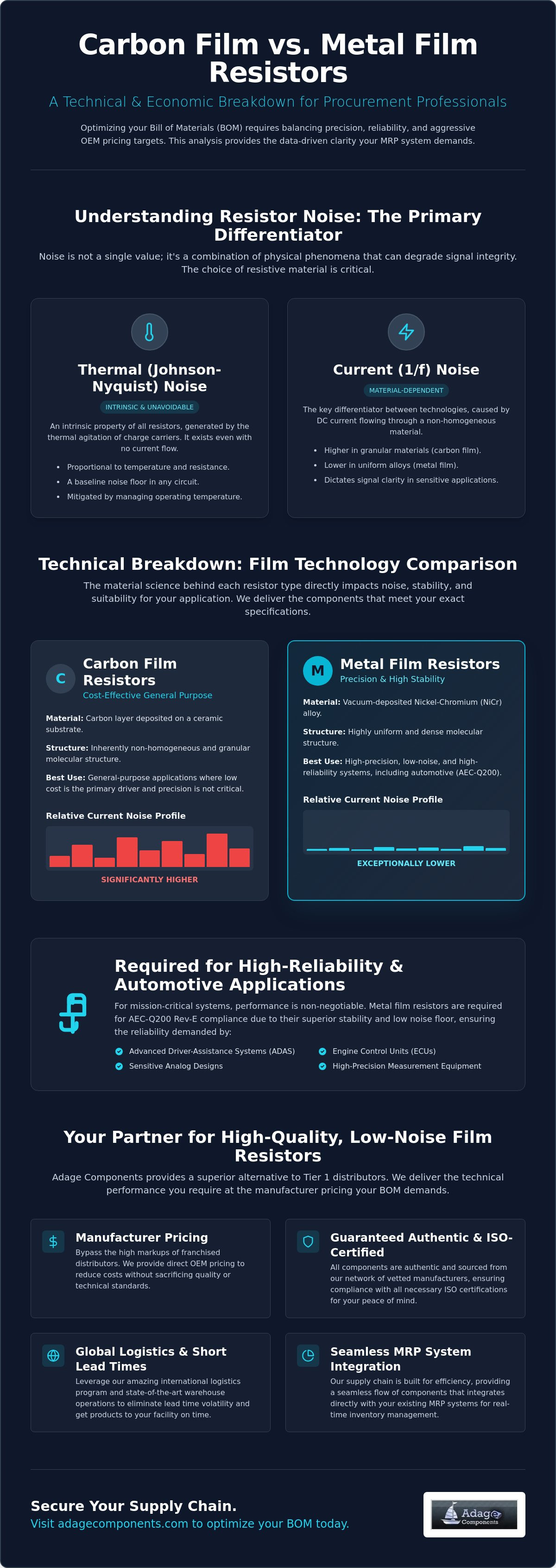
Thermal noise, often called Johnson-Nyquist noise, is an intrinsic property of all resistive elements. It exists regardless of the material used and occurs even when no current is flowing through the component. We define Johnson noise as the result of random thermal agitation of charge carriers. Because this noise is directly proportional to temperature and resistance value, high-temperature industrial environments often face elevated noise floors that can compromise accuracy in measurement equipment. This baseline noise is unavoidable; however, managing the operating temperature of your assembly can mitigate its impact on the system.
Current Noise and the 1/f Profile
Current noise, or 1/f noise, acts as the primary differentiator between film technologies. This noise occurs when DC current flows through the non-homogeneous molecular structure of a resistor. Carbon film resistors exhibit significantly higher current noise because their carbon layer is more granular and less uniform than the nickel-chromium alloys used in metal film alternatives. When you analyze carbon film vs metal film resistor noise, the structural density of the film is the deciding factor. High-value resistors are particularly susceptible to this effect because the higher resistance often correlates with a less dense conductive path. When you select components for low-signal applications, the molecular density of the resistive material dictates the excess noise levels that can either stabilize or ruin your output. Choosing metal film for these roles is a strategic decision that protects signal clarity while maintaining tight tolerances.
Carbon Film vs. Metal Film: The Technical Breakdown
Selecting the right component requires a deep dive into material science. Metal film resistors utilize a vacuum-deposited nickel-chromium alloy. This specific construction ensures superior stability and a significantly lower noise floor. Carbon film resistors use a carbon layer deposited on a ceramic substrate. While this method is cost-advantaged, it's inherently noisier due to the non-homogeneous molecular structure of the carbon. This material gap is the root of the carbon film vs metal film resistor noise debate that impacts every high-stakes procurement decision.
We provide a direct comparison of these technologies to help you optimize your MRP system requirements. The following data highlights why metal film is the preferred choice for precision while carbon remains a staple for general-purpose applications.
| Metric | Metal Film Resistors | Carbon Film Resistors |
|---|---|---|
| Noise Coefficient | Low (typically < -32 dB) | High (up to 10 µV/V) |
| Typical TCR | ±25 to ±100 ppm/°C | ±200 to ±500 ppm/°C |
| Standard Tolerance | 0.1% to 1% | 2% to 5% |
| Voltage Coefficient | Negligible | Significant |
TCR and Voltage Stability
Metal film resistors offer a Temperature Coefficient of Resistance (TCR) as low as ±25 ppm/°C. In contrast, carbon film usually sits around ±200 ppm/°C. This thermal stability is vital for preventing noise drift in high-precision measurement equipment. When temperatures fluctuate during operation, carbon film resistance changes significantly; this creates unwanted signal fluctuations. Metal film maintains integrity under thermal stress. It also features a lower voltage coefficient, ensuring that signal integrity remains intact even as voltage levels shift across the component.
Tolerance and Precision Standards
Precision is a non-negotiable requirement in modern electronics. Metal film is the industry standard for 1% and 0.1% tolerance requirements. Carbon film is better suited for cost-sensitive BOMs where a 5% tolerance is acceptable. Adage Components acts as a strategic bridge for procurement officers. We vet our partner suppliers for consistent tolerance across high-volume runs. Our state-of-the-art warehouse handles logistics in real time, ensuring you receive authentic parts that meet all ISO certifications. You can get the same advantages as Tier 1 distributors at OEM pricing. Review our comprehensive linecard to find the exact tolerance specifications for your next production cycle.
Performance in High-Precision and Automotive Applications
Automotive environments are brutal. Vibration, thermal cycling, and electromagnetic interference (EMI) demand components that won't fail under pressure. In these high-stakes applications, the distinction between carbon film vs metal film resistor noise becomes a matter of system safety. Metal film resistors are mandatory for engine control units (ECUs) and Advanced Driver Assistance Systems (ADAS) because their lower noise floor ensures sensor data remains uncorrupted. Carbon film resistors are cost-effective for cabin lighting or basic infotainment, but they lack the stability required for safety-critical systems.
Sourcing these parts through Adage Components eliminates the risks associated with Tier 1 distributors' high lead times. We provide manufacturer pricing for both commercial and automotive grade components, allowing you to navigate the cost-performance curve effectively. Our amazing international logistics program delivers authentic parts to your facility in real time, on time. We prevent the entry of counterfeit "no-name" resistors through a rigorous vetting process of all partner suppliers and vetted manufacturers. This disciplined expertise ensures your MRP system remains synchronized with your production schedule.
AEC-Q200 Compliance and Noise
The AEC-Q200 Rev-E standard, published in 2023, sets the benchmark for passive component reliability. Compliance ensures that metal film resistors maintain consistent noise floors even under extreme mechanical stress and thermal shock. At Adage Components, our multi-stage inspection processes at our state-of-the-art warehouse guarantee that every automotive-grade resistor meets these international standards. We bridge the gap between a fragmented marketplace and your specific production needs. By ensuring all ISO certifications are current, we offer the same advantages as franchised distributors at a fraction of the cost. Our commitment to integrity means you receive authentic components every time.
High-Frequency Signal Integrity
Beyond noise, parasitic inductance and capacitance are critical in high-speed digital circuits. Metal film resistors are preferred for RF applications because their construction minimizes these parasitics compared to the less uniform layers in carbon film. In sensor interface modules, switching from carbon to precision metal film can reduce signal-to-noise ratio (SNR) issues by several decibels. This technical transition stabilizes high-frequency performance. It ensures your device operates as designed without expensive post-production fixes or unpredictable circuit interference. If you're ready to secure your supply chain with high-performance components, contact us to discuss your specific technical requirements.
Strategic Sourcing: Balancing Noise Performance and BOM Costs
Procurement officers often encounter "over-specced" bills of materials where high-precision metal film resistors are utilized in non-critical signal paths. This practice inflates your production costs without providing a measurable benefit to the end product. Conversely, using carbon film in high-gain stages can introduce unpredictable circuit interference. Mastering the trade-offs in carbon film vs metal film resistor noise is a strategic necessity for maintaining both technical integrity and manufacturing margins. Adage Components acts as your strategic problem solver, helping you identify these inefficiencies to secure the best cost in the industry.
We provide a superior alternative to Tier 1 distributors by offering manufacturer pricing on a comprehensive range of film resistors. Our private label manufacturing model ensures you don't pay for the overhead of massive franchised distributors. Every component we ship is authentic, sourced from vetted manufacturers, and stored in our state-of-the-art warehouse. This disciplined approach allows you to achieve significant cost savings while maintaining compliance with all ISO certifications. We don't just sell parts; we integrate with your existing MRP system to ensure your production line never stops.
Optimizing the Bill of Materials (BOM)
Not every resistive element in your design requires a ±25 ppm/°C temperature coefficient. For general-purpose pull-up resistors or basic LED drivers, carbon film resistors offer a reliable, cost-advantaged solution. However, in critical paths like sensor feedback loops or measurement bridges, metal film is non-negotiable for noise reduction. You can submit your BOM for a cost analysis to find drop-in replacements that meet your technical standards at OEM pricing. Our team identifies where you can swap materials safely and where precision must remain the priority.
Managing Global Logistics and Lead Times
High lead times from Tier 1 distributors can derail even the most meticulously planned production schedule. The Adage Components amazing international logistics program is designed to get products to your facility in real time, on time. We maintain global stocking programs that mitigate the volatility of the electronic component market. This infrastructure allows us to act as a bridge between a fragmented marketplace and your specific facility needs. By leveraging our international scale, you gain a competitive edge over competitors who rely on traditional, slower distribution channels.
Our commitment to integrity means that rapid fulfillment never comes at the expense of quality. We pair our logistics speed with a multi-stage inspection process to verify the authenticity of every reel. This ensures that your just-in-time delivery schedule is supported by components that perform exactly as the datasheet promises. You can review our full range of commercial and automotive grade components to see how we balance high-performance noise characteristics with industry-leading pricing.
Adage Components: Your Partner for High-Quality Film Resistors
Adage Components provides a strategic advantage for procurement teams balancing performance and cost. We maintain a comprehensive linecard that includes everything from cost-effective carbon film resistors to thin film precision resistors. Understanding the technical nuances of carbon film vs metal film resistor noise is only half the battle; securing a reliable source for these parts is what prevents production delays. We deliver authentic, ISO-certified components at the best cost in the industry, positioning ourselves as the elite alternative to traditional distribution channels.
Our infrastructure is built for the high-stakes world of industrial procurement. We operate a state-of-the-art warehouse that supports rapid fulfillment for high-volume production runs. Adage Components acts as a bridge between vetted manufacturers and your specific assembly requirements. We eliminate the unpredictability of Tier 1 distributors by offering consistent availability and short lead times. This allows your team to focus on production rather than chasing down backordered reels. Our amazing international logistics program ensures that parts arrive at your facility in real time, on time, every time.
Quality Assurance and ISO Certifications
Quality is the foundation of our operations. Every component in our linecard undergoes rigorous manufacturing audits to ensure it meets our strict internal standards. We maintain compliance with all ISO certifications to establish a baseline of trust and professional credibility. Whether you require commercial or automotive grade parts, our multi-stage inspection process guarantees that you receive authentic components. You don't have to choose between speed and safety when you partner with us. Explore our full linecard of electronic components to see our complete range of resistive and capacitive solutions.
Initiating Your Strategic Sourcing Partnership
Transitioning from Tier 1 distributors to an Adage Components stocking program is a seamless process designed to integrate with your existing MRP system. We provide technical support to help your engineers find drop-in replacements for standard industry brands. Our team verifies that every replacement part matches the original footprint and performance specifications, including noise floors and thermal stability. This reduces the cognitive load on your procurement team while delivering the bottom-line benefits of manufacturer pricing. Contact our team today for a quote on high-volume resistor orders and experience a more disciplined, efficient approach to component sourcing. We are perpetually ready for immediate operational engagement to solve your most difficult sourcing puzzles.
Secure Your Supply Chain with Precision Components
Navigating the technical trade-offs of carbon film vs metal film resistor noise is a critical step in optimizing both circuit performance and manufacturing margins. You now have the framework to identify where cost-advantaged carbon film suffices and where the superior stability of metal film is non-negotiable for signal integrity. Adage Components stands ready to support your production requirements with specialized expertise in drop-in replacements for Tier 1 brands. We eliminate the friction of high lead times through our global stocking programs and real-time logistics.
Our ISO 9001:2015 certified quality management ensures that every component is authentic and reliable. We bridge the gap between a fragmented marketplace and your facility, providing manufacturer pricing that strengthens your competitive position. By integrating our state-of-the-art warehouse operations with your MRP system, we ensure your assembly line remains operational and efficient. Take the next step in securing your inventory by partnering with a specialist that values your time and bottom line.
Request a Quote for High-Volume Film Resistors
Frequently Asked Questions
Is metal film always better than carbon film for noise reduction?
Metal film is technically superior for noise reduction because its nickel-chromium alloy construction produces a significantly lower noise floor. It's the industry standard for precision measurement and high-gain stages where signal clarity is non-negotiable. Carbon film remains a viable, cost-advantaged choice for general-purpose circuits where higher noise levels don't impact the overall system performance or safety requirements.
How much noisier is a carbon film resistor compared to a metal film one?
Carbon film resistors often exhibit current noise levels up to 10 µV/V, while metal film resistors typically remain below 0.1 µV/V. This means the excess noise in carbon film can be 10 to 100 times higher depending on the applied voltage. When evaluating carbon film vs metal film resistor noise, this delta is the primary reason engineers specify metal film for sensitive analog interfaces.
Can I replace carbon film resistors with metal film in an existing design?
You can generally replace carbon film resistors with metal film as a drop-in upgrade without circuit modifications. Metal film offers tighter tolerances and superior thermal stability, which often improves the reliability of an existing assembly. Adage Components specializes in identifying these drop-in replacements for Tier 1 brands, helping you maintain technical integrity while accessing manufacturer pricing and shorter lead times.
What is the "excess noise" coefficient in resistors?
The excess noise coefficient measures the additional noise generated when DC current flows through a non-homogeneous resistive material. It's typically expressed in decibels or microvolts per volt. Metal film resistors have a negligible coefficient due to their uniform metallic structure. The granular nature of carbon film results in a much higher coefficient, which can lead to unpredictable circuit interference in high-density designs.
Do carbon film resistors "sound" different in audio circuits?
Carbon film resistors introduce a measurable hiss in high-gain audio stages that many professionals find unacceptable for modern high-fidelity equipment. While some vintage designers use them to achieve specific harmonic distortion, metal film is required for clean signal reproduction. We provide authentic, low-noise metal film resistors that ensure your audio products meet professional standards without the interference common in lower-grade components.
How does temperature affect the noise of a film resistor?
Higher temperatures increase thermal noise in all resistors, but carbon film is more susceptible to "noise drift" due to its poor thermal coefficient. Carbon film resistors typically have a TCR of ±200 ppm/°C, causing resistance to fluctuate as the assembly heats up. Metal film resistors remain stable at ±25 ppm/°C. This stability ensures your MRP system requirements for high-temperature industrial or automotive applications are met consistently.
What industries require the low-noise performance of metal film resistors?
Aerospace, medical imaging, and automotive electronics industries mandate metal film resistors for their stability and low-noise characteristics. Safety-critical systems like ADAS and engine control units must use AEC-Q200 Rev-E qualified components to prevent signal corruption. Adage Components supports these high-stakes sectors through our state-of-the-art warehouse, providing vetted manufacturers' parts that meet all necessary ISO certifications for mission-critical reliability.
How can I reduce the BOM cost of my resistor requirements?
You can reduce BOM costs by identifying over-specced resistors in non-critical signal paths and transitioning to manufacturer pricing. Moving away from Tier 1 distributors to Adage Components allows you to leverage our amazing international logistics program for significant savings. We provide a comprehensive BOM cost analysis to help you find drop-in replacements that maintain quality while hitting your aggressive OEM pricing targets.
Disclaimer
Cross-referenced components needs to be confirmed by the client with either spec. sheet or samples or both.
Please note, we use AI to help us, information is verified to be correct but we can not guarantee 100% accuracy.