

What if the biggest threat to your battery management system isn't the cell chemistry, but a single passive component currently sitting on an 18-month lead time? Most engineering teams struggle with inaccurate State of Charge (SOC) readings caused by resistor drift, only to find that the precision components they need are locked behind prohibitive Tier 1 markups. When choosing a current sense resistor for battery management, you aren't just selecting a resistance value; you're managing thermal runaway risks and complex supply chain volatility. At Adage Components, we understand that maintaining a high-performance MRP system requires both technical excellence and logistical speed.
This guide will help you master the technical and commercial criteria necessary to optimize BMS accuracy while aggressively reducing BOM costs. We'll examine why AEC-Q200 Rev E compliance is non-negotiable for automotive-grade stability and how four-terminal Kelvin designs eliminate measurement errors. You'll also discover how to leverage manufacturer pricing to bypass the excessive lead times of franchised distributors. From managing TCR to navigating international logistics, we provide the strategic framework you need to get authentic, vetted components into your facility on time.
Key Takeaways
- Understand how current sense resistors serve as the primary sensors for calculating critical State of Charge (SOC) and State of Health (SOH) metrics in a BMS.
- Identify why Temperature Coefficient of Resistance (TCR) is the most vital technical parameter when choosing a current sense resistor for battery management to ensure accuracy across thermal fluctuations.
- Evaluate how component footprints, such as 2512 and 5931, dictate thermal pad requirements and heat dissipation strategies for high-current paths.
- Discover how to bypass 26-week lead times from Tier 1 distributors by utilizing strategic sourcing partners for authentic, automotive-grade drop-in replacements.
- Learn to optimize BOM costs through direct manufacturer pricing and ISO-certified quality assurance that integrates seamlessly with your existing MRP system.
The Critical Role of Current Sense Resistors in Battery Management Systems (BMS)
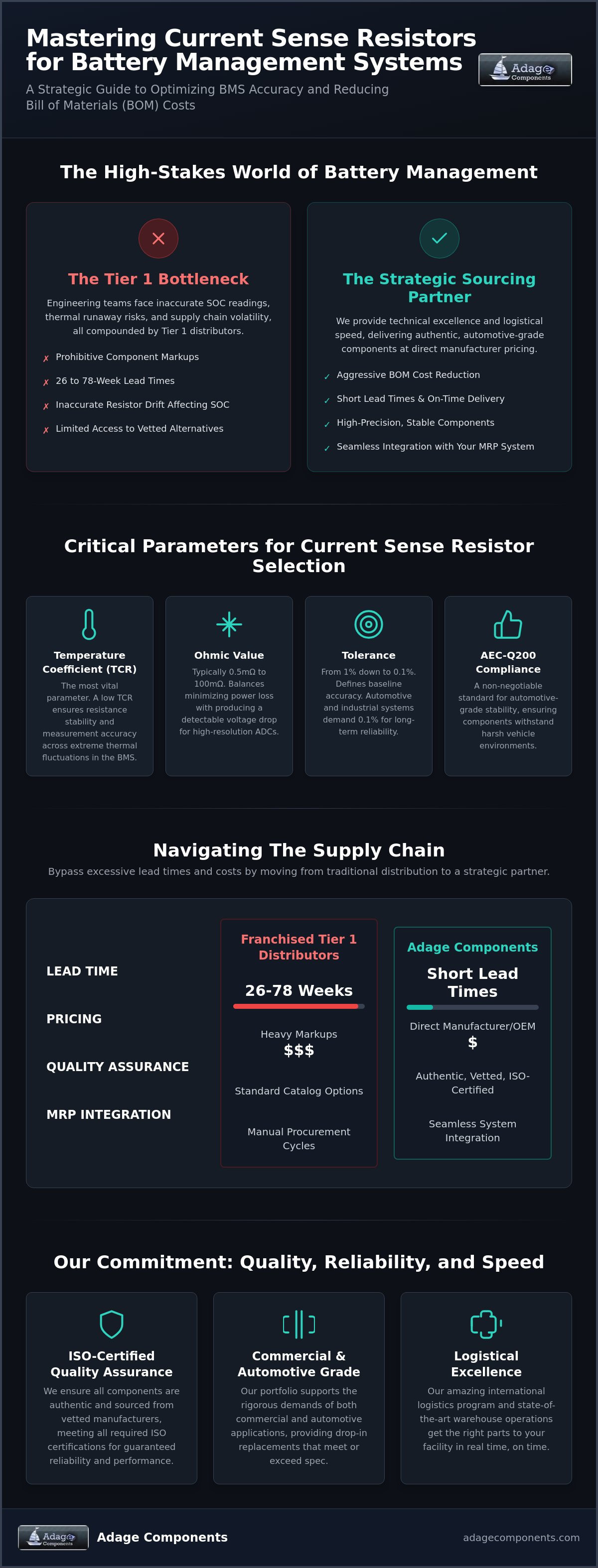
Current sense resistors (CSRs), often called shunts, function as the primary eyes and ears of a Battery Management System. They provide the raw data required to monitor energy flow across the pack. A current sense resistor is a low-value precision resistor used to measure current by monitoring voltage drop. Without this component, the BMS cannot effectively regulate charge cycles or ensure the safety of the lithium-ion cells. Adage Components provides these critical parts with the technical rigor expected of automotive-grade applications. Our components ensure your system detects overcurrent conditions in real time to prevent catastrophic failure. Foundational Current sensing techniques rely on Ohm's Law, where the known resistance allows the system to calculate current based on the measured voltage. When engineers are choosing a current sense resistor for battery management, they must prioritize stability to maintain this calculation's integrity over thousands of cycles.
To better understand the practical implementation of these shunts, watch this helpful video:
How CSRs Enable Precise SOC and SOH Monitoring
Accurate State of Charge (SOC) and State of Health (SOH) monitoring is the difference between a reliable product and a warranty nightmare. Most BMS architectures utilize Coulomb counting, a process that integrates current over time. Any minor resistor error or drift compounds during each charge and discharge cycle. This leads to ghost capacity readings or premature shutdowns. We supply resistors with ultra-low Ohmic values, often between 0.5mΩ and 100mΩ, to minimize power loss. While these low values reduce wasted energy, they require high-sensitivity ADC interfaces to resolve tiny voltage drops. This precision directly optimizes battery lifespan by preventing deep discharge and overcharging. Our linecard includes options that maintain this accuracy under the harshest conditions.
Why Standard Resistors Fail in High-Current Battery Paths
You can't simply pull a standard resistor from a generic catalog for a high-current battery path. Standard thick film resistors lack the power rating and thermal stability required for BMS shunts. They often suffer from high parasitic inductance, which distorts high-frequency current measurements during fast switching or pulse loads. We focus on specialized materials such as Manganin or Aluchrom. These alloys provide the necessary stability and low Temperature Coefficient of Resistance (TCR) that standard components lack. By sourcing through Adage Components, you receive authentic parts from vetted manufacturers that outperform the generic options found at Tier 1 distributors. Our state-of-the-art warehouse operations ensure these precision components are available with short lead times. We offer manufacturer pricing that integrates perfectly with your MRP system, providing a seamless bridge between your engineering requirements and procurement goals.
Key Technical Parameters for Choosing a Current Sense Resistor
Selection begins with the Ohmic value. For most BMS applications, this typically ranges from 0.5mΩ to 100mΩ. A lower resistance value is preferable to minimize power dissipation and heat generation, yet it must produce a voltage drop large enough for the Analog-to-Digital Converter (ADC) to detect with high resolution. Choosing a current sense resistor for battery management requires balancing this signal strength against the thermal constraints of the system. Tolerance levels, generally between 0.1% and 1%, define your baseline accuracy before any software calibration occurs. While 1% tolerance might suffice for consumer electronics, industrial and automotive systems often demand 0.1% to ensure long-term reliability and precise SOC tracking.
Power rating is another non-negotiable parameter. You must calculate for both continuous current flow and peak pulse loads. Motor start-up sequences or regenerative braking events can create massive current surges that exceed steady-state operating conditions. If the resistor cannot handle these pulses, the resistive element may degrade or fail entirely. Adage Components provides high-power current sensing resistors designed to withstand these extremes. We offer manufacturer pricing on components that meet these rigorous standards, ensuring your MRP system remains cost-effective without sacrificing safety. You can view our full range of precision options on our linecard.
Understanding TCR and Thermal EMF
Temperature Coefficient of Resistance (TCR) is often the most critical factor for accuracy in fluctuating environments. TCR defines how much the resistance value shifts as the component heats up. For high-end BMS applications, engineers should look for a TCR of less than 50ppm/°C. High-precision BMS control design also accounts for Thermal Electromotive Force (EMF). This phenomenon occurs when dissimilar metals in the resistor and PCB leads create a voltage offset due to temperature gradients. This offset can mimic actual current flow, leading to significant measurement errors at low current levels. We mitigate these risks by sourcing from vetted manufacturers that utilize advanced alloys and specialized construction techniques.
The Importance of 4-Terminal (Kelvin) Connections
Standard 2-terminal resistors often introduce unacceptable levels of error. This happens because the measurement includes the resistance of the component leads and the solder joints. In a high-current path, even a few micro-ohms of lead resistance can skew the data. 4-terminal (Kelvin) designs solve this by separating the current path from the sense path. This allows the system to perform a pure voltage measurement across the resistive element itself. Proper PCB layout is essential here; the sense traces must be kept away from high-current loops to avoid noise interference. Adage Components supports these advanced architectures with authentic, automotive-grade components at OEM pricing. We ensure your facility receives these parts in real time, on time, through our disciplined international logistics program.
Thermal Management and Physical Construction in BMS Design
Current sensing is fundamentally a thermal challenge. Every amp flowing through a shunt generates heat according to the P = I²R formula. Effective heat dissipation is mandatory to prevent component failure or accuracy degradation. When choosing a current sense resistor for battery management, engineers must select a component footprint that matches the system's thermal pad area and heat sink requirements. Common footprints like 2512, 3921, and 5931 are designed to handle varying power levels. Larger packages provide more surface area for heat transfer to the PCB. Adage Components supplies these footprints with the rigorous quality assurance required for high-stakes industrial applications.
Physical construction also dictates performance under stress. Automotive-grade requirements, such as AEC-Q200 Rev E, mandate that components survive extreme vibration, shock, and thermal cycling. This latest version of the standard, released in March 2023, ensures that passive components can withstand the rigorous environment of an electric vehicle powertrain. We ensure all our current sensing resistors meet these rigorous standards. Our state-of-the-art warehouse operations maintain strict environmental controls to protect the integrity of these authentic parts before they reach your facility.
Metal Plate vs. Thick Film Current Sensors
The choice between metal plate and thick film technologies often depends on your amperage thresholds. Metal plate resistors utilize a solid alloy element. This construction offers superior surge handling and a lower TCR for high-current shunts. They are the preferred choice for EV traction inverters and large-scale energy storage. Conversely, thick film current sensors are more cost-effective for low-power battery monitoring, such as in consumer electronics or small power tools. We help you determine when to transition from thick film to metal plate to optimize your BOM cost analysis without compromising system safety. By sourcing directly from Adage Components, you secure manufacturer pricing that avoids the standard markups found at Tier 1 distributors.
Power Rating and Derating Curves
Engineers cannot rely solely on the nominal power rating found on a datasheet. You must calculate the effective power rating based on ambient temperature and airflow within the enclosure. Derating curves are critical here. A 3W resistor might only handle 1.5W when operating in a sealed battery enclosure at 85°C. We provide detailed technical data to ensure your MRP system accounts for these physical realities. To enhance heat dissipation, we recommend the use of thermal vias placed directly under the resistor pads. This technique pulls heat into the internal copper layers of the PCB. Sourcing through Adage Components gives you access to OEM pricing on these high-performance parts, allowing you to bypass the high costs and long lead times of franchised distributors.
Strategic Sourcing: Navigating Lead Times and Tier 1 Alternatives
Tier 1 franchised distributors currently face lead times exceeding 26 weeks for precision current sensors. For high-volume automotive and industrial projects, this delay is a strategic liability. Choosing a current sense resistor for battery management is a logistical decision as much as a technical one. Adage Components acts as your strategic partner by providing drop-in replacements for industry-standard parts. We leverage direct manufacturer pricing to help OEMs reclaim margins lost to middleman markups. Our vetted manufacturing audits ensure that every private label component meets or exceeds Tier 1 specifications. We don't just act as a vendor; we function as an elite partner that solves difficult sourcing puzzles with disciplined expertise.
Mitigating Supply Chain Risks in BMS Production
Production halts due to component shortages are costly. We integrate directly with your MRP system to facilitate just-in-time delivery. Our amazing international logistics program manages global stocking to ensure your facility receives parts in real time, on time. Relying on a single franchised distributor for high-volume projects is a risk that modern supply chains can't afford. We mitigate this through safety stock programs and a diversified network of partner suppliers. This approach prevents line-down situations and keeps your production schedules on track. You can secure these supply chain advantages and stabilize your production by reviewing our current sensing resistor options.
Qualifying Private Label Components for Quality
Quality assurance is the foundation of our brand voice. All Adage components are sourced from ISO-certified facilities that undergo rigorous multi-stage inspection processes. We prioritize authenticity and traceability for every part in our state-of-the-art warehouse. While large-scale distributors offer generic service, we provide specialized technical support tailored to your specific BMS design. Our components are vetted for both commercial and automotive-grade applications. This ensures compliance with the latest industry-standard quality certifications, including AEC-Q200 Rev E. Our electronic components BOM cost analysis provides a clear roadmap for significant savings. We bridge the gap between a fragmented marketplace and your precise engineering needs with composed confidence and meticulous attention to detail.
Optimizing BOM Costs with Adage Components Current Sensing Solutions
Engineering precision is only half the battle. If your procurement strategy remains tied to the high-margin models of Tier 1 distributors, your product's market competitiveness will suffer. Adage Components offers the best cost in the industry by leveraging direct procurement and private label manufacturing. We provide a direct bridge between your technical requirements and your bottom-line goals. Choosing a current sense resistor for battery management requires a balance of engineering precision and procurement discipline. Our components are designed as drop-in replacements for Tier 1 brands such as Yageo, Vishay, and KOA Speer. This ensures that your transition to manufacturer pricing is seamless and risk-free. We maintain a state-of-the-art warehouse in Canada and an amazing international logistics program to ensure your facility receives authentic, vetted components in real time, on time.
Manufacturer Pricing for OEMs and EMS Providers
We eliminate the price inflation inherent in the traditional franchised distributor model. By working directly with a private label manufacturer, OEMs and EMS providers can stabilize material costs over long-term production cycles through volume-tiered contracts. This direct partnership allows for clear communication regarding custom specifications and lifecycle management. Our support for both commercial and automotive grade components ensures that your MRP system remains populated with parts that meet all ISO certifications. We don't just supply parts; we provide a strategic advantage that protects your margins in a volatile global market. Our short lead times and disciplined fulfillment processes mean you can maintain leaner inventory levels without risking production delays.
Submit Your BOM for a Strategic Cost Analysis
Cost optimization should be data-driven. We provide a comprehensive electronic components BOM cost analysis to identify immediate savings across your entire passive component spectrum. From thick film chip resistors and thin film precision resistors to multilayer ceramic capacitors (MLCC), we analyze every line item for cost-reduction opportunities. Our team of specialists conducts technical audits to ensure that every suggested alternative maintains the rigorous standards required for high-performance battery management systems. We invite you to submit your BOM today to initiate a strategic review of your requirements. You can also contact Adage Components directly to discuss your specific technical challenges. We are ready for immediate operational engagement to help you achieve logistical excellence and significant cost savings.
Securing Your BMS Supply Chain with Precision and Efficiency
Precision in battery management requires more than just high-performance specs; it demands a disciplined approach to procurement and thermal design. We've established that accuracy in SOC and SOH monitoring depends on low TCR values and the implementation of 4-terminal Kelvin sensing. Simultaneously, managing the physical heat generated by high-current paths necessitates a strategic choice in component footprints. When choosing a current sense resistor for battery management, you must balance these technical needs against the logistical reality of 26-week lead times from Tier 1 distributors. Adage Components acts as your steady partner by providing authentic, AEC-Q200 automotive-grade components without the middleman markups.
Our ISO-certified manufacturing partners and state-of-the-art warehouse ensure that every part is vetted for quality and ready for seamless MRP system integration. We specialize in solving sourcing puzzles by maintaining a global stocking program that gets parts to your facility in real time, on time. Don't let franchised distributor delays compromise your production schedule or inflate your BOM costs. We invite you to submit your BOM for a cost-savings analysis and technical audit. Let's optimize your system and secure your supply chain today.
Frequently Asked Questions
What is the ideal resistance value for a BMS current sense resistor?
The ideal value typically ranges from 0.5mΩ to 100mΩ for most BMS applications. You must select a value low enough to minimize power dissipation and heat generation, yet high enough to provide a detectable voltage drop for your ADC. Adage Components helps you balance these trade-offs by providing a wide range of precision Ohmic values at manufacturer pricing.
How does TCR affect the accuracy of battery State of Charge (SOC) calculations?
Temperature Coefficient of Resistance (TCR) causes the resistor's value to drift as the battery pack heats up. This drift introduces errors into Coulomb counting algorithms, leading to inaccurate SOC readings over time. When choosing a current sense resistor for battery management, selecting a part with a TCR below 50ppm/°C ensures that your system maintains high-resolution data across fluctuating thermal environments.
Can I replace a Vishay or Yageo current sense resistor with an Adage private label part?
Yes, we design our current sensing resistors as direct drop-in replacements for parts from Vishay, Yageo, and KOA Speer. This allows you to bypass the high markups of franchised distributors while maintaining the same technical specifications. Our private label model provides OEM pricing that significantly improves your bottom line without requiring a complete redesign of your existing PCB layout.
Are Adage current sense resistors AEC-Q200 compliant for automotive use?
We support a full line of automotive-grade components that comply with the latest AEC-Q200 Rev E standards. These parts undergo rigorous stress testing for vibration, shock, and thermal cycling to ensure reliability in electric vehicle powertrains. Adage Components maintains strict adherence to ISO certifications, providing the technical documentation necessary for high-stakes automotive procurement and engineering audits.
What is the advantage of a 4-terminal Kelvin connection in current sensing?
A 4-terminal Kelvin connection separates the high-current path from the voltage-sensing path to eliminate measurement errors caused by lead and solder resistance. This is critical in high-current BMS environments where even micro-ohms of parasitic resistance can skew data. Using this architecture ensures that your system measures only the voltage drop across the resistive element for maximum precision.
How does Adage Components ensure the authenticity of its resistors?
We guarantee authenticity through a rigorous multi-stage inspection process and by sourcing exclusively from vetted manufacturers and partner suppliers. Every component that enters our state-of-the-art warehouse is traceable and inspected for physical and electrical integrity. This disciplined approach to quality assurance mitigates the risk of counterfeit parts entering your supply chain, providing composed confidence for your production team.
What are the typical lead times for Adage current sense resistors compared to Tier 1 brands?
Adage Components offers significantly shorter lead times than Tier 1 distributors, who often face delays of 26 weeks or more. Our amazing international logistics program and global stocking strategies allow us to get products to your facility in real time, on time. We integrate seamlessly with your MRP system to prevent line-down situations and stabilize your production schedules despite market volatility.
How do I calculate the power rating needed for my BMS shunt resistor?
Calculate the power rating using the formula P = I²R, but you must factor in both continuous current and peak pulse loads. Choosing a current sense resistor for battery management also requires reviewing derating curves to account for high ambient temperatures inside sealed enclosures. We recommend selecting a power rating that provides a safety margin of at least 50% over your maximum calculated continuous load.
Disclaimer
Cross-referenced components needs to be confirmed by the client with either spec. sheet or samples or both.
Please note, we use AI to help us, information is verified to be correct but we can not guarantee 100% accuracy.