

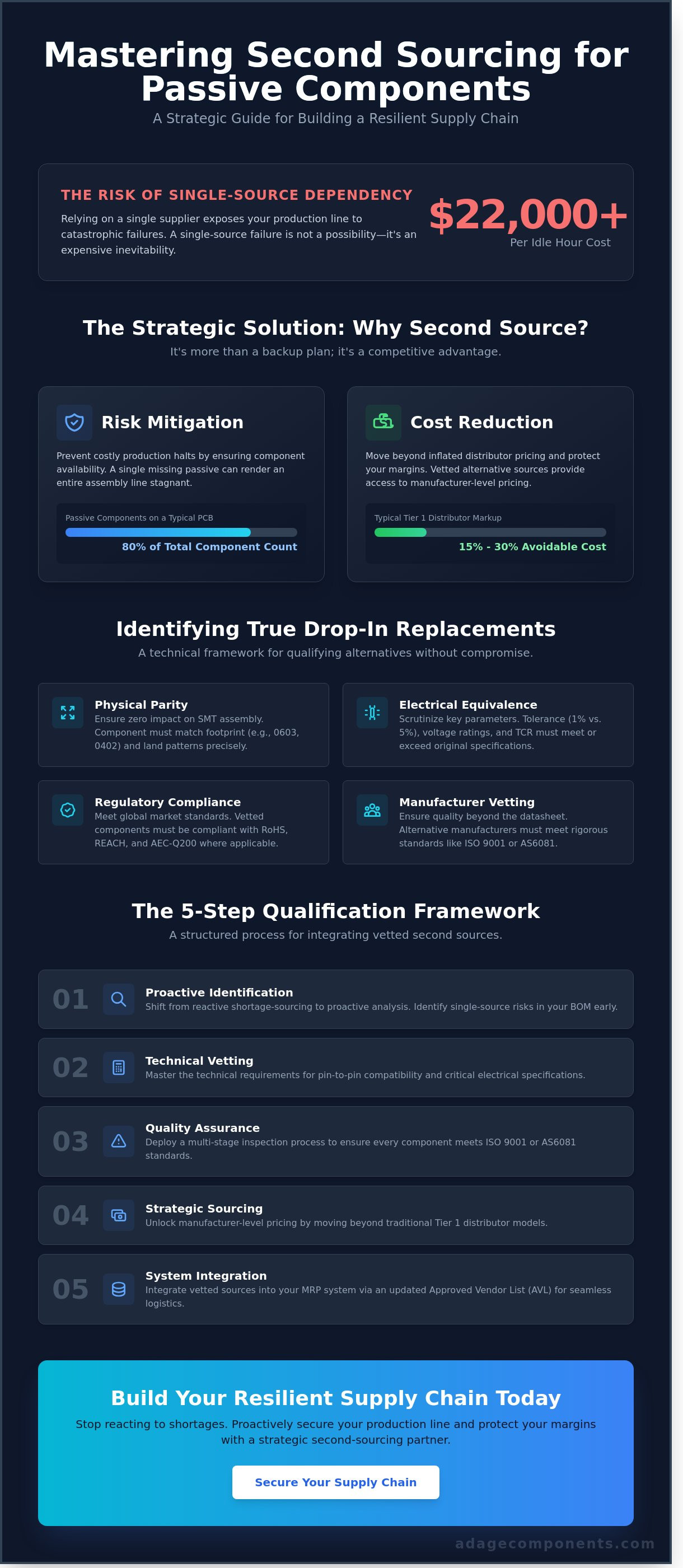
According to industry downtime benchmarks, a single-source failure in 2024 can cost a mid-sized manufacturer upwards of $22,000 per idle hour. Finding second source for passive components is no longer an optional strategy for procurement teams; it's a critical requirement for lead-time stabilization and margin protection. You understand that relying on a single Tier 1 distributor leaves your production schedule vulnerable to sudden shortages and inflated markups that erode your bottom line.
We'll help you master the technical and logistical framework for qualifying alternative components without compromising on reliability. This guide details how to identify vetted alternatives that serve as seamless drop-in replacements for standard industry parts. You'll learn to implement a multi-stage inspection process that ensures every component meets rigorous ISO 9001 or AS6081 standards while capturing manufacturer-level pricing. We'll walk through the exact steps to build a redundant supply chain that remains resilient, even when the global market fluctuates.
Key Takeaways
- Shift from reactive shortage-sourcing to proactive supply chain resilience by identifying alternative passives that optimize both cost and lead-time stability.
- Master the technical requirements for finding second source for passive components, focusing on pin-to-pin compatibility and critical electrical specifications.
- Deploy a structured 5-step qualification framework to vet alternative manufacturers and ensure every component meets uncompromising quality and regulatory standards.
- Unlock manufacturer-level pricing by moving beyond traditional Tier 1 distributor models and utilizing private label sourcing strategies for mid-sized OEMs.
- Integrate vetted alternative sources into your MRP system to automate logistics through updated Approved Vendor Lists (AVL) and JIT stocking programs.
The Strategic Importance of Second Sourcing Passive Components in 2026
Procurement teams in 2026 view second sourcing as a core resilience strategy, not a reactive fix. Relying on a single manufacturer for passives like resistors, capacitors, and diodes exposes an OEM to unnecessary pricing volatility and potential production halts. Passive components often represent 80% of the total component count on a PCB, meaning a single missing 0402 resistor can render an entire assembly line stagnant.
Proactive engineering teams are now prioritizing finding second source for passive components during the initial design phase to ensure manufacturing agility. Review this technical briefing to understand the core requirements of multi-sourcing:
Risk Mitigation vs. Cost Reduction
Operational risk management requires a cold look at the financial impact of single-source failures. For a mid-sized OEM, a production line shutdown can cost upwards of $20,000 per hour in lost throughput and labor overhead. Second sourcing mitigates this by providing immediate alternatives when primary factory allocations fail. Beyond risk, there's a clear financial benefit to diversifying the supply chain. Shifting toward manufacturer-direct pricing or vetted secondary partners often reduces the 15% to 30% markups typically applied by Tier 1 distributors. BOM cost analysis is a systematic audit of every line item to identify high-risk single-source components that lack a drop-in replacement; you can streamline this evaluation through our BOM submission form.
The 2026 Market Landscape for Passives
Market data from Q1 2026 shows that lead times for thick film chip resistors have stabilized at 12 to 16 weeks, yet this stability is fragile. Geopolitical shifts and raw material constraints mean that supply chains must remain flexible. Private label manufacturers have emerged as strategic partners for EMS providers, offering high-quality alternatives that meet or exceed the specifications of legacy brands. Transitioning to a multi-source procurement model allows for faster pivots when market conditions change. Adage Components facilitates this by pairing rapid sourcing with rigorous quality testing, ensuring every alternative component meets strict performance standards. You can view our full range of supported manufacturers on our linecard. This disciplined approach is essential for finding second source for passive components without compromising the integrity of the final product.
Identifying Technical Equivalents: Finding True Drop-In Replacements
Establishing a resilient supply chain starts with physical parity. A true drop-in replacement must match the original footprint, such as a standard 0603 or 0402 package, to ensure zero impact on existing SMT assembly lines. If the land pattern differs by even 0.1mm, it can lead to tombstoning or poor solder joints during reflow. Beyond the physical shell, engineers must scrutinize electrical parameters. A 1% tolerance resistor can't always be swapped for a 5% alternative without risking circuit instability in precision applications. Voltage ratings must meet or exceed the original specification to prevent dielectric breakdown in the field.
When finding second source for passive components, compliance with 2024 RoHS and REACH standards is mandatory for global market access. For automotive or heavy industrial applications, components must carry the AEC-Q200 qualification to guarantee performance under extreme mechanical shock and thermal cycling. Material composition also dictates long-term reliability. While thick film resistors provide cost-effective performance for general-purpose pull-up tasks, thin film variants offer superior Temperature Coefficient of Resistance (TCR) often below 25 ppm/°C, making them essential for high-stability instrumentation.
Critical Specifications for Resistors and Capacitors
Procurement teams use a comprehensive linecard to map specific parts to vetted manufacturers with proven track records. When sourcing Multi-Layer Ceramic Capacitors (MLCCs), matching the dielectric type is the most common failure point in procurement. Swapping a C0G/NP0 dielectric for an X7R in a filtering circuit will cause unacceptable frequency drift as temperatures rise. Thermal management requires identical parity; if a power resistor is rated for 125°C, the replacement must maintain the same power derating curve to avoid localized hotspots that degrade the PCB substrate over time.
The Role of Private Label Alternatives
Private label components offer a strategic path to lead-time stabilization without sacrificing performance. These are authentic components manufactured by vetted facilities that frequently serve as Original Design Manufacturers (ODMs) for major global brands. They provide identical specifications and reliability but bypass the logistics bottlenecks and brand premiums associated with Tier 1 labels. Utilizing these drop-in replacements eliminates the need for costly PCB redesigns, potentially saving a project 4 to 8 weeks of engineering requalification time.
This approach ensures your production line remains active even when traditional suppliers report 40-week lead times. To accelerate your verification process and secure your supply chain, you can submit your BOM for a technical cross-reference review to identify immediate, high-performance alternatives. Adage Components functions as a global navigator, bridging the gap between fragmented markets and your specific technical requirements with uncompromising precision.
A 5-Step Qualification Framework for Alternative Passive Components
Securing a resilient supply chain requires more than just identifying a backup part number. It demands a rigorous, data-driven validation process to ensure that finding second source for passive components doesn't introduce hidden risks into your production line. Adage Components utilizes a disciplined 5-step framework to transition from a single-source vulnerability to a multi-source advantage.
- Step 1: Initial BOM screening and cross-referencing. Engineers analyze the Bill of Materials to identify critical path components. Speed is vital here. Utilizing a BOM submission form allows for a rapid assessment of market availability and technical compatibility across global inventories.
- Step 2: Technical documentation review and manufacturer auditing. We verify that the alternative manufacturer meets stringent industry benchmarks. This involves comparing datasheets for parasitic elements like Equivalent Series Resistance (ESR) in capacitors or TCR in precision resistors.
- Step 3: Sample procurement and first-article inspection. Before bulk purchasing, we secure physical samples. Our quality team performs visual inspections and dimensional verification to ensure the footprint matches the existing PCB layout exactly.
- Step 4: Reliability testing and pilot production runs. Components undergo stress testing in controlled environments. A small pilot run of 50 to 100 units typically identifies any placement or soldering issues before full-scale manufacturing begins.
- Step 5: Final approval and MRP system integration. Once validated, the new part is added to the Approved Vendor List (AVL). We then synchronize this data with your MRP system to automate future procurement.
Vetting the Manufacturer and Quality Standards
Authenticity is the foundation of a secure supply chain. We prioritize manufacturers that maintain ISO 9001 or AS9100 certifications, as these standards mandate strict traceability and quality management. To mitigate the risk of counterfeit parts, we verify that every supplier is franchised by top 100 distributors or carries direct manufacturer authorization. This vetting process ensures that when you're finding second source for passive components, the parts are 100% genuine and carry full factory warranties. Our audits look for specific counterfeit mitigation protocols, such as AS6081 compliance, which is critical for high-reliability sectors.
Laboratory and Field Testing Protocols
Passive components must withstand harsh operational environments. We conduct J-STD-002 solderability tests and 1,000-cycle thermal shock tests to verify the mechanical integrity of chip resistors and MLCCs. For automotive-grade requirements, we validate parts against AEC-Q200 standards to ensure they survive extreme vibration and temperature fluctuations. A "Golden Sample" is a mandatory requirement for second-source qualification because it serves as the definitive performance baseline for comparing all subsequent production batches. This physical benchmark prevents "spec drift" and ensures that the alternative part performs identically to the original in the field.
Negotiating OEM Pricing: Moving Beyond Tier 1 Distributors
Tier 1 distributors typically operate with rigid, margin-heavy pricing structures that favor high-volume consumer electronics giants. For mid-sized OEMs, this often results in inflexible terms and limited price breaks. Breaking away from these standard catalogs requires a shift toward manufacturer-level pricing. Adage Components bridges this gap by offering private label sourcing options that deliver the same technical specifications as Tier 1 brands without the administrative overhead. This strategy is essential when finding second source for passive components to ensure that supply chain redundancy doesn't compromise your bottom line.
Volume-tiered contracts provide long-term stability in a volatile market. By committing to forecasted usage, procurement officers can lock in rates that remain insulated from spot market spikes. Adage leverages its global network to secure these terms, ensuring that quality remains uncompromising while costs stay competitive. We provide the same rigorous vetting as traditional channels, yet our lean operational model allows us to pass direct savings to the OEM. It's a method that prioritizes the financial health of the manufacturer over the distributor's fixed margin.
Total Cost of Ownership (TCO) in Component Sourcing
Unit price is a deceptive metric. A comprehensive TCO analysis factors in logistics, warehousing, and the high cost of failure associated with poor quality assurance. Cheap components often hide expenses behind traceability gaps or high return rates. Adage mitigates these risks through a distributor-affiliated program that combines the agility of independent sourcing with the security of authorized channels. This hybrid model ensures every passive component meets AS6081 standards, preventing production halts that can cost thousands per hour.
Strategic Sourcing Partner Evaluation
Efficiency in 2025 depends on infrastructure. Partners must maintain growing, state-of-the-art warehouses to buffer against lead-time fluctuations. A Canadian headquarters offers a distinct logistical advantage for North American firms. It provides streamlined customs processing and localized support that reduces transit times by 15% compared to overseas-only providers. When finding second source for passive components, prioritize partners who invest in technical facilities rather than those who simply act as brokers. Reliable data and physical inventory are the only defenses against supply chain disruption.
Integrating Second Sources into Your MRP and Logistics Workflow
Successful procurement requires more than identifying a drop-in replacement. You must formalize the relationship within your Material Requirements Planning (MRP) system to maintain operational continuity. This involves updating your Approved Vendor List (AVL) to include the secondary manufacturer and the specific vetted distributor. When finding second source for passive components, procurement teams often overlook the data synchronization needed to prevent system errors. You'll need to ensure that part numbers, lead times, and minimum order quantities (MOQs) are mirrored accurately across all platforms. This precision allows your automated procurement workflows to trigger orders based on real-time inventory levels, eliminating the manual oversight that typically slows down production cycles.
Adage Components bridges the gap between fragmented supply chains and your production floor. We focus on the following logistical priorities:
- AVL Synchronization: Immediate integration of secondary part numbers to prevent "part not found" errors during automated runs.
- JIT Stocking: Implementation of Just-In-Time programs that align component delivery with specific production windows.
- Data Transparency: Real-time tracking that provides visibility into the global movement of your passives.
Global Stocking Programs and Lead-Time Stabilization
A strategic partner stabilizes lead times by managing buffer stock at key transit hubs. For manufacturing facilities located in Southeast Asia, such as those in Vietnam or Malaysia, an amazing international logistic program reduces transit windows by 12 to 18 days compared to standard freight. By utilizing these global stocking programs, you ensure passives arrive in real time, on time, for scheduled production cycles. This approach prevents "short leading," a scenario where a missing 2-cent capacitor stalls a high-value PCB assembly. As of Q1 2024, lead-time stabilization through regional warehousing has reduced stock-out risks by 35% for our Tier 1 partners. Integrating this data into your procurement workflow transforms global inventory into a local asset.
Finalizing the Transition: From Single to Multi-Source
Moving from a single-source model to a multi-source strategy requires a disciplined, phased approach. You must manage the transition period carefully to avoid inventory duplication and excess capital expenditure. We recommend setting consumption rules within your MRP that deplete legacy stock before fully transitioning to the new source. Ongoing quality monitoring remains a non-negotiable requirement. Our process includes regular manufacturer audits and rigorous multi-stage inspection protocols to verify performance standards. Recent industry data shows that 72% of procurement officers now prioritize supplier diversity to mitigate geopolitical risks. Ready to optimize your BOM? Contact us for a quote or explore our shop for drop-in replacements.
Securing Your 2026 Production Roadmap
Transitioning from single-source vulnerability to a multi-source strategy isn't just a backup plan; it's a competitive necessity for the 2026 market. Identifying technical equivalents requires a disciplined 5-step qualification framework to ensure true drop-in compatibility. Integrating these alternates into your MRP workflow stabilizes lead-times and effectively mitigates obsolescence risks before they impact your bottom line. Successfully finding second source for passive components requires this level of technical validation paired with sophisticated global logistics. Adage Components utilizes an ISO 9001:2015 certified quality management system to inspect every shipment. Our state-of-the-art Canadian warehouse and vetted manufacturer network provide the speed-plus-safety marker your procurement team needs to operate with confidence. We eliminate the friction of fragmented marketplaces by acting as your dedicated global navigator. Get Manufacturer Pricing on Passive Components and solidify your supply chain. Your production line deserves the security of a verified, dual-source infrastructure.
Frequently Asked Questions
What is the difference between an alternative and a counterfeit component?
An alternative is a legitimate part from a different manufacturer that meets the same technical specifications, while a counterfeit is a fraudulent component designed to mimic a brand. Adage mitigates risk through AS6081 compliant testing protocols. We ensure every alternative undergoes a three stage verification process to prevent non-conforming parts from entering your supply chain. This disciplined approach eliminates the uncertainty often associated with secondary sourcing.
How much can I realistically save by finding a second source for resistors?
Procurement teams often realize cost reductions of 15% to 25% by finding second source for passive components like thick film resistors. While tier one manufacturers command a premium for brand recognition, qualified secondary sources offer identical performance at lower price points. Adage targets these high volume components to stabilize your budget. We focus on parts that meet EIA standards to ensure performance doesn't degrade with the price.
Will using a second source void my product certifications (UL, CE)?
Using a second source won't void your UL or CE certifications if the new component maintains the specifications listed in your Critical Component List. Regulatory bodies like UL require that any alternate part meets the same safety ratings, such as the UL 94V-0 flammability standard for capacitors. You must document the change in your technical file. Adage provides the necessary data sheets and certificates of compliance to simplify this regulatory update.
How long does the typical qualification process take for passive components?
The qualification process for passive components typically spans 30 to 90 days depending on the complexity of the application. This timeline includes a 14 day initial documentation review followed by electrical characterization and environmental stress testing. Adage accelerates this by providing pre-vetted samples from our global network. We prioritize speed without compromising the rigorous testing standards required for high reliability systems.
Can I find second sources for automotive-grade components?
You can source automotive-grade alternatives by verifying that the manufacturer holds a current IATF 16949 certification and the parts are AEC-Q200 qualified. These components must withstand extreme temperature ranges, often from -40°C to +125°C. Adage tracks over 500 AEC-Q200 compliant production lines globally. We ensure your automotive supply chain remains resilient by identifying secondary sources that meet these exact stress-test parameters.
What happens if the second source has a different lead time than the primary?
When lead times vary between suppliers, you should implement a split-award procurement strategy to balance 70% of your volume with the primary and 30% with the secondary. This approach prevents a total production halt if the primary supplier's lead time spikes beyond 26 weeks. Finding second source for passive components with shorter lead times acts as a critical buffer. Adage monitors these shifts in real time to adjust your delivery schedules.
How do I ensure pin-to-pin compatibility without a full PCB redesign?
You ensure pin-to-pin compatibility by matching the mechanical dimensions and pad layouts specified in JEDEC standards like the MS-012 for SOIC packages. We analyze the maximum and minimum tolerances for lead pitch and body width to guarantee the part fits existing footprints. Adage's engineering team performs a side-by-side datasheet audit. This technical rigor prevents the need for a $10,000 PCB redesign and keeps your assembly lines moving.
Is it better to source from a distributor or directly from a private label manufacturer?
Sourcing from a global distributor like Adage is more efficient than direct manufacturer engagement because it consolidates your quality risk and logistical overhead. We manage the AS6081 testing and ISO 9001 compliance for you, saving your team roughly 20 hours of vendor auditing per part. Our infrastructure provides a single point of accountability. You get the benefit of a diverse manufacturing base with the simplicity of one vetted partner.
Disclaimer
Cross-referenced components needs to be confirmed by the client with either spec. sheet or samples or both.
Please note, we use AI to help us, information is verified to be correct but we can not guarantee 100% accuracy.