

Over-specifying precision components is a silent killer of OEM profit margins, yet settling for loose tolerances can jeopardize your entire production run. You've likely seen how the impact of resistor tolerance on circuit performance manifests as inconsistent signal integrity or thermal instability once a design moves to mass production. We understand the pressure to balance these technical requirements with the reality of high BOM costs and the frustrating lead times typical of Tier 1 distributors. In a market where 1% tolerance resistors now often cost the same as 5% alternatives, your sourcing strategy must be as precise as your engineering.
Adage Components acts as your strategic partner to bridge the gap between rigorous technical standards and aggressive procurement goals. You'll learn how to optimize circuit performance using the latest 2026 industry standards, including the EN IEC 60115-8 updates for surface mount resistors and MIL-PRF-26 specifications. We'll explore strategic sourcing for commercial and automotive grade components that integrate directly with your MRP system. This guide details how to secure precision thin film and thick film resistors at manufacturer pricing, ensuring your facility receives authentic, ISO-certified parts on time without the traditional distributor friction.
Key Takeaways
- Analyze the impact of resistor tolerance on circuit performance by identifying how component variance compounds in critical voltage dividers and operational amplifier gain stages.
- Distinguish between AEC-Q200 automotive-grade requirements and commercial standards to ensure long-term reliability without over-paying for unnecessary specifications.
- Utilize Worst-Case Analysis (WCA) and Monte Carlo simulations to predict production yields and eliminate inconsistent circuit behavior during high-volume manufacturing.
- Lower BOM costs through strategic sourcing with Adage Components, gaining access to manufacturer pricing and ISO-certified quality without Tier 1 markups.
- Optimize your procurement lifecycle by integrating precision resistor sourcing directly into existing MRP systems for real-time logistics and shortened lead times.
Defining Resistor Tolerance: Beyond the Nominal Value
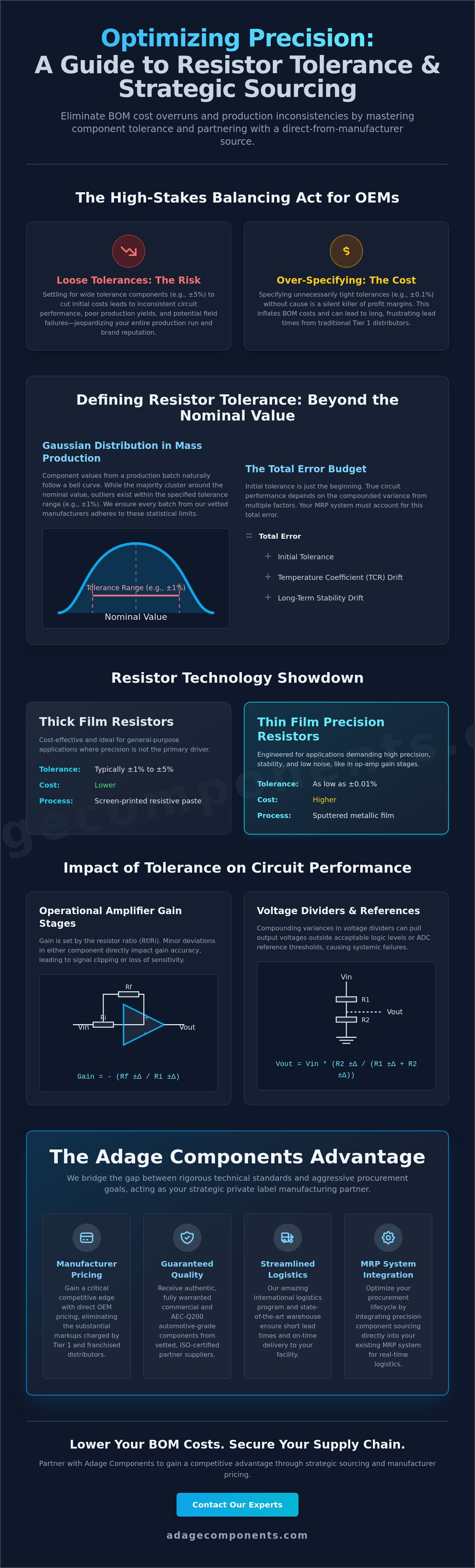
Precision in high-volume electronics manufacturing isn't a fixed state. Defining Resistor Tolerance requires looking beyond the nominal value printed on a datasheet. Tolerance represents the maximum allowable deviation from that nominal resistance, expressed as a percentage of the total value. In mass production, component values typically follow a Gaussian distribution. This means the majority of parts cluster around the target value, but outliers exist within the specified ±1%, ±5%, or ±0.1% range. The impact of resistor tolerance on circuit performance becomes critical when these deviations shift the operating point of your design. We ensure that every batch from our vetted manufacturers adheres to these statistical limits, preventing the nominal target from becoming a logistical liability.
To better understand how these values are represented and measured, watch this helpful video:
In high-stakes industrial procurement, assuming that a resistor will measure exactly its nominal value is a common error. Manufacturing audits are essential to verify that the Gaussian curve hasn't drifted, which would lead to poor production yields. Adage Components mitigates this risk by sourcing from partner suppliers who maintain rigorous quality assessment procedures, mirroring the standards set by Tier 1 distributors but at a more competitive cost structure.
The Mathematical Reality of Tolerance
Initial tolerance is only the starting point for a total error budget. You must calculate absolute deviation to understand how a ±1% variance on a 10kΩ resistor affects your signal chain. Environmental factors like the Temperature Coefficient of Resistance (TCR) cause further drift during operation. As of May 2026, compliance with the EN IEC 60115-8 standard ensures that surface mount resistors maintain their ratings under stress. If your MRP system doesn't account for these compounded variances, you risk inconsistent behavior in the field. Total error is the sum of initial tolerance, TCR drift, and long-term stability factors.
Resistor Types and Their Native Tolerances
The manufacturing process dictates the baseline precision available for your BOM. Thick Film Chip Resistors are cost-effective for general-purpose needs but typically offer wider tolerances due to the screen-printing process. Thin Film Precision Resistors provide much tighter tolerances and lower noise because the metallic film is sputtered onto the substrate with extreme control. For a deeper dive into these technologies, you can review our technical documentation on film technologies and precision components. Adage Components bridges the gap by providing manufacturer pricing on both commercial and automotive grade components, ensuring your design remains optimized without the markups of franchised distributors. We maintain a state-of-the-art warehouse to ensure these precision parts reach your facility on time, every time.
The Impact of Resistor Tolerance on Circuit Performance
The impact of resistor tolerance on circuit performance is most visible in signal integrity and gain accuracy. For operational amplifier circuits, the closed-loop gain is determined by the ratio of feedback and input resistors. A minor deviation in either component shifts the gain away from the design target, potentially clipping signals or failing to meet sensitivity requirements. In high-volume production, these small variances aggregate across multiple stages. This leads to inconsistent product behavior that forces costly manual calibration on the assembly line, an outcome we help OEMs avoid through strategic component selection.
Voltage dividers suffer from compounding variances that pull output voltages outside of acceptable logic levels or reference thresholds. When two 5% tolerance resistors are paired, the cumulative error can reach nearly 10% in a worst-case scenario. This directly affects power efficiency and thermal management. Because power dissipation follows the P = I^2R formula, a resistor with higher-than-nominal resistance generates more heat. This can exceed the thermal limits of compact SMD packages like the 008004 or 0201, which are increasingly common in 2026 designs. You can explore our Thin Film Precision Resistors to mitigate these thermal and accuracy risks at manufacturer pricing.
Timing-critical circuits, such as analog filters and RC oscillators, rely on precise resistance values to maintain stable cutoff frequencies. A shift in resistance directly alters the RC time constant, causing phase shifts or frequency drift that can disrupt communication protocols. If your design requires high-frequency stability, even a 1% variance can move the filter's pole enough to allow unwanted noise into the signal chain. Adage Components provides the technical support to ensure your BOM reflects the necessary precision for these sensitive timing applications.
Precision in Signal Conditioning
In differential amplifier designs, the Common Mode Rejection Ratio (CMRR) is extremely sensitive to resistor matching. A 0.1% mismatch in the resistor network can degrade CMRR by over 60dB, rendering the circuit unable to filter out environmental noise. This level of precision is mandatory for sensor interfaces in automotive and industrial environments. Utilizing AEC-Q200 qualified components ensures that these tolerances remain stable even under extreme temperature fluctuations. We source these high-precision parts from vetted manufacturers to guarantee authenticity and performance.
Power Supply Stability and Feedback Loops
The feedback loop of a DC-DC converter relies on a resistor divider to set the output voltage. Any variance here translates directly into output inaccuracy, which can trigger over-voltage protection or cause erratic behavior in downstream ICs. The Impact of Resistor Tolerance on Circuit Performance is documented extensively by industry leaders, highlighting how even 1% tolerance leads to significant regulation errors. Adage Components prioritizes the delivery of authentic, vetted parts to ensure your power applications maintain high reliability. Our state-of-the-art warehouse ensures these critical components integrate with your MRP system, arriving on time to prevent production bottlenecks.
Industry-Specific Requirements: Commercial vs. Automotive Grades
The impact of resistor tolerance on circuit performance isn't a static measurement; it varies significantly based on the operating environment and the component's construction grade. While a commercial-grade resistor might maintain its ±1% tolerance in a climate-controlled laboratory, an automotive or industrial setting introduces thermal shock, high humidity, and mechanical vibration. These stressors can cause permanent shifts in resistance, effectively pushing the component outside its specified tolerance window. Adage Components bridges the gap for OEMs by providing manufacturer pricing on both commercial and automotive grade components, ensuring your BOM remains robust without the typical markups found at Tier 1 distributors. We ensure that every component, whether it's a Thick Film Chip Resistor or a Thin Film Precision Resistor, meets the rigorous demands of your specific application.
Automotive and Industrial Rigour
Automotive circuits demand lower drift over a wider temperature range, often requiring components qualified to the AEC-Q200 standard. As of 2026, the demand for automotive-grade resistors has surged, particularly for parts capable of withstanding extended temperature ranges up to +175°C and featuring anti-sulfur technology for harsh environments. These parts undergo rigorous stress testing that commercial grades don't face. Adage Components maintains a state-of-the-art warehouse where we manage these high-reliability parts under strict environmental controls. Our compliance with all ISO certifications guarantees that the parts you receive are authentic and sourced from vetted manufacturers. This meticulous attention to detail protects your supply chain from the risks of component degradation during storage or transit.
Cost-Benefit Analysis of Tolerance Selection
Choosing the right tolerance is a balance between technical necessity and fiscal discipline. While ±5% is often sufficient for pull-up resistors or LED current limiting, it's rarely acceptable for feedback loops in DC-DC converters or precision sensor interfaces. You can review our Linecard to see the full range of available tolerance options, from general-purpose to ultra-precision ±0.01% thin-film variants. Over-specifying precision parts in non-critical sub-circuits leads to inflated BOM costs that erode your competitive edge. Conversely, under-specifying can lead to system failures. Industry leaders often provide a technical analysis on power supply accuracy to help engineers determine the exact point where tighter tolerance yields diminishing returns. We help you navigate these choices by offering OEM pricing that makes high-precision components more accessible, allowing you to optimize performance without exceeding your budget. Our international logistics program ensures these parts integrate with your MRP system in real time, keeping your production lines moving on time.
Advanced Tolerance Management for OEMs
Advanced engineering teams don't rely on luck for production consistency. They use Worst-Case Analysis (WCA) to simulate the impact of resistor tolerance on circuit performance at the absolute boundaries of component variance. If your design fails when every resistor drifts to its ±1% limit, the design isn't production-ready for high-volume environments. While WCA is essential for safety-critical systems, it can lead to over-specification. To balance this, we recommend the Root Sum Squared (RSS) method. This provides a more realistic error budget by assuming that not every component will fail in the same direction simultaneously, allowing for tighter control without unnecessary cost inflation.
Monte Carlo simulations offer the most sophisticated look at potential production yields. By running thousands of iterations using the Gaussian distribution of our vetted components, you can predict exactly how many units will fall outside of performance specs. Integrating this component data directly into your MRP system allows procurement officers to see the technical necessity of precision parts. This visibility ensures that supply chain decisions are driven by data rather than just the lowest initial unit cost. Adage Components supports these advanced methodologies by providing highly consistent data and authentic parts sourced from partner suppliers.
Our state-of-the-art warehouse and international logistics program ensure that the precision resistors identified in your simulations are the exact ones that arrive at your facility. We act as a strategic bridge between your engineering requirements and the realities of a volatile global market. By mapping the impact of resistor tolerance on circuit performance during the design phase, you can secure long-term reliability and avoid the frantic sourcing puzzles that plague unoptimized supply chains.
Designing for Manufacturability (DFM)
Mitigating supply chain risk requires flexibility in your BOM. Adage Components offers high-quality drop-in replacements for parts typically sourced from Tier 1 distributors. By using our vetted private label components, you maintain short lead times and avoid the markups of franchised distributors. These parts are designed to meet the same rigorous standards as commercial and automotive grade components from name-brand manufacturers. For a comprehensive look at these strategies, read The Strategic Guide to Sourcing Passive Electronic Components for OEMs.
BOM Optimization and Cost Reduction
Strategic consolidation is the key to achieving the best cost in the industry. By standardizing on a higher precision resistor, such as a 0.1% Thin Film variant, you can often eliminate multiple 1% or 5% line items from your inventory. This consolidation allows you to leverage volume-tiered OEM pricing across your entire product line. Our manufacturing audits ensure these private label parts match or exceed the performance of Tier 1 equivalents. To start this process, you can submit your BOM for analysis. Our team will identify specific opportunities for cost reduction while maintaining the integrity of your circuit performance.
Browse our precision resistor categories to optimize your next design.
Strategic Sourcing: The Adage Advantage for Precision Components
Understanding the technical impact of resistor tolerance on circuit performance is only half the battle. The remaining challenge lies in procurement. Traditional Tier 1 distributors often bundle precision components with significant markups and rigid lead times that disrupt production schedules. Adage Components offers a superior alternative by providing direct access to manufacturer pricing. We eliminate the friction of the middleman, ensuring your BOM reflects the best cost in the industry without compromising the integrity of your signal chain. As a strategic partner, we bridge the gap between high-level engineering requirements and the practical need for logistical efficiency.
We've built our reputation on being a Reliable Specialist for OEMs and EMS providers globally. By integrating our sourcing capabilities with your existing MRP system, we ensure that the precision resistors identified in your Worst-Case Analysis are available when you need them. The impact of resistor tolerance on circuit performance requires a supply chain that is as precise as the components themselves. Our international logistics program is designed to move materials across borders in real time, on time, keeping your facility operational even during market volatility. We don't just supply parts; we provide a disciplined solution to complex sourcing puzzles.
Quality Assurance and Authenticity
Trust is built on rigorous testing. We maintain a state-of-the-art warehouse where every batch undergoes a multi-stage inspection process before it reaches your line. This ensures all components are authentic and sourced from vetted manufacturers or partner suppliers. We don't just find hard-to-get items; we verify them. Our compliance with all ISO certifications provides the professional credibility necessary for safety-critical applications in the automotive and industrial sectors. Adage Components acts as a bridge in a fragmented marketplace, ensuring that every Thin Film Precision Resistor or Thick Film Chip Resistor meets the exact specifications listed on your datasheet.
Logistical Excellence and Supply Chain Security
Lead time volatility is a primary pain point for modern procurement officers. We mitigate this risk through our global stocking programs and disciplined supply chain management. By maintaining a deep inventory of commercial and automotive grade components, we offer short lead times that franchised distributors often struggle to meet. Our goal is to provide seamless integration with your internal processes, reducing cognitive load and allowing your team to focus on production rather than sourcing puzzles. To explore how we can support your broader network, learn more about our Distributor Affiliated Program. We remain perpetually ready for immediate operational engagement, ensuring your facility receives authentic parts on time, every time.
Secure Your Production with Precision Sourcing
Optimizing your bill of materials requires a disciplined balance between mathematical precision and procurement efficiency. You've seen how the impact of resistor tolerance on circuit performance dictates everything from signal integrity in sensor interfaces to the thermal stability of power feedback loops. Stop overpaying for precision. By moving beyond the high markups of Tier 1 distributors and utilizing advanced simulation methods, you protect your production yields from the risks of component variance.
Adage Components stands ready as your strategic partner. As an ISO 9001 certified entity, we offer authentic, vetted parts that integrate seamlessly with your existing MRP system. Whether you require AEC-Q200 automotive grade support or high-precision thin film resistors, we deliver manufacturer pricing with short lead times. We invite you to experience the reliability of an elite partner that values your time as much as your technical standards. Request a Quote for Manufacturer Pricing on Precision Resistors and stabilize your supply chain today.
Frequently Asked Questions
How does resistor tolerance differ from the Temperature Coefficient of Resistance (TCR)?
Tolerance is the initial manufacturing variance measured at a fixed reference temperature. TCR represents the predictable drift in resistance as the operating temperature changes during use. While tolerance is a fixed percentage of the nominal value, TCR is measured in ppm/°C. Both factors must be included in your error budget to understand the total impact of resistor tolerance on circuit performance over the product's full lifecycle.
What is the impact of resistor tolerance on high-frequency RF circuits?
Tolerance affects the impedance matching and resonant frequencies within RF signal paths. In high-frequency applications, even a 1% variance can lead to significant signal reflection and increased VSWR. This mismatch degrades power transfer efficiency and causes frequency shifts in analog filters. Precision thin film resistors are preferred here because their tighter tolerances and lower parasitic inductance maintain signal integrity at gigahertz frequencies.
Can I replace a 1% resistor with a 5% resistor in a digital pull-up circuit?
Yes, a 5% resistor is generally sufficient for digital pull-up or pull-down applications where absolute resistance isn't critical. These circuits only require that the logic level remains safely above or below the transition thresholds. Using general-purpose thick film resistors for these non-critical tasks is a strategic way to lower BOM costs. Adage Components provides manufacturer pricing on these high-volume parts to optimize your procurement budget.
How do manufacturing audits help in maintaining resistor tolerance standards?
Audits verify that a manufacturer's processes consistently produce components within the specified Gaussian distribution. These evaluations check calibration records, material purity, and environmental controls during the sputtering or screen-printing phases. We source exclusively from vetted manufacturers who pass these rigorous audits. This ensures every batch arriving at our state-of-the-art warehouse is authentic and meets the high-performance standards required by global OEMs.
Why do automotive-grade resistors have stricter tolerance requirements?
Automotive-grade resistors must maintain their tolerance under extreme thermal cycling and mechanical stress as defined by the AEC-Q200 standard. While the initial tolerance might match commercial parts, the "effective" tolerance over time is much tighter due to specialized anti-sulfur construction. This reliability prevents system failures in safety-critical modules where environmental drift could compromise the impact of resistor tolerance on circuit performance during high-stress operation.
What is the difference between initial tolerance and end-of-life tolerance?
Initial tolerance is the deviation measured immediately after manufacturing. End-of-life tolerance accounts for the cumulative drift caused by aging, moisture, and operational heat over thousands of hours. Most precision designs use a total error budget that combines initial tolerance with these long-term stability factors. We provide detailed datasheets for our thin film and thick film components to help engineers calculate these realistic performance limits for durable applications.
How can Adage Components offer OEM pricing on precision resistors?
We operate as a private label manufacturer and direct supplier, which removes the overhead costs associated with Tier 1 distributors. By maintaining an amazing international logistics program and a centralized state-of-the-art warehouse in Canada, we streamline the supply chain. This lean model allows us to offer the best cost in the industry. You receive the same ISO-certified quality found at franchised distributors but at manufacturer pricing.
What are the benefits of using a private label manufacturer for resistors?
Private label manufacturers provide greater supply chain security and significant cost savings compared to traditional name-brand sourcing. We offer short lead times and direct technical support that helps you avoid the volatility of the open market. Our components are drop-in replacements for Tier 1 parts, ensuring seamless integration with your MRP system. This partnership allows OEMs to maintain high quality standards while significantly reducing their overall BOM expenditure.
Disclaimer
Cross-referenced components needs to be confirmed by the client with either spec. sheet or samples or both.
Please note, we use AI to help us, information is verified to be correct but we can not guarantee 100% accuracy.