

The "safe" choice of a Tier 1 brand name is often the most significant risk to your production schedule and your bottom line. While many procurement officers rely on brand recognition, the real value lies in the raw data. Mastering how to read a resistor datasheet allows you to bypass inflated distributor markups and identify high-performance, private-label alternatives that meet the exact same specifications. At Adage Components, we know that technical clarity is the foundation of a lean supply chain.
You've likely struggled with conflicting tolerance ratings or the fear that a substitute component might fail in a harsh industrial environment. We understand that in a volatile market, you need composed confidence in every part you source. This guide will teach you to decode complex derating curves, navigate the July 2026 RoHS lead-related exemption updates, and qualify commercial or automotive grade components with precision. We'll show you how to cross-reference datasheets to reduce lead times and integrate these findings directly into your MRP system for immediate cost savings and manufacturer pricing. By the end of this briefing, you'll be able to identify exact performance limits and confidently qualify cost-effective alternatives that keep your facility running on time.
Key Takeaways
- Master how to read a resistor datasheet to identify high-performance alternatives, allowing you to bypass Tier 1 distributor markups and secure manufacturer pricing.
- Learn to interpret power derating curves and environmental stability metrics to ensure long-term reliability in both commercial and automotive grade applications.
- Identify exact technical matches for drop-in replacements, enabling you to achieve the best cost in the industry without compromising on ISO-certified quality.
- Streamline your procurement by integrating vetted, authentic components into your MRP system via our efficient international logistics program and technical BOM audits.
The Anatomy of a Resistor Datasheet: Why Precision Matters for OEMs
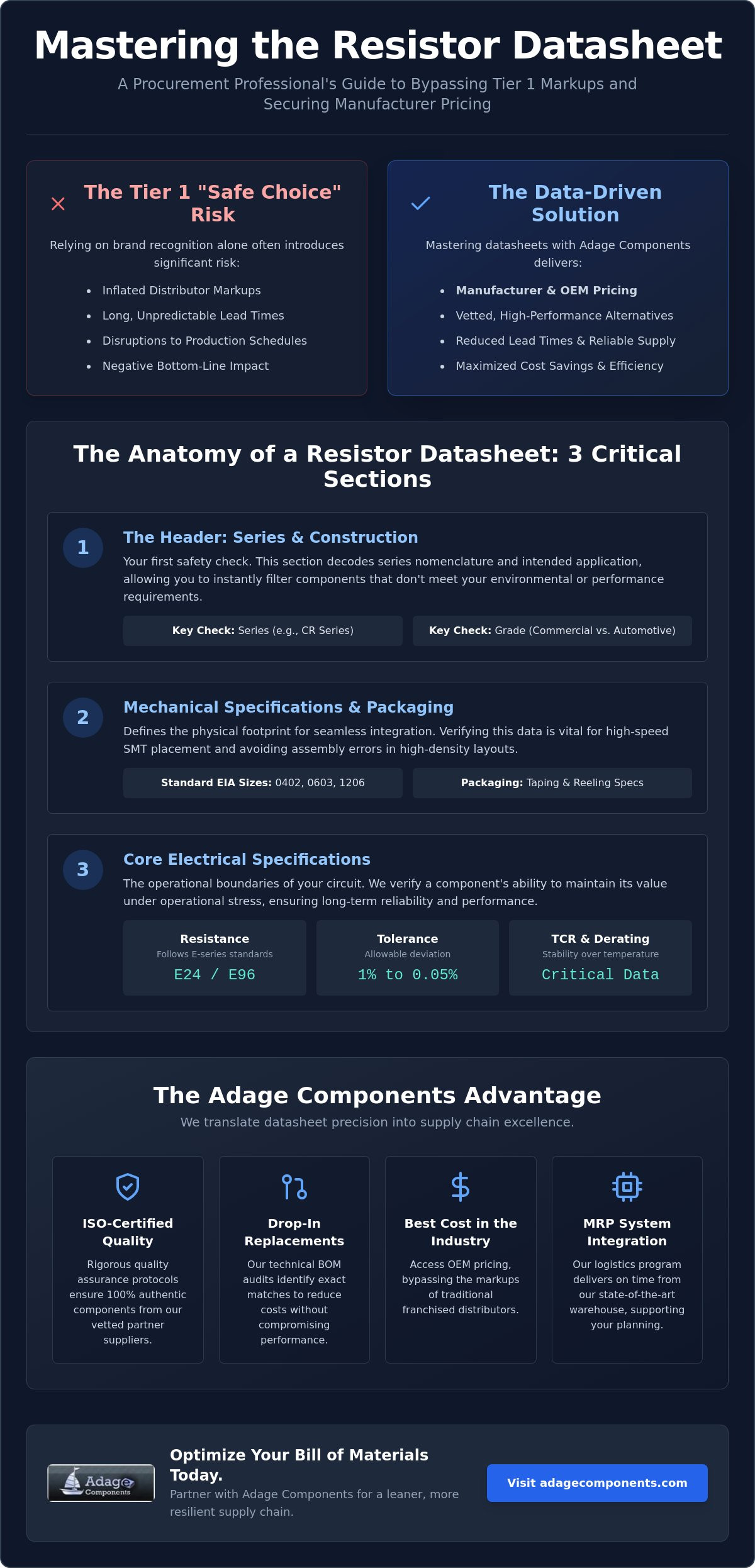
A resistor datasheet is the definitive technical contract between the manufacturer and the design engineer. It outlines the exact performance boundaries that a component must maintain throughout its operational life. For procurement officers and EMS providers, mastering how to read a resistor datasheet is a prerequisite for effective risk mitigation. At Adage Components, we view these documents as the primary benchmark for our rigorous quality assurance protocols. Every component we source from our vetted manufacturers is cross-referenced against these specifications to ensure 100% authenticity.
Precision goes beyond simple resistance. The material composition and mechanical dimensions dictate the long-term reliability of your BOM. Whether you're sourcing Thick Film Chip Resistors or Thin Film Precision Resistors, the datasheet reveals how the component will behave under environmental stress. Understanding Resistor fundamentals is essential here, as it provides the theoretical context for non-ideal properties like parasitic inductance and capacitance. This level of technical scrutiny allows us to offer OEM pricing while maintaining the high standards expected from Tier 1 distributors.
To better understand the basics of component identification and marking, watch this helpful tutorial on resistor coding:
The Header: Identifying Series and Construction
The datasheet header is your first safety check. It decodes the series nomenclature, such as the CR Series for standard thick film components. This section explicitly states the intended application, which is crucial for identifying if a part is commercial or automotive grade. Understanding how to read a resistor datasheet header allows you to quickly filter out components that don't meet your environmental requirements. We prioritize these details to ensure that the components arriving at your facility are fit for purpose. We analyze these construction details to help you transition from expensive Tier 1 brands to our cost-effective, high-quality alternatives that offer the best cost in the industry.
Mechanical Specifications and Packaging
Mechanical specifications define the physical footprint and integration potential of the component. EIA case sizes like 0402, 0603, and 1206 are industry standards, yet their metric equivalents must be verified to avoid assembly errors in high-density layouts. Taping and reeling specifications are equally vital for seamless integration with high-speed SMT placement equipment. Aligning this mechanical data with your strategic sourcing guide empowers you to find drop-in replacements that reduce lead times. Adage Components manages these logistics through our state-of-the-art warehouse, ensuring that every reel is inspected and delivered on time to support your MRP system requirements.
Decoding Core Electrical Specifications: Resistance, Tolerance, and TCR
Electrical specifications represent the operational boundaries of your circuit. When you analyze how to read a resistor datasheet, you aren't just looking for a resistance value. You're verifying the component's ability to maintain that value under operational stress. Nominal resistance follows the E-series standards, typically E24 for standard thick film and E96 or E192 for precision thin film. These logarithmic scales ensure that the tolerance bands of adjacent values don't overlap, providing a structured approach to circuit design that prevents signal interference.
Tolerance defines the allowable deviation from the nominal resistance value. While 1% is the industry standard for Thick Film Chip Resistors, high-precision applications often require Thin Film Precision Resistors with tolerances as tight as 0.1% or 0.05%. Adage Components bridges the gap between these requirements. We provide OEM pricing for high-precision parts that usually carry a significant premium at Tier 1 distributors. Understanding these nuances is a key part of Reading between the lines of a datasheet to avoid over-specifying and inflating your BOM costs. You can explore our high-tolerance options on our global linecard.
Understanding the TCR Curve
TCR is the change in resistance per degree Celsius change in temperature. In high-density PCB layouts, heat buildup is inevitable. A high TCR means your resistance value drifts as the board warms up, which can lead to circuit instability or timing errors. Selecting the right TCR is a balancing act between cost and performance. For automotive grade components, a low TCR, often below 50 ppm/°C, is essential to ensure performance across extreme temperature swings. Commercial applications might tolerate 100 ppm/°C or higher, but precision instruments demand the stability that only low-TCR thin film technology provides.
Power Rating and Voltage Limits
Rated power is the maximum amount of energy a resistor can dissipate as heat without failing. This value is calculated based on a specific ambient temperature, usually 70°C, after which the resistor must be derated. Maximum Working Voltage (MWV) is the continuous voltage the resistor can handle, whereas Maximum Overload Voltage (MOV) is a short-term limit. Exceeding these values leads to dielectric breakdown or catastrophic failure. Because we offer manufacturer pricing, our clients often select higher-spec components with greater voltage margins. This strategy ensures reliability without causing budget bloat. We help you integrate these high-limit components into your MRP system to maintain a lean, robust supply chain.
Evaluating Environmental Stability: Power Derating and Reliability Metrics
Environmental stability determines if a component will survive the lifecycle of your product. Understanding how to read a resistor datasheet requires a deep dive into the power derating curve. This graph defines the precise temperature at which a resistor can no longer dissipate its full rated load. Typically, full power is maintained up to an ambient temperature of 70°C. Beyond this point, the allowable power drops linearly to zero at the maximum operating temperature, often 155°C. For engineers designing for sealed enclosures or high-heat industrial zones, ignoring this curve leads to immediate thermal failure and costly field recalls.
We source components that undergo rigorous environmental testing, including humidity resistance, thermal shock, and load life. These metrics ensure that our Thick Film Chip Resistors and Metal Film Resistors perform predictably in volatile conditions. Resistance to Soldering Heat (RSH) is another critical datasheet metric. It specifies the maximum temperature and duration a component can withstand during the reflow process. If your sourcing partner hasn't vetted these parameters, you risk latent defects that only appear after the product reaches the end user. Adage Components eliminates this risk by only using vetted manufacturers and partner suppliers who comply with all ISO certifications.
Automotive Grade and AEC-Q200 Compliance
The distinction between commercial and automotive grade is a major gap in common procurement knowledge. AEC-Q200 qualification involves far more than just a higher price tag; it requires components to pass intense stress tests. This includes 1,000 cycles of thermal shock and long-term exposure to high humidity. While commercial grade parts suffice for consumer electronics, automotive grade resistors are essential for high-vibration environments and mission-critical industrial hardware. We provide these high-reliability parts at OEM pricing, offering a strategic advantage over Tier 1 distributors. Integrating these Resistor selection factors into your design process ensures your BOM is optimized for both cost and durability.
Long-Term Stability and Load Life
Initial tolerance is often a vanity metric. What matters for long-term reliability is the "ΔR," or the change in resistance over time. A datasheet will specify the maximum ΔR after 1,000 or 10,000 hours of operation at rated power. If a resistor has a 1% initial tolerance but a 3% ΔR over its load life, your precision circuit will eventually drift out of spec. Learning how to read a resistor datasheet for these stability metrics allows you to reduce warranty claims and increase the lifecycle of your OEM products. Our amazing international logistics program ensures these high-stability components reach your facility in real time, on time, fully integrated with your existing MRP system.
Cross-Referencing Parts: Finding Drop-in Replacements Using Datasheet Specs
Finding a drop-in replacement requires more than matching a part number. It requires a disciplined comparison of technical data points. When you master how to read a resistor datasheet for cross-referencing, you unlock the ability to swap expensive Tier 1 brands for high-quality, cost-effective alternatives. A true drop-in replacement must match the original footprint, power rating, and thermal characteristics perfectly. We provide the technical transparency needed to make these decisions with composed confidence, ensuring your production line never stops due to component shortages.
Identifying Tier 1 equivalents is a strategic move to secure the best cost in the industry. Many procurement professionals are hesitant to move away from franchised distributors, but the data doesn't lie. By verifying ISO certifications and manufacturing audits of alternative suppliers, you ensure that the private-label component meets or exceeds the original specification. We facilitate this process through our Adage Components Linecard, which serves as a bridge between high-stakes requirements and manufacturer pricing.
Validating Material Compatibility
Material compatibility is often overlooked in basic sourcing. You must check termination materials to ensure they meet lead-free (RoHS) requirements, especially with the July 2026 directive updates. It's equally important to ensure the replacement matches the original’s pulse-handling capabilities. If a Thick Film Chip Resistor is subjected to high-energy surges, a generic replacement might fail even if the resistance value is identical. We conduct rigorous manufacturing audits to verify these capabilities, ensuring all components in our state-of-the-art warehouse are authentic and reliable.
The Sourcing Advantage: OEM Pricing vs. Tier 1
Datasheet transparency allows us to offer competitive manufacturer pricing without the traditional distributor markup. By qualifying multiple manufacturers on a single BOM, we drastically reduce lead times. This multi-source strategy is a core component of risk mitigation in a volatile global market. Our amazing international logistics program delivers these parts to your facility in real time, on time. We ensure that every alternative part is ready for seamless integration into your existing MRP system, providing a logistical excellence that Tier 1 distributors struggle to match. Explore our offerings on the Adage Components Linecard to start optimizing your BOM today.
Optimizing Your BOM: Adage Components’ Technical Audit and Logistics Support
Efficiency in sourcing must be matched by excellence in logistics. We ensure seamless integration with your facility through our amazing international logistics program. By leveraging our state-of-the-art warehouse and global stocking initiatives, we maintain short lead times that franchised distributors often can't match. We deliver authentic, high-quality components in real time, on time, ensuring your production schedule remains uninterrupted. Every part we ship is sourced from vetted manufacturers and partner suppliers, maintaining strict compliance with all ISO certifications to guarantee the integrity of your hardware.
BOM Cost Analysis and Risk Mitigation
Proactive risk management is essential in today's volatile market. When you use our BOM submission form, our technical team conducts a deep-dive analysis to identify potential "end-of-life" (EOL) risks before they halt your production line. We provide a rapid quote that reflects manufacturer pricing, allowing you to bypass the inflated margins of Tier 1 distributors. Our audits ensure that every Thick Film Chip Resistor or Thin Film Precision Resistor on your list is optimized for its specific application. This Adage promise brings Tier 1 quality standards to your facility at OEM pricing, directly boosting your bottom line.
Partnering for Scalable Growth
Long-term supply stability requires a partner with massive infrastructure and meticulous attention to detail. Our Distributor Affiliated Program is designed for OEMs and EMS providers looking for scalable growth and reliable lifecycle management. Whether you need technical support for commercial grade or automotive grade component selection, our specialists are ready to assist. We bridge the gap between complex datasheet specifications and practical procurement solutions, ensuring your MRP system is always populated with authentic, cost-effective parts. Contact our team to initiate a technical inquiry today and discover how we can streamline your sourcing process.
Securing Your Supply Chain for 2026 and Beyond
Mastering how to read a resistor datasheet transforms your procurement strategy from reactive to proactive. You've learned that decoding electrical specifications and power derating curves is essential for maintaining circuit integrity; it also provides the technical leverage needed to qualify cost-effective alternatives. By moving away from the high markups of Tier 1 distributors, you can secure the best cost in the industry through our private label manufacturing and OEM pricing models.
We're committed to your operational success. Adage Components pairs ISO Certified Quality Management with a state-of-the-art warehouse to ensure every part you receive is authentic and delivered on time. Our amazing international logistics program integrates directly with your MRP system, providing a steady bridge between global manufacturing and your facility. Don't let supply chain volatility dictate your production schedule. Take control of your component lifecycle by partnering with a meticulous specialist dedicated to precision and speed. Optimize your BOM costs with Adage Components; submit your BOM for a technical audit today.
We look forward to solving your most difficult sourcing puzzles and building a more resilient future together.
Frequently Asked Questions
How do I know if a resistor is a drop-in replacement for a Yageo or Vishay part?
You verify a drop-in replacement by matching the case size, resistance, tolerance, and Temperature Coefficient of Resistance (TCR) exactly. It's also critical to ensure the power rating and pulse-handling capabilities meet or exceed the original specifications. Adage Components performs technical BOM audits to cross-reference these parameters, allowing you to transition from Tier 1 distributors to our manufacturer pricing with composed confidence.
What is the difference between a thick film and a thin film resistor datasheet?
Thin film datasheets prioritize precision metrics, often featuring tolerances as tight as 0.01% and TCR values below 25 ppm/°C. Thick film datasheets focus on cost-efficiency and power handling, typically showing a standard 1% tolerance. Understanding these distinctions is a fundamental part of how to read a resistor datasheet when you're balancing high-stability requirements against your sourcing budget.
Why does the power rating of a resistor change at higher temperatures?
Power ratings decrease at higher temperatures because the resistor's ability to dissipate heat is limited by the ambient environment. Once the temperature exceeds the rated threshold, usually 70°C, the component must be derated to prevent thermal failure. We ensure all our vetted manufacturers provide clear derating curves so you can maintain reliability in sealed or high-density industrial enclosures.
What does AEC-Q200 qualified mean on a resistor datasheet?
AEC-Q200 qualification signifies that a component has passed rigorous stress tests, including thermal shock, humidity resistance, and vibration testing for automotive environments. These parts offer superior reliability compared to standard commercial grade components. We provide AEC-Q200 qualified resistors at OEM pricing, ensuring your mission-critical hardware survives the harshest operational conditions without the typical Tier 1 markup.
How do I read the part numbering system at the end of a datasheet?
The part numbering system is a structured code that identifies the series, case size, tolerance, resistance value, and packaging type. Most manufacturers use a three or four-digit code where the last digit represents the multiplier. Mastering this nomenclature is a vital step in how to read a resistor datasheet to ensure the correct SKU is integrated into your MRP system without errors.
Can I use a higher wattage resistor than what is specified on the datasheet?
Yes, using a higher wattage resistor is a safe practice that provides additional thermal headroom and improves long-term reliability. The main trade-offs are the physical case size and the potential for increased costs. Because Adage Components offers the best cost in the industry, our clients often select higher-wattage components to enhance circuit safety while still reducing their overall BOM expenses.
What is the "Maximum Working Voltage" and why is it lower than the overload voltage?
Maximum Working Voltage is the continuous voltage limit a resistor can withstand throughout its operational life without dielectric breakdown. The overload voltage is a short-term limit designed to handle transient pulses or surges. We maintain strict ISO certifications and source from partner suppliers who guarantee these limits, ensuring your designs are protected against catastrophic failure during voltage fluctuations.
How does the TCR (Temperature Coefficient) affect my circuit’s precision?
TCR determines how much the resistance value drifts as the operating temperature changes, which can lead to timing errors or signal instability. A lower TCR value, such as 10 or 25 ppm/°C, ensures that your precision instruments remain accurate across a wide temperature range. This stability is essential for automotive grade components and high-precision medical devices where even minor resistance changes are unacceptable.
Disclaimer
Cross-referenced components needs to be confirmed by the client with either spec. sheet or samples or both.
Please note, we use AI to help us, information is verified to be correct but we can not guarantee 100% accuracy.