With lead times for polymer tantalum capacitors stretching as far as 40 weeks in 2026, settling for whatever inventory is available from Tier 1 distributors often leads to unpredictable tantalum capacitor leakage current issues. You've likely seen the results in the field: rapid battery drain in low-power IoT devices or, worse, catastrophic thermal runaway in high-density PCBs. We understand the frustration of balancing tight MRP schedules with the technical necessity of stable DC leakage performance during a period of intense supply chain volatility.
This article provides the technical framework you need to master DC leakage causes and mitigate risks through disciplined 50% voltage derating and rigorous manufacturing audits. We'll examine the 0.01CV standard and explain how Adage Components leverages a state-of-the-art warehouse and vetted partner suppliers to deliver high-performance commercial and automotive grade parts. You'll learn how to secure cost-effective alternative parts that meet ISO standards without the high markups of franchised distributors. We're here to help you bypass current market constraints and achieve seamless integration with your existing production systems through strategic sourcing and manufacturer pricing.
Key Takeaways
- Master the technical causes of DC leakage and understand why tantalum dielectric properties require different management strategies than MLCC counterparts.
- Learn to apply the 0.01CV standard and 50% voltage derating rules to proactively mitigate tantalum capacitor leakage current issues in high-density PCB designs.
- Identify how 100% factory-level testing and Moisture Sensitivity Level management protect your circuits from thermal runaway and premature battery drain.
- Discover how to bypass the high markups and long lead times of Tier 1 distributors by sourcing authentic, ISO-certified components at manufacturer pricing.
- Streamline your procurement by integrating Adage Components’ global logistics and vetted supply chain directly into your existing MRP system.
Understanding DC Leakage (DCL) in Tantalum Capacitors
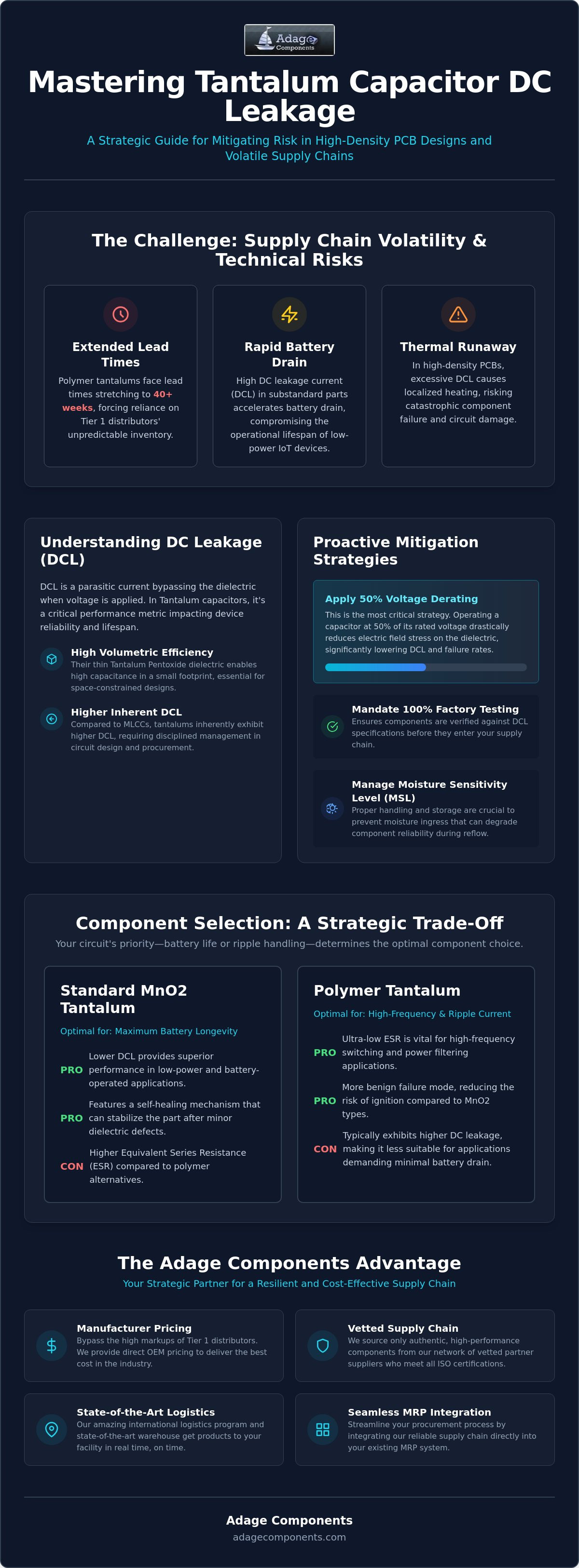
DC Leakage (DCL) represents the parasitic current that bypasses the dielectric layer when a steady-state voltage is applied. In high-density PCB designs, tantalum capacitor leakage current issues are a primary concern because these components inherently exhibit higher DCL than Multilayer Ceramic Capacitors (MLCC). While MLCCs offer excellent insulation resistance, the unique construction of a Tantalum capacitor allows for significantly higher volumetric efficiency. This makes them indispensable for power management and decoupling where space is at a premium.
For procurement officers managing BOMs for portable IoT sensors or medical devices, DCL is a critical performance metric. High leakage translates directly to accelerated battery drain, reducing the operational lifespan of remote hardware. In extreme cases, excessive leakage leads to localized heating, which can trigger thermal runaway. Adage Components prioritizes sourcing from vetted manufacturers who provide 100% factory-level testing to mitigate these risks before parts reach your facility.
To better understand the physical risks associated with component failure, watch this helpful video:
Standard MnO2 (Manganese Dioxide) tantalum capacitors possess a unique self-healing mechanism. If a microscopic defect occurs in the dielectric, the heat generated by the leakage current triggers a chemical reaction. This reaction converts the conductive MnO2 into an insulating state, effectively sealing the defect. While this stabilizes the part, it doesn't eliminate the underlying tantalum capacitor leakage current issues entirely. Our technical team ensures your MRP system accounts for these component-level behaviors during the design phase to avoid field failures.
The Role of the Tantalum Pentoxide Dielectric
The dielectric in these parts is an extremely thin layer of tantalum pentoxide grown on the surface of a porous tantalum pellet. This thinness enables high capacitance in a small footprint but creates high electric field stress. Manufacturing defects, such as impurities in the tantalum powder or uneven oxide growth, create low-resistance paths for current. Adage Components manages this risk by utilizing our state-of-the-art warehouse and strict inspection protocols to ensure every part is authentic and compliant with ISO certifications. We vet manufacturers specifically for dielectric uniformity to guarantee long-term stability.
Tantalum vs. Polymer Tantalum: Leakage Trade-offs
Polymer tantalums have gained significant market share due to their ultra-low ESR (Equivalent Series Resistance). This is vital for high-frequency switching and power filtering. However, they typically exhibit higher DCL than standard MnO2 versions. When your circuit priorities demand maximum battery longevity, MnO2 is often the superior choice. If ripple current handling is the goal, polymer is the standard. We provide both commercial and automotive grade components at OEM pricing. This allows you to bypass the high markups of Tier 1 distributors. For a detailed BOM analysis, you can submit your requirements via our BOM submission form to secure the best cost in the industry and ensure your supply chain remains resilient.
Critical Factors Driving Tantalum Capacitor Leakage Issues
Engineering teams often overlook how assembly and environmental conditions exacerbate tantalum capacitor leakage current issues. While a datasheet provides a baseline, real-world variables like temperature spikes and voltage transients determine whether a component survives the first 100 hours of operation. We ensure our vetted manufacturers provide parts that meet rigorous ISO certifications to handle these high-stress environments. Managing these factors is not just about circuit design; it's a strategic procurement necessity to avoid costly field failures and line stops.
The reliability of a tantalum capacitor is defined by its ability to maintain dielectric integrity under stress. Failures typically fall into two categories: infant mortality and long-term wear-out. Infant mortality is often triggered by the thermal shock of PCB reflow soldering, which can cause micro-fractures in the tantalum pentoxide layer. Wear-out mechanisms, on the other hand, are accelerated by continuous operation at the edge of the component's rated specifications. Adage Components mitigates these risks by sourcing authentic, commercial and automotive grade components that have undergone multi-stage inspection processes.
Thermal Stress and DCL Acceleration
Thermal stress is a primary catalyst for dielectric failure. As ambient temperature rises, the energy within the tantalum pentoxide layer increases, allowing more electrons to bypass the barrier. The Arrhenius relationship states that the rate of chemical or physical degradation in the dielectric accelerates exponentially with temperature increases. This means even a small rise above the design temperature can double the leakage current. Without proper thermal management, this leads to a feedback loop where increased leakage generates more heat, eventually resulting in thermal runaway. We provide technical support to ensure your components are rated for the thermal realities of your application.
Voltage Stress and the Importance of Derating
Voltage stress is equally critical. Operating a tantalum capacitor at its maximum rated voltage significantly reduces its Mean Time Between Failures (MTBF). The industry-standard 50% derating rule is the most effective way to mitigate tantalum capacitor leakage current issues and prevent permanent punch-through defects. For our clients in the EV and ADAS sectors, we supply automotive-grade components that undergo even stricter screening to ensure they handle overvoltage transients without compromise. By choosing our OEM pricing over the high markups of Tier 1 distributors, you gain a partner that prioritizes technical integrity as much as cost-efficiency. Review our full range of high-reliability capacitors to find the right fit for your next MRP cycle.
Calculating and Measuring Leakage: The 0.01CV Standard
Precision is non-negotiable when integrating high-performance components into a complex MRP system. Many tantalum capacitor leakage current issues stem from a fundamental misunderstanding of how DC Leakage (DCL) is calculated and verified against datasheet limits. The industry standard formula used by manufacturers is DCL = k * C * V, where 'k' represents the leakage constant. For standard commercial parts, 'k' is typically 0.01. It's vital to ensure your engineering team uses the correct units: Capacitance (C) must be in microfarads (uF) and Voltage (V) in Volts to result in a DCL value expressed in microamps (uA).
While 0.01CV is the universal maximum limit for standard series, "Low Leakage" series are engineered to meet much stricter thresholds, often targeting 0.003CV or lower. Procurement professionals should recognize that high-reliability designs, such as medical implants or remote IoT sensors, often require these tighter tolerances to prevent unintended battery depletion. We source these specialized parts from vetted manufacturers to ensure they meet your specific technical requirements at manufacturer pricing, providing a significant advantage over the higher costs found at Tier 1 distributors.
Accurate measurement requires a disciplined test protocol that accounts for the component's physical behavior. You can't simply probe a part and expect a stable reading immediately. Soak time is the mandatory duration a capacitor must remain under biased voltage before a DCL measurement is taken to ensure the charging current has fully decayed. Typically, this requires 60 to 120 seconds of charging at the rated voltage before the leakage current reaches a steady state suitable for inspection.
Step-by-Step DCL Calculation Example
Consider a 100uF capacitor rated at 16V. Using the 0.01CV standard, the calculation is 0.01 * 100 * 16, which results in a maximum theoretical DCL of 16uA. However, our internal quality audits at Adage Components often show measured values at roughly 10% of this limit under stable conditions. This significant margin provides the safety buffer necessary for high-reliability applications and protects against tantalum capacitor leakage current issues during unexpected voltage transients.
Comparison Table: Tantalum vs. MLCC vs. Aluminum Electrolytic
Understanding where tantalum fits in the broader component landscape helps in making informed sourcing decisions. The table below highlights the trade-offs between different dielectric technologies.
| Feature | Tantalum | MLCC (Ceramic) | Aluminum Electrolytic |
|---|---|---|---|
| Typical DCL | Moderate (0.01CV) | Extremely Low | High (0.03CV+) |
| ESR | Low to Moderate | Ultra-Low | High |
| Volumetric Efficiency | Highest | Moderate | Low |
Tantalum remains the leader for volumetric efficiency, but in high-impedance circuits where even 16uA of leakage is unacceptable, we recommend exploring our high-capacitance MLCC alternatives. Our state-of-the-art warehouse stocks both technologies, ensuring you get the right part for your specific circuit priorities on time and at the best cost in the industry.
Mitigation Strategies: Quality Assurance and Manufacturing Audits
Technical design choices only solve half the equation. To effectively eliminate tantalum capacitor leakage current issues, you must enforce 100% DCL testing at the factory level. Many low-cost manufacturers skip this step or use batch sampling, which allows marginal components to enter your supply chain. We eliminate this risk by auditing every partner supplier to verify they perform 100% screening at rated voltage and temperature before the parts are packaged. This ensures that every component reaching your line meets the 0.01CV standard discussed previously.
Moisture sensitivity (MSL) is another critical factor that procurement teams often overlook. If components aren't stored correctly, moisture absorption can cause dielectric delamination during the high heat of reflow soldering. This physical damage creates immediate DCL spikes and potential long-term reliability failures. Adage Components manages this through our state-of-the-art warehouse operations, ensuring every reel is handled according to strict moisture-barrier protocols. We provide drop-in replacements that have been pre-vetted for dielectric integrity, allowing you to maintain production without the need for expensive PCB redesigns.
Vetting Suppliers for Dielectric Consistency
Our manufacturing audits focus on the root causes of leakage: powder purity and furnace control. High-quality tantalum powder must be free of metallic impurities that create conductive paths through the oxide layer. We verify that our partner manufacturers utilize precision vacuum-sintering furnace controls that guarantee a uniform dielectric thickness. This authentic sourcing is your primary defense against counterfeit parts that often flood the market during global shortages. While Tier 1 brands claim exclusivity on quality, Adage Components delivers the same ISO-compliant reliability at OEM pricing.
Implementation in the MRP System
Seamless integration is vital for supply chain stability. We design our private label components to be direct alternatives to parts from franchised distributors, ensuring your MRP system requires minimal updates for a transition. With general lead times currently at 16 to 18 weeks and polymer tantalums reaching up to 40 weeks in 2026, our amazing international logistics program provides a critical safety net for your production. We get products to your facility in real time, on time, bypassing the logistical bottlenecks of larger distributors. View our Adage Linecard for a full list of qualified passives and initiate a quote to secure your production schedule against current market volatility.
Strategic Sourcing: High-Reliability Tantalum Alternatives
In a volatile global market where lead times for polymer tantalums have surged to 40 weeks in 2026, procurement officers need more than just a vendor. You need a strategic partner capable of solving difficult sourcing puzzles without compromising on technical standards. We position Adage Components as that elite partner. We act as a bridge between a fragmented marketplace and your specific production requirements. While Tier 1 distributors often prioritize high-volume accounts and apply significant markups, we offer manufacturer pricing on authentic, high-reliability components.
Our approach ensures that your technical requirements, specifically regarding tantalum capacitor leakage current issues, are met through rigorous multi-stage inspection processes. We don't just find parts; we verify their integrity in our state-of-the-art warehouse before they ever reach your MRP system. This disciplined expertise allows us to provide a steady flow of materials even when franchised distributors report stock-outs. Our commitment to quality is backed by full compliance with all ISO certifications, providing the corporate stability your supply chain requires.
Reducing BOM Costs without Increasing DCL Risk
Identifying overpriced Tier 1 parts is a core component of our service. Our electronic components BOM cost analysis identifies opportunities for significant savings by transitioning to Adage private label components. We offer the best cost in the industry by providing OEM pricing directly to our clients. This model ensures you don't overpay for the brand name of a distributor while receiving the same advantages of high-reliability manufacturing. By choosing our pre-vetted alternatives, you mitigate tantalum capacitor leakage current issues while simultaneously improving your bottom line. Use our BOM Submission Form to initiate a cost-saving comparison today.
The Adage Advantage: Logistics and Reliability
Headquartered in Canada with an amazing international logistics program, we have the infrastructure to source materials anywhere in the world. We understand that in supply chain management, time is a critical resource. Our global stocking programs ensure that we get products to your facility in real time, on time. Whether you require commercial or automotive grade components, our commitment to technical precision remains absolute. We maintain meticulous attention to detail to inspect every individual component for authenticity. We invite you to Contact Adage Components today for a quote on high-reliability tantalum capacitors and experience a seamless integration with your existing procurement workflow.
Secure Your Supply Chain against DC Leakage Risks
Managing tantalum capacitor leakage current issues requires a dual approach of engineering precision and strategic procurement. By applying the 50% derating rule and enforcing strict 100% factory-level testing, you protect your PCB designs from thermal runaway and excessive battery drain. We've shown that high-performance alternatives don't have to come with the inflated markups of Tier 1 distributors or the extreme lead times currently impacting the global market.
Adage Components provides the corporate stability and technical expertise needed to navigate these supply chain disruptions. As an ISO 9001:2015 certified partner with Canadian-based support, we ensure every part is authentic and vetted for dielectric integrity. Our amazing international logistics program delivers commercial and automotive grade components in real time, on time, at manufacturer pricing. You don't have to sacrifice quality for cost-efficiency; we offer the best cost in the industry for high-reliability passives.
Optimize your BOM with Adage Components—Get a Quote Today to integrate our global sourcing power into your MRP system. We're ready to help you build more resilient, high-performance electronics.
Frequently Asked Questions
What is the acceptable leakage current for a tantalum capacitor?
Acceptable leakage current is defined by the 0.01CV formula, where C is capacitance in microfarads and V is the rated voltage. While this represents the maximum datasheet limit, real-world measurements for high-quality parts typically hover around 10% of this value. We ensure our vetted manufacturers meet these tighter internal tolerances to prevent field failures and ensure long-term reliability in your MRP system.
Can tantalum capacitor leakage increase over time?
Leakage can increase due to dielectric wear-out or exposure to environmental humidity. High humidity can penetrate the component packaging, causing the dielectric to degrade or creating parasitic surface leakage paths. Our state-of-the-art warehouse maintains strict moisture control and storage protocols to ensure parts remain within specification before they reach your facility in real time, on time.
Why do tantalum capacitors fail with a short circuit?
Tantalum capacitors fail as a short circuit when the amorphous tantalum pentoxide dielectric undergoes crystallization. This change creates a low-resistance path that leads to localized heating and rapid thermal runaway. Adage Components mitigates these tantalum capacitor leakage current issues by sourcing authentic, automotive grade components that have undergone rigorous manufacturing audits to ensure dielectric stability.
Is polymer tantalum better for low leakage applications?
Polymer tantalum capacitors offer superior ESR but are generally not the best choice for ultra-low leakage applications. Standard MnO2 types typically exhibit lower DCL than their polymer counterparts. When your priority is maximum battery longevity in low-power IoT devices, MnO2 remains the industry standard. We provide both technologies at OEM pricing to help you bypass the high markups of Tier 1 distributors.
How does voltage derating affect tantalum leakage?
Voltage derating dramatically reduces leakage current and extends component life. Operating a part at 50% of its rated voltage can lower the DCL by an order of magnitude compared to its performance at full rated voltage. This practice is the most effective way to mitigate tantalum capacitor leakage current issues and prevent permanent punch-through defects in high-density PCB designs.
What is the difference between DCL and ESR?
DCL represents the current that flows through the dielectric under a steady DC voltage, serving as a measure of insulation loss. ESR represents the resistive losses during AC operation, such as when handling ripple current in power supplies. Both impact circuit efficiency, but they represent different physical phenomena. We support your technical team in selecting the right balance for your specific circuit priorities.
How do I measure tantalum leakage current in-circuit?
Measuring leakage in-circuit is unreliable because parallel components provide alternative current paths that skew the reading. To get an accurate measurement, you must isolate the capacitor from the circuit and apply the proper soak time of 60 to 120 seconds. This ensures you are measuring the component's true DCL rather than charging currents or board-level parasitic paths.
Are Adage tantalum capacitors drop-in replacements for Tier 1 brands?
Adage tantalum capacitors are designed as direct, high-performance replacements for parts from global Tier 1 manufacturers. We provide authentic, ISO-certified components at manufacturer pricing, ensuring seamless integration into your existing production lines. Our amazing international logistics program ensures that these high-reliability parts are available with short lead times to keep your production moving.
Disclaimer
Cross-referenced components needs to be confirmed by the client with either spec. sheet or samples or both.
Please note, we use AI to help us, information is verified to be correct but we can not guarantee 100% accuracy.