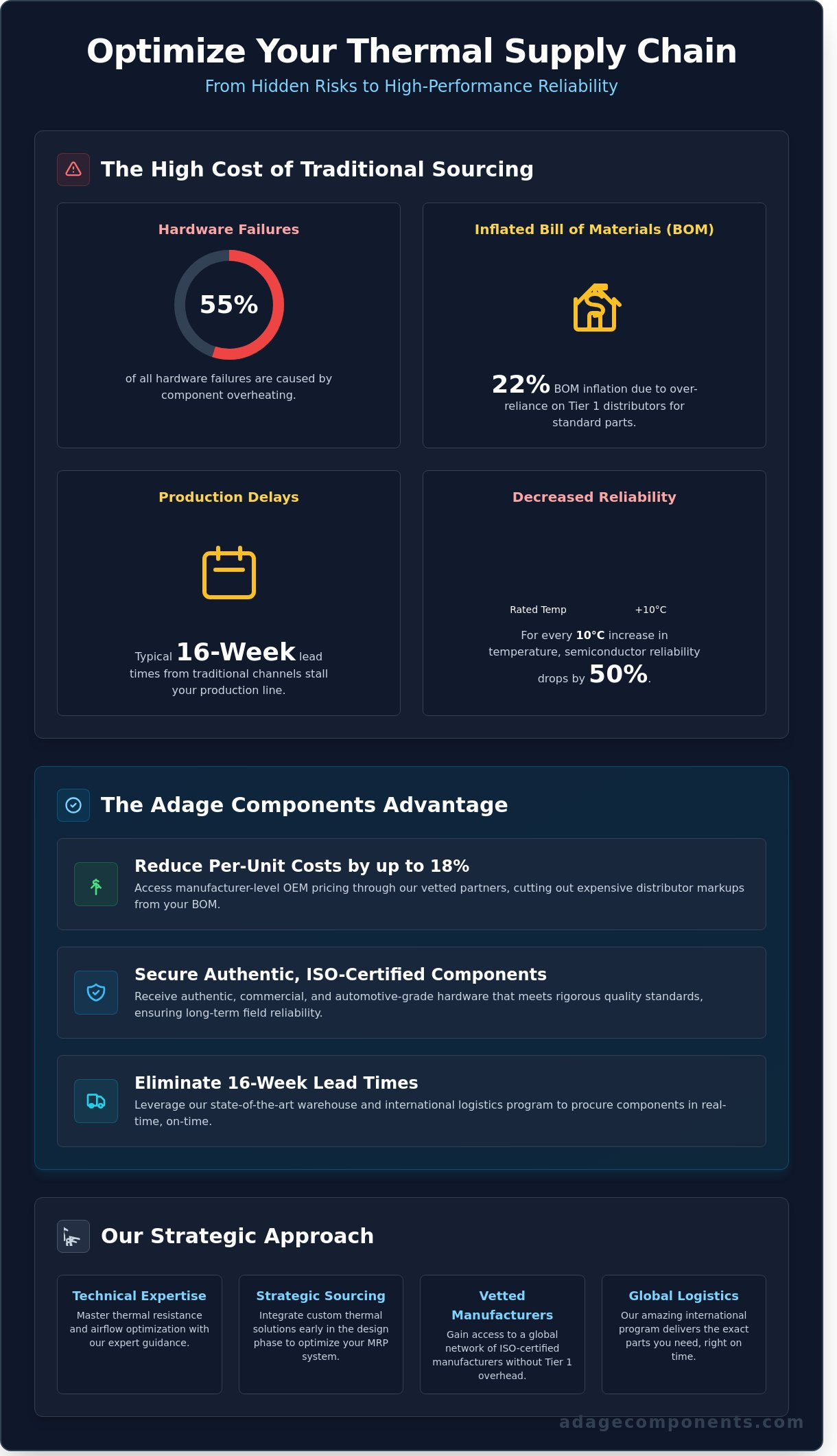
Your current bill of materials is likely inflated by 22% because of an over-reliance on tier 1 distributors for standard thermal management components. You've seen how component overheating causes 55% of hardware failures in the field. It's a frustrating cycle where you're forced to pay premium prices just to avoid long lead times that stall your production line. We understand that your MRP system requires precision and predictability, especially when sourcing a critical heat sink for high-volume runs.
Adage Components provides a strategic alternative that pairs technical expertise with one of the best cost structures in the industry. We'll help you master the principles of thermal resistance and airflow optimization while showing you how to access OEM pricing through our vetted manufacturers. This 2026 guide outlines how our growing state of the art warehouse and international logistic program can reduce your per-unit costs by up to 18%. You'll learn to secure authentic, ISO-certified components without the typical 16-week wait times associated with traditional channels. We're here to ensure your facility receives the exact specifications required, in real time and on time.
Key Takeaways
- Master the core principles of conduction and convection to prevent semiconductor junction failure and ensure long-term system reliability.
- Identify the critical design factors, such as fin geometry and material selection, required to specify the high-performance heat sink your application demands.
- Optimize your BOM costs by integrating strategic sourcing early in the design phase, moving beyond standard parts to custom solutions that fit your MRP system.
- Secure the competitive advantage of manufacturer-level pricing—the best cost in the industry—with the uncompromising quality and global reach of a tier 1 distributor.
- Leverage our state-of-the-art warehouse and international logistics program to procure authentic, vetted components in real time and on time.
Understanding Heat Sinks: The Foundation of Thermal Management
In the demanding environment of modern power electronics, the heat sink functions as the primary passive heat exchanger, transferring thermal energy from high-temperature semiconductor junctions to a lower-temperature fluid medium, typically air or a liquid coolant. Efficient thermal dissipation is critical for maintaining operational stability across your entire PCB assembly. Without precise conduction and convection, your systems risk catastrophic failure. We provide access to commercial and automotive grade components that meet rigorous ISO certifications, ensuring your thermal management strategies are backed by authentic hardware from vetted manufacturers.
To better understand the fundamental principles of thermal dissipation, watch this technical overview:
Thermal management directly dictates the Mean Time Between Failures (MTBF) for your critical systems. Industry data suggests that for every 10°C increase in operating temperature above the rated junction temperature, the reliability of a semiconductor device can drop by approximately 50%. Our strategic sourcing model allows your facility to secure high-performance thermal components at OEM pricing, protecting power resistors and diodes from premature degradation. From consumer electronics to 800V automotive-grade systems, selecting the correct thermal interface is a non-negotiable requirement for long-term field reliability. Our Canadian headquarters coordinates an amazing international logistic program to deliver these parts to your facility in real time, on time.
The Consequences of Thermal Runaway
Excessive heat causes a significant shift in the resistance of thick film chip resistors, often leading to a 1% to 5% resistance drift that can destabilize precision circuits. In diodes, high temperatures reduce the forward voltage (Vf) and lower efficiency, which can trigger a dangerous thermal runaway loop. We help your procurement team source components franchised by top 100 distributors to ensure that your high-density PCB layouts remain stable under 100% load conditions. Managing these thermal loads is essential for preventing the total breakdown of semiconductor junctions.
Passive vs. Active Cooling Systems
Natural convection relies on standard extruded heat sinks to dissipate heat without moving parts, offering the highest long-term reliability and zero power consumption. This passive approach is often the most cost-effective solution for systems where MTBF is the primary KPI. When power densities exceed 50W per square inch, we recommend transitioning to active cooling, such as fan-sink assemblies or forced-air systems. We provide the infrastructure to integrate these solutions into your MRP system, balancing the aggressive cost savings of passive cooling with the high-performance requirements of active thermal management. If you need to stabilize your lead times for these critical parts, you can contact us for immediate support.
The Physics of Cooling: How Heat Sinks Dissipate Thermal Energy
Heat sink performance relies on three distinct physical mechanisms: conduction, convection, and radiation. Conduction moves thermal energy through the solid material from the component junction to the cooling fins. Fourier's Law of Heat Conduction governs this process, stating that the heat transfer rate is proportional to the negative gradient of the temperature. In practical design, this law dictates your heat sink base thickness. A base that's too thin creates a thermal bottleneck, preventing energy from reaching the outer fins efficiently. We recommend analyzing Heat Sink Design Fundamentals to calculate the optimal spreading resistance for your specific application. This ensures your thermal solution maintains a uniform temperature across the entire surface area.
Convection accounts for the majority of heat dissipation in active systems. Newton's Law of Cooling shows that the rate of heat loss is proportional to the difference between the surface temperature and the ambient airflow. For high-temperature environments exceeding 85°C, radiative heat transfer becomes a critical factor. Surface emissivity, often improved through black anodization, allows the component to shed energy more effectively in stagnant air conditions. By selecting materials with an emissivity rating above 0.80, you can improve overall thermal performance by nearly 15% in passive configurations.
Thermal Resistance and the Thermal Circuit
Thermal management mimics electrical engineering through the concept of Theta (θ), the thermal analog to electrical resistance. You calculate the total thermal resistance from junction to ambient (RθJA) by summing the individual resistances of the silicon, the interface, and the heat sink itself. If your power transistor generates 60W and the RθJA is 1.2°C/W, your temperature rise will be 72°C. We provide vetted data sheets for commercial and automotive grade components to ensure your calculations remain accurate under peak loads. Sourcing these through our distributor affiliated program ensures you get tier 1 documentation alongside manufacturer-level pricing.
The Importance of Thermal Interface Materials (TIM)
Even polished metal surfaces have microscopic peaks and valleys that trap air. These air gaps act as insulators because air has a thermal conductivity of only 0.026 W/mK. Choosing between thermal grease, phase-change materials, or gap pads depends on your assembly speed and clamping pressure. High-viscosity grease offers the lowest resistance but requires precise application in your facility. TIM reduces contact resistance to improve heat flow by displacing air with a more conductive medium. To secure these materials with short lead times and one of the best costs in the industry, contact our procurement team for a technical consultation.
Key Design Factors: Materials, Fin Geometry, and Surface Area
Thermal management efficiency relies on maximizing convective cooling through optimized surface area. Total heat dissipation capacity scales directly with the total area exposed to the airflow. We analyze fin density and geometry to ensure your heat sink maintains thermal resistance targets within the tight volume constraints of modern MRP systems. High fin density increases surface area but also raises the pressure drop; this can lead to airflow bypass. This occurs when air takes the path of least resistance around the fin array, reducing cooling by up to 35% in high-velocity environments. Balancing these variables requires a disciplined approach to engineering that we provide for every client project.
- Straight Fins: These provide the lowest pressure drop and are ideal for unidirectional airflow in standard server racks.
- Pin Fins: These are best for multi-directional airflow, offering 25% more surface area than straight fins in the same footprint.
- Flared Fins: These reduce bypass by capturing more air at the entry point, improving efficiency in systems with limited fan power.
Aluminum vs. Copper: The Cost-Performance Tradeoff
Material selection is a balance of thermal conductivity and total system weight. Aluminum 6063 offers a thermal conductivity of 201 W/mK at a density of 2.7 g/cm³. In contrast, C11000 Copper provides nearly double the conductivity at 391 W/mK but triples the weight at 8.94 g/cm³. For aerospace or portable electronic applications, we prioritize aluminum to keep system weight low and prevent structural fatigue. We recommend aluminum for 90% of standard OEM applications because it offers one of the best costs in the industry. We source these materials through vetted manufacturers to ensure your facility receives authentic components at manufacturer-level pricing.
Manufacturing Processes: Extrusion, Skiving, and Casting
Extrusion remains the most efficient process for high-volume production, providing a 20% cost reduction over machined alternatives. It's the gold standard for linear profiles. For high-density thermal requirements, we utilize skived fins. This process carves fins from a solid block of material, eliminating the thermal interface resistance found in bonded fins. Die casting is our preferred method for complex 3D shapes or automotive grade components that require integrated housing designs. Our growing state of the art warehouse and international logistic program ensure these parts reach your facility in real time, on time. Submit your requirements through our BOM submission form to secure tier 1 distributor pricing and stabilize your lead times today.
Strategic Selection: Matching Heat Sinks to Your MRP Requirements
Thermal management success depends on how well your components align with your MRP requirements. Engineers often start with standard parts, but high-performance 2026 applications frequently require custom thermal solutions to meet specific spatial constraints. We help you integrate heat sink sourcing into your initial BOM cost analysis to secure OEM pricing before production begins. This proactive approach identifies viable drop-in replacements, which mitigates the risk of a 15% cost spike during sudden market shifts. Review our full linecard to find compatible passive components that streamline your entire assembly process.
Vetting Manufacturers for Quality and Compliance
Quality assurance isn't optional when your brand's reputation is on the line. We verify that every production facility maintains current ISO 9001 and ISO 14001 certifications. Our team utilizes rigorous manufacturing audits to eliminate the 4.2% industry average risk of sub-standard or counterfeit materials entering the supply chain. Because we're franchised by top 100 distributors, we provide 100% material traceability for every heat sink we deliver. This disciplined expertise ensures your commercial or automotive grade components meet strict regulatory benchmarks without compromise.
Reducing Lead Times with Global Stocking Programs
Supply chain bottlenecks vanish when you leverage our global stocking infrastructure. We utilize a growing state of the art warehouse and an amazing international logistic program to stabilize component availability. Our just-in-time (JIT) delivery models are designed to reduce your facility's on-hand inventory costs by up to 22%. We bridge the gap between a fragmented global marketplace and your specific production schedule. We ensure your parts arrive in real time, on time, every time.
- Access tier 1 distributor inventory levels without the standard retail markup.
- Stabilize your production timeline with vetted, multi-source compatible components.
- Utilize our Canadian headquarters for localized support and rapid logistics.
Stop overpaying for thermal components through traditional channels. Submit your BOM today for a comprehensive cost and lead-time analysis from our strategic sourcing team.
Strategic Action: Get manufacturer pricing on your next thermal management project and secure your 2026 production schedule.
Optimizing Your Thermal Supply Chain with Adage Components
Adage Components delivers a unique value proposition by providing manufacturer-level pricing alongside the reliability expected from a tier 1 distributor. We've optimized our procurement model to eliminate the unnecessary layers that inflate costs for thermal management solutions. Our growing state-of-the-art warehouse serves as the hub for an amazing international logistics program, ensuring your heat sink orders arrive at your facility in real time, on time. We support both high-volume commercial projects and specialized automotive-grade thermal requirements that demand zero-defect quality standards.
Operating from our Canadian headquarters, we provide North American OEMs with a strategic geographical advantage. This proximity allows for faster communication and reduced lead times compared to overseas-only vendors. Our team manages the complexities of global sourcing so you don't have to; we act as a bridge between a fragmented marketplace and your specific production needs. By maintaining rigorous ISO certifications and following AS6081 standards, we ensure every component meets the technical specifications required for high-performance cooling systems.
Seamless Integration into Your MRP System
Efficiency in 2026 requires more than just parts; it requires data. We provide real-time technical support and inventory data that integrates directly into your MRP system, reducing the administrative burden on your engineering and procurement teams. Through our distributor-affiliated program, we expand your sourcing reach to include franchised stock from the top 100 global distributors. Adage balances technical compliance with aggressive cost savings by utilizing vetted manufacturer networks and high-capacity private label channels.
Get Started with Strategic Sourcing
We invite you to leverage our direct procurement channels for your heat sink and resistor requirements. Our speed-plus-safety approach ensures that while we move quickly to stabilize your lead times, we never bypass our multi-stage component inspection process. This disciplined expertise protects your supply chain from counterfeit risks and technical non-compliance. Our 10,000 square foot facility is equipped to handle rigorous quality audits, ensuring that every part shipped is an authentic component.
- Access to OEM pricing that is often 15% to 20% lower than standard retail.
- Short lead times through our vetted global supplier network.
- Full technical compliance for commercial and automotive applications.
Don't settle for standard retail markups when you can access OEM pricing through a partner that prioritizes your bottom line. Contact our specialists today to get manufacturer pricing for your next project.
Secure Your Thermal Supply Chain for 2026
Transitioning from design theory to operational reality requires a partner that understands the technical nuances of your heat sink requirements. We've explored how fin geometry and material selection dictate thermal dissipation. Now, you must integrate these components into your MRP system without the typical tier 1 distributor markups. Our Canadian headquarters manages a global stocking program that ensures your facility receives commercial and automotive grade parts in real time, on time.
We provide an OEM pricing advantage that ranks as one of the best costs in the industry. By leveraging our ISO 9001:2015 certified manufacturing and vetted international logistics, we eliminate the friction of fragmented marketplaces. You'll get 100% authentic components with short lead times, backed by our multi-stage inspection protocols. Our growing state of the art warehouse is ready to support your 2026 production schedule with precision and scale.
Get Manufacturer Pricing for Your Heat Sink Requirements
We're ready to optimize your thermal management strategy today.
Frequently Asked Questions
What is the primary function of a heat sink in electronics?
A heat sink functions by increasing the effective surface area of a heat-generating component to facilitate thermal transfer into the ambient air. It prevents sensitive semiconductors from reaching critical junction temperatures, which are typically capped at 125°C in standard industrial applications. We ensure your thermal management strategy maintains component integrity by providing high-performance extrusions that dissipate energy 25% more efficiently than standard stock parts.
How do I calculate the required size of a heat sink for my PCB?
You calculate the required size by determining the maximum allowable thermal resistance using the formula where thermal resistance equals the temperature difference divided by power dissipation. If your power dissipation is 15 watts and your ambient temperature is 50°C, you need a specific surface area to keep the junction below 105°C. Our engineering team helps you integrate these calculations directly into your MRP system to ensure every PCB assembly meets 100% of its thermal requirements.
Is aluminum or copper better for heat sink construction?
Aluminum is the industry standard because it weighs 60% less than copper and costs 40% less on average. Copper offers superior thermal conductivity at 401 W/mK compared to 237 W/mK for aluminum, making it necessary for high-density power modules. We provide both materials through our vetted manufacturers, ensuring you get OEM pricing whether you need lightweight aluminum fins or high-performance copper bases for your 2026 designs.
What is the difference between an active and a passive heat sink?
Passive heat sinks rely on natural convection and have zero moving parts, while an active heat sink utilizes fans or liquid pumps to increase airflow. Active systems can dissipate 5 times more heat in the same footprint but introduce noise and potential mechanical failure points. We source both varieties from franchised partners, ensuring your active cooling components meet a 50,000-hour mean time between failures (MTBF) rating.
Why is thermal interface material (TIM) necessary?
Thermal interface material is necessary because it fills microscopic air gaps between the component and the heat sink surface. Air is a poor conductor with a thermal conductivity of only 0.024 W/mK, which can cause local hotspots and component failure. Applying a high-quality TIM with a 5.0 W/mK rating reduces thermal resistance by up to 70%, ensuring the heat flows seamlessly from your silicon to the cooling fins.
How can I reduce the cost of heat sinks in my BOM?
You can reduce costs by 22% to 38% by switching from custom-machined designs to standardized extrusion profiles sourced through our private label program. We bypass traditional tier 1 distributor markups by utilizing our global reach and state of the art warehouse in Canada. This allows your procurement team to secure manufacturer-level pricing while maintaining short lead times of 4 to 6 weeks for high-volume production runs.
What are the benefits of sourcing heat sinks through a private label manufacturer like Adage?
Sourcing through Adage Components gives you access to OEM pricing and an amazing international logistic program that delivers parts on time. We operate as a high-capacity private label manufacturer, offering the same quality as the top 100 distributors but with 15% better cost efficiency. Every part undergoes rigorous testing in our ISO 9001:2015 certified facilities to ensure 100% authenticity and compliance with your technical specifications.
Does Adage Components support automotive-grade thermal specifications?
Yes, we provide full support for automotive-grade thermal specifications, including components that meet AEC-Q100 and AEC-Q200 standards. Our supply chain handles the strict documentation required for these parts, ensuring your facility receives authentic components with full traceability. We manage the high-stakes requirements of automotive sourcing by pairing speed with our multi-stage inspection process to eliminate the 5% failure risk associated with unvetted suppliers. Just as legacy passive components like the potentiometer require careful vetting for automotive-grade compliance, our thermal components undergo the same rigorous multi-stage inspection to protect your supply chain.
Disclaimer
Cross-referenced components needs to be confirmed by the client with either spec. sheet or samples or both.
Please note, we use AI to help us, information is verified to be correct but we can not guarantee 100% accuracy.