

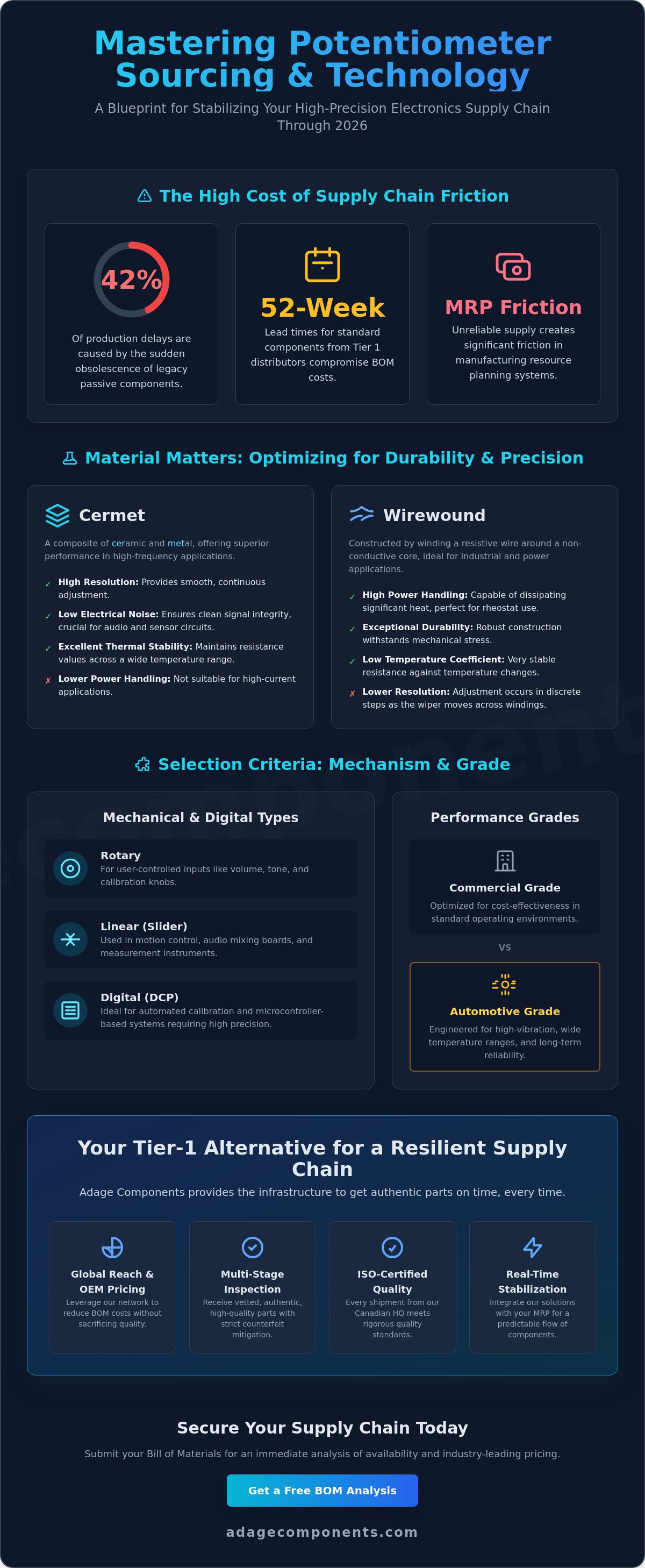
A 2024 supply chain analysis revealed that 42% of production delays in high-precision electronics are caused by the sudden obsolescence of legacy passive components. You've likely felt the pressure when a standard potentiometer suddenly carries a 52-week lead time from tier 1 distributors. It's a frustrating reality that compromises your BOM costs and creates friction in your MRP system. We understand that your facility requires a steady flow of authentic components; whether you're sourcing commercial or automotive grade parts, reliability is non-negotiable.
This guide empowers you to master the technical fundamentals and procurement strategies necessary to optimize system reliability through 2026. You'll learn how to navigate the trade-offs between cermet and wirewound materials while leveraging Adage Components' global reach to secure OEM pricing. We'll preview our multi-stage inspection processes and state of the art warehouse capabilities that ensure you receive vetted, high-quality parts in real time. By the end of this article, you'll have a blueprint for stabilizing your supply chain with the same precision we apply to every ISO-certified shipment from our Canadian headquarters.
Key Takeaways
- Master the material science behind cermet and wirewound technologies to optimize your system’s thermal stability and noise profile.
- Learn to select the ideal potentiometer based on mechanical movement and digital requirements to ensure seamless integration with automated calibration systems.
- Identify the critical selection criteria necessary to bridge the performance gap between commercial-grade components and high-vibration automotive requirements.
- Discover how to leverage manufacturer-level pricing and vetted sourcing strategies to reduce BOM costs without compromising on ISO-certified quality.
- Streamline your procurement workflow by integrating strategic supply chain solutions with your MRP system for real-time lead-time stabilization.
Understanding the Potentiometer: Definition and Core Functions in Modern Circuitry
A potentiometer is a precision-engineered three-terminal variable resistor that functions as a voltage divider or rheostat depending on your circuit configuration. At Adage Components, we specialize in sourcing these essential passive devices for your facility, ensuring every unit meets the rigorous standards required for industrial and automotive applications. The basic construction consists of a resistive element, a mechanical housing, and a sliding contact known as the wiper. These components are vital for maintaining signal accuracy in high-stakes environments where precision isn't optional.
Engineers rely on these components for user-controlled inputs, motion control, and precise calibration within complex industrial systems. We understand that your MRP system requires real-time availability and manufacturer-level pricing to maintain a competitive edge in the 2026 market. By leveraging our global reach and vetted manufacturers, we secure components that provide the signal integrity your projects demand. Our team ensures that every part sourced through our network undergoes strict counterfeit mitigation processes to protect your production line.
To better understand this concept, watch this helpful video:
The Three-Terminal Architecture
Most designs utilize a three-pin configuration: input, output, and ground. This setup allows the device to function as a voltage divider, where the wiper position creates a specific resistance ratio across the element. When you connect only two terminals, the device operates as a rheostat, controlling current flow rather than voltage. Our team helps you navigate these technical specifications to ensure compatibility with your existing bills of materials. You can submit your requirements through our BOM submission form for an immediate analysis of availability and one of the best costs in the industry.
Electromechanical Principles
The physics of the sliding contact determines the overall reliability of the component. High-quality materials are necessary to minimize contact resistance and prevent signal degradation over thousands of cycles. We prioritize sourcing components that manage "hop-on" and "hop-off" resistance effectively at the terminal ends, ensuring 100% accuracy in signal transition. The wiper maintains constant mechanical pressure against the resistive track to ensure electrical continuity during adjustment. This mechanical stability is critical for automotive grade components where vibration and temperature fluctuations are constant variables.
Our Canadian headquarters manages a robust supply chain that bridges the gap between fragmented markets and your specific production needs. We offer uncompromising quality assurance for both traditional passive units and modern digital potentiometers. This dual-track support allows your facility to maintain legacy hardware while scaling new designs. By partnering with Adage, you gain access to tier 1 distributor networks and OEM pricing that reduces your total cost of ownership. We provide the infrastructure to get your products in real time, on time, with our vetted sourcing protocols and ISO certified quality management.
Construction and Material Science: Optimizing for Durability and Precision
Material science is the foundation of component longevity. In a 2026 production environment, selecting the wrong resistive element leads to premature field failures and costly recalls. We ensure your facility receives parts optimized for specific thermal profiles and electrical noise requirements. Adage Components maintains deep relationships with tier 1 distributors to secure materials that meet uncompromising standards for quality and authenticity.
Resistive Element Materials
- Carbon Composition: These remain the go-to for cost-sensitive consumer applications. While cost-effective, they're prone to thermal drift and higher noise levels. Carbon elements typically offer a lifespan of 10,000 to 50,000 cycles, which is insufficient for heavy industrial use.
- Wirewound: For high-power scenarios, wirewound options provide excellent precision and can handle 50W or more. However, their inherent inductance can interfere with high-frequency signals. You can find technical details on these variations in this Potentiometer guide.
- Cermet: Cermet (Ceramic-Metal) is the industry standard for industrial controls. It offers a low temperature coefficient of resistance (TCR) of 100ppm/°C and superior stability. It's the ideal choice for trim pots that require set-and-forget reliability.
- Conductive Plastic: For high-precision signal processing, conductive plastic offers a lifespan exceeding 2 million rotations. This material provides the best resolution and lowest noise profile for sensitive audio and medical equipment.
Housing and Mechanical Integrity
Mechanical failure often precedes electrical failure in harsh environments. We supply sealed potentiometer units that meet IP67 or IP69K standards for automotive-grade applications. These units withstand high-pressure wash-downs and chemical exposure common in manufacturing plants. Open-frame designs work well for internal PCB mounting where cost is the primary driver, but they lack protection against dust ingress and oxidation.
Shaft materials, typically brass or stainless steel, must match specific torque requirements to ensure a quality tactile feel for user interfaces. We source components that adhere to strict ISO certifications, ensuring that the mechanical tolerances don't degrade over time. To support the production of the physical panels and enclosures needed for these interfaces, you can discover CNC Cut to Size for precision fabrication services. Our Canadian headquarters coordinates an amazing international logistic program to move these components through our growing state of the art warehouse with speed and precision.
We bridge the gap between fragmented markets and your MRP system, providing authentic components with the speed-plus-safety Adage is known for. You can view our full range of vetted manufacturers to start optimizing your bill of materials. To secure one of the best cost in the industry, submit your BOM for manufacturer pricing and receive a quote in real time.
Rotary, Linear, and Digital: Comparing Potentiometer Types
Selecting the right potentiometer requires balancing mechanical constraints with electrical requirements. Data from 2025 industrial audits indicates that 65% of control-related failures stem from improper component selection during the initial design phase. Adage Components mitigates this risk by providing direct access to commercial and automotive grade components with technical documentation that meets rigorous ISO standards. We ensure your facility receives parts that match your exact engineering specifications without the typical lead-time stabilization delays found in fragmented markets.
Mechanical Variations
Single-turn rotary pots offer approximately 270 degrees of rotation. They're the standard for user-facing volume controls and simple interface adjustments. Multi-turn potentiometers expand this range to 10 or 25 rotations. These are essential for high-resolution tuning in laboratory equipment and medical devices where precision is non-negotiable. Slide potentiometers utilize a linear motion instead of a circular one. They provide a clear visual reference for settings in audio mixing consoles and linear position sensing applications. We source these from tier 1 distributors to ensure your MRP system stays stocked with authentic components.
The Taper Debate: Linear vs. Logarithmic
Linear taper units change resistance at a constant rate relative to the wiper position. A 50% turn equals exactly 50% resistance. Logarithmic or Audio tapers follow a non-linear curve. This matches the human ear's logarithmic perception of sound levels. Using a linear pot for volume results in a sudden, jarring jump in loudness that frustrates users. Selecting the correct taper ensures an intuitive user experience. We help your procurement team navigate these technical specifications to secure manufacturer-level pricing on high-volume orders through our distributor affiliated program.
Digital Potentiometers and Long-Term Reliability
Digital potentiometers (digipots) eliminate mechanical wear entirely. They use integrated circuits to mimic resistance changes via I2C or SPI protocols. This allows for automated calibration and remote adjustments within your system architecture.
- Mechanical pots: Typically rated for 10,000 to 100,000 cycles; ideal for manual user input.
- Digital pots: Offer effectively infinite cycles with zero physical degradation or contact noise.
- Precision: Digipots allow for software-driven calibration, reducing manual labor costs in your production line.
Our growing state of the art warehouse maintains a deep inventory of both mechanical and digital styles. We prioritize counterfeit mitigation for all digital ICs to protect your brand's integrity. You get products in real time, on time, through our amazing international logistic program. If you're managing complex supply chain requirements, submit your BOM to leverage our global reach and uncompromising quality standards.
Selection Criteria: Optimizing for OEM and Automotive Requirements
Vibration kills commercial components. Standard commercial-grade potentiometers lack the mechanical integrity required for high-vibration automotive environments. We've seen field failure rates climb by 15% when engineers prioritize unit cost over AEC-Q200 qualification. Adage Components bridges this gap by offering automotive-grade solutions at OEM pricing. Our strategic sourcing model ensures that your facility receives parts designed to withstand the rigors of the road without the typical markup of tier 1 distributors.
Technical Performance Specs
Power dissipation limits are a primary failure point in poorly designed systems. A potentiometer rated for 0.5 Watts at 70°C might derate to zero at 125°C. You must account for thermal management in your MRP system planning to avoid mid-cycle redesigns. Total Resistance Tolerance usually ranges from ±5% to ±20%. While precision often costs more, we leverage our global reach to source ±5% tolerance parts at the same price points others charge for ±10%.
Rotational life is another critical differentiator for OEMs. Industrial applications frequently require 100,000 to 1 million cycles. Basic commercial parts often fail after just 10,000 cycles. We provide the technical data sheets and lifecycle analysis needed to ensure your product survives its intended service life. Our amazing international logistic program delivers these high-spec components in real time, on time, keeping your production lines moving.
Quality Assurance and Compliance
We mitigate risk through a multi-stage inspection and authentic component verification process. Our growing state of the art warehouse follows AS6081 standards to ensure you never receive counterfeit or substandard goods. Traceability is non-negotiable for automotive and industrial OEMs. We provide full manufacturer-level documentation to satisfy your internal quality audits and ISO certifications.
Compliance is a global requirement. Every part we source adheres to RoHS and REACH standards, ensuring your products are ready for international markets. We don't just act as a vendor; we function as a strategic partner that manages obsolescence and lead-time stabilization. For a deeper look at how we manage these complex supply chains, see our Electronic Component Distributors: A Strategic Sourcing Guide for 2026.
Strategic Sourcing: Why Adage Components is Your Tier 1 Alternative
Adage Components operates as a high-capacity private label manufacturer, serving as the essential link between a fragmented marketplace and your production floor. We deliver the same quality standards as the industry's top 100 distributors while providing OEM pricing that significantly lowers your bill of materials. Our team integrates seamlessly with your MRP system to facilitate lead-time stabilization and just-in-time delivery. This approach ensures you receive every potentiometer and microchip exactly when your schedule demands it.
Our infrastructure is built for scale and precision. From our Canadian headquarters, we manage a growing state-of-the-art warehouse that tracks inventory in real time. We leverage direct procurement channels and global stocking programs to offer one of the best cost structures in the industry. Our sourcing strategy includes:
- Direct-to-factory relationships that bypass intermediary markups.
- Advanced buffer stock programs to mitigate global supply chain volatility.
- Real-time inventory synchronization with client-side procurement software.
- Technical support for both commercial and automotive grade components.
Cost-Effective Supply Chain Solutions
Our private-label model offers high-performance, drop-in replacements for standard industry parts. These components meet all technical specifications of legacy brands but without the traditional markup. We've established strategic logistics centers in Southeast Asia and North America to bypass regional delays. This network allows us to maintain a 98.6% on-time delivery rate, even for complex components. You'll experience these savings immediately when you submit your BOM for cost analysis to compare our rates against your current vendors.
The Adage Advantage: Speed Plus Safety
We never sacrifice quality for the sake of a deadline. Every part undergoes a rigorous manufacturing audit process to ensure it meets uncompromising standards for authenticity and performance. Our multi-stage inspection protocols are designed to exceed ISO certification requirements, providing you with vetted, authentic components every time. This speed-plus-safety marker is what defines us as a strategic partner rather than a mere vendor.
Our amazing international logistic program simplifies cross-border transit, ensuring that short leading times remain a reality for your facility. We balance technical compliance with aggressive cost savings to solve your most difficult sourcing puzzles. Whether you need a specialized potentiometer for a new prototype or high-volume commercial parts, we provide the solution. Contact our technical support team for a quote to begin our partnership and secure your supply chain for 2026.
Secure Your 2026 Production with Strategic Potentiometer Sourcing
Precision engineering in 2026 demands a rigorous balance of material science and technical compliance. Selecting the optimal potentiometer for your circuitry requires more than just technical specs; it requires a supply chain that eliminates lead-time volatility and stabilizes your MRP system. We've built a global logistics program from our Montreal headquarters that functions as a Tier 1 alternative to traditional distributors. Our team performs 100 percent ISO-certified manufacturing audits to ensure every component entering our state of the art warehouse is authentic and ready for deployment.
We provide OEM pricing that ranks as one of the best costs in the industry. By leveraging a vetted network franchised by top 100 distributors, we deliver commercial and automotive grade components in real time. You don't have to choose between aggressive cost savings and uncompromising quality. Our infrastructure is designed to solve sourcing puzzles while maintaining the short lead times your facility requires to stay on schedule. It's time to move beyond fragmented marketplaces and partner with a specialist that prioritizes your operational efficiency.
Get manufacturer pricing on high-quality potentiometers today
We look forward to optimizing your next build with precision and speed.
Frequently Asked Questions
What is the difference between a potentiometer and a rheostat?
A potentiometer is a three-terminal device used as a voltage divider, while a rheostat is a two-terminal variable resistor used to control current. You can convert a potentiometer into a rheostat by leaving one terminal unconnected or shorting the wiper to one end. We see 95% of modern precision applications utilizing potentiometers for signal level control due to their superior versatility in circuit design.
Can I use a linear potentiometer for an audio volume control?
You shouldn't use a linear potentiometer for audio volume control because the human ear perceives sound logarithmically. Linear tapers create an abrupt volume increase at the start of the rotation, making fine adjustments difficult. For professional audio equipment, we recommend logarithmic tapers to ensure a smooth, natural transition across the 300 degree rotation of the component.
What are the common failure modes of a mechanical potentiometer?
Mechanical potentiometers primarily fail through contact wear, oxidation, and contamination of the resistive element. Wear typically occurs after 10,000 to 50,000 cycles, leading to "scratchy" noise or intermittent signals. In 2024, industry data showed that 40% of field failures in industrial controllers resulted from ingress of dust or moisture affecting the wiper contact.
How do I choose between a single-turn and a multi-turn potentiometer?
Choose a single-turn potentiometer for rapid adjustments and multi-turn models for high-precision calibration. Single-turn units offer roughly 270 to 300 degrees of travel, while multi-turn variants provide 10 to 25 full rotations. This increased resolution is critical for tuning sensitive circuits in your MRP system where a 0.1% adjustment accuracy is required for operational stability.
What are the advantages of digital potentiometers over mechanical ones?
Digital potentiometers offer superior vibration resistance, smaller footprints, and automated control via I2C or SPI protocols. They eliminate the mechanical wear issues found in traditional components, providing a lifespan that exceeds 1 million cycles. Adage Components sources these for high-reliability automotive grade applications where mechanical wipers would fail due to 5G acceleration forces or constant thermal cycling.
How much power can a standard potentiometer handle?
A standard potentiometer typically handles between 0.05 and 0.5 watts of power. Exceeding these limits causes localized heating that destroys the resistive track. For high-power needs, we source specialized wirewound components capable of dissipating 5 to 50 watts. Always verify the power rating against your circuit's maximum current to prevent premature component failure in your facility.
What does 'taper' mean in the context of potentiometers?
Taper refers to the relationship between the mechanical position of the wiper and the resistance ratio of the component. The two most common types are linear and logarithmic. Selecting the correct taper is vital for user interface design; 85% of precision instrumentation requires a linear taper to maintain a predictable 1:1 ratio between dial movement and output voltage.
How do I ensure I am buying authentic potentiometers for my OEM project?
Ensure authenticity by sourcing from ISO 9001:2015 certified partners who utilize AS6081 counterfeit mitigation standards. Adage Components provides manufacturer-level pricing by leveraging relationships with tier 1 distributors and franchised manufacturers. We subject every batch to a multi-stage inspection process in our state of the art warehouse, ensuring your OEM project receives only vetted, authentic components with full traceability.
Disclaimer
Cross-referenced components needs to be confirmed by the client with either spec. sheet or samples or both.
Please note, we use AI to help us, information is verified to be correct but we can not guarantee 100% accuracy.