

The safest incoming-inspection plan isn’t automatically the one that checks every component. AQL sampling standards for incoming passive component inspection use a defined sample and acceptance criteria to decide whether a lot passes. AQL describes the worst tolerable quality level, not a promise that every accepted lot is defect-free.
It’s reasonable to want complete certainty when resistors, capacitors, or other components enter production. But sampling and 100% inspection serve different purposes: sampling assesses a lot through selected units, while 100% inspection examines every unit and requires more inspection effort.
This guide explains how AQL plans set sample sizes and acceptance or rejection limits, when special inspection levels may suit a check, and how to weigh sampling against inspecting every part. It also explains why lot size, defect type, and inspection risk matter when setting an incoming-inspection approach.
Key Takeaways
- Read AQL as a lot-acceptance threshold, not a guarantee that every component in an accepted lot is defect-free.
- Use the lot size, chosen AQL, and inspection level together to determine the sample size and the accept-or-reject limits.
- Match special inspection levels to the inspection’s purpose, particularly when checks are destructive or require a different sample size.
- Classify defects as critical, major, or minor so acceptance criteria reflect their impact on safety, function, and usability.
- Compare sampling with 100% inspection based on lot risk and inspection effort; critical parts or uncertain supplier quality may call for tighter checks.
What is Acceptable Quality Level (AQL)?
Acceptable Quality Level (AQL) is the worst tolerable quality level used to set lot-acceptance criteria. Applying AQL sampling standards for incoming passive component inspection means using a defined sample and decision rules to assess a batch instead of checking every unit.
AQL Batch Acceptance Decisions
AQL batch acceptance decisions use sample results to accept or reject a lot. This gives incoming quality control a consistent way to handle component deliveries without fully inspecting every batch.
For an illustrative 1% AQL, a lot of 100 widgets allows no more than one defective item under the example rule. This does not mean every accepted lot contains exactly one defect or that its uninspected items are defect-free. The example shows how an agreed quality limit guides acceptance.
For passive components, the plan identifies the lot and defines the defect criteria. AQL tables connect lot size and the selected quality limit to a sample size and decision numbers. MIL-STD-105E and ANSI/ASQ Z1.4-2003 (R2018) are examples of standards used for attribute sampling.
Sample Sizes and Decision Numbers
The sample size is the number of units inspected; acceptance and rejection numbers set the lot’s decision boundary. These values matter because different settings can produce different outcomes from the same defect count.
For code letter L at AQL 2.5, the example plan samples 200 units. The lot passes with 10 or fewer failed units and is rejected with 11 or more. At code letter J and AQL 2.5, the acceptance number is 5 defects and the rejection number is 6.
These examples show why an AQL value alone cannot determine a lot’s result. Read it alongside the code letter, sample size, and acceptance or rejection numbers. Lot size and inspection level can change the applicable sample and thresholds.
Accept and Reject Points
Acceptance and rejection points define the sample defect counts that pass or fail a lot. They turn inspection findings into a decision based on the selected plan’s stated limits.
With an acceptance number of 5 and a rejection number of 6, a sample with five or fewer defects passes; six or more rejects the batch. For teams applying AQL sampling standards for incoming passive component inspection, the selected plan’s thresholds make the decision consistent across component lots.
In a 5,000-unit electronic-component delivery inspected at AQL 0.65%, the example sample contains 200 parts. Its acceptance number is 7 defects, and its rejection number is 8. Finding 5 defective parts means the lot passes under that plan, without proving every uninspected part is defect-free.
When should you use special inspection levels instead?
Special inspection levels suit checks with a specific purpose, such as destructive testing or a narrowly defined functional test. Select the sample size by considering lot size, acceptable quality level, inspection level, and inspection severity.
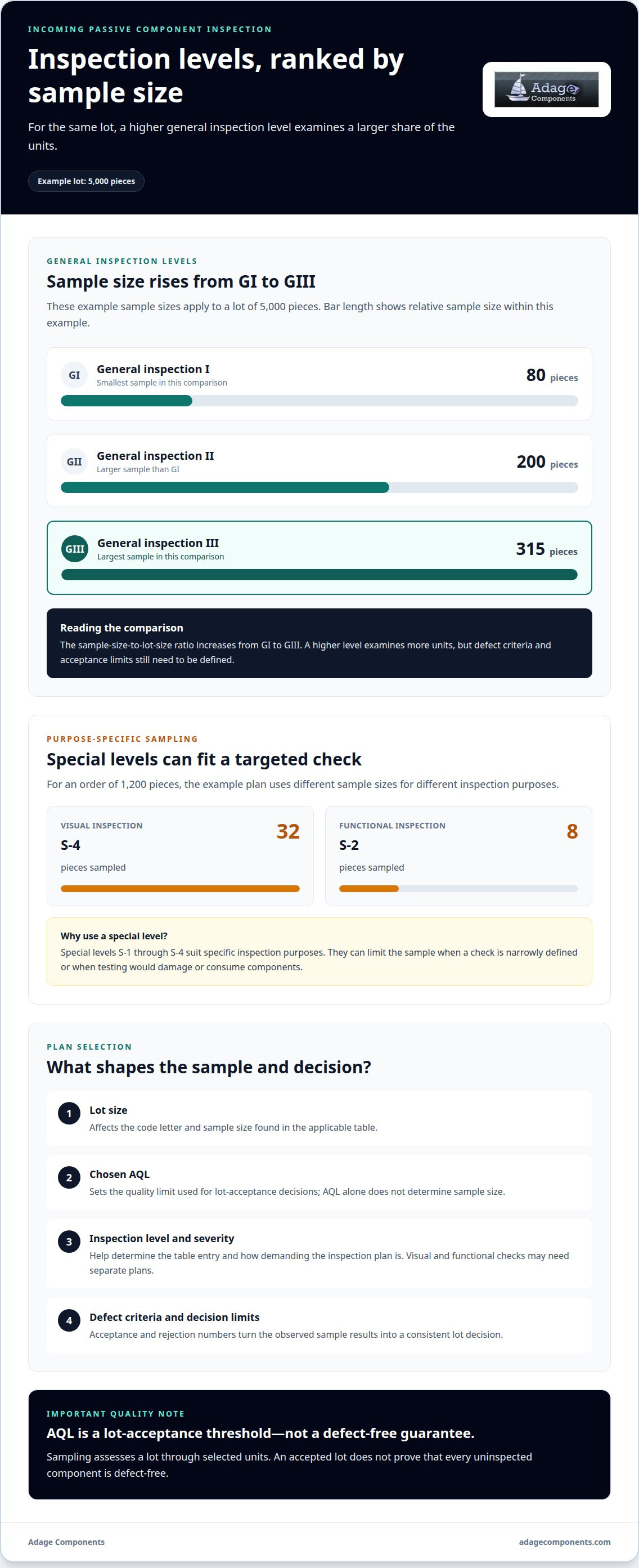
General inspection levels GI, GII, and GIII provide different sample sizes for a given lot. The sample-size-to-lot-size ratio increases from GI to GIII, so GIII examines a larger share than GI. Choose a level based on the assurance needed and the inspection effort practical for the incoming lot. A higher level means more units are examined, but it does not replace the need to define defect criteria and acceptance limits.
Special levels S-1 through S-4 are used mainly for specific inspection purposes. They can be useful when a check should be limited, or when inspecting every unit would damage or consume components. For an order of 1,200 pieces, the example plan calls for 32 pieces for visual inspection at S-4 and 8 pieces for functional inspection at S-2. The different sample sizes reflect different inspection purposes.
Lot size affects the code letter and sample size found in the applicable table. For a lot of 5,000 pieces, GI uses a sample of 80 pieces, GII uses 200, and GIII uses 315. These figures illustrate the levels’ relative sampling intensity. They are not universal sample sizes: the selected lot-size range and inspection level determine which table entry applies.
AQL shapes the plan, but it does not determine sample size by itself. Table selection combines lot size, the chosen acceptable quality level, and inspection severity. Severity reflects how demanding the inspection plan is, while the AQL setting determines the quality limit used for acceptance decisions. Incoming components may therefore need separate plans for visual and functional checks.
Use a special level when the inspection task, rather than routine lot coverage, drives the sampling decision. Destructive checks are a clear example: testing a small, targeted sample can provide information without consuming the entire lot. For non-destructive checks on routine incoming lots, a general level may better suit the need to assess lot quality. Supplier quality history and component risk help determine the appropriate level of inspection assurance.
For component planning, the electronic component line card can help identify the product families relevant to an incoming inspection plan. Match the selected family and inspection purpose with the lot size and applicable table before setting the sample.
What are the benefits of AQL quality control inspections?
AQL quality control accounts for defect severity in the inspection plan. Buyers classify findings as critical, major, or minor, then assign a suitable acceptable quality level to each category. This distinguishes safety and functional risks from cosmetic deviations and gives incoming inspection a consistent basis for lot decisions.
A critical defect can breach a mandatory requirement or affect end-user safety. For critical findings, example guidance uses an AQL of 0% to 0.1%, with zero tolerance often set in a general consumer-product plan. A major defect can cause product failure or substantially reduce usability or saleability. Typical example settings assign major defects an AQL of 2.5.
Minor defects depart from quality standards but are unlikely to reduce usability or saleability. An example plan uses an AQL of 4 for minor defects. Typical ranges place major defects at 0.65% to 2.5% and minor defects at 2.5% to 4.0%. These are planning examples, not universal thresholds; the product’s risk and inspection criteria determine the setting.
- Critical: A defect affecting safety or mandatory compliance, commonly assigned a zero-acceptance setting.
- Major: A defect affecting function, reliability, or saleability, with 2.5 as an example AQL.
- Minor: A non-functional deviation, with 4 as an example AQL.
Separate categories help buyers set priorities instead of treating every defect alike. For example, a component that fails its required function is more consequential than a minor marking variation. Distinct acceptance criteria make quality control more targeted, while recording defects by category helps teams interpret results consistently across lots.
AQL also supports measurable inspection performance. Track the number of units inspected, defects found by category, lots accepted or rejected, and recurring defect types. These measures show whether incoming supplier quality is stable or changing. A rise in major defects, for example, signals a different operational concern than recurring minor appearance issues.
For useful KPIs, keep the inspection method and defect definitions consistent across comparable lots. Buyers can then compare defect counts and lot outcomes over time, identify recurring supplier issues, and adjust inspection severity as risk changes. AQL does not eliminate defects; it structures how teams classify them and act on the evidence collected.
Tightened, normal, and reduced sampling plans
Sampling severity determines how closely an incoming lot is examined. A documented plan links the selected severity, AQL, and acceptance criteria to the inspection objective.
Sampling Plan Severity Options
ANSI/ASQ Z1.4 provides tightened, normal, and reduced attribute sampling plans. Normal inspection is the starting condition in many lot-by-lot plans; tightened inspection increases scrutiny, while reduced inspection uses less sampling under the applicable plan.
These options matter when supplier performance or incoming risk changes. Buyers can document the selected plan, the conditions for changing severity, and who approves that change. For passive-component suppliers, record the component or part family, lot identification, defect categories, AQL settings, inspection level, and decision criteria. This creates an objective record for each acceptance decision.
Single Sampling at Normal Severity
A single-sampling plan inspects one sample and determines lot acceptance from its results. ISO 2859-1:2026 specifies single, double, and multiple sampling plans for attribute inspection, indexed by AQL for lot-by-lot inspection.
For a normal-severity example, a lot of 1,000 pieces at level II uses a sample of 80 pieces. The sample size and AQL table determine the acceptance number; inspection findings are compared with that number to decide the lot outcome. A larger lot does not necessarily require a proportionally larger sample, so buyers should use the applicable table rather than a fixed sampling percentage.
To implement and review a plan, buyers should document its standard and edition, lot-size basis, inspection level, defect definitions, AQL values, sample size, and acceptance number. Review those settings when supplier quality evidence or component risk changes, and retain the lot results for comparison.
Comparing Attribute Sampling Standards
ANSI/ASQ Z1.4-2003 (R2018) covers attribute inspection on a continuing stream of lots at a specified AQL. ISO 2859-1:2026 specifies single, double, and multiple plans for lot-by-lot inspection; MIL-STD-105E is another named reference used for sampling tables. These descriptions identify their stated scope without treating the standards as interchangeable.
Current official tables are published in the applicable ISO or ANSI/ASQ standards; use the edition named in the purchasing or quality requirement. Prices depend on the standard and edition, so consult the issuing organization’s current listing for the relevant document.
For a clear supplier requirement, specify the standard and edition, inspection level, AQL by defect category, and lot decision criteria. Include the sampling-plan type and how changes between tightened, normal, and reduced inspection will be recorded.
AQL sampling compared with 100% inspection
Choosing between AQL sampling and 100% inspection means balancing coverage, risk, and inspection effort. AQL sampling standards for incoming passive component inspection apply a defined sample and acceptance criteria to assess a shipment; 100% inspection examines every unit. ISO 2859 uses lot size, selected quality level, and inspection severity to determine the plan, rather than applying the same inspection percentage to every delivery.
Consider a shipment of 5,000 electronic components inspected at AQL 0.65%. The example plan inspects 200 parts, or 4% of the shipment. That reduces inspection workload compared with checking every component, while still applying a defined lot-acceptance rule. The sample size does not rise in direct proportion to lot size, because the applicable table sets the sample needed for the chosen plan.
AQL sampling is practical for large lots when inspection is non-destructive and supplier quality is established. It gives procurement and quality teams a repeatable way to assess incoming lots without inspecting each part. The selected AQL also distinguishes defect tolerance by category. For example, buyers may set different acceptance criteria for major and minor defects to reflect their different effects on function and usability.
Full inspection can be more suitable for critical safety parts, small lots, or new suppliers. It may also apply when an AQL table indicates 100% inspection because the required sample equals or exceeds the lot size. This approach checks each unit, but requires inspection capacity for the complete shipment. For passive components, the decision should reflect the consequence of a missed defect and the inspection method’s ability to detect it.
A fixed inspection percentage is not a substitute for a sampling plan. ISO 2859-10 clause 4.3.3 addresses why choosing a fixed percentage is discouraged. A set percentage can overlook how lot size, AQL, and inspection severity combine to define a statistically based sample. Applying AQL sampling standards for incoming passive component inspection means using the applicable table and documented acceptance criteria to make the decision traceable.
Use AQL when a planned sample provides suitable coverage for the lot and its risk profile. Use 100% inspection when every unit requires examination, or when the table’s sample reaches the full lot. Neither method alone defines defect priorities: buyers still need clear criteria for critical, major, and minor findings, plus a consistent way to record shipment results.
For each incoming component family, align the inspection method with the risk of missing a defect and the consequences for production. This keeps inspection effort focused on the quality decision the shipment requires.
Adage Components
Adage Components supports sourcing for incoming passive components with authentic components from vetted manufacturers and partner suppliers, many franchised by top 100 distributors. We support commercial and automotive grade components and compliance with all ISO certifications. Our amazing international logistics program and growing state-of-the-art warehouse support short lead times and are perfect for your MRP system, helping components reach your facility in real time, on time.
For Thick Film Chip Resistors, Thin Film Precision Resistors, and Carbon Film Resistors, get manufacturer pricing, one of the best costs in the industry, and the same advantages as buying from tier 1 distributors, but at OEM pricing. Contact Adage Components to discuss your sourcing requirements.
Turn inspection criteria into a sourcing decision
Make incoming quality criteria part of the sourcing decision, not a separate receiving document. Align component requirements, defect definitions, and purchasing records so quality and procurement teams share the same expectations. Consistently applying AQL sampling standards for incoming passive component inspection can help maintain that alignment as sourcing requirements evolve.
Use inspection criteria to guide supplier discussions and internal approvals. Record who owns changes to the requirements and how those changes are communicated across purchasing and receiving. This gives your team a practical foundation for managing component sourcing with discipline.
With clear requirements in place, you can move forward with a focused sourcing plan. Keep quality expectations visible throughout the decision process and give your team a clear basis for evaluating its next component need.
Frequently Asked Questions
What is an AQL Inspection?
An AQL inspection is an acceptance-sampling procedure that evaluates a lot using a selected sample and decision criteria. For passive components, define observable or measurable defects before inspection, such as a marking issue or a value outside the specified requirement. The inspector records findings against those criteria, then applies the plan’s acceptance rule. This makes incoming-lot decisions repeatable across shifts and shipments.
How do AQL inspection levels compare to 100 percent inspection?
AQL inspection examines a sample; 100 percent inspection examines every unit in the lot. Sampling can suit large, non-destructive checks, while full inspection may better fit a small lot or a critical safety part. Consider whether the inspection method can reliably detect the defect and whether checking every component is practical. Sampling reduces inspection effort, but it cannot establish that every uninspected unit is defect-free.
How is AQL calculated?
AQL is not calculated by dividing observed defects by the number of units inspected. The plan uses a chosen AQL setting alongside lot size and inspection level to select a sample and its decision limits from the applicable tables. After inspection, count the defects and compare that count with the plan’s acceptance and rejection numbers. The table, not a standalone percentage calculation, determines the lot decision.
What Does AQL Mean?
AQL means Acceptable Quality Level. In acceptance sampling, it describes the quality level treated as the worst tolerable for a continuing process or lot-by-lot inspection plan. It is a parameter for setting sampling decisions, not a claim that every accepted delivery will contain a particular defect rate. For procurement teams, recording the AQL alongside defect definitions makes a supplier quality requirement clearer and easier to apply consistently.
What Is ISO 2859-1:2026?
ISO 2859-1:2026 specifies single, double, and multiple sampling plans for inspection by attributes, indexed by AQL for lot-by-lot inspection. Attribute inspection classifies units or findings into categories, rather than assessing a measured variable as a continuous value. A purchaser applying this standard should identify the plan type and inspection settings in the quality requirement, so the supplier and receiving team use the same decision framework.
Which AQL sampling standards apply to incoming inspection of passive electronic components?
Commonly referenced attribute-sampling standards include ISO 2859-1, ANSI/ASQ Z1.4-2003 (R2018), and MIL-STD-105E. The applicable choice depends on the purchasing specification and the quality system governing the lot. State the chosen standard and edition in the inspection requirement, then align its AQL, inspection level, defect categories, and plan type. This prevents teams from applying tables from different references to one shipment.
How do lot size and inspection level determine sample size under ANSI/ASQ Z1.4?
Under ANSI/ASQ Z1.4, identify the lot-size range and selected general inspection level, then use the table to find the corresponding code letter. Use that letter with the selected AQL and sampling-plan type to determine the sample size and decision numbers. For example, a shipment of 4,000 units maps to code letter L at General Inspection Level II in the stated table example. The chosen AQL is also required to complete the plan.
How do acceptance and rejection numbers work in single-sampling AQL plans?
In a single-sampling plan, inspect one sample and compare its defect count with the plan’s acceptance and rejection numbers. For letter code N at AQL 4, the stated example sets acceptance at 21 and rejection at 22. A count at or below the acceptance number passes the lot; a count at or above the rejection number rejects it. Use the figures from the selected table entry, not another plan’s thresholds.
Disclaimer
Cross-referenced components needs to be confirmed by the client with either spec. sheet or samples or both.
Please note, we use AI to help us, information is verified to be correct but we can not guarantee 100% accuracy.


