

Eliminating passive component delivery bottlenecks in high-mix manufacturing starts with finding the current constraint, tracing where materials wait, and improving that point before speeding up other stages. Automation can help with repetitive tasks, but it is most effective when it targets a confirmed source of delay.
Frequent changeovers, varied routes, and shifting demand make delivery delays hard to trace to a single cause. A queue at one workstation may reflect a constraint elsewhere, while inaccurate inventory records or poor material sequencing can leave production waiting even when capacity is available.
This article explains how to identify bottlenecks using cycle times, work-in-progress queues, and dwell-time data. It also covers how automation, better material coordination, and constraint-focused improvements can strengthen flow without simply pushing more work into the system.
Key Takeaways
- Trace delivery delays across material, information, and work flows instead of assuming the most visible queue is the root cause.
- Use cycle times, queue lengths, and dwell-time data to locate where work waits and identify changing constraints.
- Automate repetitive handling and replenishment tasks where they remove a demonstrated source of delay.
- Apply the Theory of Constraints by improving the current limiting operation, then reassessing flow as constraints shift.
- Adapt lean methods, routing, and material coordination to the product mix and changeover demands of each job shop.
Automation for repetitive tasks and material handling
In high-mix production, material handling, equipment, labor, or process constraints can interrupt the next operation. Automation helps most when it removes a specific delay rather than speeding up a process that is already waiting.
Start by tracing a delayed order from receiving through storage, kitting, and the production process. If materials enter a shop-floor example at 100 units per hour but downstream operators still wait, investigate inventory accuracy, receiving delays, and sequencing before increasing machine speed. Each can create a material bottleneck even when the parts have arrived at the facility.
Automate repetitive scans, replenishment signals, and the movement of standard work-in-progress carriers when those tasks repeatedly interrupt production. Inventory systems can flag parts running low, while Kanban provides a visual signal to replenish material. These controls reduce searching and manual coordination, but depend on accurate part records and clearly defined replenishment points.
When comparing electronic component sources, assess quoted availability, price, delivery terms, and traceability records for the exact part. Manage counterfeit risk through source vetting, component inspection, and lot documentation rather than assuming any channel is risk-free.
For passive-component demand forecasting in high-mix, low-volume production, combine the current schedule and bill of materials with order changes, lead-time information, and recorded consumption. Review exceptions when a design change or revised build sequence changes which parts are needed, then update planned requirements before kitting begins.
Managing Inventory and Material Readiness
Material readiness means having the correct parts available, identified, and sequenced for the operation that needs them. Safety stock can buffer uncertain demand or deliveries, while consignment can align replenishment with consumption under agreed inventory terms. Both require visibility into usage and responsibility for replenishment.
Sequence kits to match the production schedule, and use low-stock signals to replenish parts before a build reaches the point of use. The National Institute of Standards and Technology notes that manufacturers can hold goods as a buffer against shortages caused by uncertain deliveries and demand. Set the buffer using item criticality, supply variability, and carrying-cost exposure.
Improving Kitting and Feeder Setup
Kitting groups components for a specific job, while feeder setup places the required reels in their assigned positions for surface-mount technology production. A controlled workflow links the work order, part number, lot, kit location, and feeder assignment so operators can identify mismatches before a run starts.
Use barcode or scan-based checks at picking, kit release, and feeder loading, then record substitutions and quantities against the production run. The U.S. Consumer Product Safety Commission identifies lot numbers, product codes, production volumes, and component parts or substitutes used in each run as production-record details. This traceability supports investigation when a shortage, setup error, or rework disrupts flow.
Keep automation focused on the constraint revealed by these records. A flow-path map can expose excess travel between receiving, storage, and SMT lines; rearranging replenishment points or grouping commonly used materials can shorten handoffs. In high-labor-cost plants, technicians may spend 10-15% of a shift searching for work-in-progress carriers, calibrated tools, or fixtures. Standard locations and automated location signals target that avoidable search time while preserving operator oversight.
Manufacturing bottlenecks and the Theory of Constraints
Production output follows the slowest active constraint, not the fastest individual station. The Theory of Constraints focuses improvement on that limiting point across the value stream.
Applying the Theory of Constraints
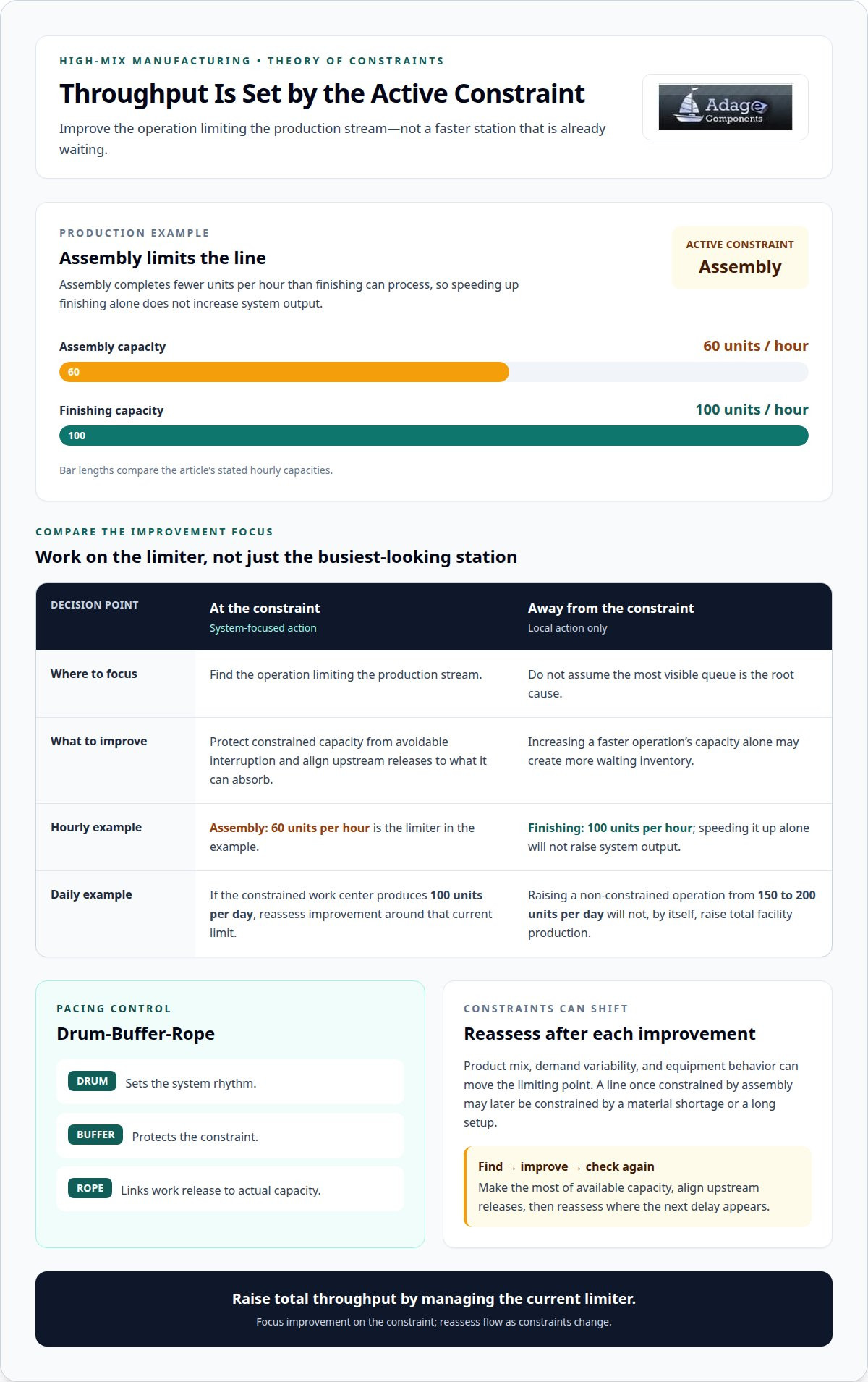
The Theory of Constraints is a method for improving total throughput by identifying and managing the operation that limits the production stream. In synchronous manufacturing, other stations are paced to support that constraint instead of maximizing local utilization. For example, if assembly completes 60 units per hour and finishing can process 100, speeding up finishing alone won’t increase system output. It may only create more waiting inventory.
Applying this approach means protecting the constrained station from avoidable interruption and releasing work at a pace it can absorb. Drum-Buffer-Rope provides that pacing control: the drum sets the system rhythm, a buffer protects the constraint, and the rope links release to actual capacity. The buffer can hold work or material, including goods held against uncertain deliveries and demand.
Managing Shifting Constraints
Continuous constraint management is the ongoing cycle of finding the current limiter, improving it, and checking where the next delay appears. This matters because product mix, demand variability, and equipment behavior can shift the constraint. A line once limited by assembly may become limited by a material shortage or a long setup after the schedule changes.
Use current performance indicators to reassess the value stream after each improvement. If the constrained work center produces 100 units per day, raising a non-constrained operation from 150 to 200 units per day won’t raise total facility production by itself. That improvement may still help locally, but the next action should focus on the current constraint.
Once the active constraint is clear, use a focused improvement cycle: make the most of available capacity, align upstream releases, and decide whether added capacity or process changes are justified. For a setup constraint, teams can prepare tools and materials before changeover. For a labor constraint, cross-training can help maintain coverage at a bottleneck-prone station. Match each intervention to observed waiting rather than applying a standard fix.
After relieving a constraint, measure throughput and waiting again. The bottleneck may move, so a previous solution can become less relevant as production conditions change. Keep reviewing the new constraint instead of continuing to optimize the former one. For passive-component planning, reviewing component categories can help teams relate supply needs to the operations that depend on them.
Signs of bottlenecks, including work-in-progress queues and overtime
A growing queue before one workstation often signals that inputs arrive faster than the station can process them. Compare the queue with station cycle times and scheduled demand to distinguish a capacity constraint from a temporary production imbalance.
Work-in-progress accumulation shows where production is waiting, but its location matters. Components waiting before SMT placement, for example, may point to a feeder setup delay, a missing kit, or a slower placement operation. Trace the affected work order upstream, then identify when the queue began growing and which handoff failed to keep material moving.
Overtime can provide another clue when the same operation repeatedly needs extra hours to recover the schedule. Compare overtime by station with rework by shift, machine downtime, and queue growth. If one work center shows all three patterns, investigate its process conditions before adding labor elsewhere. Extra hours may clear orders temporarily without fixing the constraint causing the wait.
Passive-component prices, minimum order quantities, and lead times vary by exact part, order quantity, sourcing channel, and current availability. Compare item-specific quotes and committed delivery terms alongside on-time performance and component traceability. A channel label alone does not establish price, supply certainty, or counterfeit risk.
Track a small set of linked measures for each production area. Use consistent definitions and time periods across shifts so trends reflect operations rather than differences in recording.
- Lead time: Record elapsed time from order release to completion, then isolate delays between production steps.
- On-time delivery: Compare promised dates with actual shipment or job-completion dates.
- Work in progress: Record queue size and location, then watch for recurring accumulation before a station.
- Cycle time: Compare actual station performance with takt requirements to reveal where output falls behind demand.
Accurate, timely records turn these measures into an action signal. Real-time analytics can help teams investigate rising cycle times, rework by shift, and growing WIP. A sudden increase in queue length alongside a longer cycle time, for example, points to a station worth examining. A queue that grows only after a material shortage instead suggests a supply or sequencing issue.
Review continuously to test whether an intervention improves flow beyond a single shift. After changing a schedule or task assignment, compare lead time, delivery performance, and WIP at the affected operations. If the queue moves to another station, the constraint has shifted. Let the evidence guide the next action rather than preserving the previous fix by default.
Bottleneck detection and dwell-time tracking
Dwell time measures how long a job, component, or carrier waits between production events. Tracking it alongside machine cycle time helps separate processing delays from idle time and reveals where a complex flow loses capacity.
Start with a consistent sequence of events: material arrival, operation start, operation completion, and transfer to the next stage. Compare timestamps across the production route, then group waiting by station, part, and cause. Repeated delays before a machine may point to unavailable material, while long waits after processing may indicate blocked downstream capacity.
Industrial Internet of Things sensors can identify increased wait times at production stages in real time. Connected equipment can also monitor machine status without waiting for an operator update. Automatically captured idle periods, blocked signals, and missed scans give teams a more frequent view of the process than manual reporting alone.
Use those signals to distinguish a true capacity constraint from a data or handoff problem. In a static example, upstream and downstream processes each manage 80 components per hour. Matching rates do not rule out intermittent waiting: missed scans, transfer delays, or uneven arrivals can still interrupt flow. Check event timing across both stages before assigning the constraint to either machine.
- Record: Capture when a job enters and leaves each operation, including pauses and blocked states.
- Compare: Review dwell time by station and product route to find recurring delays.
- Investigate: Connect the delay to its source, such as a material hold, equipment stop, or transfer issue.
- Reassess: Track throughput and cycle times after a change to see whether the constraint moved.
Digital production data can show bottleneck location, cause, and business impact. One product route may spend more time waiting for a resource than another, even when both use the same equipment. That distinction supports targeted action: correct the material handoff or resource allocation instead of changing the entire production process.
Reporting frequency affects how quickly teams can respond. Facilities with live operational data can identify emerging constraints within hours, while daily reporting may take days or weeks to expose the same issue. Real-time tracking is especially useful when product mix changes frequently and a previously stable station begins to lag.
Keep the tracking system practical. Define dwell events consistently, review exceptions with operators, and assign an owner to each investigation. If a missed scan hides a transfer delay, improve scan discipline; if blocked signals recur, examine the downstream resource. Recheck throughput after making a change, because preventing one delay can expose another constraint.
Bottlenecks in high-mix environments
High-mix, low-volume production combines varied products with small batch quantities, changing routings, and frequent changeovers. That mix complicates capacity planning because actual workloads shift as orders and build requirements change. A schedule that fits one product family may overload shared equipment when another job needs the same station. Teams need to account for route-specific demand, not rely on a single average production rate.
Consider a route where laser cutting processes 300 parts per day, while downstream welding handles 180. Welding limits the route’s output, even if cutting has capacity available for other orders. Value stream mapping can expose this mismatch by showing material and information movement across processes. It also helps reveal where separate product routes compete for shared labor, tooling, or equipment.
Map the actual path for each product family rather than assuming every job follows the same sequence. Compare setup requirements, processing, and handoffs across routes, then identify where they compete for resources. Digital twin platforms can simulate production runs and test proposed changes before implementation. A revised sequence, for example, may ease congestion at one workstation but increase waiting at a shared inspection step.
Lean methods should address the friction points the map reveals. Standard work clarifies recurring tasks, while 5S organizes workspaces to support swift changeovers. Grouping workstations by common processes can reduce movement between operations. These methods must fit the environment: an improvement affecting only a few products may take more effort than it returns. The work of eliminating passive component delivery bottlenecks in high-mix manufacturing should therefore prioritize changes that support the routes with the greatest operational impact.
Scheduling must also reflect material readiness, tool access, and equipment availability at each route’s point of use. Kanban can signal replenishment while helping limit excess inventory. Accurate production information helps job shops sequence orders and respond to changing priorities. After process changes, communicate updated standard operating procedures so teams do not revert to outdated routines on later builds.
Make continuous improvement a measured cycle. Record the current constraint, the change made, and its effect on throughput and lead time. Then reassess as the product mix shifts. For teams focused on eliminating passive component delivery bottlenecks in high-mix manufacturing, this means linking component requirements to the specific routes and build schedules they support, rather than treating every part as equally urgent.
To align component planning with your product mix, explore the available component categories alongside your production routes and material requirements.
Adage Components
Adage Components helps procurement teams align passive-component sourcing with high-mix production needs. We supply authentic components through vetted manufacturers and partner suppliers, many franchised by top 100 distributors. Our range includes Thick Film Chip Resistors, Thin Film Precision Resistors, and Carbon Film Resistors, with manufacturer pricing and OEM pricing designed to deliver one of the best costs in the industry.
We support commercial and automotive grade components and coordinate international logistics to help align supply with your MRP system and production schedule. Our partner network includes manufacturers with certifications such as ISO 9001, IATF 16949, ISO 14001, and QC080000. Short lead times and a growing state-of-the-art warehouse support material planning for your facility.
Contact Adage Components to discuss your component requirements and sourcing needs.
Connect Sourcing Decisions to Your Next Production Plan
Make the next improvement cycle part of production planning. When schedules, component requirements, and supplier commitments stay aligned, procurement decisions can support the constraints that matter most to each build. Eliminating passive component delivery bottlenecks in high-mix manufacturing also means matching sourcing decisions to actual product mix and demand changes.
Adage Components offers Thick Film Chip Resistors, Thin Film Precision Resistors, and Carbon Film Resistors for passive-component requirements across varied builds. Share the relevant part numbers and production needs to start a focused sourcing discussion.
Explore component options with Adage Components and take a practical next step toward steadier material planning. Clear requirements can help your team move from identifying constraints to aligning procurement with production priorities.
Frequently Asked Questions
What are some common strategies for eliminating bottlenecks?
Prioritize the constraint that threatens current delivery commitments, then assign an owner to address its specific cause. If frequent changeovers consume a shared machine’s available time, for example, production planning can group compatible jobs where customer priorities allow. If material release is the issue, procurement and production control can align order status with the build schedule. Review the results against completed orders, not just local machine utilization.
Why do bottlenecks matter?
Bottlenecks matter because a delay at one operation can disrupt commitments across the production route. A constrained test or assembly step may leave labor and downstream equipment waiting, while upstream work continues to occupy floor space and inventory. For procurement teams, component availability can affect more than purchasing: it can alter build priorities, promised ship dates, and the timing of customer updates.
What causes passive component delivery bottlenecks in high-mix manufacturing?
Common causes include variable demand, changing bills of materials, supplier allocation, long replenishment cycles, and poor coordination between purchasing and production control. A small build can still be delayed when one resistor value is missing from an otherwise complete kit. Part-number errors or outdated demand signals can also hide a shortage until order release, leaving little time to adjust the schedule or source the required component.
How do component shortages affect SMT line utilization, changeover time, and production lead times?
A missing reel can prevent an SMT run from starting, interrupt a scheduled build, or force the line to switch to another ready job. That switch may require a different feeder arrangement and another setup, while the incomplete order waits for the missing component. The line may appear busy yet produce fewer completed assemblies for the delayed job, extending its lead time and complicating later schedule changes.
How do approved alternates and multi-sourcing reduce passive-component supply risk?
Approved alternates give engineering and procurement a documented option when the preferred part is unavailable. Before use, engineering evaluates whether the alternate meets the design’s electrical, mechanical, and operating requirements, then records approval against the relevant bill of materials. Multi-sourcing can reduce dependence on one supply path, but works best when sources, part identities, and qualification status remain visible in purchasing records.
What steps should manufacturers take to build a resilient passive-component supply chain?
Start by identifying components that could stop a build, then connect each item to demand, replenishment status, and approved alternatives. Keep purchasing and production control aligned when schedules or bills of materials change. Map supply dependencies so teams can see when different suppliers rely on the same upstream source. Review shortages and substitutions after each affected order, and update planning records to reflect the outcome.
What are the risks and costs of spot buying, excess inventory, and redesigning around available components?
Spot buying can involve uncertain traceability, variable documentation, and less predictable delivery terms. Excess inventory ties up working capital and may become obsolete when designs or demand change. Redesigning around an available component can require engineering review, documentation updates, and production validation. Compare these operational consequences with the disruption risk of waiting, and retain records of any substituted part and the affected build.
Disclaimer
Cross-referenced components needs to be confirmed by the client with either spec. sheet or samples or both.
Please note, we use AI to help us, information is verified to be correct but we can not guarantee 100% accuracy.


