

A CoC is useful only when it matches the parts and requirements in your order. It documents that a product meets specified standards or requirements. Effective CoC compliance verification for imported SMD passives also checks whether the certificate and supporting records apply to the exact component batch. A document that names a standard but does not connect it to the supplied parts leaves an important gap.
A certificate should provide clear evidence of conformity. This guide explains what a CoC should contain, how to obtain one, and how to compare laboratory test results, physical inspection records, factory audit reports, and manufacturing documents with purchase orders and specifications. It also distinguishes a compliance certificate from a manufacturer’s conformance statement, helping you assess what each document establishes before accepting a shipment.
Key Takeaways
- CoC documentation varies by destination and product type, so identify the relevant requirements before relying on a certificate.
- Match the standards and test references in the document to the product and importing market.
- Understand how a CoC demonstrates conformity and how it differs from a supplier’s statement against customer requirements.
- Assess test, inspection, and audit records for evidence that supports the certificate; ISO/IEC 17025 accreditation helps support reliable laboratory results.
- Connect manufacturing records to the purchase order and specifications to assess whether the supplied parts meet requirements.
What Information is Included in a COC Certificate?
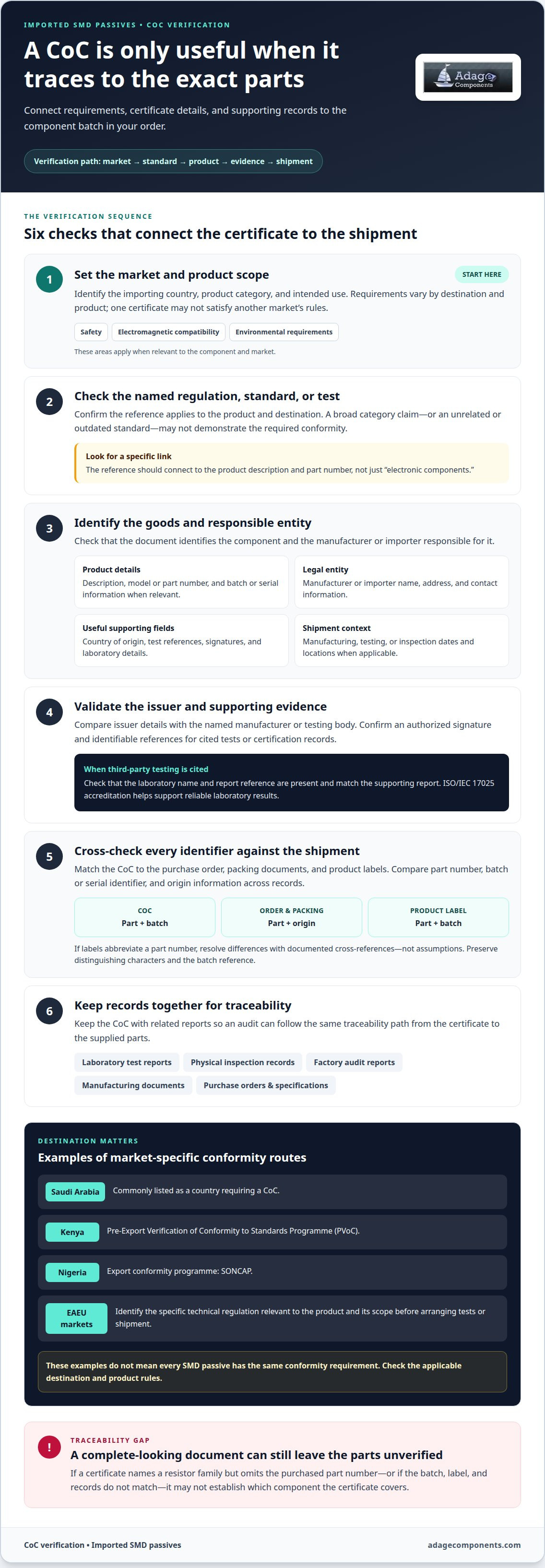
A CoC records that a product meets identified standards, regulations, or technical requirements. For imported SMD passives, its value depends on a clear link between the certificate, the destination country, and the supplied parts.
Destination and Product Requirements
CoC requirements depend on the importing country and the product category covered by its rules. An electronics certificate intended for one market may not meet another market’s requirements.
Saudi Arabia is commonly listed as a country requiring a CoC. Kenya’s Pre-Export Verification of Conformity to Standards Programme is called PVoC, while Nigeria’s export conformity programme is SONCAP. These examples show why buyers must identify the destination’s applicable process rather than assume one certificate works everywhere. They do not mean every SMD passive is subject to the same requirement.
Product type also affects which standards and evidence belong on the document. For electronics, a CoC may address electromagnetic compatibility, safety, or environmental requirements. It should name the applicable standard or regulation and identify the product it covers. A broad reference such as “electronic components” is less useful than a description tied to the specific passive component and its part number.
Product and Manufacturer Identification
Product and manufacturer identification link a CoC to identifiable goods and a responsible legal entity. That link matters when a shipment contains multiple passive part numbers or production batches.
Look for the product description and model or part number. Include batch or serial information when relevant. The document should also identify the manufacturer or importer by legal name, address, and contact information. If a third party tested or certified the product, include its certification or testing details where applicable.
Other useful fields include the standards met, country of origin, test references, signatures, and laboratory details. For example, a certificate that names a resistor family but omits the purchased part number may not establish which component it covers. Manufacturing, testing, or inspection dates and locations can further link records to a shipment when applicable.
Marking and labeling can complicate identification. A reel label may use a shortened part number while the CoC lists a fuller designation. The traceable match should preserve distinguishing characters and the batch reference. Missing or inconsistent identifiers can make it difficult to link a certificate to the goods, even when both documents appear complete on their own.
Authenticity and Traceability Checks
Authenticity and traceability checks establish whether the issuer and supporting records match the shipment. They matter because a supplier’s document alone does not show how its claims relate to a particular lot.
Compare the issuer’s legal name and contact details with those of the named manufacturer or testing body. Confirm that the certificate carries an authorized signature and references identifiable tests or certification records. Where third-party testing is cited, the laboratory name and report reference should be present so the documents can be matched.
Then link the CoC to the purchase order, packing documents, and product labels. Check that the part number, batch or serial identifier, and origin information are consistent across those records. Resolve differences in abbreviations or label formats with documented cross-references, not assumptions. Keep the CoC and related reports together in the compliance record so later audits can follow the same traceability path.
What Is a Certificate of Compliance (CoC), and How Can I Get One?
A Certificate of Compliance (CoC) documents that a product meets identified requirements. CoC compliance verification for imported SMD passives begins by establishing which regulations, standards, and test references apply to the product and destination market.
Applicable Regulations and Standards
Applicable regulations and standards define the criteria a CoC must address. Identifying them matters because customs documentation for one country may not satisfy another country’s technical requirements.
Start with the importing country, product category, and intended use. Then identify the current technical regulations and standards that apply to that combination. For an electronics component, potential compliance areas include safety, electromagnetic compatibility, and environmental requirements. The applicable requirements depend on the product and market, not simply on its being an electronic part.
For exports to a market using EAEU technical regulations, identify the specific regulation relevant to the product before arranging tests or shipment. The regulation’s scope determines which evidence and conformity route apply. Use the current regulation and its relevant test references. A certificate citing an unrelated or outdated standard may not demonstrate the required conformity.
Requirements Named on a CoC
A CoC should identify the requirements and evidence supporting its conformity claim. Precise references matter because they let procurement, logistics, and customs teams connect the claim to applicable tests.
The document may name a regulation, standard, or test the product has passed. It should connect that reference to the product description and part number, rather than make a broad claim for an entire component category. Supporting records can include technical specifications, test reports, inspection records, labels, and certification-body details. Keep references specific enough to trace the test evidence to the supplied part.
To obtain a CoC, establish the applicable requirements, then approach the manufacturer, supplier, or an authorized representative. Manufacturers commonly issue compliance documents, and accredited third-party testing laboratories may also provide them. Request the certificate with its supporting records. Check whether the named standard is current for the destination, whether the test covers the relevant product, and whether the issuer and test references are identifiable.
For U.S. imports, the facts identify a digital Certificate of Compliance filing for certain regulated consumer products, not a blanket certificate rule for every electronic component. From 8 July 2026, affected products must have the digital certificate electronically filed before import. The relevant product category determines whether that filing applies.
Environmental Declarations and CoCs
RoHS and REACH declarations address environmental or chemical compliance claims, while a CoC can cover broader technical or regulatory requirements. This distinction matters because one document may not establish every type of conformity needed for a shipment.
For imported passives, assess each declaration according to its stated scope. Match it to the specific component and supporting evidence, then keep it with the CoC and applicable test records. A declaration can support an environmental compliance review, but it should not be treated as proof of unrelated safety, performance, or destination-market requirements.
Consistent CoC compliance verification for imported SMD passives also depends on keeping component references aligned across certificates, declarations, and test reports. A component line card can help keep product-family identification aligned with sourcing documentation.
What is the purpose of the Certificate of Conformity?
A Certificate of Conformity (CoC) records that a product meets applicable technical or regulatory requirements. Its purpose is to link a product or shipment to the standards required by a destination market.
For imported SMD passives, the CoC supports a compliance decision by identifying what the certificate covers and which requirements apply. A Certificate of Conformity is typically issued by a regulatory authority or certification body. A Certificate of Conformance, by contrast, is typically issued by a manufacturer or supplier to state that parts meet customer-specific requirements. The distinction matters: a customer-facing statement does not automatically serve as regulatory evidence for national import requirements.
Some countries require a CoC for customs clearance. In those cases, the document helps customs assess whether goods meet relevant technical regulations and national, regional, or international standards. It does not replace every other shipment record. Its role is narrower: to support the conformity claim for the identified product against applicable requirements. An outdated standard, unclear product scope, or missing supporting record can weaken that evidence and contribute to shipment rejection.
For U.S. Customs, there is no single CoC rule in the cited facts that applies to every imported electronic component. From 8 July 2026, certain regulated consumer products entering the United States must have a digital Certificate of Compliance electronically filed before import. Whether that requirement applies depends on the product category. The CoC alone should not be treated as a complete customs entry package for every shipment.
To understand what a CoC contributes to U.S. clearance, distinguish product compliance evidence from the customs entry process. When compliance information is required, it may form part of the customs-clearance process. The manufacturer or supplier may already hold the relevant certificate and identifiers. This makes the document’s product scope and traceability important to the filing process.
In international trade, the purpose also depends on the importing country’s programme and product type. A CoC required for a regulated category supports a different decision from a supplier’s statement confirming purchase-order requirements. The destination’s applicable rules determine the document’s role. Confirm that the certificate refers to the shipment’s actual part numbers and relevant standards, rather than treating a general statement as proof for every component.
A CoC can help prevent avoidable clearance issues when its claim is specific and supported. Procurement teams can use it to link technical requirements with the shipment record, while customs officials can assess the stated conformity evidence. Keep the certificate with relevant test reports and supplier records. This creates a traceable compliance file for shipment review, re-verification, and later audits.
Review of laboratory testing, physical inspection and factory audit reports
Laboratory, inspection, and audit records provide evidence behind a CoC’s compliance claim. Review them together to link the manufacturer’s processes and test results to the specific SMD passive shipment.
Testing and Inspection Records
Testing and inspection records document what was examined, how, and when. They matter because a CoC’s claim needs supporting evidence tied to the product and applicable requirements.
Start with the test report’s part number, test references, dates, and laboratory details. Compare them with the CoC and purchase order. For example, a report naming a resistor family without identifying the supplied part may not establish that the tested sample represents the shipment. Manufacturing, testing, and inspection dates and locations also help link the records to the relevant production lot.
For laboratory testing, check that the report identifies the procedure, results, and equipment controls relevant to the cited standard. According to the International Organization for Standardization, ISO/IEC 17025 accreditation helps ensure robust laboratory procedures, calibrated equipment, and reliable results for CoC testing. The accreditation supports confidence in the laboratory’s methods; the report must still identify the product tested and the requirements assessed.
Physical inspection records add evidence about the goods themselves, such as observed markings, packaging, or condition. Match recorded identifiers to reel labels and lot information. A factory audit provides a different view: it documents manufacturing controls and production practices, rather than proving that each component passed a particular test. Treat audit findings as context alongside test and inspection results.
The cost of third-party CoC verification and component testing in the United States depends on the test scope, sample quantity, inspection work, and whether a factory audit is included. Laboratory reports, physical inspections, and manufacturing audits involve distinct activities, so the requested evidence determines the overall scope.
Pre-Acceptance Verification Steps
Pre-acceptance verification links the CoC and supporting evidence to the shipment before acceptance. This sequence matters because discrepancies found after goods enter inventory can complicate traceability and disposition.
Before accepting an SMD passive shipment, match the CoC and reports to the purchase order, part number, batch identifiers, and applicable test references. Then review laboratory details, results, inspection findings, and any factory audit records. Resolve mismatches in product identity or evidence before recording the lot as compliant.
- Match product and batch identifiers across the CoC, report, and package labels.
- Confirm test references align with the requirements named for the product.
- Review inspection findings and record any mismatch for resolution.
- File the linked records with the shipment’s quality documentation.
For example, if the report covers a different part number, the records do not directly support the received lot. Keep the certificate, reports, and inspection notes together so an auditor can follow the evidence from the manufacturer’s test through receiving acceptance.
Manufacturing CoCs against purchase orders and specifications
A manufacturing Certificate of Compliance can confirm that completed parts meet customer requirements in a purchase order, technical drawing, or design specification. It serves a different purpose from a regulatory certificate of conformity, which addresses requirements set by an importing country. For SMD passives, link the manufacturer’s statement to the exact revision and lot being shipped. CoC compliance verification for imported SMD passives should therefore assess customer requirements as well as applicable regulatory evidence.
In manufacturing, a certificate of compliance is generated after production is complete and the products are ready to ship. This timing links the document to finished goods, rather than only to a product family or future production plan. The certificate should identify the parts it covers and the customer requirements used for acceptance. A clear link to completed production helps distinguish a shipment-specific statement from general product literature.
Review the certificate against the purchase order as a set of linked requirements, not as a general assurance statement. Confirm that the part number, description, quantity or lot reference, and drawing or specification revision match the order. Then compare each named requirement with its corresponding record. A certificate that cites an old drawing revision may not establish conformity to the revision currently governing the order. This comparison is central to CoC compliance verification for imported SMD passives because the accepted revision defines the ordered configuration.
Specifications can contain different types of criteria. A drawing may define physical dimensions, while a technical specification may define electrical limits or inspection requirements. The CoC should make its scope clear, and supporting test or inspection records should relate to the relevant criteria. If the document only says “meets specification” but does not identify which specification or revision, its claim is difficult to assess during receiving or an audit.
Separate customer requirements from applicable standards. A purchase order may call for a particular standard, but the CoC’s customer-specific statement does not itself prove compliance with every national import rule. Likewise, do not automatically apply a certificate issued for consumer goods or another product category to imported SMD passives. Keep regulatory evidence and manufacturing conformance records distinct, then link both to the same part and shipment.
For international supply, this distinction helps teams identify gaps before goods are released for transport. A mismatch between a part number, revision, or lot reference can delay acceptance, trigger requests for records, or complicate a customs review. Record the discrepancy and its resolution in the shipment file. This creates a clear chain from order requirements to production evidence and finished goods.
The practical takeaway is to judge the manufacturing CoC by its traceable relationship to the purchase order and specifications, not by its title alone. Aligning component descriptions with your bill of materials can clarify which parts the documentation covers. Review component families against your requirements as you organize part references for procurement records.
Adage Components
Adage Components helps procurement teams source authentic components through vetted manufacturers and partner suppliers, many franchised by top 100 distributors. We provide manufacturer pricing and OEM pricing, with one of the best costs in the industry, while supporting commercial and automotive grade components and compliance with all ISO certifications.
Our component range includes Thick Film Chip Resistors, Thin Film Precision Resistors, Carbon Film Resistors, and MELF Resistors. An international logistics program, growing state-of-the-art warehouse, and short lead times support MRP planning and delivery to your facility in real time, on time.
Contact Adage Components to discuss your component sourcing requirements.
Make Your Next Sourcing Decision With Confidence
Make CoC compliance verification for imported SMD passives a repeatable part of your sourcing process. For each new order, link the component requirements with the documents and records your team needs to review. This keeps procurement decisions aligned with your specifications as sourcing needs change.
Adage Components offers Thick Film Chip Resistors, Thin Film Precision Resistors, and Carbon Film Resistors. To discuss whether these components fit your requirements, share the relevant part details and documentation needs with our team.
Take the next step by exploring the component range and identifying potential fits for your requirements. Review the Adage Components line card and move your sourcing decision forward with a clear view of the available options.
Frequently Asked Questions
Do You Need a COC When Importing from China?
Not automatically. The country of origin alone does not determine whether a CoC is required; the destination market and product category do. Before shipment, identify the destination’s conformity programme and whether it covers the specific passive components. A supplier’s general certificate may not satisfy a market-specific requirement. For international orders, link the document to the relevant part numbers and shipment so the compliance record supports the goods being imported.
How Long is a COC Certificate Valid?
A CoC may be valid for up to 10 years after the last production date, according to the available market information. That period doesn’t mean every certificate applies to every shipment: underlying type approval certificates may be valid for one to three years, while a CoC is still required for each shipment. Product changes or significant changes to the underlying standards can also require renewal, so assess the certificate’s scope and issue details.
Is a COC Certificate Mandatory?
Only when the applicable importing-country rules or product requirements call for one. Some markets require conformity evidence for defined regulated goods, while other shipments may rely on different documentation. A customer may also request a manufacturer’s conformance statement against purchase-order requirements. Separate that contractual document from a regulatory certificate, then determine which applies to the destination, product category, and intended use before dispatch.
What Happens if You Don’t Have a COC Certificate?
If a CoC is required for the product and destination, missing documentation can prevent the shipment from demonstrating conformity and may lead to rejection or clearance delays. The importer may need to provide supporting records or obtain the required certificate before release. Outcomes depend on the applicable market rules and shipment circumstances; there is no single consequence for every missing certificate. Keep compliance documents in the shipment file to support review.
Which Products Require a COC Certificate?
There is no single global product list. Requirements depend on the destination country and the product category covered by its rules. Electronics may require evidence addressing applicable safety, electromagnetic compatibility, or environmental requirements. Some regulated consumer products also have specific documentation obligations. Classify the goods accurately and assess the rule’s product scope. Do not assume every electronic component is covered simply because it crosses an international border.
What information should a CoC for SMD resistors, capacitors, and inductors include?
A CoC should identify the component clearly enough to link the document to the supplied lot. Include a product description, exact model or part number, and batch or serial reference when relevant. The certificate should identify the responsible manufacturer or importer and state applicable standards, regulations, or test references. For a mixed shipment, keep each component’s identifiers distinct so one part’s documentation is not mistakenly applied to another.
What tests and standards apply to verifying SMD passive component compliance?
There is no single test set that applies to every SMD passive. The relevant tests and standards depend on the importing market, component type, and customer specification. Use test reports that identify the part assessed, method or standard referenced, and results. ISO/IEC 17025 concerns laboratory competence, not a product performance standard; its accreditation helps support reliable laboratory procedures and results.
What are the risks and penalties for false or missing compliance certificates?
False or incomplete certificates can undermine the evidence supporting a shipment’s conformity claim. If required information is missing, authorities may reject the documentation or delay clearance; inaccurate records can also complicate audits and supplier traceability. Specific penalties depend on the importing country and applicable rules, so do not assume a universal fine or outcome. Preserve the certificate and supporting records, and address discrepancies before treating a shipment as compliant.
Disclaimer
Cross-referenced components needs to be confirmed by the client with either spec. sheet or samples or both.
Please note, we use AI to help us, information is verified to be correct but we can not guarantee 100% accuracy.


