

With the global certification and testing market reaching $204.9 billion in 2026, the document sitting on your desk is more than just paperwork; it is the only barrier between your production line and a catastrophic supply chain failure. You understand that manual verification is a grueling, high-stakes process that often creates a bottleneck in your MRP system. Learning how to verify component certifications is no longer optional when the Market Sentiment Index for electronics has hit a five-year high of 154.1, demanding both speed and absolute precision in sourcing.
We agree that the complexity of international regulatory compliance, from the latest EU RoHS updates to the upcoming ISO 9001:2026 transition, can feel overwhelming. This guide provides a definitive roadmap to validate the integrity of your resistors, capacitors, and diodes without sacrificing efficiency. You will learn the rigorous steps required to confirm certificate authenticity, ensuring your facility maintains 100% compliance for both commercial and automotive grade projects. We will preview a reliable validation checklist that allows you to secure OEM pricing and manufacturer-direct advantages while maintaining a secure, vetted supply chain that delivers in real time, on time.
Key Takeaways
- Protect your supply chain integrity by identifying the critical role of certification verification in preventing counterfeit infiltration and field failures.
- Master the technical requirements of ISO and RoHS standards to ensure 100% compliance for your automotive and commercial grade projects.
- Implement a rigorous 5-step process on how to verify component certifications, focusing on original documentation and official database cross-referencing.
- Identify sophisticated forgeries by recognizing red flags like inconsistent fonts, low-resolution imagery, and illogical certification timelines.
- Learn how strategic sourcing from vetted manufacturers provides the same advantages as tier-1 distributors at competitive OEM pricing.
What is Component Certification Verification and Why Does it Matter?
Component certification verification is the systematic process of validating that resistors, capacitors, and diodes meet stringent safety, quality, and environmental benchmarks. It's the primary defense mechanism for procurement managers tasked with protecting production integrity. Knowing how to verify component certifications ensures that every item entering your MRP system is legitimate. Without this rigor, you risk field failures that compromise entire production runs and damage long-term reliability.
Global technical standards, such as those overseen by the International Electrotechnical Commission (IEC), provide the essential foundation for these requirements. For OEMs and EMS providers, the financial stakes are massive. Non-compliant parts trigger expensive recalls and legal liabilities that can dismantle a project's profitability. Utilizing authentic components isn't just about safety; it's about protecting your brand's reputation in a volatile global market. We understand that in industrial procurement, precision is the only path to cost-effectiveness.
To better understand this concept, watch this helpful video:
The Risk of Counterfeit Electronic Components
Forged certifications are the gateway for substandard hardware into the global supply chain. These documents often appear identical to originals but hide internal defects that lead to early lifecycle failure. The dangers are particularly acute for automotive grade components, where a single failure can compromise passenger safety. In contrast, commercial grade failures might only result in a returned consumer product, yet both scenarios destroy ROI. The Grey Market refers to the trade of electronic components through unofficial or unauthorized distribution channels where certification integrity is frequently compromised or entirely absent.
The Role of Vetted Manufacturers in Quality Assurance
Reducing risk requires shifting away from opaque trading companies toward vetted manufacturers. Adage Components operates as a strategic partner, utilizing partner suppliers franchised by top 100 distributors to ensure traceability. Unlike a standard trading company that simply moves stock, we are a private label manufacturer with a growing state-of-the-art warehouse. We ensure every part on our comprehensive linecard meets strict ISO standards. This approach allows you to get manufacturer pricing and OEM pricing without the traditional compliance headaches. You receive the same advantages as buying from tier 1 distributors but at a better cost, ensuring your facility stays on schedule and under budget.
Key Industry Standards: ISO, RoHS, and REACH Explained
Understanding the technical landscape of industry standards is the first step in learning how to verify component certifications. While many procurement officers focus on basic safety marks, passive components like resistors and capacitors require a deeper dive into quality management and environmental safety. ISO 9001:2015 remains the current global baseline for quality management systems, though the industry is already preparing for the ISO 9001:2026 revision expected later this year. For those sourcing automotive grade components, IATF 16949 is non-negotiable. It builds upon ISO 9001 with specific requirements for the automotive supply chain, emphasizing defect prevention and the reduction of variation in the manufacturing process.
ISO Certifications: More Than Just a Document
A common mistake in procurement is accepting an ISO certificate at face value without validating its scope. You must confirm that the specific factory site producing your MLCCs or tantalum capacitors is actually covered by the certification. It's also vital to ensure the registrar is accredited by an International Accreditation Forum (IAF) member body. While ISO covers quality management, specialized hardware destined for the US market may require additional checks through the FCC ID database to ensure regulatory alignment for active parts. For environmentally conscious procurement, ISO 14001 provides the framework for managing environmental responsibilities, a standard we strictly uphold across our vetted manufacturer network.
Environmental Compliance: RoHS and REACH
RoHS compliance is mandatory for global market access. As of July 1, 2026, new delegated directives have revised several lead-related exemptions, making it critical to review your supplier's RoHS Declaration of Conformity (DoC) for the most current data. This document must confirm that the component does not exceed the threshold for 10 restricted substances, including lead, mercury, and cadmium. REACH compliance is equally dynamic. The list of Substances of Very High Concern (SVHC) reached 253 entries in February 2026. Constant monitoring is required to ensure your assembly process remains compliant with these evolving chemical safety regulations, preventing costly production delays.
Adage Components bridges the gap between high-volume manufacturing and these rigorous standards. We provide the same advantages as buying from tier 1 distributors but at OEM pricing, ensuring your facility receives authentic components that are perfect for your MRP system. Every part on our comprehensive linecard is backed by full documentation to streamline your validation process and maintain supply chain integrity.
How to Verify Component Certifications: A 5-Step Process
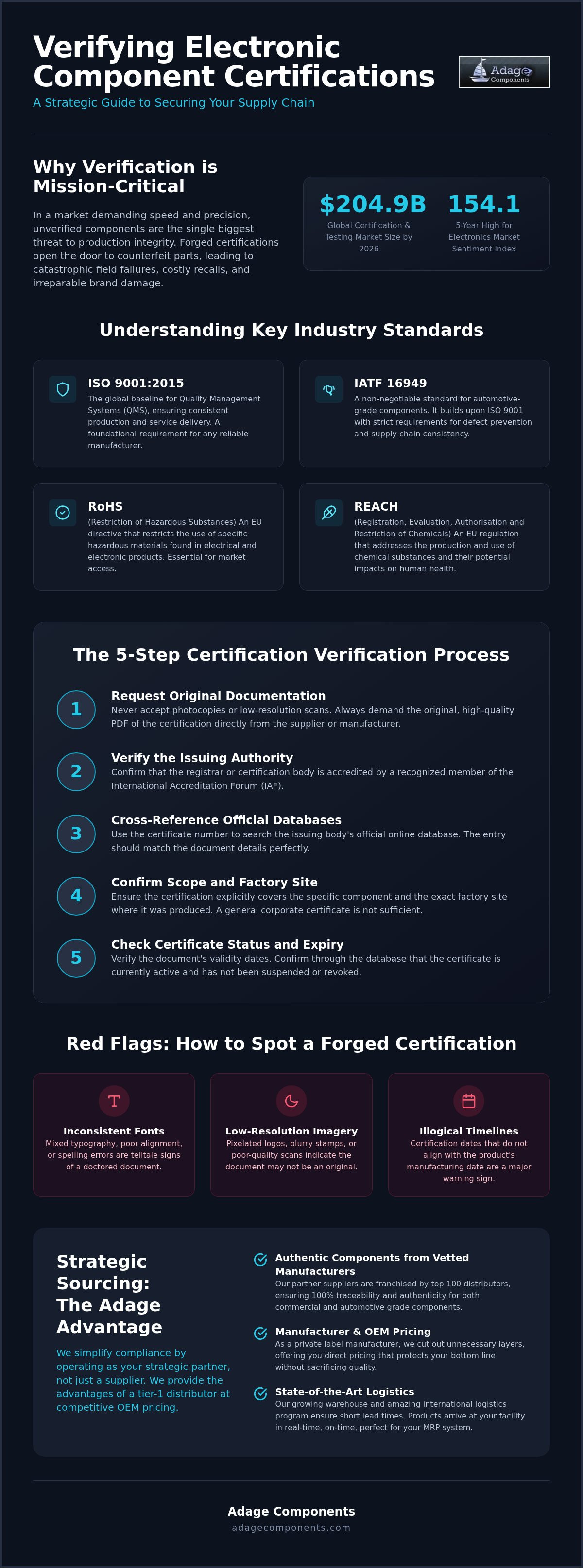
Securing your supply chain requires a disciplined approach to documentation. Validation is not a one-time event; it's a continuous multi-stage protocol. Learning how to verify component certifications involves moving beyond the surface level to scrutinize the source of the data itself. Follow this rigorous 5-step process to ensure every resistor, capacitor, and diode in your facility is authentic and compliant.
- Step 1: Request the original PDF certificate. Avoid accepting scans, screenshots, or low-resolution images. Original digital files often contain metadata and digital signatures that are difficult to forge, whereas a scan can easily hide altered text or mismatched logos.
- Step 2: Cross-reference the certificate number. Use the unique ID on the document to search the issuing body’s official database. If the certificate number doesn't return a valid, active result, the part should be flagged immediately.
- Step 3: Validate the company name and address. Ensure the manufacturing site listed on the certificate matches the actual production facility. Trading companies often provide a manufacturer's certificate as their own, which obscures the true origin of the components.
- Step 4: Check the expiration date and scope. A certificate is only valid if it's current and covers the specific product category you're purchasing. Verify that the "Scope of Certification" explicitly includes the component types, such as tantalum capacitors or schottky diodes, required for your project.
- Step 5: Perform or request a manufacturing audit. For high-volume or critical automotive grade components, a paper trail isn't enough. A physical or remote audit of the factory remains the gold standard for verifying quality management systems.
Validating the Issuing Authority
Reputable third-party labs like SGS, TUV, and Intertek are the industry benchmarks for component testing and certification. Be wary of certificates issued by unknown registrars that may sell "accreditation" without conducting legitimate on-site audits. You can use the IAF CertSearch portal to verify that an ISO certificate was issued by an accredited certification body, providing a necessary layer of global transparency. This step ensures that your partner suppliers are held to the same high standards you expect from tier-1 distributors.
Cross-Referencing with Your MRP System
Data integration is the final bridge to a secure supply chain. Ensure that part numbers on the certificate align perfectly with your internal Bill of Materials (BOM). While "short leading" times are essential for maintaining production speed, they must never come at the expense of quality checks. Through our distributor affiliated program, Adage Components integrates rigorous compliance data into the sourcing process. This allows you to get manufacturer pricing and OEM pricing while ensuring that every part arriving at your facility is perfect for your MRP system and arrives in real time, on time.
Red Flags: How to Spot Fake or Expired Certifications
Identifying a forgery requires more than a casual glance. While basic visual checks are a starting point, modern counterfeiters use sophisticated digital tools to mimic legitimate documentation. Understanding how to verify component certifications means developing a sharp eye for the subtle inconsistencies that signal a compromised supply chain. A single fraudulent document can introduce thousands of substandard resistors or capacitors into your assembly, leading to catastrophic field failures and legal liability.
Procurement professionals should immediately flag any certificate featuring inconsistent fonts, low-resolution logos, or pixelated signatures. These are hallmarks of a poorly executed digital edit. Another critical red flag is a logic gap in dates. If a certificate's issuance date pre-dates the supplier's corporate registration, the document is clearly a fabrication. Scrutinize the "Scope of Certification" with extreme care. A common tactic involves presenting a valid ISO certificate for "general office management" or "logistics services" as proof of "semiconductor manufacturing" capability. If a supplier refuses to provide the direct contact details of their issuing registrar, consider the partnership high-risk and move to a vetted source.
Common Document Forgery Tactics
Counterfeiters often rely on "pre-certified" claims to bypass rigorous inspection. They may claim a component is compliant because a raw sub-material holds a certification, even if the final assembly does not. Be particularly wary of "Self-Declaration" forms that lack accompanying third-party test reports from recognized labs. Without independent validation, a self-declaration is merely a promise with no legal or technical weight. Authentic components must be backed by a verifiable paper trail that links the specific batch to an audited production line.
The "Ghost Factory" Problem
The "Ghost Factory" phenomenon occurs when a supplier provides legitimate certifications for a high-quality facility they don't actually use for your order. They leverage the reputation of a Tier-1 plant to secure the contract, then outsource the actual production to an unvetted, substandard workshop. Adage Components eliminates this risk through direct manufacturing audits and a network of partner suppliers franchised by top 100 distributors. We act as a bridge between high-quality manufacturing and your facility, ensuring every part is perfect for your MRP system. For more on optimizing your supply chain, consult our electronic component distributors strategic sourcing guide.
Secure your production line today by sourcing from a partner that prioritizes technical reliability and cost-effectiveness. View our full range of resistors, capacitors, and diodes on our comprehensive linecard to get manufacturer pricing without the compliance headache.
Strategic Sourcing: How Adage Components Simplifies Compliance
Procurement managers often find that the manual labor involved in learning how to verify component certifications creates significant operational friction. We eliminate this bottleneck by acting as an elite partner that combines the scale of a major distributor with the pricing benefits of a direct manufacturer. Every component we sell, from thick film chip resistors to rectifier diodes, is backed by rigorous quality assurance protocols that meet the highest industrial standards. By sourcing from our network of vetted manufacturers, you secure supply chain integrity without the traditional overhead of manual validation.
Our infrastructure is designed for speed and reliability. We provide the same advantages as buying from tier 1 distributors but at OEM pricing, ensuring your facility remains competitive. Our amazing international logistic program and growing state-of-the-art warehouse ensure that products arrive at your facility in real time, on time. This level of integration is perfect for your MRP system, allowing for short leading times that don't sacrifice precision or safety.
Why OEMs Choose Adage for Cost and Quality
We offer one of the best costs in the industry because we provide manufacturer pricing directly to our clients. This cost-effectiveness doesn't come at the expense of quality; we maintain strict ISO certification compliance for both commercial and automotive grade components. As a Canadian-headquartered specialist, we provide a strategic bridge to global markets, ensuring that your just-in-time delivery needs are met with composed confidence. We understand that in a volatile market, you need a partner that treats individual component authenticity with meticulous attention to detail.
This dedication to meticulous quality control is a hallmark of established Canadian manufacturing, a tradition exemplified by companies like Matelas Expert that have managed their own production facilities since 1888 to ensure every product meets rigorous standards.
Streamlining Your BOM Submission
Our technical team simplifies the procurement cycle by conducting a comprehensive review of certifications during the quote process. This ensures that when you receive a bid, the technical reliability and regulatory alignment are already verified. If you're looking for a deeper dive into our methodology, read our guide on sourcing passive electronic components. Ready to optimize your supply chain and reduce your BOM costs? Contact our technical team today to initiate a transactional inquiry and experience the Adage difference.
Secure Your Supply Chain with Data-Driven Procurement
Mastering the rigorous steps of how to verify component certifications is the only way to protect your production line from the escalating risks of the global grey market. By implementing a multi-stage validation process and scrutinizing document scope, you ensure that every resistor and diode in your facility meets the highest industrial standards. This proactive approach eliminates the threat of field failures while maintaining the integrity of your MRP system. You don't have to choose between speed and safety when your sourcing strategy is built on verified data.
Adage Components acts as your strategic partner in this high-stakes environment. We provide manufacturer pricing for OEMs and ISO-certified quality assurance that rivals tier-1 distributors. Our amazing international logistics program ensures that authentic components arrive at your facility in real time, on time. Don't let compliance hurdles slow your production or inflate your costs. We are ready to help you optimize your supply chain with precision and efficiency.
Submit your BOM for a cost-saving analysis with guaranteed compliance and secure the advantages of OEM pricing today.
Frequently Asked Questions
How do I check if an ISO 9001 certificate is valid?
You can verify an ISO 9001 certificate by searching the IAF CertSearch portal or the issuing registrar's official database. Ensure the certificate number, company name, and factory address match the manufacturer's physical location. If the registrar isn't accredited by an IAF member body, the document lacks global recognition. This is a critical step for anyone learning how to verify component certifications to ensure supply chain integrity.
What is the difference between RoHS and REACH certifications?
RoHS restricts specific hazardous substances in electrical equipment, while REACH governs the safety of all chemical substances used in manufacturing. RoHS focuses on the finished product's composition, such as lead or mercury levels. REACH requires ongoing monitoring of the Substances of Very High Concern (SVHC) list, which was updated to 253 entries in February 2026. Both are essential for maintaining 100% compliance in your MRP system.
Can I trust a CE mark on a component from an unknown supplier?
You shouldn't trust a CE mark from an unknown supplier without requesting a full Technical Construction File (TCF) and third-party test reports. Because CE marking is often a self-declaration, it's frequently misused on counterfeit components. Authentic components from vetted manufacturers always provide the underlying data to support the mark. Relying on a logo alone exposes your facility to significant legal and operational risks.
What should I do if a component certificate has expired?
You should immediately quarantine the associated parts and request an updated certificate or a valid extension letter from the manufacturer. An expired certificate means the quality management system hasn't been audited within the required timeframe, making the parts non-compliant. We recommend only sourcing from partner suppliers who maintain active, up-to-date ISO certifications to avoid production delays and ensure real-time delivery.
How does Adage Components vet its manufacturing partners?
We vet our manufacturing partners through a multi-stage process that includes rigorous factory audits and mandatory ISO compliance checks. Many of our partner suppliers are franchised by top 100 distributors, ensuring a secure and transparent supply chain. This meticulous attention to detail allows us to offer manufacturer pricing and OEM pricing while guaranteeing that every resistor and diode meets strict quality benchmarks.
Why is automotive grade certification (IATF 16949) different from commercial grade?
Automotive grade certification (IATF 16949) requires much higher reliability and more stringent testing than commercial grade standards. It emphasizes a zero-defect mindset and the reduction of variation in the manufacturing process to ensure safety in high-stakes environments. Commercial grade components are suitable for standard applications, but automotive grade is mandatory for systems where failure isn't an option.
This same zero-tolerance approach to quality is mandatory in the medical sector, where global wholesalers such as IMT Medical Devices export specialized equipment that must satisfy rigorous international safety and performance certifications.
Are self-declared RoHS certificates legally sufficient for OEMs?
Self-declared RoHS certificates are rarely sufficient for OEMs who need to mitigate legal liability and ensure long-term reliability. While legally permitted in some contexts, they offer no proof of actual testing or substance analysis. Procurement managers learning how to verify component certifications should always demand third-party test reports from accredited labs to confirm that components stay below the 10 restricted substance thresholds.
How can I verify a REACH declaration for SVHC chemicals?
You can verify a REACH declaration by cross-referencing the manufacturer’s statement against the European Chemicals Agency (ECHA) candidate list. The list is updated twice a year; the February 2026 update brought the total to 253 substances. Ensure the declaration specifically mentions the most recent SVHC additions to confirm the manufacturer is actively monitoring their material composition and maintaining supply chain transparency.
Disclaimer
Cross-referenced components needs to be confirmed by the client with either spec. sheet or samples or both.
Please note, we use AI to help us, information is verified to be correct but we can not guarantee 100% accuracy.


