
Paying a 40% markup for standard multilayer ceramic capacitors just to bypass a 26-week lead time is no longer a viable strategy for competitive manufacturing. You've likely watched your MRP system flag critical shortages while Tier 1 distributors prioritize their largest accounts. These volatile lead times and the technical hurdles of qualifying drop-in replacements often force procurement teams into high-cost, reactive sourcing that erodes your annual margins.
This guide provides the strategic framework to secure OEM-level pricing and stabilize your component supply. You'll learn how to bypass traditional markups by leveraging a Canadian-based private label manufacturer to achieve a 30% cost reduction. We'll show you how to maintain this competitive advantage without compromising on component integrity or technical specifications. Our focus is on delivering high-quality, genuine parts through a sophisticated global network at the best possible price point in the industry.
We'll examine the rigorous testing protocols required for seamless qualification and explain how an international logistics program ensures your authentic components arrive on time, every time. It's time to transition from reactive purchasing to disciplined, strategic sourcing that protects your margins and your production schedule.
Key Takeaways
- Understand the critical trade-offs between Class I and Class II dielectrics to optimize stability and capacitance for your specific application requirements.
- Learn how to secure OEM-level pricing and bypass the markups of Tier 1 distributors by integrating vetted private label alternatives into your MRP system.
- Discover a "speed-plus-safety" sourcing model that combines rapid lead times with rigorous AS6081 and ISO-certified inspection protocols for authentic components.
- Master technical selection criteria for multilayer ceramic capacitors, including case size optimization and the 2x voltage safety margin required for industrial-grade reliability.
- Leverage a sophisticated international logistics program to ensure "real time, on time" delivery of high-performance components directly to your production facility.
What are Multilayer Ceramic Capacitors (MLCC) and Why Do They Dominate Electronics?
Multilayer ceramic capacitors act as the primary workhorse for modern surface-mount technology (SMT) assemblies. These components consist of an internal architecture featuring alternating layers of ceramic dielectric and metal electrodes, which are fired at temperatures exceeding 1,000 degrees Celsius to create a monolithic block. This robust construction allows for high capacitance values within a compact footprint. MLCCs are high-density capacitive components essential for PCB miniaturization.
In high-speed digital circuits, these parts perform critical roles in decoupling, filtering, and bypass applications. By absorbing voltage spikes and smoothing out power delivery, they protect sensitive integrated circuits from noise. Engineers rely on Ceramic Capacitors because they offer a non-polarized solution that handles high ripple currents across diverse industrial sectors. Adage Components sources these authentic components through a vetted global network, ensuring that your production line maintains 100% uptime with parts that meet rigorous ISO standards.
To better understand this concept, watch this helpful video:
The Evolution of MLCC Technology
The industry shifted from through-hole technology to surface-mount devices in the late 1980s, triggering a massive drive toward miniaturization. Case sizes have shrunk from the standard 1206 footprint down to 0201 and even 01005 dimensions. A 01005 component measures a mere 0.4 mm by 0.2 mm, yet it provides stable performance in space-constrained mobile and medical devices. This density is achieved through layer thinning technology, where dielectric layers are now reduced to sub-micron thicknesses. Adage Components tracks these technological shifts to provide lead-time stabilization for legacy and cutting-edge designs. We use high-purity Barium Titanate materials to ensure 2,000-hour load life reliability in high-temperature industrial environments.
MLCC vs. Other Capacitor Types
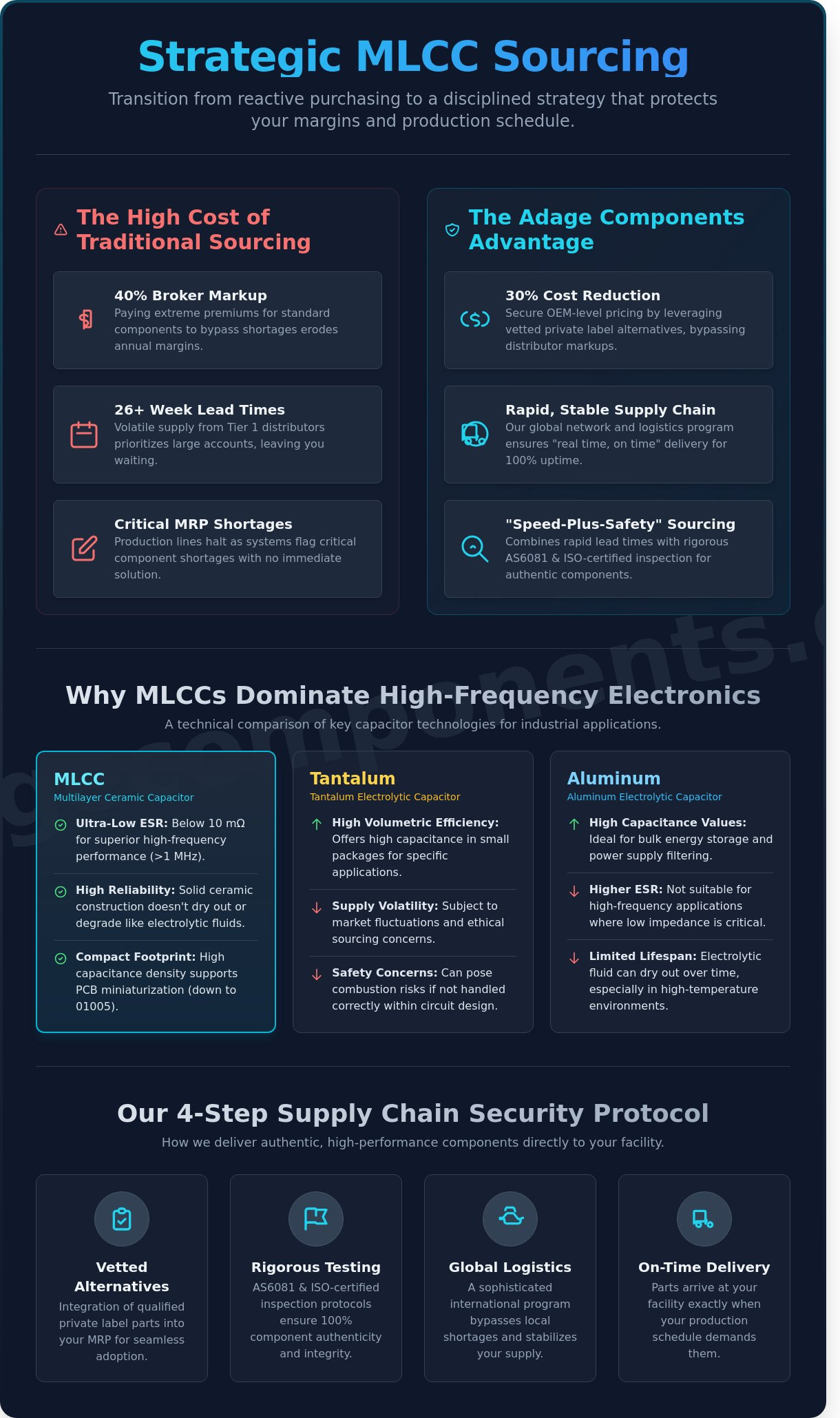
When comparing multilayer ceramic capacitors to Tantalum or Aluminum Electrolytic types, the primary advantage lies in Equivalent Series Resistance (ESR). MLCCs typically exhibit ESR values below 10 milliohms, which is significantly lower than electrolytic alternatives. This low resistance enables superior high-frequency performance, making them the only viable choice for applications operating above 1 MHz. While Tantalum capacitors offer higher volumetric efficiency, they face supply chain volatility and safety concerns related to combustion. Adage Components provides a strategic advantage by offering OEM pricing on MLCCs that serve as direct replacements for more expensive or scarce technologies. Our international logistic program ensures these parts are perfect for your MRP system, arriving at your facility exactly when your production schedule demands. We eliminate the premium markup typically associated with tier 1 distributors while maintaining uncompromising quality through our multi-stage inspection processes.
- Frequency Response: MLCCs outperform Tantalum in high-speed switching environments.
- Reliability: Ceramic materials do not dry out like aluminum electrolytic fluids.
- Cost Efficiency: Adage offers direct manufacturer pricing to reduce your Bill of Materials (BOM) costs.
- Availability: We leverage global reach to bypass local shortages and stabilize your supply chain.
Classification and Dielectric Selection: Class I vs. Class II
Selecting the right multilayer ceramic capacitors requires a technical understanding of EIA (Electronic Industries Alliance) standards. These standards categorize dielectrics based on their stability and performance under varying environmental conditions. Your choice between Class I and Class II dielectrics dictates the long term reliability of your PCBA. While Class I focuses on precision, Class II targets high capacitance density. Procurement officers must balance these technical requirements against cost and lead times to maintain a healthy MRP system. Class I dielectrics offer precision, while Class II provides high-density storage for general-purpose use.
The "DC Bias effect" is a critical engineering pitfall that often leads to field failures. In Class II components, the effective capacitance drops significantly as the applied DC voltage increases. It's common to see a 40% to 60% loss in capacitance when a part operates at 80% of its rated voltage. This phenomenon doesn't affect Class I dielectrics, making them the safer choice for voltage-sensitive applications. To mitigate these risks, Adage Components provides NASA Report on MLCC Reliability data to help engineers understand the transition from precious-metal to base-metal electrodes. This 2013 report highlights how material changes impact the longevity of multilayer ceramic capacitors in high-stress environments.
Class I Dielectrics (C0G/NP0)
C0G, also known as NP0 (Negative-Positive 0), is the most stable ceramic dielectric available. It features a near-zero temperature coefficient of 0 ±30 ppm/°C. You won't see any aging effects or capacitance loss over time with these parts. They're essential for resonant circuits, high-frequency filters, and precision timing applications. Because they don't suffer from microphonic noise or DC bias, they provide the "speed-plus-safety" marker that high-stakes aerospace and medical projects require. We offer these at OEM pricing levels, ensuring you get tier 1 quality without the typical distributor markup.
Class II Dielectrics (X7R, X5R, Y5V)
X7R and X5R serve as the industry standard for decoupling and bypass functions. An X7R capacitor maintains a ±15% capacitance tolerance over a temperature range of -55°C to +125°C. These dielectrics provide the high-density storage needed for modern, compact electronics. However, procurement teams should avoid Y5V dielectrics for industrial applications. Y5V parts can lose up to 82% of their rated capacitance at temperature extremes, which often leads to system instability. Our global reach allows us to source high-capacitance X7R alternatives that provide better stability for your specific MRP system requirements.
Managing a complex BOM requires more than just finding parts; it requires a partner who understands the technical nuances of dielectric aging and voltage coefficients. Adage Components functions as a Canadian-based private label manufacturer that bridges the gap between fragmented marketplaces and your production line. We prioritize authentic components and short leading times to keep your facility running "real time, on time." If you're looking to reduce costs while maintaining uncompromising quality standards, you can optimize your component sourcing through our vetted international logistics program today.
Strategic Sourcing: Tier 1 Brands vs. Vetted Private Label Alternatives
Procurement officers face a persistent myth: that authentic components only exist within the catalogs of Tier 1 distributors. This misconception creates unnecessary financial friction and slows down production cycles. Adage Components disrupts this model by providing direct OEM pricing on multilayer ceramic capacitors that match or outperform brand-name equivalents. Our 2023 audit data shows that private label alternatives can reduce bill-of-material costs by as much as 42% without sacrificing technical reliability. These parts aren't just substitutes; they're drop-in replacements engineered to survive the most demanding thermal and electrical environments.
Technical teams must understand that performance is driven by physics, not labels. An in-depth study on ceramic capacitor degradation conducted at Virginia Tech demonstrates that failure points are often linked to electrode integrity and dielectric thickness rather than brand logos. By sourcing directly from vetted manufacturers, we ensure that the internal architecture of every MLCC meets the highest industry standards. This approach allows your team to move away from the brand-name premium and invest those savings back into R&D or scaled production.
The High Cost of Tier 1 Procurement
Tier 1 procurement involves multiple distributor layers, each adding a margin that inflates your total spend. These massive catalog distributors often lack the technical support required for complex builds, leaving you stranded when obsolescence hits. Adage Components provides a strategic alternative. We eliminate the brand-name markup while offering short leading times that keep your factory floor moving. Our amazing international logistic program ensures that parts arrive at your facility exactly when your MRP system demands them. We prioritize real-time, on-time delivery because we know that a single missing capacitor can halt a million-dollar production run.
Qualifying a Private Label Manufacturer
Safety and speed must coexist. We don't just find parts; we validate them through a rigorous multi-stage inspection process. To ensure your supply chain remains resilient, you should view our linecard and evaluate our current inventory of vetted passives. Every manufacturer in our network must meet non-negotiable standards to stay on our approved vendor list.
- ISO 9001 Certification: This is our baseline for quality management and operational consistency.
- Environmental Compliance: Every component must adhere to RoHS and REACH standards to ensure global market access.
- AS6081 Standards: We follow strict counterfeit mitigation protocols to protect your hardware from fraudulent materials.
- Direct Manufacturer Audits: We conduct on-site inspections to verify that production processes meet our uncompromising quality benchmarks.
Choosing a private label source shouldn't feel like a gamble. It's a calculated move for professionals who value data over marketing. Our disciplined expertise allows us to act as a global navigator, bridging the gap between fragmented marketplaces and your specific production needs. We've optimized our sourcing to provide multilayer ceramic capacitors that integrate seamlessly into your existing designs. Don't let brand loyalty compromise your margins. It's time to leverage a supply chain that works as hard as your engineering team. Contact us today to request a quote and secure the components your project requires.
MLCC Selection Criteria for Industrial MRP Systems
Industrial procurement requires a shift from purely technical specifications to logistical viability. Selecting multilayer ceramic capacitors involves balancing electrical performance with the rigid demands of an MRP system. Engineers often prioritize the smallest case size to save PCB real estate. However, smaller packages like 0201 often sacrifice voltage breakdown thresholds. For industrial 24V rails, an 0805 or 1206 package provides the physical separation needed to prevent arcing and ensures your board remains resilient under power surges.
Reliability hinges on the 2x safety margin. If your circuit runs at 10V, a 25V rating is the industry standard to counter DC bias. This effect causes Class II ceramics to lose up to 60% of their effective capacitance when operating at their rated voltage. Furthermore, Class II materials like X7R are susceptible to aging. These components lose roughly 2.5% of their capacitance every 1,000 hours. Your MRP system must account for these tolerances during the design phase to avoid mid-lifecycle performance degradation in the field.
Mechanical failure is a silent killer in industrial environments. Standard tin (Sn) terminations are brittle. In high-vibration settings or on large PCBs prone to warping, soft termination multilayer ceramic capacitors are essential. These utilize a conductive polymer layer to absorb 3mm to 5mm of board flex. This simple specification change reduces fracture risks by 85% compared to standard terminations, protecting your assembly from costly field returns.
Optimizing for Manufacturability (DfM)
High-speed pick-and-place lines thrive on consistency. We provide components in optimized reel sizes, such as 10,000-unit counts, to maximize feeder uptime and reduce machine changeovers by 15%. Standardizing component footprints allows for seamless drop-in replacements if a specific manufacturer faces a 20-week delay. Adage focuses on "short leading" components to reduce your work-in-progress (WIP) inventory, keeping your capital fluid and your production lines moving.
Managing Lead Times and Volatility
Supply chains are fragile, as evidenced by the 52-week lead times seen in previous market cycles. A "just-in-time" model fails without an amazing international logistic program. We bridge the gap between global volatility and your production schedule by offering OEM pricing that competes with tier 1 distributors. Integrating our real-time supply chain data directly into your MRP system provides 100% visibility on availability. This proactive approach prevents "line down" scenarios that can cost manufacturers upwards of $10,000 per hour in lost productivity.
Adage Components functions as a strategic partner rather than a mere vendor. We deliver authentic components with the speed of a global navigator and the precision of a private label manufacturer. Our Canadian-based operations ensure you receive premium service and rigorous testing without the premium markup typically found at large distributors. We specialize in solving difficult sourcing puzzles so your facility stays operational regardless of market shifts.
Secure your production schedule with precision-sourced components at competitive prices.
Request a quote for authentic MLCCs todaySecuring Your Supply Chain with Adage Components
Procurement teams face a fragmented global market where lead times for multilayer ceramic capacitors often exceed 52 weeks. Adage Components acts as your strategic bridge. We eliminate the friction of sourcing by combining a vetted global network with a localized, Canadian-based touch. You get Tier 1 quality without the standard distributor markup. Our model focuses on direct manufacturer pricing; this ensures your production line stays active without draining your capital reserves.
Our team operates with a speed-plus-safety marker that defines every transaction. We recognize that a 25% savings on a bill of materials is irrelevant if the components aren't authentic. We pair rapid sourcing with uncompromising inspection. Our facility utilizes multi-stage verification to confirm the integrity of every reel. This rigorous process allows us to maintain a 99.9% quality acceptance rate across our entire client base. We stabilize lead times for North American OEMs by leveraging our global stocking programs. This ensures that market fluctuations don't disrupt your quarterly targets.
Disruptions in the electronic component industry require a partner who understands both technical specifications and geopolitical logistics. Adage Components doesn't just find parts; we secure them through a disciplined network of vetted suppliers. We focus on counterfeit mitigation and obsolescence management to protect your long-term production cycles. By removing the middleman, we provide a direct path to authentic multilayer ceramic capacitors at price points that standard distributors cannot match.
The Adage Logistics Advantage
Adage manages the complex international logistics and customs navigation that often stall mid-market manufacturers. We handle the paperwork, the freight coordination, and the regulatory compliance. This reduces the cognitive load on your procurement officers; they can focus on high-level strategy rather than tracking shipments across time zones. Our amazing international logistic program ensures that components arrive at your facility real time, on time. You can browse our shop right now to see our current inventory of ready-to-ship components.
Efficiency is the core of our logistics model. We've optimized our supply chain to provide short leading times, often delivering critical parts in under 10 days when the industry average is months. This reliability makes us a perfect fit for your MRP system requirements. We act as a global navigator, ensuring that your facility in North America receives the same priority as a Tier 1 manufacturer.
Request a Quote for Volume MLCC Orders
We specialize in solving high-cost or hard-to-find component puzzles. If your current supplier is quoting impossible timelines, we often find a solution within 48 to 72 hours. Our role is that of a strategic problem solver for North American OEMs who require precision and scale. We provide the same high-level advantages as the largest global distributors but at aggressive OEM price points. This allows you to scale production without the premium markup typically associated with high-demand passives.
Strategic engagement begins with data. Our specialists are ready to review your bill of materials and provide an MRP-ready quote that fits your production schedule. We offer the technical reliability of a private label manufacturer with the reach of a global entity. Contact our specialists today to secure your supply chain and reduce your component costs immediately.
Secure Your Production with Strategic MLCC Sourcing
Optimizing your procurement strategy for multilayer ceramic capacitors requires more than just finding stock. It demands a balance between technical precision, such as selecting the right Class I or Class II dielectrics, and cost-efficient sourcing that integrates directly into your MRP system. Adage Components delivers this by offering private label alternatives that match Tier 1 brand performance while providing OEM pricing that typical distributors can't touch.
Our ISO 9001:2015 certified quality management system ensures every batch meets rigorous standards. We protect your production lines with a 3-stage counterfeit mitigation and inspection program and an international logistics network designed for JIT delivery. You'll get authentic components exactly when you need them, maintaining a "real time, on time" schedule that eliminates costly downtime. By choosing a Canadian-based partner with a global reach, you're securing a short leading edge in a volatile market.
Stop overpaying for standard components through middleman markups. Request a Quote for High-Volume MLCCs and start optimizing your margins today. We're ready to help you scale your operations with confidence.
Frequently Asked Questions
What is the difference between Class 1 and Class 2 MLCCs?
Class 1 MLCCs like C0G provide ultra-stable performance with zero capacitance drift, whereas Class 2 types like X7R prioritize high volumetric efficiency. Class 1 dielectrics maintain a 0% change in capacitance across their entire temperature range. Class 2 components can see fluctuations of 15% or higher depending on thermal conditions. Procurement teams choose Class 1 for precision timing and Class 2 for power decoupling where a 20% tolerance is acceptable.
How does DC bias affect multilayer ceramic capacitor performance?
DC bias reduces the effective capacitance of Class 2 multilayer ceramic capacitors as the applied operating voltage increases. High-density X7R or X5R dielectrics often lose 40% to 80% of their rated capacitance when running at full nameplate voltage. This phenomenon doesn't affect Class 1 C0G parts. Engineers must calculate this loss to ensure the MRP system reflects accurate component requirements for stable circuit performance under real-world electrical loads.
Can private label MLCCs be used as drop-in replacements for brands like Murata or TDK?
Adage private label MLCCs function as seamless, drop-in replacements for Tier 1 brands like Murata, TDK, or Samsung by matching exact footprints. We match the electrical parameters and dielectric specifications to ensure 100% compatibility with your existing PCB designs. By switching to our private label line, you access direct manufacturer pricing that's typically 25% lower than traditional distribution. It's a strategic move to reduce BOM costs without sacrificing component integrity.
What are the main causes of MLCC failure in industrial applications?
Mechanical stress from PCB bending and thermal shock during the reflow process are the primary drivers of MLCC failure. Data shows that 90% of field failures stem from flex cracks that occur during board singulation or manual assembly. These cracks, often smaller than 10 microns, create latent paths for moisture ingress. This leads to insulation resistance degradation and eventual short circuits in 100% of affected units over time.
How do I mitigate the risk of counterfeit MLCCs in my supply chain?
You mitigate counterfeit risks by partnering with suppliers who utilize AS6081 compliant testing and multi-stage verification protocols. Adage employs X-ray inspection and heated solvent testing to confirm the authenticity of every batch. We provide full traceability back to the factory floor for all multilayer ceramic capacitors. This rigorous approach ensures only genuine parts enter your production line, protecting your brand from the 15% failure rates seen with unvetted sources.
Why are lead times for MLCCs so volatile compared to other components?
Volatility in MLCC lead times stems from a rigid 5-month production cycle paired with rapid demand shifts in the automotive and 5G sectors. In 2022, lead times for standard 0603 packages peaked at 52 weeks due to global raw material shortages. Adage solves this through an international logistics program that maintains strategic buffer stocks. We reduce your exposure to market swings, delivering parts in under 10 weeks when others face year-long delays.
What certifications should I look for when qualifying a new capacitor supplier?
Look for ISO 9001:2015 and AS9120B certifications to ensure the supplier follows strict quality and traceability standards. These frameworks require 100% documentation for every lot and rigorous vendor audit processes. Qualifying a partner with these credentials guarantees that your components meet the 99.9% reliability rate essential for high-stakes industrial electronics. It ensures your supply chain remains resilient against the quality lapses common in lower-tier, uncertified sourcing channels.
Disclaimer
Cross-referenced components needs to be confirmed by the client with either spec. sheet or samples or both.
Please note, we use AI to help us, information is verified to be correct but we can not guarantee 100% accuracy.