

In 2026, the most effective strategy for negotiating with electronic component distributors isn't haggling over unit prices. It's leveraging private-label partnerships to access manufacturer pricing that traditional channels simply cannot match. You've likely seen your margins squeezed by rising material costs and unpredictable lead times that threaten your production deadlines. Vetting multiple international suppliers often feels like a full-time job that yields diminishing returns in a volatile global market.
We understand that procurement professionals need more than just a vendor; they need a strategic partner capable of delivering supply chain resilience. This guide will teach you how to secure tier-1 pricing and achieve OEM-level advantages through direct manufacturing relationships. You'll discover how to reduce your total BOM cost while ensuring every resistor, capacitor, and diode meets rigorous ISO standards for quality and authenticity. We will preview how a "short-leading" supply chain, supported by a state-of-the-art warehouse and an international logistics program, can integrate seamlessly into your MRP system to deliver components in real time, on time.
Key Takeaways
- Shift from transactional haggling to strategic supply chain integration to ensure long-term resilience and component quality.
- Discover advanced tactics for negotiating with electronic component distributors by benchmarking traditional markups against direct manufacturer pricing.
- Leverage private-label "drop-in replacements" as a powerful tool to drive down total BOM costs while maintaining ISO-certified standards.
- Prioritize "short leading" logistics and MRP-ready delivery schedules to eliminate production delays and reduce inventory carry costs.
- Secure tier-1 supply chain advantages at OEM pricing by partnering with vetted manufacturers for both commercial and automotive grade components.
The Evolution of Negotiating with Electronic Component Distributors
Negotiation in 2026 has moved beyond simple transactional exchanges. It's now a strategic alignment of quality, cost, and logistics. Procurement officers no longer just look for the lowest unit price. They demand supply chain resilience. The industry has shifted from transactional buying to long-term supply chain integration. Traditional haggling fails because it doesn't account for the volatility of the post-2024 market. Success in negotiating with electronic component distributors requires a deep understanding of factory vetting and transparency in procurement audits. You must verify that your partner utilizes a network of vetted manufacturers to ensure component authenticity.
Why Traditional Sourcing Models are Stressed in 2026
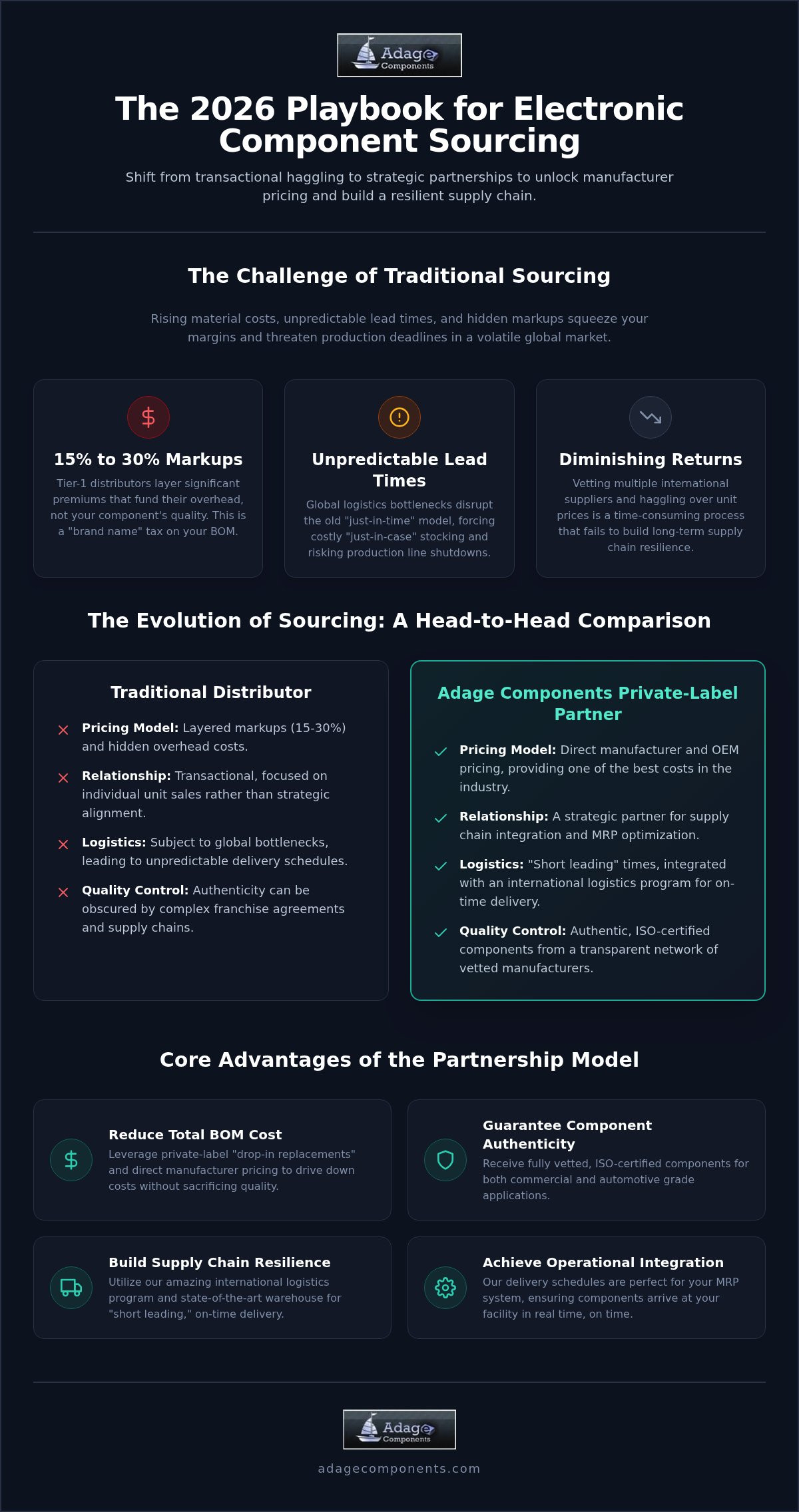
Global logistics bottlenecks have fundamentally altered standard distributor pricing structures. When shipping lanes are disrupted, the hidden costs of traditional tier-1 distribution become apparent. We've seen a massive shift where "short leading" times are now more valuable than raw unit costs. The old "just-in-time" model has evolved into "just-in-case" stocking programs to prevent production line shutdowns. This change forces buyers to look for partners with a growing state-of-the-art warehouse and integrated logistics.
The Shift to Strategic Private-Label Partnerships
For OEMs and EMS providers, the private label model offers a distinct advantage. By working with a private label manufacturer like Adage Components, you get manufacturer pricing without the typical distribution markup. We act as a bridge between the factory and your facility. This model provides the same advantages as buying from tier-1 distributors but at OEM pricing. It's a shift from being a mere vendor to a strategic partner for MRP optimization.
These partner suppliers provide a reliable source for electronic components like resistors, capacitors, and diodes. Our network consists of vetted manufacturers, many of whom are franchised by top 100 distributors. This ensures you receive authentic components that meet all ISO certifications. We support both commercial and automotive grade components, ensuring your high-standard requirements are met. The ultimate goal is MRP optimization. This integration ensures your linecard needs are delivered to your facility in real time, on time. We provide one of the best costs in the industry by eliminating the unnecessary layers of traditional distribution.
Benchmarking Your Costs: Manufacturer vs. Distributor Pricing
Effective procurement begins with a forensic breakdown of your Bill of Materials (BOM). Most tier-1 distributors layer significant markups on top of the base manufacturing costs, which include raw materials, energy, and labor. When negotiating with electronic component distributors, you must identify where these distribution layers inflate your final price. Traditional wholesale models often include hidden costs related to global marketing, massive corporate overhead, and complex franchise agreements. By benchmarking these against direct manufacturer pricing, you can isolate the true value of the component from the premium charged for the distributor's brand name.
Achieving a fair and reasonable price negotiation requires data transparency. You aren't just buying a part; you're funding a supply chain. Calculating the value of OEM pricing involves looking past the unit cost to the long-term stability of volume-tiered contracts. These contracts protect your production from sudden market spikes, providing a predictable cost basis for your MRP system. We've found that moving away from standard wholesale to a direct-from-factory model allows for one of the best costs in the industry without compromising on technical performance.
Understanding Tier 1 Distributor Markups
In the current market, markups from tier-1 distributors typically range between 15% and 30%. This premium often funds the distributor's infrastructure rather than the component's quality. Procurement officers frequently pay a "brand name" premium for parts that offer the same technical specifications as authentic components from vetted manufacturers. Negotiating "pass-through" pricing is a viable strategy for high-volume commodities, but it rarely matches the financial advantages of getting manufacturer pricing directly through a partner supplier.
Leveraging Manufacturer Pricing for Passive Components
Passive components offer the most immediate opportunity for BOM cost reduction. Specifically, Thick Film Chip Resistors are an ideal starting point because they are used in high volumes across almost every PCB. By accessing direct factory rates through private label channels, you secure the same advantages as buying from tier-1 distributors but at OEM pricing. This approach is particularly effective when comparing automotive grade versus commercial grade price points; both require rigorous testing, but the direct model eliminates the middleman's margin. This ensures your products arrive at your facility in real time, on time, and at a price point that protects your bottom line. To see how these savings apply to your specific needs, you can review our full component linecard for immediate benchmarking.
Leverage Points: Using Private Label as a Negotiation Tool
The most powerful lever in negotiating with electronic component distributors isn't just your purchase volume; it's your ability to demonstrate a viable technical exit strategy. By qualifying private label alternatives as "drop-in replacements," you neutralize the vendor lock-in that traditional distributors use to maintain pricing control. This strategy shifts the conversation from a simple request for a discount to a comprehensive review of your sourcing model, forcing incumbents to compete against the direct manufacturer pricing available through more streamlined channels.
To initiate this shift, procurement teams should leverage a structured BOM submission form. This process allows partner suppliers to conduct a deep-dive analysis of your entire linecard, identifying high-volume passive components that are ripe for cost optimization. It moves the negotiation from a part-by-part struggle into a holistic bidding environment. When you present a vetted alternative that meets every technical specification, you transition from a price-taker to a price-maker, securing one of the best costs in the industry.
Qualifying Drop-In Replacements for Resistors and Capacitors
Technical qualification is the bedrock of your negotiation power. For resistors and capacitors, the qualification must be rigorous, focusing on exact mechanical footprints, electrical tolerances, and TCR (Temperature Coefficient of Resistance). Many OEMs have successfully transitioned from legacy brand-name suppliers to high-quality private label alternatives by conducting thorough manufacturing audits. This ensures the component performs identically under stress while providing the financial advantages of a direct manufacturing relationship.
- Footprint: Exact mechanical alignment for high-speed SMT assembly.
- Tolerance: Precision levels that meet or exceed the original design requirements.
- TCR: Thermal stability to ensure consistent operation in variable temperature environments.
Negotiating with Vetted Manufacturers
Quality assurance serves as your primary justification for choosing a private label partner over a traditional distributor. We utilize a network of vetted manufacturers, many of whom are franchised by top 100 distributors, to ensure you receive authentic components. This relationship allows you to use "Automotive Grade" certifications as a powerful lever, proving that your cost-reduction strategy doesn't compromise safety or reliability. Every partner supplier in our network maintains full compliance with ISO certifications, providing the same advantages as buying from tier 1 distributors but at OEM pricing. This meticulous attention to detail ensures that your supply chain remains resilient and your products arrive at your facility in real time, on time.
Operational Integration: Negotiating Logistics and MRP Compatibility
Negotiating with electronic component distributors in 2026 requires looking past the unit price and focusing on operational efficiency. A low price is meaningless if components don't arrive at your facility in real time, on time. You must prioritize negotiating for "short leading" times. This reduces the capital tied up in inventory and keeps production lines moving. Strategic procurement officers now treat logistics as a core part of the negotiation, demanding transparency into the distributor's warehousing capabilities and international infrastructure. We've positioned ourselves to meet these demands by offering one of the best costs in the industry alongside a sophisticated delivery network.
Integrating Supply Chains into Your MRP System
Efficiency is built on automation. When you're negotiating with electronic component distributors, push for API or EDI integration. This connectivity makes our service perfect for your MRP system. It allows for automated ordering based on real-time production needs. You can set up "Just-In-Time" delivery schedules that align perfectly with your manufacturing cycles. This level of integration supports distributor-managed inventory (VMI), which significantly reduces your safety stock requirements. By automating the procurement loop, you eliminate manual errors and ensure your linecard remains fully stocked without constant oversight. We provide manufacturer pricing while stripping away the inefficiencies of manual procurement and legacy distribution markups.
Negotiating Global Stocking and Warehousing Terms
Security of supply is non-negotiable. You should negotiate for specific buffer stock agreements to mitigate sudden market shortages. A partner with a growing state-of-the-art warehouse can hold reserved inventory specifically for your facility. Our Canadian headquarters serves as a critical hub for North American logistics. We've developed an amazing international logistic program that bridges the gap between global manufacturers and local production. This infrastructure allows us to offer OEM pricing while maintaining the speed of a local distributor. Every component stored undergoes multi-stage inspection to ensure you receive authentic components from vetted manufacturers.
You can secure guarantees for "real time, on time" delivery in your 2026 contracts, ensuring your supply chain remains resilient against global disruptions. This approach provides the same advantages as buying from tier 1 distributors but at OEM pricing. We support both commercial and automotive grade components, ensuring that your technical requirements are met with precision. By integrating our logistics directly into your operations, you achieve a level of supply chain integrity that traditional vendors can't provide.
Ready to streamline your procurement and reduce lead times? Browse our full linecard to see how our logistics integrate with your production needs.
Conclusion: Implementing a Strategic Sourcing Program with Adage Components
The shift from transactional price-haggling to strategic sourcing is no longer optional for North American manufacturers. As established in the preceding sections, negotiating with electronic component distributors in 2026 requires a model that prioritizes structural cost reduction and supply chain resilience over short-term discounts. By consolidating your passive component spend through a private-label partner, you eliminate the overhead costs associated with multi-tiered distribution. Adage Components provides the specialized bridge needed to navigate this transition, offering one of the best costs in the industry while maintaining the technical standards of tier-1 suppliers. Negotiating with electronic component distributors becomes a streamlined process when you leverage manufacturer pricing from the start.
Implementing a strategic sourcing program allows your procurement team to move from reactive buying to proactive supply chain management. This transition ensures that your BOM is optimized for both cost and reliability, utilizing vetted manufacturers to avoid the risks of the independent market. By focusing on long-term partnerships rather than individual transactions, you secure the supply chain integrity necessary to compete in a high-stakes global marketplace.
The Adage Components Advantage for OEMs and EMS Providers
Our Distributor Affiliated Program is engineered specifically for high-reliability sectors that demand precision. We maintain a network of vetted manufacturers franchised by top 100 distributors, ensuring that every resistor, capacitor, and diode is an authentic component. Because we're headquartered in Canada with a growing state-of-the-art warehouse, we provide a strategic logistics edge that offshore vendors cannot match. We support both commercial and automotive grade components, ensuring that your procurement strategy meets all ISO certifications and regulatory requirements. This model allows you to get manufacturer pricing and the same advantages as buying from tier 1 distributors but at OEM pricing.
Take Action: Optimize Your Component Costs Today
The path to a more efficient supply chain begins with a data-driven assessment of your current requirements. Procurement managers should move beyond the benchmarking phase and begin the integration process by submitting their current BOM for a comprehensive cost-reduction analysis. This audit identifies immediate opportunities for drop-in replacements that stabilize your production costs without requiring a redesign. We recommend requesting samples for your most critical applications to verify performance and quality firsthand.
Our technical team is ready to assist with the integration of our logistics data into your MRP system, ensuring that your orders are managed with the precision your production schedule demands. By choosing a partner that values speed and rigorous testing, you ensure your facility receives components in real time, on time. Contact us today to discuss how Adage Components can solve your most difficult sourcing puzzles and deliver the "short leading" times your operations require for long-term success.
Secure Your Supply Chain Resilience in 2026
Mastering the art of negotiating with electronic component distributors requires a decisive shift from transactional haggling to deep structural integration. Success in the current market depends on your ability to leverage private label partnerships that provide direct manufacturer pricing and OEM-level advantages. You've seen that operational efficiency, including "short leading" times and MRP compatibility, is just as critical as the base unit cost. By prioritizing vetted manufacturers and ISO certified quality management, you ensure that cost-effectiveness never comes at the expense of technical reliability.
We act as a bridge between a fragmented marketplace and your specific production needs. Our growing state-of-the-art warehouse and international logistics program ensure that authentic components arrive at your facility in real time, on time. It's time to move beyond the limitations of traditional distribution and secure the same advantages as tier 1 buyers with one of the best costs in the industry. We're ready to help you optimize your passive component procurement and build a more resilient supply chain through global stocking and logistics support.
Submit Your BOM for a Strategic Cost Analysis to unlock direct manufacturer pricing and streamline your operations today. We look forward to optimizing your production cycle.
Frequently Asked Questions
How do I ensure private label components are truly authentic?
Authenticity is guaranteed through multi-stage inspection processes and the use of vetted manufacturers. We only source from partner suppliers franchised by top 100 distributors to maintain full traceability throughout the supply chain. This rigorous approach ensures every resistor, capacitor, and diode on your linecard is an authentic component. Our manufacturing audits verify that every part meets the high standards required for critical industrial and automotive applications.
What is the difference between 'short leading' and standard lead times?
Short leading refers to lead times that are significantly reduced through pre-stocked buffer inventory and a growing state-of-the-art warehouse. Standard lead times often fluctuate based on factory capacity and distribution bottlenecks, which can lead to unpredictable production delays. Our amazing international logistic program ensures products reach your facility in real time, on time. This proactive stocking strategy is essential for maintaining supply chain resilience in a volatile global market.
Can I get OEM pricing on small-to-medium volume orders?
You can access manufacturer pricing regardless of order scale by bypassing traditional distribution layers. We offer one of the best costs in the industry by providing OEM pricing to small and medium-sized OEMs. This model levels the playing field when negotiating with electronic component distributors for better total BOM value. It allows you to secure the same advantages as tier-1 buyers without meeting the typical massive volume hurdles.
Are private label resistors compatible with my existing PCB designs?
Private label resistors are designed as direct drop-in replacements for your existing PCB designs. We verify footprint, tolerance, and TCR to ensure complete electrical and mechanical compatibility with your current layouts. This technical precision allows for a seamless transition without the need for expensive redesigns. Our technical team provides the necessary data sheets and samples to confirm performance before you initiate a full production switch.
What certifications should I look for in a component distributor?
Prioritize distributors with full ISO certifications for quality management and environmental standards. If you're in a high-reliability sector, verify support for automotive grade components to ensure long-term durability and safety. These certifications prove a commitment to rigorous testing and industry-standard safety protocols. Working with an ISO-compliant partner guarantees that the components you source meet the technical requirements of your most demanding industrial projects.
How does MRP integration with a distributor actually work?
MRP integration works through automated API or EDI links between your procurement software and our state-of-the-art warehouse. This creates a real-time feedback loop for inventory levels, ordering, and shipping status without manual intervention. It's the most efficient way to manage high-volume passive components while reducing administrative overhead. This automated system is perfect for your MRP system, ensuring your production line remains fully stocked according to your specific manufacturing cycles.
Why is a Canadian-based distributor advantageous for North American OEMs?
A Canadian headquarters provides a strategic logistics hub for North American operations, offering stable transit times and simplified customs processes. It eliminates the risks associated with long-distance offshore sourcing and volatile international shipping lanes. Our amazing international logistic program utilizes this geographic advantage to serve your facility with maximum speed and reliability. This proximity allows for better communication and faster resolution of any technical or logistical sourcing challenges.
What are the risks of using independent distributors for sourcing?
Independent distributors often lack direct factory traceability, which significantly increases the risk of receiving counterfeit or substandard parts. They also operate on volatile spot-market pricing that can disrupt your long-term BOM stability and project margins. Choosing a private label partner ensures you receive authentic components at a consistent cost while negotiating with electronic component distributors for long-term supply resilience and technical support from vetted manufacturers.
Disclaimer
Cross-referenced components needs to be confirmed by the client with either spec. sheet or samples or both.
Please note, we use AI to help us, information is verified to be correct but we can not guarantee 100% accuracy.


