
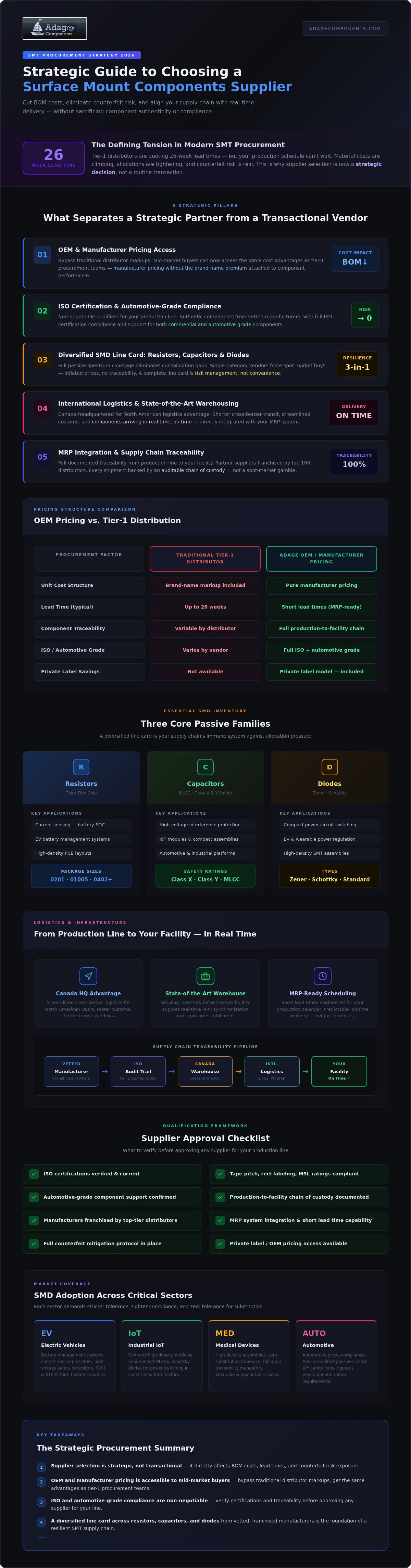
Your tier-1 distributor just quoted you a 26-week lead time. Your production schedule can't wait 26 weeks. This is the defining tension of modern SMT procurement, and it's forcing engineering and purchasing teams to rethink every assumption about where their components actually come from. Choosing the right surface mount components supplier is no longer a routine vendor decision; it's a strategic one that directly impacts your BOM costs, your line uptime, and your exposure to counterfeit risk.
You already know the pressure. Material costs are climbing, tier-1 allocations are tightening, and your MRP system needs predictable, on-time delivery, not promises. The fear of receiving non-compliant or inauthentic parts adds another layer of risk that no procurement officer can afford to ignore.
This guide gives you a practical framework for qualifying suppliers, cutting BOM costs without sacrificing component authenticity, and building a sourcing strategy that works in real time. From evaluating vetted manufacturers and ISO-certified supply chains to identifying drop-in replacements and unlocking OEM pricing, every section is designed to move your procurement operation from reactive to strategic.
Key Takeaways
- Selecting the right surface mount components supplier in 2026 is a strategic decision that directly affects your BOM costs, lead times, and counterfeit risk exposure — not a routine vendor transaction.
- OEM and manufacturer pricing is accessible to mid-market buyers: learn how to bypass traditional distributor markups and secure the same cost advantages as tier-1 procurement teams.
- ISO certifications and automotive-grade compliance are non-negotiable qualifiers — this guide breaks down exactly what to verify before approving any supplier for your production line.
- A diversified line card covering resistors, capacitors, and diodes from vetted, franchised manufacturers is the foundation of a resilient SMT supply chain that won't stall your MRP system.
- Real-time, on-time delivery is achievable through advanced international logistics and state-of-the-art warehousing — discover the infrastructure benchmarks that separate strategic partners from transactional vendors.
The Evolving Role of a Surface Mount Components Supplier in 2026
The definition of a reliable surface mount components supplier has fundamentally changed. A warehouse with inventory is no longer enough. Procurement teams in 2026 are evaluating suppliers on logistics infrastructure, manufacturing audit trails, counterfeit mitigation protocols, and the ability to integrate directly with MRP systems. The transactional vendor model is being replaced by something more demanding: a strategic supply chain partner.
That shift is being driven by the technology itself. Surface mount device (SMD) adoption has accelerated well beyond standard consumer electronics into automotive platforms, industrial IoT systems, and high-density medical assemblies. Each of these sectors brings stricter tolerance requirements, tighter regulatory compliance, and zero tolerance for component substitution without engineering approval.
From SMD Basics to Advanced SMT Integration
Package size reduction is one of the clearest indicators of where SMT is heading. The 0201 and 01005 form factors are now standard specifications in high-density PCB layouts, particularly in wearable devices, EV battery management systems, and compact IoT modules. These miniaturized passives, including thick film chip resistors and multilayer ceramic capacitors (MLCCs), demand tighter placement tolerances and more precise reel packaging to run efficiently on automated pick-and-place lines.
High-speed SMT assembly depends on consistency at the component level. Tape pitch, reel labeling, and moisture sensitivity ratings all affect line throughput. When passive components don't meet those specs, you don't just get a quality escape; you get line stoppages, rework cycles, and missed production targets.
In EV and IoT applications specifically, passive components carry more functional responsibility than their size suggests. Current sensing resistors manage battery state-of-charge accuracy. Class X and Class Y safety capacitors protect against electrical interference in high-voltage environments. Zener and Schottky diodes regulate switching in compact power circuits. The performance of these components directly determines system reliability.
Why Proximity and Private Labeling Matter for Modern OEMs
OEMs sourcing standard passives through traditional tier-1 distributors are often paying a brand-name premium that has nothing to do with component performance. Private labeling from a vetted, ISO-certified manufacturer closes that gap. At Adage Components, our private label model gives customers access to manufacturer pricing and OEM pricing on resistors, capacitors, and diodes that meet identical performance and compliance standards, without the markup built into branded distribution channels.
Our Canada-based headquarters provides a concrete logistics advantage for North American production facilities. Shorter cross-border transit times, streamlined customs documentation, and direct integration with your MRP schedule mean components arrive in real time, on time. That's not a marketing claim; it's the operational baseline our international logistics program is built around.
Bridging manufacturing audits and final delivery is where many suppliers fall short. Our partner suppliers include franchised manufacturers recognized by top-tier distributors, and every shipment is backed by documented traceability from the production line to your facility. That chain of custody is what separates a strategic supplier from a spot-market gamble.
Essential SMD Inventory: Resistors, Capacitors, and Diodes
Your BOM is only as strong as the components that populate it. For procurement teams building resilient SMT supply chains, the foundation starts with three passive families: resistors, capacitors, and diodes. The depth and authenticity of a supplier's line card in these categories determines whether your production schedule holds or fractures under allocation pressure.
Sourcing from a surface mount components supplier with a genuinely diverse inventory isn't a convenience; it's a risk management decision. Single-category vendors create consolidation gaps that force you into spot market buys, often at inflated prices and with no traceability. A supplier carrying the full passive spectrum, from thick film chip resistors to Class Y safety capacitors, gives your procurement team the flexibility to consolidate POs, reduce vendor count, and maintain documented chain of custody across every line item.
High-Performance Resistors: Thick Film vs. Thin Film Precision
Thick film chip resistors are the volume workhorses of SMT assembly. They're cost-effective, available in the full range of 0201 through 2512 form factors, and suitable for the vast majority of general-purpose industrial and consumer circuit applications. When your BOM calls for high-velocity resistor SKUs at competitive cost, thick film is the default specification.
Thin film precision resistors serve a different function entirely. Where thick film tolerances typically run at ±1% or ±5%, thin film achieves ±0.1% or tighter, with significantly lower temperature coefficients. These are non-negotiable in instrumentation, medical sensing, and high-frequency RF circuits where resistance drift directly corrupts measurement accuracy.
MELF resistors occupy a specialized but critical niche. Their cylindrical form factor and robust end-cap construction make them the preferred choice in high-reliability environments, including automotive electronics and military-grade assemblies, where mechanical stress, thermal cycling, and vibration would compromise a standard flat-chip package. Explore the full resistor line card, including thick film chip resistors and precision alternatives, to identify the right specification for your application.
Critical Capacitors and Diodes for Industrial Applications
MLCC availability remains constrained across several key dielectric grades and case sizes. Procurement teams that aren't actively managing their MLCC pipeline are absorbing the cost of that exposure through emergency buys. Tantalum capacitors offer a viable alternative in space-constrained, high-capacitance applications, though their voltage derating requirements demand careful engineering review. Aluminum electrolytic capacitors remain the standard for bulk filtering in power supply designs where board real estate is less critical.
For Class X and Class Y safety capacitors, regulatory compliance is the procurement driver. These components must meet IEC 60384-14 requirements for line-to-line and line-to-ground filtering in AC-connected equipment. Substituting an uncertified part to close a supply gap isn't a workaround; it's a compliance liability.
On the semiconductor side, Schottky diodes deliver the low forward voltage drop and fast reverse recovery that switching power supplies and rectifier circuits demand. Zener diodes provide precision voltage clamping across a wide range of reference and protection applications. Both require verified manufacturer sourcing to ensure parametric consistency across production lots.
Balancing inventory depth with high-velocity SKU turnover requires a supplier with both warehousing capacity and vetted manufacturer relationships. We work exclusively with partner suppliers, many franchised by top-tier distributors, to ensure that every component, regardless of volume, arrives with full documentation and authentic provenance. That's the standard a serious surface mount components supplier has to meet in 2026.
OEM Pricing vs. Tier-1 Distribution: Maximizing Your BOM Cost Analysis
Traditional tier-1 distribution channels carry a structural cost that most procurement teams accept without scrutiny. By the time a thick film chip resistor or MLCC moves from manufacturer to authorized distributor to your facility, it's passed through a margin stack that has nothing to do with component performance. That markup funds distributor infrastructure, sales teams, and catalog operations. You're paying for all of it, whether it adds value to your supply chain or not.
For mid-market OEMs competing against larger global manufacturers, that cost gap isn't academic. It's the difference between a BOM that wins a contract and one that doesn't.
The Financial Advantage of Manufacturer-Direct Pricing
At Adage Components, our private label model gives customers direct access to manufacturer pricing and OEM pricing on resistors, capacitors, and diodes. The same advantages tier-1 procurement teams negotiate at high volume are accessible to mid-market buyers through our sourcing structure. Volume-tiered contracts amplify those savings further: as your annual consumption of specific passive SKUs consolidates under a single supplier relationship, your per-unit cost decreases without any reduction in component specification or compliance standard.
This is how mid-market OEMs compete with global manufacturers on BOM cost. Not by cutting corners on component quality, but by eliminating the distribution margin that was never adding value in the first place. We're direct. That's the structural advantage.
A systematic BOM cost analysis is where that opportunity becomes visible. When procurement teams audit their passive component spend line by line, high-velocity SKUs, particularly thick film chip resistors in standard 0402 and 0603 packages, frequently represent the largest cost reduction opportunity. These aren't specialty components requiring brand-specific sourcing. They're commodity passives where manufacturer pricing, backed by full ISO-certified compliance and documented traceability, delivers identical performance at a fraction of the tier-1 distributed cost.
Transitioning to Private Label Components Without Quality Compromise
The practical concern with private label sourcing is always qualification. Engineering teams that have validated a Yageo or Vishay resistor into a design aren't wrong to ask hard questions before approving a drop-in replacement. The qualification framework should cover:
- Parametric equivalence: resistance value, tolerance, temperature coefficient, power rating, and case size must match the original specification exactly
- Compliance documentation: ISO certification records, RoHS/REACH declarations, and AEC-Q200 qualification for automotive-grade applications
- Manufacturer traceability: date code, lot number, and production facility documentation from a franchised or vetted partner supplier
- Packaging and reel specification: tape pitch, carrier dimensions, and moisture sensitivity level ratings compatible with your pick-and-place line
Our partner suppliers include franchised manufacturers recognized by top-tier distributors. Every component ships with full documentation. The private label designation changes the price point; it doesn't change the compliance standard or the chain of custody.
If you're ready to quantify what that cost delta looks like across your actual production BOM, the fastest path forward is a direct analysis. Submit your BOM for a cost-saving analysis and get a line-by-line comparison against your current sourcing costs. That's where the procurement decision becomes concrete, and where working with the right surface mount components supplier stops being a theoretical advantage and starts showing up in your margins.
Qualifying Reliability: Quality Assurance and Automotive Grade Compliance
Component failure in a deployed automotive ECU or industrial power system isn't a quality escape you recover from quietly. It's a recall, a liability, and a supply chain audit that traces directly back to your sourcing decision. That's why qualification isn't a checkbox exercise. It's the structural foundation of every reliable SMT procurement program.
The gap between a supplier who claims quality compliance and one who can document it is wider than most procurement teams realize until something goes wrong. Certifications, audit trails, and traceability records aren't administrative overhead. They're the evidence that a component will perform to spec across its full operational life, not just when it leaves the factory floor.
ISO Certifications and Rigorous Manufacturing Audits
ISO 9001 certification establishes the baseline: a supplier's quality management system is structured, auditable, and consistently applied. But for automotive and high-reliability industrial applications, the qualification bar is higher. AEC-Q200 qualification for passive components defines the stress test protocol that separates commercial-grade resistors and capacitors from automotive-grade equivalents. The distinction matters because automotive-grade components are validated against temperature cycling, mechanical shock, humidity exposure, and electrical overstress conditions that commercial-grade testing doesn't require.
When evaluating any surface mount components supplier, the quality management system audit should cover:
- Factory-level quality controls: incoming inspection protocols, in-process statistical process control, and finished goods verification procedures
- Lot traceability: date codes, batch numbers, and production facility identifiers documented on every shipment
- Environmental compliance: RoHS and REACH declarations verified at the component level, not just at the distributor level
- AEC-Q200 qualification records: for any passive component destined for automotive or high-reliability industrial applications
- Moisture sensitivity level (MSL) documentation: critical for MLCC and tantalum capacitors entering automated SMT assembly lines
At Adage Components, every shipment is backed by documented traceability from the production facility to your dock. ISO-certified manufacturing audits aren't a supplier claim we make; they're records we provide. That chain of custody is what gives your engineering team the confidence to approve a private label component without reopening the full qualification cycle.
Vetting Partner Suppliers for Authenticity and Longevity
Counterfeit passives don't always fail immediately. Some pass incoming inspection, enter your production line, and create field failures months later. The only reliable mitigation is sourcing from partner suppliers with verifiable manufacturer relationships, not spot-market intermediaries with no auditable origin.
Our partner suppliers include franchised manufacturers recognized by top-tier distributors. That franchised status isn't incidental; it means the manufacturer relationship is contractual, the supply chain is documented, and the components carry authentic provenance from production through delivery. It's the structural difference between a vetted supply chain and a price-optimized gamble.
Red flags that should disqualify a supplier immediately include: no ISO certification documentation on request, lot numbers that don't match manufacturer date code conventions, missing RoHS declarations at the component level, and pricing that sits significantly below market without a clear structural explanation. If a supplier can't explain why their cost is lower, the answer is usually the one you don't want.
For procurement teams building long-term supplier relationships rather than transactional buys, our Distributor Affiliated Program provides a structured framework for ongoing collaboration, backed by the same compliance standards and manufacturer traceability that govern every component we ship. Explore our full line card to verify compliance coverage across your passive component requirements.
Optimizing the Supply Chain: Logistics, Warehousing, and MRP Integration
Inventory on a shelf solves yesterday's problem. What your production schedule actually requires is a supplier whose logistics infrastructure is calibrated to your operational rhythm, delivering the right components at the right moment without requiring your procurement team to chase confirmations or manually reconcile delivery discrepancies. The shift from static stock models to real-time, on-time delivery is where supply chain strategy separates from supply chain hope.
Leveraging State-of-the-Art Warehousing for Just-In-Time Delivery
Our growing state-of-the-art warehouse is designed around one operational objective: compressing the gap between your purchase order and your production line. Global stocking programs stabilize your schedule by positioning high-velocity passive SKUs, including thick film chip resistors, MLCCs, and Schottky diodes, ahead of demand cycles rather than in response to them. That forward positioning is what makes a short leading strategy viable for SMT operations running tight production windows.
The practical effect is measurable. When a supplier maintains pre-positioned inventory with documented lot traceability, your team isn't absorbing the cost of emergency freight, expedite fees, or line-down delays caused by a distributor's allocation backlog. Strategic warehousing converts those reactive costs into predictable, budgeted procurement. It also eliminates the spot-market exposure that erodes BOM cost discipline every time a critical passive goes on allocation.
Seamless Integration with Your MRP and ERP Systems
Component data quality is where most supplier relationships quietly fail. An MRP system is only as accurate as the inputs feeding it. Incorrect lead time fields, mismatched unit-of-measure conventions, or missing MSL ratings force your planning team to manually verify data that should arrive clean. That administrative friction compounds across every SKU in your BOM, consuming time that belongs in engineering and procurement strategy, not data reconciliation.
A surface mount components supplier that understands your operational workflow delivers more than parts. Component data structured for direct import, lead times that reflect actual logistics performance rather than optimistic estimates, and packaging specifications that match your pick-and-place line requirements all reduce the friction between your supplier relationship and your production output. That's what "perfect for your MRP system" means in practice: zero manual correction, clean data, predictable delivery windows.
Our international logistics program is built to support North American production facilities with cross-border efficiency, streamlined customs documentation, and transit timelines that integrate directly with your planning cycles. Regional market disruptions, whether caused by port congestion, allocation constraints, or geopolitical trade shifts, are absorbed at the supply chain level rather than passed downstream to your schedule.
Future-proofing your supply chain requires a partner who treats logistics as a core competency, not an afterthought. If your current supplier can't answer precisely where your components are at any point between production and your dock, that's a structural gap your MRP system is already absorbing silently. Contact Adage to discuss your logistics needs and establish a supply chain framework built around your actual production requirements, not a standard distributor's delivery model.
Build a Procurement Strategy That Holds Under Pressure
Reactive sourcing is expensive. Every emergency buy, every spot-market expedite, and every line-down event traces back to a supplier relationship that wasn't built for the demands of modern SMT production. The framework in this guide gives your procurement team a concrete path forward: qualify on ISO-certified compliance, secure OEM pricing that eliminates unnecessary distribution margin, and build logistics infrastructure around real-time delivery rather than optimistic lead time estimates.
The core advantage of working with the right surface mount components supplier isn't just cost. It's the combination of Global Stocking Programs that position inventory ahead of your demand cycles, ISO Certified Quality Management that removes counterfeit risk from your supply chain, and Automotive and Commercial Grade Support that covers your full application range without requiring multiple vendor relationships.
Your BOM is the starting point. Explore our full line card to verify compliance coverage and request OEM pricing on your passive component requirements. The right supply chain partnership is closer than your current lead time suggests.
Frequently Asked Questions
What is the difference between an SMT supplier and an SMD manufacturer?
An SMD manufacturer produces the physical components: resistors, capacitors, diodes, and other passive devices at the fabrication level. An SMT supplier, by contrast, sources those components through vetted manufacturer relationships and delivers them to your production line with full compliance documentation, logistics support, and MRP-compatible data. The distinction matters because the supplier is the link between the factory floor and your assembly operation.
At Adage Components, we function as a private label distributor with direct manufacturer relationships, not a spot-market intermediary. That structure gives your procurement team access to authentic components with documented traceability, without the overhead of managing multiple direct manufacturer accounts across different passive families.
How can a private label supplier offer lower pricing than a major distributor?
Major distributors build margin into every transaction to fund their catalog infrastructure, sales networks, and warehousing overhead. A private label model eliminates those layers. We source directly through vetted partner suppliers, many of them franchised by top-tier distributors, and pass that cost advantage directly to your BOM. The component specification doesn't change; the distribution margin does.
This is how mid-market OEMs access the same pricing advantages that large-volume buyers negotiate at tier-1 level. Our structure gives you manufacturer pricing and OEM pricing on resistors, capacitors, and diodes without requiring the annual purchase volumes that typically unlock those rates through traditional channels.
Are Adage Components resistors drop-in replacements for major brands?
Yes, provided the qualification process confirms parametric equivalence. Our thick film chip resistors, thin film precision resistors, and MELF resistors are specified to match resistance value, tolerance, temperature coefficient, power rating, and case size against the original design requirement. Full compliance documentation, including ISO certification records, RoHS and REACH declarations, and AEC-Q200 qualification for automotive-grade applications, ships with every order.
Engineering teams don't need to reopen a full qualification cycle to approve a private label component when the documentation is complete and the manufacturer traceability is intact. If your team needs to validate specific SKUs against an existing approved vendor list, submit your BOM and we'll provide a line-by-line comparison with supporting compliance records.
Does your warehouse support automotive-grade component storage and handling?
Our growing state-of-the-art warehouse is built to handle both commercial and automotive-grade passive components with the storage conditions and handling protocols those specifications require. Moisture sensitivity level ratings are tracked and documented for MLCCs and tantalum capacitors, and lot traceability is maintained from receipt through shipment. AEC-Q200 qualified components are stored and handled in accordance with their classification requirements.
For procurement teams supplying automotive ECU, EV battery management, or high-reliability industrial applications, that infrastructure isn't optional; it's the baseline. Components that arrive at your dock without documented storage compliance create qualification gaps your engineering team then has to close. We eliminate that exposure at the warehouse level.
How do you ensure component authenticity and prevent counterfeits?
Authenticity is enforced at the sourcing level, not just at incoming inspection. Every component we ship comes from partner suppliers with verifiable, contractual manufacturer relationships. Franchised supplier status means the origin is documented, the supply chain is auditable, and the components carry authentic provenance from production through delivery. We don't source from spot-market intermediaries where that chain of custody breaks down.
Procurement teams should treat any surface mount components supplier that can't provide lot numbers matching manufacturer date code conventions, or that prices significantly below market without a clear structural explanation, as a counterfeit risk. Our documentation package on every shipment gives your quality team the records needed to verify authenticity without conducting independent lab testing on every incoming lot.
Can you integrate with my company's MRP or ERP system for automated ordering?
Our logistics and order management infrastructure is designed to deliver component data in formats compatible with standard MRP and ERP environments. Lead times reflect actual logistics performance, not optimistic estimates, and packaging specifications including tape pitch, carrier dimensions, and MSL ratings are provided in structured formats that reduce manual data entry on your side. Clean data in means accurate planning outputs, not manual reconciliation cycles.
If your operation runs a just-in-time production model, our global stocking programs position high-velocity passive SKUs ahead of your demand cycles rather than in response to them. That forward inventory positioning is what makes short lead times operationally real rather than a quoted number that shifts under allocation pressure. Contact us to discuss how our logistics program maps to your specific planning cadence.
What ISO certifications should I look for in a surface mount components supplier?
ISO 9001 is the baseline quality management certification and the minimum acceptable standard for any supplier entering your approved vendor list. For automotive and high-reliability industrial applications, look for AEC-Q200 qualification documentation on passive components, which confirms stress testing against temperature cycling, mechanical shock, and electrical overstress conditions that commercial-grade certification doesn't cover.
Beyond certifications, ask for factory-level audit documentation, not just a certificate number. RoHS and REACH declarations should be verified at the component level, and any supplier supporting automotive-grade assemblies should be able to provide lot-level traceability records on request. Certifications without supporting documentation are a compliance gap waiting to surface during your next customer audit.
What are the typical lead times for high-volume SMT resistor orders?
Lead times for high-volume thick film chip resistor orders depend on the specific case size, tolerance, and whether the SKU is pre-positioned in our warehouse inventory. For high-velocity passive SKUs in standard 0402 and 0603 packages, our global stocking programs are designed to support short lead strategies that integrate directly with your production schedule rather than forcing you to plan around extended distributor allocation windows.
The most accurate lead time for your specific requirements comes from a direct inquiry against your actual BOM, not a generic range that may not reflect current inventory positioning. If you're qualifying us as a supplier for ongoing production volumes, we can establish volume-tiered contracts that lock in both pricing and delivery commitments aligned to your MRP schedule.
Disclaimer
Cross-referenced components needs to be confirmed by the client with either spec. sheet or samples or both.
Please note, we use AI to help us, information is verified to be correct but we can not guarantee 100% accuracy.


