

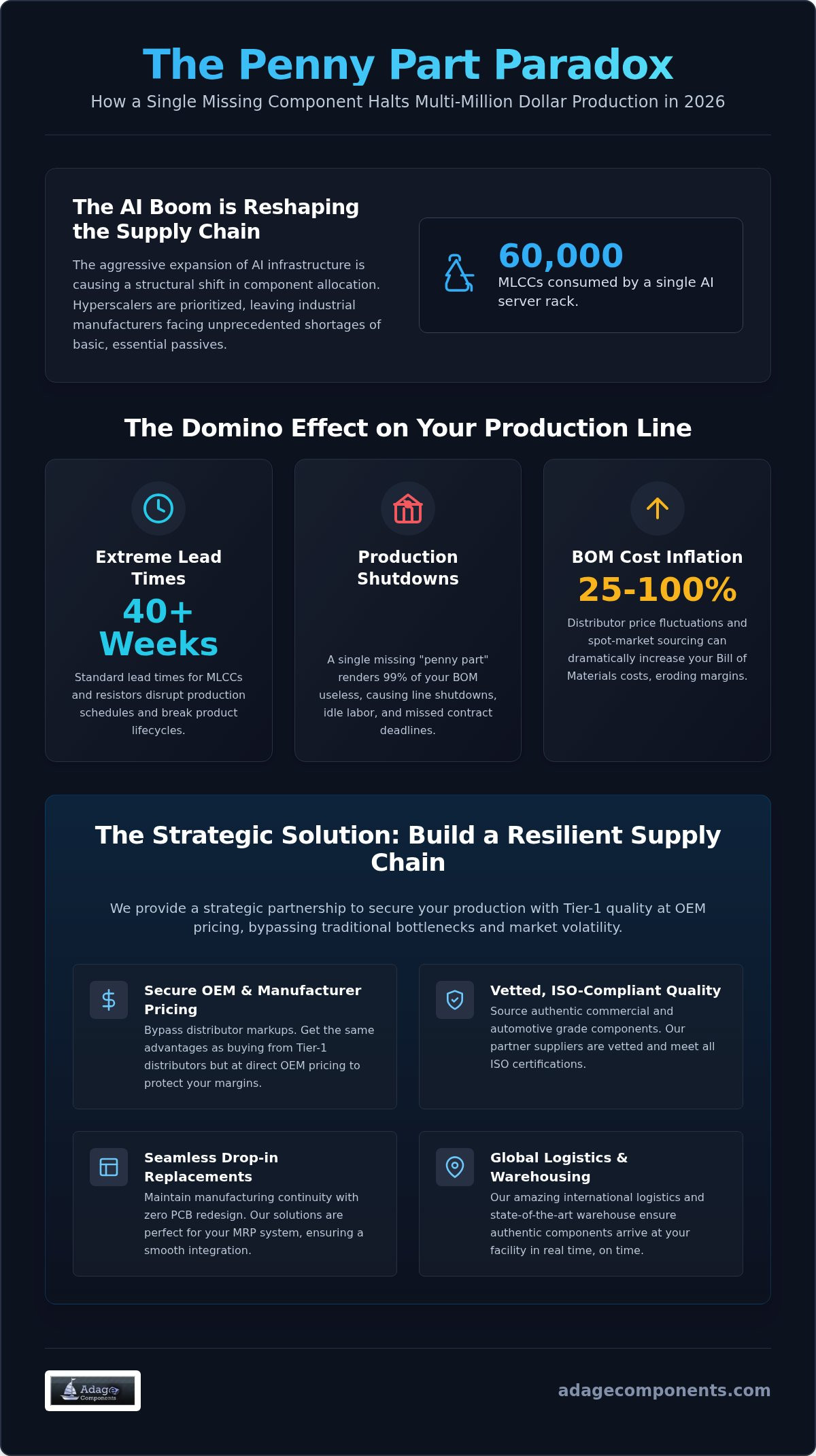
A single AI server rack now consumes up to 60,000 MLCCs, a structural shift that is pushing lead times for standard passives toward the 40-week mark. You're likely feeling the impact of component shortages on production as tier-1 distributors prioritize hyperscalers; this leaves industrial manufacturers facing line shutdowns over simple resistors or capacitors. It's a frustrating reality when a "penny part" jeopardizes a multi-million dollar delivery schedule. We understand that maintaining a stable assembly line requires more than just a vendor; it requires a strategic partner with global reach.
You don't have to accept these delays or the skyrocketing markups that often accompany market volatility. This article demonstrates how to secure your supply chain through strategic sourcing and OEM-direct pricing that rivals the biggest players in the industry. We'll explore how to integrate drop-in replacements that require zero PCB redesign and utilize vetted, ISO-compliant manufacturers to bypass traditional bottlenecks. You'll discover a clear roadmap to maintain manufacturing continuity, secure authentic components, and significantly reduce your BOM costs throughout 2026.
Key Takeaways
- Identify the structural shifts in 2026 supply chains and learn why missing "penny parts" like resistors create disproportionate assembly line shutdowns.
- Evaluate the total financial impact of component shortages on production, including the hidden costs of idle labor, missed contracts, and MRP friction.
- Discover how to utilize drop-in replacements for passive components to maintain manufacturing continuity without the high overhead of engineering redesigns.
- Learn to bypass traditional distributor markups by securing OEM pricing from vetted, ISO-compliant partner manufacturers.
- Build supply chain resilience using global stocking programs and state-of-the-art warehousing to ensure authentic components arrive at your facility in real time.
The Reality of Component Shortages in 2026: Why Production Lines Stall
The electronics industry is currently grappling with a structural shift that has redefined manufacturing stability. The impact of component shortages on production has evolved from a cyclical inconvenience into a persistent operational threat. Central to this crisis is the "Penny Part Paradox." It's a scenario where a single $0.01 resistor, missing from a kit, halts the assembly of a $10,000 industrial controller. These small, high-volume passives are the bedrock of modern electronics, yet their availability is increasingly compromised by the aggressive expansion of AI infrastructure and automotive electrification.
We see manufacturers moving away from the "Just-in-Time" inventory model that dominated the last decade. In 2026, "Just-in-Case" has become the standard for survival. With AI server racks consuming up to 60,000 MLCCs each, the massive reallocation of capacity toward hyperscalers has left traditional industrial OEMs fighting for remaining stock. This isn't a temporary spike; it's a fundamental change in how global supply chains prioritize demand. To maintain continuity, procurement teams must look beyond traditional vendors to find vetted manufacturers capable of delivering at scale.
Root Causes of Modern Supply Chain Volatility
Raw material scarcity remains a primary bottleneck. Specialized ceramics and high-purity films required for automotive-grade components are under immense pressure. Geopolitical tensions continue to complicate cross-border transit, often adding weeks to standard shipping routes. Additionally, manufacturing consolidation has reduced the number of partner suppliers for specific passive components. This lack of diversity in the supply base means any single factory disruption ripples through the entire market, driving up the impact of component shortages on production and leaving buyers with few alternatives.
Why Traditional Distribution Channels are Failing OEMs
Tier-1 distributors are increasingly bound by allocation constraints that favor high-volume consumer electronics and data center projects. For many OEMs, this results in lead times extending to 40 weeks or more for critical passives. These delays break product lifecycles and force companies to seek expensive spot-market solutions. Adage Components acts as a bridge in this fragmented market. We provide manufacturer pricing and OEM pricing that allows you to bypass these distribution bottlenecks. By working with vetted manufacturers and maintaining a growing state-of-the-art warehouse, we ensure your MRP system remains fueled with authentic components without the typical distributor markup. Our amazing international logistic program is designed to deliver products to your facility in real time, on time, even when traditional channels fail.
- Allocation Deprioritization: Smaller OEMs are often pushed to the back of the line during global shortages.
- Lead Time Friction: 24-40 week lead times for MLCCs and resistors disrupt production schedules.
- Margin Erosion: Price fluctuations at the distribution level can increase BOM costs by 25% to 100%.
Quantifying the Operational Impact: Lead Times, Costs, and MRP Friction
The impact of component shortages on production is most visible in the breakdown of the Bill of Materials (BOM). A single missing passive component, such as an MLCC or a Thick Film Chip Resistor, renders the remaining 99% of the BOM useless. This ripple effect creates a massive inventory bottleneck; you're left holding stock for completed portions of a board that cannot be shipped. It ties up capital in "work in progress" that should be generating revenue.
Beyond inventory, the financial consequences are severe. Idle labor on a stalled production line represents a total loss of overhead. For many electronics manufacturing services (EMS), these delays trigger penalty clauses in customer contracts, turning a profitable project into a liability overnight. These pressures often drive procurement teams toward the gray market. However, the hidden cost of sourcing from unvetted vendors includes the high risk of counterfeit parts that lack the rigorous testing of authentic components. Adage Components eliminates this risk by serving as a bridge to vetted manufacturers who prioritize quality and reliability.
Lead Time Analysis: The 2026 Benchmark
Standard lead times for Thick Film Chip Resistors have shifted dramatically from the historical 8-week average. In 2026, market benchmarks for high-demand passives frequently exceed 30 weeks, creating significant planning friction. Lead time variance is the statistical deviation between a supplier's quoted delivery window and the actual fulfillment date, a metric that directly dictates the level of safety stock required in your warehouse. Utilizing "Short Leading" strategies allows you to compress these windows. By sourcing directly through our global network, you gain the same advantages as buying from tier 1 distributors but at OEM pricing, ensuring your production schedule remains intact.
MRP Integrity and Supply Continuity
Unreliable delivery dates break the logic of automated Material Requirements Planning. For an MRP system to optimize production, it requires "real time, on time" data inputs. Integrating secondary supplier data into your system is no longer optional; it's a requirement for risk mitigation. Our amazing international logistic program ensures that components arrive at your facility precisely when needed, making our service perfect for your MRP system. We operate a growing state-of-the-art warehouse that acts as a buffer against global volatility. We maintain compliance with all ISO certifications to ensure every part meets your technical standards. To see how we can stabilize your supply chain, we invite you to review our full linecard of commercial and automotive grade components.
Mitigation Frameworks: Evaluating the Cost of Redesign vs. Drop-in Replacements
When the impact of component shortages on production threatens your shipping deadlines, the immediate reaction is often to task engineering with a PCB redesign. However, this "Redesign Trap" frequently costs more in the long term than the shortage itself. A redesign isn't merely a layout change; it triggers a cascade of expensive validation cycles, new stencils, and potential regulatory re-certifications. Diverting your top engineering talent away from new product development to fix legacy boards creates a massive opportunity cost that many manufacturers fail to quantify until it's too late.
We advocate for a more efficient framework: the strategic use of drop-in replacements. A true drop-in replacement maintains 100% form, fit, and function compatibility with the original part. By utilizing vetted manufacturers, you can secure authentic components that match the technical specifications of your original BOM without altering a single trace on your board. This approach preserves your manufacturing continuity and keeps your engineering team focused on innovation rather than fire-fighting.
The True Cost of PCB Redesign
Hidden expenses often lurk beneath the surface of a "simple" board spin. Beyond engineering hours, you must account for validation testing and re-certification for standards like UL, CE, or specialized automotive-grade requirements. If your product is in a regulated industry, the documentation trail alone can add months to your timeline. Redesigning should be your last resort, reserved only for when a component technology has reached true end-of-life (EOL) with no viable alternatives in the global marketplace.
Strategic Sourcing of Drop-in Replacements
Identifying standard industry parts with high cross-compatibility is the key to supply chain resilience. Many high-demand passives from major industry brands have direct functional equivalents that meet or exceed their performance benchmarks. Adage Components specializes in providing cost-effective alternatives that maintain the integrity of your design while offering one of the best costs in the industry.
We act as your strategic partner by performing the rigorous technical audits required to qualify these partner suppliers. Our process ensures that every component, whether it's a Thick Film Chip Resistor or a specialized capacitor, is sourced from vetted manufacturers, many of whom are franchised by top 100 distributors. This allows you to get manufacturer pricing and OEM pricing without sacrificing quality. Every part we supply is backed by compliance with all ISO certifications, ensuring that the impact of component shortages on production is mitigated through reliable, high-standard alternatives.
- Form, Fit, and Function: We ensure replacements match the original footprint and electrical characteristics exactly.
- Vetted Manufacturers: Every partner supplier undergoes strict manufacturing audits to guarantee part authenticity.
- Short Leading Times: Our global network allows us to bypass the 40-week lead times common in traditional distribution.
- Automotive and Commercial Grade: We support high-reliability sectors with components that meet rigorous industry standards.
By shifting your focus from redesign to strategic sourcing, you protect your margins and your schedule. Our growing state-of-the-art warehouse and amazing international logistic program are designed to support your MRP system in real time. We provide the same advantages as buying from tier 1 distributors but at OEM pricing, giving you a decisive edge in a volatile market.
Building Resilient Supply Chains: Quality Assurance and Strategic Stocking
Sourcing a part is only half the battle in a volatile market. To truly mitigate the impact of component shortages on production, you must transition from transactional buying to a strategic partnership model. This shift involves moving beyond simple price-and-delivery queries toward a framework built on manufacturing audits and technical reliability. In 2026, the risk of counterfeit parts in the gray market is at an all-time high, making multi-stage inspection processes a requirement for any authentic components entering your assembly line.
Resilience is built on the ability to verify quality before a part ever reaches your facility. We act as an elite partner by bridging the gap between fragmented global markets and your specific production needs. By utilizing partner suppliers franchised by top 100 distributors, we offer the same advantages as buying from tier 1 distributors but at OEM pricing. This allows you to maintain one of the best costs in the industry without compromising the technical integrity of your Bill of Materials.
Vetting Your Partner Suppliers
Our vetting process is disciplined and meticulous. We conduct manufacturing audits that focus on equipment precision, process control, and rigorous material traceability. This ensures that every part, whether it's a commercial grade capacitor or a specialized automotive grade resistor, meets industry-standard quality certifications. We only work with vetted manufacturers who demonstrate a commitment to lifecycle management. This level of scrutiny protects your production line from the "Penny Part Paradox" discussed earlier, ensuring that every component is technically sound and fully compliant with all ISO certifications.
Logistics and Infrastructure: The Backbone of Continuity
Reliable logistics are the primary hedge against supply chain volatility. We utilize a growing state-of-the-art warehouse to manage global stocking programs, creating a buffer of safety stock for our partners. This infrastructure is designed to reduce the impact of component shortages on production by ensuring that "short leading" times are a reality, not just a promise. Our amazing international logistic program navigates complex customs requirements to deliver products to your facility in real time, on time.
This integrated approach is perfect for your MRP system. By feeding accurate, real-time data into your procurement workflows, you eliminate the friction caused by unreliable lead times. We invite you to view our full capabilities on our Linecard page to see how our manufacturer pricing and strategic infrastructure can secure your 2026 production schedule.
- Material Traceability: Full documentation from vetted manufacturers to ensure part authenticity.
- Strategic Stocking: Leveraging our warehouse capacity to bypass 40-week market lead times.
- MRP Integration: Logistics data that fits seamlessly into your automated planning systems.
- Quality Benchmarks: Rigorous multi-stage inspections for both commercial and automotive grade components.
Adage Components: Securing Your Production with Tier-1 Quality at OEM Pricing
The impact of component shortages on production in 2026 requires a shift from reactive buying to disciplined, strategic sourcing. Adage Components provides this stability by offering one of the best costs in the industry without compromising the technical standards your assembly line requires. We deliver manufacturer pricing and OEM pricing on essential passives, allowing you to maintain the same advantages as buying from tier 1 distributors but with significantly better cost-effectiveness. Our approach ensures that your Bill of Materials remains resilient against the volatility of the global market.
We specialize in securing supply for critical items like Thick Film Chip Resistors, MLCCs, and Diodes. Every part that enters our growing state-of-the-art warehouse undergoes a multi-stage inspection process to ensure you receive only authentic components. By bypassing traditional distribution markups and working directly with vetted manufacturers, we act as a bridge between high-quality production facilities and your MRP system. We understand that in industrial procurement, precision and reliability are just as important as speed.
Professional Procurement for Modern OEMs
Adage Components positions itself as an elite partner rather than a mere vendor. We thrive on solving difficult sourcing puzzles that leave traditional distributors with 40-week backlogs. Our brand acts as a bridge between a fragmented global marketplace and your facility's specific needs. This personality of a Reliable Specialist is backed by a commitment to integrity and a disciplined expertise in lifecycle management. We ensure that every component, whether commercial or automotive grade, meets all ISO certifications before it reaches your facility. This meticulous attention to detail is what allows us to deliver products in real time, on time, regardless of market conditions.
Next Steps for Supply Chain Security
The impact of component shortages on production doesn't have to dictate your 2026 revenue. You can take immediate action to secure your supply chain and reduce your material costs. We invite you to initiate a transactional inquiry today to experience the efficiency of our amazing international logistic program. Our team is ready for immediate operational engagement to help you find drop-in replacements and secure long-term stock for your most critical projects.
- Cost Optimization: Get manufacturer pricing that rivals the largest global buyers.
- Quality Assurance: Every part is sourced from vetted manufacturers franchised by top 100 distributors.
- MRP Integration: Our logistics data is designed to be perfect for your MRP system.
- Technical Support: Access expert guidance on drop-in replacements to avoid the Redesign Trap.
Don't let missing passives halt your assembly line. Submit your BOM today for a comprehensive cost and lead time analysis. For a deeper look at procurement strategies, read our companion piece: The Strategic Guide to Sourcing Passive Electronic Components for OEMs.
Stabilizing Your 2026 Production Roadmap
Navigating the current industrial landscape requires a departure from traditional, reactive sourcing. We've established that the impact of component shortages on production is a structural shift rather than a temporary hurdle. By prioritizing drop-in replacements over costly PCB redesigns and securing OEM pricing through vetted manufacturers, you protect both your margins and your delivery schedules. These strategies transform your supply chain from a point of vulnerability into a competitive advantage.
Adage Components acts as your strategic bridge, offering the same advantages as buying from tier 1 distributors but at manufacturer pricing. As specialists in Thick Film Chip Resistors and ISO 9001:2015 compliant processes, we provide the technical reliability your MRP system demands. Our growing state-of-the-art warehouse and amazing international logistic program ensure your authentic components arrive at your facility in real time, on time. We are ready to help you maintain manufacturing continuity with one of the best costs in the industry.
Get Manufacturer Pricing on Your Next BOM - Contact Adage Components to secure your supply chain today. We look forward to solving your most difficult sourcing puzzles together.
Frequently Asked Questions
How do component shortages specifically affect automotive production in 2026?
Automotive production faces severe bottlenecks due to the high volume of AEC-Q200 compliant passives required for electric vehicle power trains and ADAS systems. In 2026, the demand for these high-reliability components often results in lead times exceeding 40 weeks. This specific impact of component shortages on production forces automotive OEMs to secure long-term allocation or risk total line shutdowns during critical assembly phases.
What are the risks of using drop-in replacements for resistors and capacitors?
The primary risk involves technical non-compliance with the original footprint or electrical characteristics, such as Temperature Coefficient of Resistance (TCR) or voltage coefficients. We mitigate this through rigorous manufacturing audits and technical validation. Every drop-in replacement we provide is sourced from vetted manufacturers to ensure 100% form, fit, and function compatibility with your original design, preventing any operational failures.
How can I verify if a private-label component is automotive grade?
Automotive grade components must be AEC-Q200 certified and supported by full material traceability documentation. We verify this by auditing our partner suppliers to ensure they meet these stringent reliability standards. You can confirm the grade by reviewing the manufacturer technical data sheets and ISO certifications. We provide this documentation for all automotive-grade passives to ensure they meet your high-standard requirements.
What is the difference between OEM pricing and tier-1 distributor pricing?
Tier-1 distributor pricing includes significant markups to cover their massive overhead and inventory costs. In contrast, manufacturer pricing or OEM pricing allows you to bypass these middleman fees. We provide the same advantages as buying from tier 1 distributors but at a lower cost basis. This approach allows us to offer one of the best costs in the industry for high-volume procurement.
Can Adage Components help with sourcing obsolete or end-of-life (EOL) parts?
We specialize in finding high-quality alternatives for obsolete or EOL parts through our network of partner suppliers. If a specific part is no longer in production, we identify drop-in replacements that match the original technical specifications. This strategy allows you to maintain manufacturing continuity without the high cost and delay of a complete PCB redesign, keeping your legacy products in production longer.
How does a global stocking program help mitigate lead time variance?
A global stocking program reduces the impact of component shortages on production by maintaining safety stock in a growing state-of-the-art warehouse. This infrastructure acts as a hedge against lead time variance, ensuring that parts are available for immediate dispatch regardless of market spikes. It allows us to offer "short leading" times that stay consistent even when traditional distribution channels face significant delays.
What ISO certifications should I look for in a component manufacturer?
You should prioritize manufacturers with ISO 9001:2015 for quality management systems and IATF 16949 for automotive-specific requirements. We ensure all our partner suppliers comply with these essential ISO certifications. These standards guarantee that the manufacturing process is disciplined, repeatable, and focused on delivering authentic components with zero defects. This compliance is non-negotiable for maintaining the technical integrity of your supply chain.
Is it possible to integrate a new supplier into my existing MRP system quickly?
Our amazing international logistic program is designed to be perfect for your MRP system, allowing for rapid integration. We provide real-time data on stock availability and shipping timelines, ensuring your automated procurement workflows remain accurate. This seamless integration allows products to arrive at your facility in real time, on time, reducing the administrative friction typically associated with onboarding new partner suppliers.
Disclaimer
Cross-referenced components needs to be confirmed by the client with either spec. sheet or samples or both.
Please note, we use AI to help us, information is verified to be correct but we can not guarantee 100% accuracy.


