

What if the right tantalum capacitor derating guidelines depend on more than the voltage printed on the part? A familiar percentage may not fit when construction, temperature, ripple current, and circuit transients all affect operating stress. Start with the selected manufacturer’s datasheet, then compare its limits with the conditions the capacitor will actually encounter.
This reference explains how to apply manufacturer-specific guidance rather than rely on a universal rule. It covers how voltage and thermal stresses affect selection, how solid manganese dioxide, polymer, and wet tantalum technologies differ, and what to verify in the datasheet. It also connects component selection to sourcing: the part procured should match the approved manufacturer and part number. Adage Components supplies tantalum capacitors and other electronic components to OEMs and EMS providers, with cost-effective alternatives and supply-chain support. The result is a practical framework for balancing electrical requirements, quality controls, and procurement priorities.
Key Takeaways
- Use tantalum capacitor derating guidelines as a datasheet-led decision, not a universal percentage.
- Assess voltage, temperature, impedance, and transient behavior together to understand circuit stress.
- Compare solid, polymer, and wet tantalum constructions against the operating conditions and datasheet checks relevant to your design.
- Separate verified circuit inputs from assumptions, then document the manufacturer guidance used in your selection.
- Support electrical suitability with controlled sourcing, traceable procurement records, and quality controls that fit your requirements.
Tantalum Capacitor Derating: What It Means for Circuit Reliability
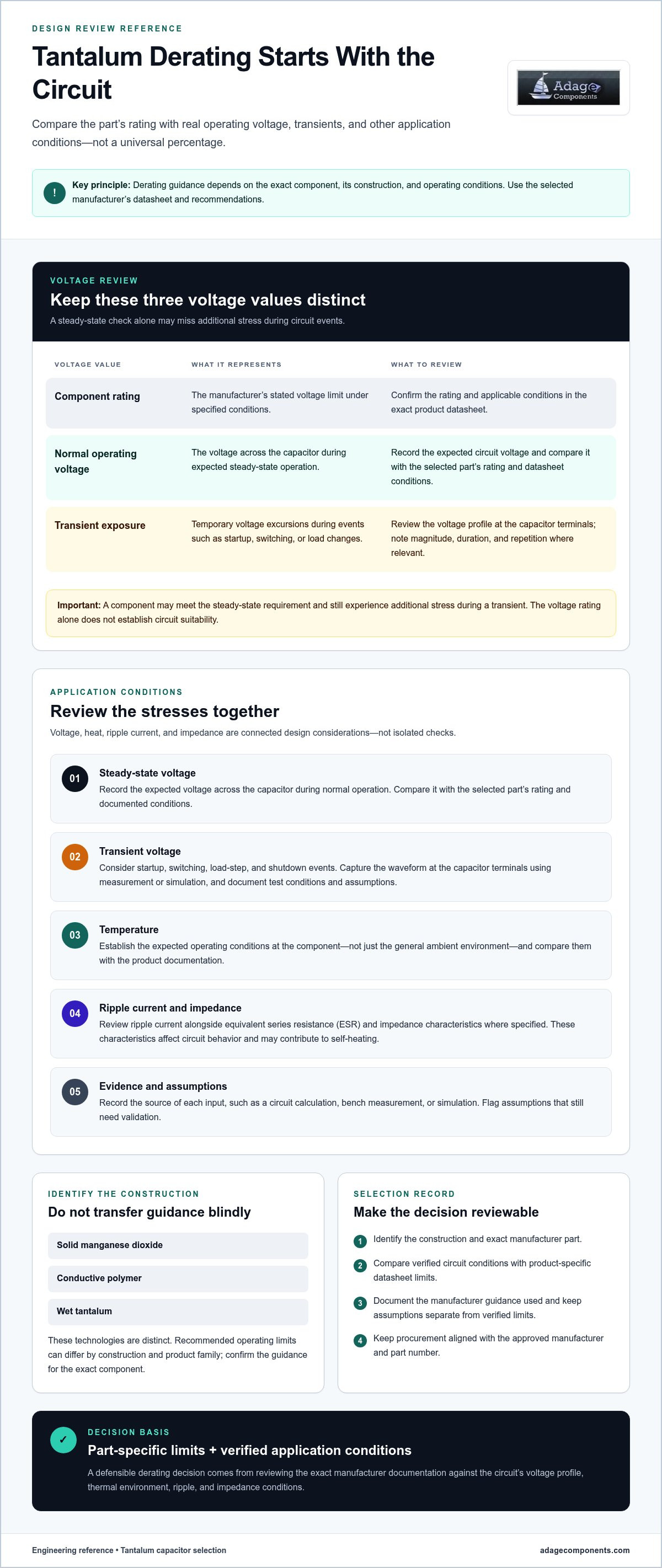
Voltage derating means operating a capacitor below its rated voltage, in accordance with the limits and recommendations specified for that product. There is no universal percentage that fits every part: appropriate guidance can vary with capacitor construction, product family, and operating conditions. When applying tantalum capacitor derating guidelines, evaluate the selected component in its actual circuit rather than treating the voltage rating as a complete measure of suitability.
Keep three voltage values distinct during design review:
- Component rating: The manufacturer’s stated voltage limit under specified conditions.
- Normal operating voltage: The voltage across the capacitor during expected steady-state operation.
- Transient exposure: Temporary voltage excursions during events such as startup, switching, or load changes.
A part may meet the steady-state requirement and still experience additional stress during a transient. Review the operating profile and applicable datasheet limits together. The rating alone does not establish whether the component suits the circuit.
Why does voltage derating matter in tantalum capacitors?
Electrical stress can influence reliability, so operating below a rating can provide design margin. That margin is not a guarantee against failure, and it does not account for every source of stress. Temperature, circuit impedance, and transient behavior also matter. Make the decision using the exact manufacturer datasheet and the application conditions, rather than applying a rule of thumb on its own.
Which tantalum capacitor construction is in the design?
Identify whether the part uses a solid manganese dioxide cathode, a conductive polymer cathode, or a wet tantalum construction. These technologies are distinct, and recommended operating limits can differ by construction and product family. For foundational context on structure and types, see the Tantalum electrolytic capacitor overview and the broader capacitor fundamentals article.
Next, consult the manufacturer’s documentation for the exact component. Check its stated voltage conditions and guidance relevant to the intended operating environment. Do not transfer a recommendation from one tantalum type or product family to another without confirming that it applies.
In power supply design, derating is a circuit-specific reliability decision. Record the normal voltage and expected transients, identify the capacitor construction, and compare those inputs with the selected product’s datasheet. This gives engineering reviewers a clear basis for the decision and keeps assumptions separate from verified limits.
How Voltage, Temperature, and Circuit Conditions Shape Derating
A tantalum capacitor does not experience voltage, heat, and ripple current as isolated design questions. In a power supply, operating voltage and transients establish electrical stress, while ripple current and impedance can contribute to heating. Define the application conditions before selecting a part. This checklist helps identify the inputs to review:
- Steady-state voltage: Record the expected voltage across the capacitor during normal operation. Compare it with the selected part’s rating and datasheet conditions.
- Transient voltage: Identify startup, switching, load-step, and shutdown events that could create excursions. Note their magnitude, duration, and repetition where relevant.
- Temperature: Establish the expected operating conditions at the component, not just the general ambient environment.
- Ripple and impedance: Review ripple current, equivalent series resistance (ESR), and impedance characteristics where the datasheet specifies them.
- Evidence: Record the source of each design input, such as a circuit calculation, bench measurement, or simulation. Flag assumptions that still need validation.
Check component limits against the selected part’s datasheet and manufacturer documentation under the intended operating conditions. A voltage rating by itself does not establish suitability for every power supply. Manufacturer recommendations and specified limits apply to particular parts and conditions, not automatically to every tantalum capacitor.
How should operating voltage and transients be assessed?
Compare the expected steady-state voltage with the component’s specified rating, then examine the circuit voltage profile during relevant events. For example, a supply may operate steadily at one level but experience a brief startup overshoot or switching excursion. Use measurement or simulation to capture the waveform at the capacitor terminals. Record the operating mode, test conditions, and assumptions with the result. If the transient profile is unknown, resolve it before treating the design margin as established.
How do temperature, ripple, and impedance affect the review?
Compare the actual thermal environment with the selected product’s documented conditions. Assess ripple current alongside ESR and impedance data where provided, since these characteristics affect the capacitor’s behavior in the circuit and may contribute to self-heating. Unknown waveforms or thermal conditions call for engineering analysis, measurement, or simulation, not an assumed safe margin. For additional application context, NASA’s NASA Polymer Tantalum Capacitor Guidelines address polymer tantalum components. Use them as a focused reference, not as a replacement for the selected part’s datasheet.
These checks make tantalum capacitor derating guidelines specific to both the component and its circuit. For procurement planning, compare your approved design requirements with Adage Components’ electronic components line card.
Solid, Polymer, and Wet Tantalum: Apply Guidance to the Right Type
Tantalum capacitors use different cathode constructions, and their electrical behavior and manufacturer recommendations can vary. A general comparison helps identify what to investigate, but it cannot set a derating rule for every part. Use this matrix to guide the review, then apply the datasheet and manufacturer guidance for the selected product family.
| Construction | Datasheet checks | Application questions |
|---|---|---|
| Solid manganese dioxide (MnO₂) | Rated voltage conditions, temperature limits, ripple or ESR data, and any stated charging or transient guidance. | What voltage profile and circuit conditions will the part experience? Does the manufacturer specify additional application precautions? |
| Conductive polymer | Voltage and temperature conditions, ESR and ripple characteristics where specified, and product-specific transient guidance. | Do the part’s documented characteristics suit the supply’s ripple, load behavior, and operating environment? |
| Wet tantalum | Product-specific voltage and temperature limits, mounting or operating conditions, and stated derating requirements. | Does the selected wet construction have guidance that differs from assumptions used for solid tantalum parts? |
What changes between manganese dioxide and polymer tantalum?
Solid MnO₂ parts use manganese dioxide in the cathode system; polymer parts use a conductive polymer cathode. These construction differences are a reason to compare datasheets, not to assume that one type is always more reliable or suitable. For each candidate, check the documented voltage and temperature conditions, impedance or ESR information, and application notes. Follow the selected part’s charging and transient recommendations. Do not transfer limits from another construction or product family.
For broader technology trade-offs, review the existing tantalum-versus-ceramic comparison alongside this construction-specific assessment. Do not treat the two technologies as interchangeable based on capacitance alone. Evaluate their documented characteristics against the circuit requirements.
When should wet tantalum guidance be treated separately?
Wet tantalum has a different construction from solid MnO₂ and polymer parts, so do not automatically apply selection assumptions from either solid type. Find the exact wet tantalum part’s derating requirements and stated operating conditions in its manufacturer documentation. Compare only distinctions supported by that documentation, including voltage and temperature limits or product-specific application instructions.
The practical rule is straightforward: use construction to identify which guidance to review, then let the selected part’s documentation govern the design decision. That keeps tantalum capacitor derating guidelines specific to the actual component and its intended circuit conditions.
A Datasheet-Led Workflow for Applying Tantalum Derating Guidelines
Apply tantalum capacitor derating guidelines through a documented review of the circuit and the exact component. This workflow separates verified design inputs from estimates and avoids turning a generic voltage percentage into a universal pass-or-fail threshold.
- Characterize the circuit. Record normal operating voltage, startup behavior, relevant transients, expected temperature, and ripple conditions at the capacitor.
- Separate facts from assumptions. Mark each input as verified by calculation, measurement, or simulation, or identify it as an assumption requiring further analysis.
- Identify the exact component. Record manufacturer, part number, construction, and the approved source or manufacturer documentation associated with the part.
- Review its datasheet. Check rated voltage and temperature conditions, capacitance tolerance, and relevant impedance data. Review surge, ripple, charging, and polarity instructions where specified.
- Compare circuit conditions with manufacturer guidance. Evaluate the documented limits against the characterized application. If a waveform or thermal condition is uncertain, resolve it through engineering analysis rather than assuming margin.
- Document the decision. Record the part number, construction, applicable limits, datasheet revision, source documents, design inputs, and rationale for selection.
What should an engineer check in the capacitor datasheet?
Confirm that the document matches the exact component, not just a similar series or construction. Record its revision and the relevant conditions attached to each rating. Check electrical characteristics and application instructions together, including surge, ripple, charging, or polarity guidance when the manufacturer provides it. If a required limit or condition is unclear, treat it as an open engineering question rather than infer a value from another part.
How can the design review make derating decisions auditable?
Keep a concise decision record that links each conclusion to evidence. Include normal, startup, and transient operating conditions, along with temperature and ripple assumptions. Identify which values came from measurement or simulation and which remain unverified. Record the manufacturer’s guidance and explain how it informed the selection. This gives reviewers a traceable basis for the decision and helps prevent assumptions from becoming undocumented design inputs.
Reopen the review if voltage, temperature, circuit behavior, component construction, or component source changes. A revised part or operating profile can make the original rationale inapplicable, so verify that the documentation still matches the design. For component planning, compare your approved requirements with Adage Components’ electronic components line card.
Source Tantalum Capacitors with Derating and Quality Controls in View
A sound derating decision depends on more than choosing a part with suitable electrical specifications. Procurement must preserve the link between the approved component, its manufacturer guidance, and the part received. Adage Components supplies tantalum capacitors to OEM and EMS customers and provides technical support and quality assurance for electronic component sourcing.
What sourcing controls support a qualified tantalum capacitor?
Adage Components works with manufacturers and supplier channels to source electronic components. For a controlled procurement process, keep records that connect the approved manufacturer and part number with supplier documentation and received components. Compare the component identity and documentation against the requirements established during engineering approval.
Quality control and compliance documentation support component qualification and help align supplied parts with customer requirements. Keep electrical approval tied to the exact capacitor construction and datasheet, then align purchasing records with that approved component. Application-specific qualification and documentation requirements should remain part of the procurement record.
How can sourcing align with production planning?
Adage Components supports OEM and EMS procurement through bulk product sales, direct procurement channels, global stocking programs, and international logistics coordination. These services can help align component sourcing with production planning and manage material requirements across the supply chain. Cost-effective alternatives and drop-in replacements for standard industry parts can also support cost and continuity planning, provided the selected component meets the approved electrical and quality requirements.
For a BOM review, use the BOM submission form to share component requirements for sourcing and cost analysis. This connects engineering specifications with procurement planning while keeping approved electrical requirements central.
Keep component identity, datasheet guidance, and purchasing records aligned as designs move into production. Review the electronic component line card to identify components relevant to your requirements.
Turn Derating Decisions into a Reliable Sourcing Plan
Effective tantalum capacitor derating guidelines start with the exact component, its construction, the manufacturer’s datasheet, and the conditions in your power supply. Review steady-state voltage alongside transients, temperature, ripple, and impedance. Then document the evidence and assumptions behind the selection so engineering and procurement teams can work from the same approved requirements.
Carry that discipline through sourcing. Adage Components supplies tantalum capacitors to OEM and EMS customers, with supply-chain support, technical assistance, and quality controls. Keeping procurement aligned with the approved part helps preserve component identity as designs move into production.
Ready to connect your component requirements with your sourcing plan? Submit your BOM for sourcing and cost analysis. A datasheet-led selection and a documented procurement process give your team a clear basis for moving forward.
Frequently Asked Questions
How much should you derate a tantalum capacitor?
There is no single derating percentage that applies to every tantalum capacitor. The appropriate operating margin depends on the capacitor construction, product family, circuit conditions, and manufacturer recommendations. Compare the expected steady-state voltage and transients with the exact part’s datasheet limits, including relevant temperature and ripple conditions. Document the guidance used and any assumptions that need measurement or simulation before approving the component for the design.
Why do tantalum capacitors need voltage derating?
Voltage derating means operating the capacitor below its rated limit, which can reduce electrical stress in the intended application. It does not guarantee the component will not fail, and voltage is not the only factor. Temperature, ripple, circuit impedance, and transient events also influence conditions at the part. Use the manufacturer’s recommendations for the specific capacitor and review them alongside the power supply’s actual operating profile.
Do polymer tantalum capacitors require the same derating as manganese dioxide types?
Not necessarily. Polymer and solid manganese dioxide capacitors use different cathode constructions, and their application guidance can differ. Do not transfer a recommendation from one construction or product family to another. Review the selected part’s datasheet for voltage and temperature conditions, ESR or ripple information, and any charging or transient precautions. Choose based on the circuit requirements and manufacturer documentation, not a general assumption that one type is always preferable.
How do temperature and ripple current affect tantalum capacitor selection?
Check temperature and ripple current against the selected capacitor’s documented operating conditions. Ripple can contribute to heating, while the part’s ESR and impedance characteristics affect its behavior in the circuit. Review the manufacturer’s applicable limits and conditions together rather than treating each value in isolation. If the capacitor’s actual temperature or ripple waveform is unknown, use engineering analysis, measurement, or simulation to establish the design inputs.
Can a tantalum capacitor be operated at its full rated voltage?
That depends on whether the manufacturer’s documentation allows the intended operating conditions. The voltage rating alone does not prove the part is suitable. Check the exact datasheet, including temperature conditions and any applicable ripple, surge, or transient guidance. Assess normal operation and startup behavior in the circuit. If those conditions fall outside documented limits or remain uncertain, resolve them before approving the design.
What happens if a tantalum capacitor experiences a voltage transient?
The effect depends on the transient’s magnitude, duration, repetition, circuit impedance, and capacitor construction. A brief excursion may still create stress beyond what the selected part’s application guidance permits, potentially affecting reliability or causing damage. Do not assume a steady-state voltage check covers startup or switching events. Measure or simulate the waveform at the capacitor, then compare the results with the exact manufacturer datasheet and application recommendations.
How can I verify that a tantalum capacitor is authentic?
Use a controlled procurement process and retain records that connect the approved manufacturer and part number to the purchased component. Check supplied documentation and markings against the manufacturer’s information, and investigate discrepancies through your quality process. Adage Components supports OEM and EMS customers with electronic component sourcing, quality controls, and technical support. Traceable purchasing records help maintain component identity through procurement.
Disclaimer
Cross-referenced components needs to be confirmed by the client with either spec. sheet or samples or both.
Please note, we use AI to help us, information is verified to be correct but we can not guarantee 100% accuracy.


