

The right-looking capacitor can still be the wrong choice for a safety-critical circuit. Safety Capacitors must be qualified for their position and function, not selected as generic substitutes based on matching capacitance or package size. Class X capacitors are used across line conductors to address differential-mode interference, while Class Y capacitors are used between line and ground to address common-mode interference, with different safety considerations if a component fails.
Before approving a part, establish which class the circuit requires, what ratings and approvals must be verified, and how the component’s identity and supply path will be documented. This guide explains the functional distinction between Class X and Class Y types, then provides practical checks for reviewing schematics, datasheets, safety approvals, traceability, and supplier documentation.
Adage Components supplies electronic components, including safety capacitors, to OEMs and EMS providers. Its services include manufacturing audits, technical support, international logistics, and global stocking programs. These services can support component qualification and supply planning, while the responsible engineering team remains accountable for confirming that a specific component meets the design requirements.
Key Takeaways
- Understand how Safety Capacitors are selected for different circuit positions, and why Class X and Class Y designations aren’t interchangeable.
- Use the schematic and design requirements to identify the required capacitor class before evaluating possible parts or substitutions.
- Build a qualification checklist that verifies approvals, datasheet revision, traceability, and manufacturer identity for the exact component.
- Adage Components supplies electronic components and offers manufacturing audits, technical support, and supply chain services. Confirm that the exact component and its documentation meet your requirements.
- For supply planning, check current availability and lead-time information, and clarify any logistics or stocking requirements before making production commitments.
What Are Safety Capacitors, and What Do X and Y Classes Do?
Safety capacitors are components selected for circuit positions where applicable electrical safety requirements must be addressed. Their class, ratings, approvals, and intended application must match the design; using one doesn’t make the equipment safe by itself. The overall circuit and product still require engineering review against the requirements that apply to them.
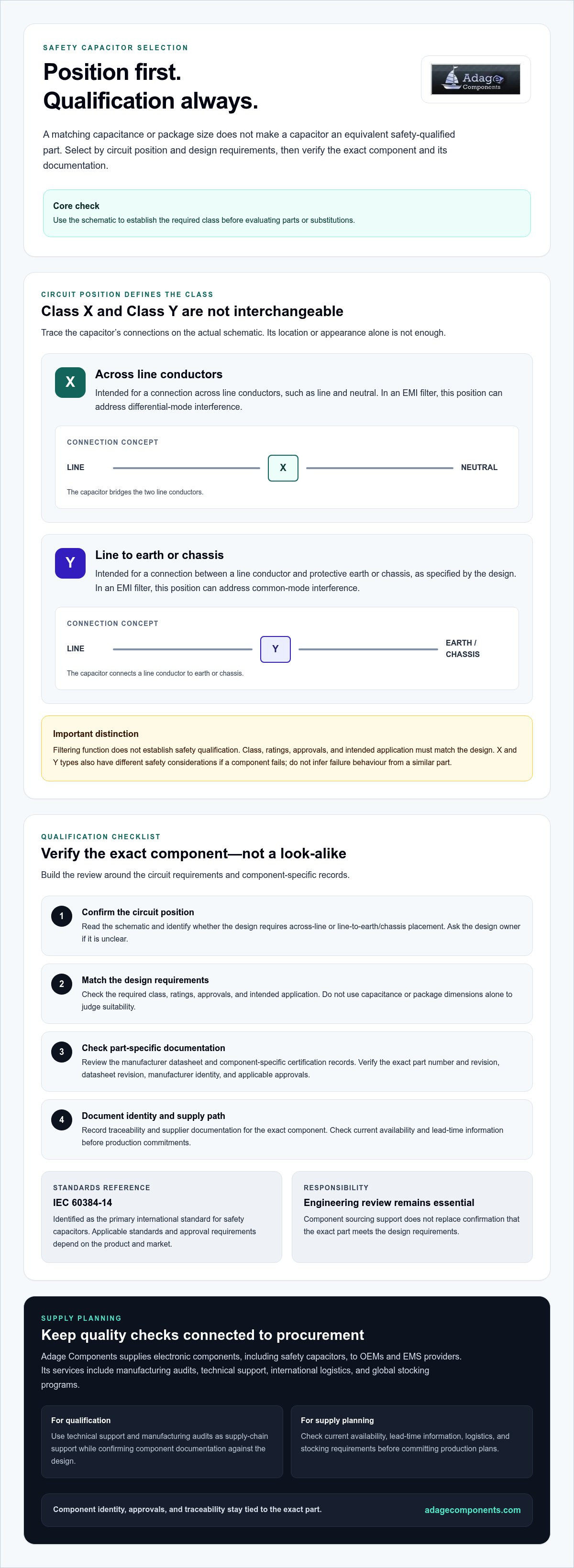
Class X capacitors are intended for connection across line conductors, while Class Y capacitors are intended for connection between a line conductor and earth or chassis, as specified by the design. The schematic determines which position applies. Don’t choose a class based only on the capacitor’s value or appearance. If the schematic or component specification is unclear, ask the design owner to confirm the intended connection before requesting a part.
For a visual overview of these roles in EMI filters, watch this explanation:
Where do X and Y capacitors appear in a circuit?
In a typical EMI-filter schematic, an X capacitor sits across the line conductors, such as line and neutral. A Y capacitor connects from a line conductor to protective earth or chassis, where the design calls for that connection. These placements support different noise-suppression needs: across-line capacitors can address differential-mode interference, while line-to-earth or chassis capacitors can address common-mode interference. For background on mains filtering safety requirements, see the overview of capacitor applications. Trace the capacitor’s connections on the actual schematic rather than relying on its location or symbol alone. EMI suppression describes a function; it doesn’t establish a capacitor’s safety qualification.
Why is a standard capacitor not automatically a safety capacitor?
Matching capacitance or package dimensions doesn’t establish equivalent approval or suitability. A general-purpose capacitor may lack the documented class designation, ratings, or approvals required for the intended circuit position. Before approving a part, check its manufacturer datasheet and component-specific certification records. Confirm that the exact part number and revision support the intended use.
Review the applicable requirements for the design and verify that the component documentation addresses them. IEC 60384-14 is the primary international standard identified for safety capacitors, but the applicable standard and approval requirements depend on the product and market. Check current documentation for the exact component, and don’t infer its suitability or failure behaviour from a similar part. Adage Components can support sourcing; circuit approval remains an engineering responsibility.
How Safety Capacitors Work in Mains and EMI-Suppression Circuits
In a mains EMI filter, a capacitor can provide a frequency-dependent path for unwanted high-frequency noise. Its effect depends on the surrounding components and circuit layout. For example, a capacitor working with inductors can help reduce conducted interference, but its value and placement must be chosen as part of the filter design.
Capacitor class follows the circuit position and design requirements, not the desired filtering function alone. Start with the schematic: identify the conductors connected to each capacitor, then assess the intended noise path. An X-class or Y-class designation describes a safety-related application category, not a guarantee that the part will perform a particular filtering task or make the equipment compliant.
What does an X capacitor do in an across-the-line position?
An X capacitor is connected across line conductors, such as line and neutral, when the design calls for that position. In a filter, it may help attenuate differential-mode interference by providing a path for noise between those conductors. Its suitability depends on the circuit, required ratings, and applicable standards. Check the exact part’s datasheet for its class, ratings, and approvals.
What does a Y capacitor do in a line-to-earth position?
A Y capacitor connects a line conductor to earth or chassis in designs that use this path to address common-mode interference. The schematic and grounding arrangement determine whether this connection is appropriate. Confirm that the selected class, ratings, and approvals match the intended connection. A Y designation alone doesn’t establish zero leakage, eliminate risk, or prove that the complete equipment design meets its requirements.
Keep function and qualification separate. A capacitor’s role in suppressing noise is determined by its place in the filter; whether it is approved for that use depends on the exact component documentation and the requirements applicable to the equipment. Review the manufacturer datasheet and certification records for the specific part number, and confirm that the documented class and ratings match the design. Broader IEEE application and safety guidelines can provide additional context, but they don’t replace component-specific verification or design review.
Before selecting a part, trace its connections directly on the schematic. Is it across the line conductors, or between a line conductor and earth or chassis? Confirm the answer with the design team before procurement, especially if considering a substitute. For an overview of available component categories, review Adage Components’ electronic components linecard.
X vs. Y Safety Capacitors: Compare Application, Approval, and Substitution
Class X and Class Y capacitors serve different circuit positions, so their designations aren’t interchangeable. The schematic and qualification requirements determine which class is appropriate. A similar capacitance or footprint doesn’t establish equivalent function, approval, or suitability.
The table summarizes typical distinctions. Use it as a starting point, then verify the exact component and application against current requirements and manufacturer documentation.
| Class | Typical circuit position | Design purpose | Documentation checks |
|---|---|---|---|
| Class X | Across line conductors | Can support suppression of differential-mode interference in an appropriately designed filter. | Confirm the exact class, voltage rating, capacitance, approvals, and operating conditions. |
| Class Y | Between a line conductor and earth or chassis, as specified by the design | Can support suppression of common-mode interference in an appropriately designed filter. | Confirm the exact class, ratings, approvals, and documentation for the intended connection. |
For additional context on capacitor-based EMI filtering, see Noise Suppression Techniques. That functional discussion doesn’t replace checking whether a specific part is qualified for your application.
Which details should an engineer compare in the datasheet?
Compare the exact class, rated voltage, capacitance, approvals, and stated operating conditions with the schematic and design requirements. Check package and mounting details, environmental limits, and lifecycle requirements against the board design and bill of materials. Use the manufacturer’s current datasheet and certification records for the exact part number. If a specification or approval is missing, outdated, or unclear, mark it for engineering review rather than assuming equivalence.
When is a safety-capacitor replacement a true drop-in candidate?
A proposed replacement requires engineering approval, not just a footprint match. Compare electrical, mechanical, environmental, and certification requirements for the specific application, then have the design owner review the supporting documentation before approving the change. Don’t treat matching capacitance or package dimensions as evidence that a substitute has the same qualification.
For broader OEM qualification context, use your organization’s approved sourcing references and component records. Adage Components can support component sourcing and technical support; include the exact part number and application requirements when requesting assistance. Verify the component identity and documentation as part of your qualification process.
How to Qualify Safety Capacitors for Design and Procurement
Qualify the exact component before it enters an approved BOM. Safety Capacitors require both engineering review and procurement controls: circuit suitability is determined by the design, while sourcing checks help establish component identity, documentation, and supply readiness. Keep these reviews connected, but don’t treat supplier records as a substitute for design approval.
- Confirm the design requirements. Review the schematic, intended connection, required class, ratings, operating conditions, and applicable standards with the design owner.
- Match the exact part. Compare the manufacturer part number and datasheet against the engineering specification. Don’t assume a similar capacitance or package is an approved substitute.
- Verify product documentation. Check the current datasheet revision and component-specific safety approvals. Confirm the documented class and ratings apply to the exact part under consideration.
- Maintain traceability. Ensure the manufacturer identity, part number, revision, and traceability details are consistent across approval records, purchasing documents, and the BOM.
- Validate the supply path. Confirm supplier status, documentation availability, and current lead-time information before making production commitments. Record any open qualification items for engineering and procurement follow-up.
What documents should accompany a safety-capacitor qualification?
Request the current manufacturer datasheet and relevant component-specific approval documentation. Check that each record matches the exact manufacturer and part number, and keep revisions consistent in engineering and purchasing systems. A generic certificate or supplier-level quality record doesn’t prove that a particular capacitor is suitable for every end application.
Management-system compliance and product approval answer different questions. When reviewing any supplier’s management-system credentials, check the certification and its scope. Separately, check the exact capacitor’s approvals against its manufacturer documentation and the requirements for your design.
How can procurement reduce authenticity and continuity risks?
Use supplier qualification controls to check the component’s manufacturer identity, documentation, and supply path. Adage Components works with manufacturers and partner suppliers, and provides manufacturing audits and quality support. Ask for the documentation required by your process, then verify the specific part and supplier records before approving a source.
For continuity planning, confirm current lead-time information and whether a global stocking or logistics program fits your requirements. Don’t rely on a general supply estimate when making production commitments. Record the agreed part number, source, documentation, and any open supply risks in your procurement records.
For help reviewing a defined component list, submit it through the BOM submission form. To review component categories, see the Adage Components linecard.
Source Safety Capacitors with Quality and Supply Requirements in View
Once engineering confirms the required component class and approvals, procurement must secure the exact qualified part and its supporting records. Adage Components supplies electronic components, including safety capacitors, and supports OEMs and EMS providers with sourcing and supply chain services. Keep design approval with the responsible engineering team, and align sourcing decisions with its documented specification.
What should buyers confirm before requesting a supply proposal?
Provide a clear request package so the supplier can respond to the actual requirements. Include:
- The exact manufacturer part number and your policy for engineering-approved alternatives.
- Required datasheets, component-specific approvals, traceability records, and other quality documentation.
- Your expected demand profile and production timing, so availability and lead-time information can be checked before commitments are made.
- Whether you require commercial or automotive grade components. Verify the grade and suitability for each specific part rather than assuming it from a category description.
Ask the supplier to confirm manufacturer identity, available quality records, current availability, and lead-time information. Adage Components works with manufacturers and partner suppliers and offers international logistics and supply chain support. Confirm the documentation and arrangements for the specific supply path you’re considering.
How can a sourcing partner support production planning?
A sourcing partner can help coordinate component procurement with your MRP system when order requirements, confirmed lead times, and logistics arrangements are clear. Adage Components offers global stocking programs and international logistics coordination. Discuss your requirements and confirm current, order-specific details before using them in a production plan.
When evaluating supplier quality systems, verify any applicable certifications and their scope. Management-system certification is distinct from a capacitor’s product-specific safety approval, so check both separately. Adage Components also provides manufacturing audits and technical support; confirm the documentation relevant to your supplier assessment and exact part.
For sourcing support on your defined component list, use the BOM submission form. You can also review the safety capacitor and component linecard to identify relevant categories and plan your sourcing requirements.
Put Your Capacitor Qualification into Practice
Choosing Safety Capacitors starts with the schematic: Class X and Class Y parts serve different circuit positions, so the required class, ratings, and approvals must match the design. Before approving a replacement, verify the exact part’s datasheet, documentation, and traceability. A matching footprint isn’t enough.
Adage Components supplies safety capacitors and other electronic components to OEMs and EMS providers. Its sourcing, technical support, manufacturing audit, and supply chain services can help with component procurement and supplier review. Confirm the exact part’s identity, documentation, and suitability with the responsible engineering team.
For sourcing support, submit your component list through the BOM submission form and include the part numbers and documentation requirements you need reviewed.
Frequently Asked Questions
What is a safety capacitor?
A safety capacitor is selected for use in a circuit position where applicable electrical safety requirements must be addressed. Its class, ratings, and approvals need to match the design and relevant requirements. The component alone doesn’t make equipment safe: the complete circuit and product require engineering review. Check the manufacturer’s documentation for the exact part rather than relying on a general capacitor description or appearance.
What is the difference between X and Y safety capacitors?
Class X capacitors are intended for across-the-line connections, typically between line conductors. Class Y capacitors are intended for line-to-earth or line-to-chassis connections when specified by the design. These positions serve different circuit purposes and have distinct safety considerations. The schematic determines which connection is required; the exact class, ratings, and approvals must then be verified against the component documentation and application requirements.
Can an X capacitor be used instead of a Y capacitor?
No, not as a direct substitution based on matching capacitance or package size. An X capacitor is intended for a different circuit position than a Y capacitor, so the replacement may not meet the design’s connection-specific requirements. Any proposed change needs review and approval by the responsible design engineer. Verify the replacement’s class, ratings, approvals, and manufacturer documentation for the exact application before procurement or installation.
How do I choose the right safety capacitor for a circuit?
Start with the schematic and identify the capacitor’s electrical connections. Determine whether the design requires an across-the-line or line-to-earth or chassis position, then establish the required class, capacitance, rated voltage, operating conditions, and applicable approvals with the design owner. Compare those requirements with the exact manufacturer datasheet and certification records. Don’t approve a part or substitute based only on nominal capacitance or a similar footprint.
What does an X or Y class marking tell you about a capacitor?
An X or Y marking identifies the capacitor’s safety class and intended circuit application. In general, X indicates an across-the-line application, while Y indicates a line-to-earth or line-to-chassis application as specified by the design. The marking doesn’t provide every detail needed for selection or prove suitability for every end product. Check the exact part number, ratings, approvals, and current manufacturer documentation.
What documents should I check when sourcing safety capacitors?
Review the current manufacturer datasheet and component-specific approval documentation for the exact part number. Confirm that the class, ratings, manufacturer identity, and document revisions match your engineering specification and purchasing records. Check traceability information and request any quality records required by your process. A generic certificate or supplier-level management-system claim doesn’t establish that a particular capacitor is approved or suitable for every application.
How can I verify that a safety capacitor replacement is suitable?
Compare the replacement against the approved part across electrical, mechanical, environmental, and certification requirements for the specific application. Verify the manufacturer identity, exact part number, current datasheet, applicable approvals, and traceability records. Then obtain approval from the responsible design owner and update controlled engineering and purchasing records. A matching footprint or capacitance alone doesn’t establish equivalence, and procurement shouldn’t treat an unapproved alternative as a drop-in replacement.
Disclaimer
Cross-referenced components needs to be confirmed by the client with either spec. sheet or samples or both.
Please note, we use AI to help us, information is verified to be correct but we can not guarantee 100% accuracy.


