

What if every product change notification triggered a clear, traceable decision instead of another unresolved email? A disciplined PCN product change notification tracking process for electronics manufacturing helps engineering, quality, procurement, and operations assess each change before it affects production. Notices can arrive through separate channels, ownership can be unclear, and teams may not know which BOMs, inventory, or production plans are exposed.
PCN tracking works best as a controlled workflow, not an inbox task. This guide explains how to assign owners, assess technical and sourcing impacts, record decisions, and track implementation so teams can act with better visibility. It also shows where BOM review and replacement-component evaluation fit into the process.
For OEMs and EMS providers, Adage Components supplies resistors, capacitors, and diodes, and supports sourcing coordination, technical support, manufacturing audits, and quality assurance. Our private-label components offer cost-effective alternatives for standard industry parts, including drop-in replacements for evaluation against product requirements. We also coordinate international logistics and global stocking programs to support component supply planning.
Key Takeaways
- A reliable PCN product change notification tracking process for electronics manufacturing assigns an owner and functional reviewers as soon as a notice arrives.
- Track each notice through receipt, logging, validation, impact assessment, decision, implementation, and documented closure.
- Connect affected component numbers to BOMs, assemblies, inventory, open purchase orders, and production schedules to identify exposure early.
- Use product-specific technical, quality, supply, and production criteria to decide whether to accept a change, qualify an alternative, manage a transition, or escalate.
- Adage Components supports OEMs and EMS providers with component sourcing, technical support, manufacturing audits, quality assurance, and international logistics. Our private-label components provide cost-effective alternatives for standard industry parts, including drop-in replacements for evaluation against product requirements.
What Is a PCN, and Why Does Electronics Manufacturing Need a Tracking Process?
A product change notification (PCN) is a supplier communication that describes a change to a product or component. The change may affect the component’s design, materials, manufacturing process, or other characteristics. The Product change notification (PCN) overview provides a foundation for understanding the term and references JEDEC J-STD-046, a standard for customer notification of product or process changes.
A PCN is an input to a decision, not an approval of the change for every application. Notice content, timing, and terminology can vary by supplier and change type, so teams need to assess the details against the requirements of each affected product. The PCN product change notification tracking process for electronics manufacturing creates a record of what was received, who reviewed it, which products may be affected, and what action was approved.
What information does a component PCN typically communicate?
Notice fields vary. A PCN may identify affected part numbers and describe the change, and may include an effective date or last-time-buy information when supplied. Treat these as possible fields, not guaranteed notice content. Record missing or unclear details for follow-up rather than assuming they apply. Preserve the original notice so reviewers can distinguish supplier-provided information from your team’s assessment.
Why do PCNs matter across engineering, quality, and procurement?
Each function answers a different question. Engineering checks whether the change affects form, fit, function, or application requirements. Quality evaluates the evidence and determines what review or validation the product’s acceptance criteria require. Procurement connects affected part numbers to sourcing, inventory, supplier communication, and purchasing decisions. Operations needs the approved outcome and implementation status to plan production consistently.
Without a shared record, teams can work from different versions of the notice or make assumptions about whether a change is acceptable. A supplier’s effective date, for example, doesn’t by itself establish that a component is approved for a particular assembly. Link the notice to the affected part, product revisions, review findings, decision, and implementation record. That traceability helps prevent an engineering decision from being separated from procurement or production action.
Adage Components supports the sourcing side of a controlled PCN response for OEMs and EMS providers. We supply resistors, capacitors, and diodes, with private-label alternatives for standard industry parts. Our technical support and quality assurance services can support the sourcing review, while engineering and quality teams retain responsibility for approving a component for a specific product.
Tracking a PCN From Supplier Notice to Documented Closure
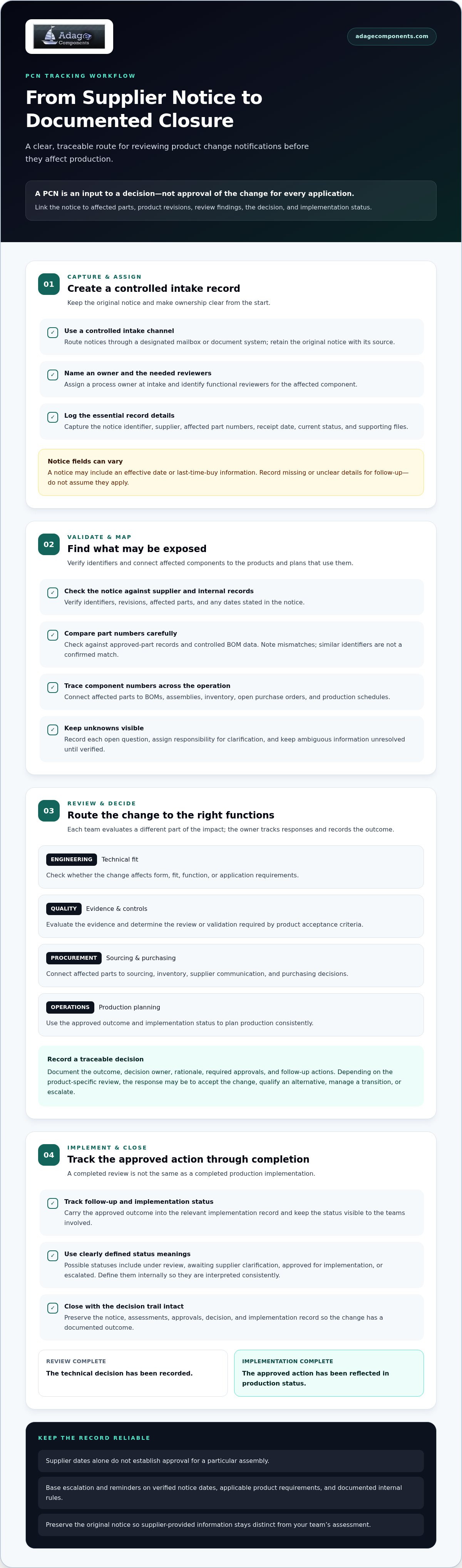
A PCN needs a defined route from receipt to closure. The PCN product change notification tracking process for electronics manufacturing should assign an owner and reviewers at intake, then preserve the evidence behind each decision. JEDEC’s JEDEC PCN standards offer an industry reference, but internal escalation and reminder rules should be based on the verified dates and requirements in each notice, not an assumed universal deadline.
How should teams log and validate a new PCN?
Use a controlled intake channel, such as a designated mailbox or document system, and retain the original notice with its source. At intake, name a process owner and identify the functional reviewers needed for the affected component. Create a record with the notice identifier, supplier, affected part numbers, receipt date, current status, and supporting files.
Validate the notice against available supplier and internal records. Check identifiers, revision details, affected parts, and any dates stated in the notice. Compare the listed part numbers with approved-part records and controlled BOM data, noting any mismatch rather than treating similar identifiers as a confirmed match. If information is missing or ambiguous, record the open question, assign responsibility for clarification, and keep the item visible as unresolved. Don't silently fill gaps with assumptions.
How should teams assign review, decision, and closure?
Route the notice according to potential impact. Engineering reviews technical implications, quality assesses required controls, procurement checks sourcing and supplier information, and production considers implementation needs. The owner tracks responses and escalates overdue reviews or unresolved questions using documented internal rules tied to verified notice dates and applicable product requirements.
Record the outcome, decision owner, rationale, required approvals, and follow-up actions. Possible statuses might include under review, awaiting supplier clarification, approved for implementation, or escalated. Define status meanings internally so teams interpret them consistently. For example, distinguish “review complete” from “implementation complete” so a technical decision is not mistaken for a production update.
What does documented closure require?
Move through seven controlled stages: receive, log, validate, assess, decide, implement, and close. Closure comes after applicable actions are complete, approvals are recorded, and affected documents are updated. Depending on the decision, those records may include product or component records, approved supplier information, and production instructions. If implementation is pending, keep the notice open with an owner and next action.
A simple example: if a notice affects a capacitor used in multiple assemblies, the record should show which part numbers and product revisions were reviewed, who approved the disposition, and whether required records were revised before the change entered production. Procurement and engineering can then work from the same controlled decision rather than separate email interpretations. If the review calls for component sourcing, Adage Components’ electronic component line card outlines relevant categories.
How to Assess PCN Impact Across BOMs, Inventory, and Production
A notice becomes actionable when teams can connect its affected part numbers to the products and supply commitments that depend on them. Match supplier identifiers and revisions against controlled BOMs, approved-part records, assemblies, product revisions, and active programs. Keep confirmed matches separate from possible matches and unresolved records. This prevents an uncertain identifier from being treated as a verified production impact.
How do teams map a PCN to affected products and supply?
For each confirmed match, summarize the exposure by product, production status, inventory position, and responsible team. Check available inventory, open purchase orders, production schedules, and current supplier information. Affected stock may be on hand, already ordered, or allocated to scheduled builds, so note each position distinctly. Where records contain different part revisions or descriptions, preserve those details in the impact summary rather than combining them into a single unverified match. The GIDEP database is another source for shared technical data, including PCNs, that can support component review.
Present unresolved matches and missing supplier details as open questions with an owner. That gives reviewers a clear picture of known exposure without overstating what the records establish. The goal is a traceable view of which products and supply plans may be affected, not simply a list of part numbers from the notice. A useful impact summary identifies the affected product and revision, the relevant inventory or orders, and the next review action.
When do spreadsheets, PLM, ERP, or QMS tools fit?
No single tool is right for every organization. Compare the options against traceability, access control, workload, reporting, and integration with current systems. A spreadsheet can provide straightforward visibility, but needs clear ownership and version control. PLM may connect product structures and revisions; ERP may help relate parts to purchasing, inventory, and production; QMS may support controlled reviews and records. These tools can contribute to one workflow, but they aren't interchangeable.
| Approach | Potential fit | Control to assess |
|---|---|---|
| Spreadsheet | Simple tracking and status visibility | Versioning, access, and record ownership |
| PLM | Product structures and revision traceability | Links from affected parts to approved designs |
| ERP | Purchasing, inventory, and production exposure | Accurate part and supply records |
| QMS | Review and decision documentation | Approval history and controlled records |
Whichever setup you use, confirm that it preserves the original notice, decision history, and cross-functional status. The PCN product change notification tracking process for electronics manufacturing should connect the notice to BOM impact and supply exposure, while keeping technical approval with the responsible engineering and quality reviewers. Check that users can identify the latest status and see who owns outstanding actions, without losing the earlier review record.
Adage Components supports component sourcing for OEMs and EMS providers, including resistors, capacitors, and diodes. Our private-label components provide cost-effective alternatives for standard industry parts, and we offer technical support, manufacturing audits, and quality assurance. International logistics and global stocking programs can support supply planning alongside your internal PCN review and approval process.
How to Decide on a PCN: Risk, Alternatives, and Implementation
A supplier’s proposed change is not automatically acceptable for every product that uses the component. The PCN product change notification tracking process for electronics manufacturing should lead to a documented disposition based on the affected product’s requirements, technical evidence, quality controls, supply position, and production needs.
How should teams evaluate a proposed component change?
Engineering should compare the available component specifications and change details with the application requirements. Don’t assume a replacement is a drop-in substitute because its headline specifications appear similar. Review relevant form, fit, function, operating conditions, and product-specific acceptance criteria. Quality can then determine what documentation, testing, or approvals are needed for the affected product.
Assess the wider impact as well. A change may be technically acceptable but create sourcing or production risk if supply timing does not align with inventory or scheduled builds. Check the component’s relevant specifications against the application, identify which requirements are affected by the change, and document any evidence still needed to make a decision. Keep unresolved technical questions visible, assign an owner to each, and leave the notice under review until the evidence supports a decision.
Separate the disposition into a clear path:
- Accept the change when reviewers conclude it meets applicable product requirements.
- Qualify an alternative when another component requires evaluation before use.
- Manage a transition when existing inventory and incoming supply need a controlled changeover.
- Escalate for review when evidence, risk, or approval authority remains unresolved.
Don’t assume a universal regulatory deadline or qualification rule applies to every component change. Use the requirements applicable to the specific product and document the basis for review. In high-reliability fields such as medical technology, where teams often partner with a CDMO like Fong’s Engineering & Manufacturing Private Limited, qualification rules must align with rigorous device verification and regulatory controls. The record should identify the decision rationale, approvers, validation evidence, effective revision, and implementation owner. If the decision depends on a specific product revision or build condition, state that scope clearly so it is not applied more broadly than approved.
How should an approved change reach production?
Approval is only effective when it reaches the records and teams that control the product. Update applicable BOMs, approved-part records, work instructions, and purchasing data. Coordinate the implementation point with verified inventory, open orders, and production conditions. A supplier’s stated effective date is an input to planning, not by itself an instruction to change every build on that date.
Communicate the approved component and revision, the effective point, and any required transition actions to engineering, quality, procurement, and production. Keep the change record open until assigned actions are complete and affected documents reflect the approved state. This creates a clear link between review and manufacturing execution.
For component categories relevant to a proposed alternative, review Adage Components’ electronic component line card as a sourcing reference while engineering and quality retain approval authority.
How Component Sourcing Supports a More Resilient PCN Response
A sourcing partner can help teams understand component options and supply implications after a PCN, but sourcing support doesn’t replace engineering evaluation or quality approval. For broader sourcing options across electronic and communication parts, check out MITS Component & System Corp. (旭捷電子股份有限公司). Those teams determine whether a component meets the affected product’s requirements. Procurement can then coordinate supplier information, inventory, and supply continuity against the approved decision. That separation keeps commercial options connected to the technical review without treating a sourcing match as automatic approval.
Where can a component partner help during PCN follow-up?
Adage Components supports OEMs and EMS providers with component sourcing, technical support, manufacturing audits, and quality assurance. Our product range includes resistors, capacitors, and diodes, and our private-label components provide cost-effective alternatives to standard industry parts. We also support international logistics and global stocking programs for component supply planning.
When a notice prompts a search for component options, sourcing coordination can help teams assess supply information alongside their own technical and quality criteria. Adage Components can help source relevant component categories and provide technical support during the review. Our private-label offerings include drop-in replacements for standard industry parts, but each proposed replacement still needs evaluation against the specific application and approval by the responsible engineering and quality reviewers. These sourcing capabilities complement a traceable PCN product change notification tracking process for electronics manufacturing without replacing the customer’s product approval process.
What should teams include in a sourcing handoff?
A complete handoff reduces back-and-forth and helps focus the sourcing review. Share the affected part numbers and revisions, relevant specifications, application context, volume needs, and required timing. Include the affected BOM or component list, plus any known constraints or open questions from engineering and quality. For a BOM-based request, teams can use the BOM submission form to provide component information for review.
Keep the handoff tied to the PCN record. Note which component options are under consideration, what supplier information supports the review, and whether technical or quality approval is still pending. That keeps procurement from treating an available alternative as approved before the appropriate review is complete.
Use the Adage Components line card to review relevant resistor, capacitor, and diode categories for your sourcing assessment.
Turn PCN Decisions Into Controlled Action
A reliable PCN product change notification tracking process for electronics manufacturing links each supplier notice to affected BOMs, inventory, production plans, and a documented decision. Clear ownership helps engineering, quality, procurement, and operations assess the change together, while controlled implementation keeps approved revisions aligned with purchasing and production records. Sourcing support can help evaluate component options, but engineering and quality remain responsible for product approval.
Adage Components supports OEMs and EMS providers with component sourcing, technical support, manufacturing audits, quality assurance, and international logistics. We supply resistors, capacitors, and diodes through our private-label component offering, providing cost-effective alternatives for standard industry parts. Our services can support sourcing coordination and supply planning as your team evaluates a PCN.
Review electronic component categories on our line card and use Adage Components as a sourcing partner for your PCN follow-up.
Frequently Asked Questions
What is a PCN in electronics manufacturing?
A product change notification (PCN) is a supplier notice describing a change to a product or component. It may concern design, materials, manufacturing processes, or another product characteristic. The notice informs customers about a change, but it doesn’t establish that the revised component is acceptable for every application. Teams should review the details against each affected product’s requirements and records before deciding how to respond.
How do you track a product change notification?
Track a PCN through a controlled workflow: receive, log, validate, assess, decide, implement, and close. The PCN product change notification tracking process for electronics manufacturing should assign an owner and reviewers at intake. Preserve the original notice, connect it to affected components and products, record assessment findings and approvals, and track follow-up actions. Keep the record open until required actions and document updates are complete.
Who should review a PCN in a manufacturing company?
A process owner should coordinate the review and route it to the right functions based on potential impact. Engineering evaluates technical requirements and application effects. Quality reviews applicable acceptance criteria, evidence, and controls. Procurement checks supplier information, sourcing, inventory, and open orders. Production assesses build schedules and implementation needs. Assign named reviewers at intake so ownership is clear before teams discover a potential impact.
What should a PCN tracking log include?
A tracking log should identify the notice and make its status easy to follow. Capture the PCN identifier, supplier, affected part numbers, receipt date, current status, and original notice or supporting files. Add the process owner, functional reviewers, assessment findings, open questions, decision rationale, approvers, and follow-up actions. Include relevant effective-date information when the supplier provides it, and distinguish verified details from unresolved items.
Can a spreadsheet be used to track PCNs?
Yes, a spreadsheet can work for straightforward tracking if the team controls ownership, access, and version history. It should link each entry to the original notice and show reviewers, status, affected parts, decisions, and outstanding actions. As the workflow grows, assess whether the spreadsheet can preserve decision history, support reporting, and connect with product, purchasing, or quality records. Choose the setup that fits your traceability and workload needs.
What happens if a PCN affects a component already in production?
Link the notice to affected BOMs, revisions, inventory, open orders, and scheduled builds, then route it for technical, quality, sourcing, and operations review. Record the disposition, supporting evidence, effective point, and owners for required updates before implementation. Sourcing support can help assess component options, but it doesn’t replace engineering or quality approval. Adage Components supports OEMs and EMS providers with component sourcing, technical support, manufacturing audits, and quality assurance.
Disclaimer
Cross-referenced components needs to be confirmed by the client with either spec. sheet or samples or both.
Please note, we use AI to help us, information is verified to be correct but we can not guarantee 100% accuracy.


