

In 2026, a surface-level factory tour is no longer a safety net; it's a liability. Mastering the factory audit process for electronics suppliers is now the only way to navigate the EU Corporate Sustainability Due Diligence Directive, which holds your brand legally liable for failures deep in the supply chain. You recognize that securing authentic components at manufacturer pricing requires more than a signed contract. The rise of "Ghost Factories" and persistent 25% Section 301 tariffs mean that inconsistent batch quality or counterfeit parts can instantly derail your production schedule.
This guide provides a repeatable framework to ensure your resistors, capacitors, and diodes meet rigorous automotive-grade standards while capturing the same advantages as buying from Tier 1 distributors. We'll preview the updated IPC-2591 V2.0 standards and the risk-based thinking required to vet partner suppliers effectively. By the end, you'll have the technical and logistical tools to ensure your components arrive at your facility on time, perfectly integrated with your MRP system. We'll show you how to maintain supply chain resilience through disciplined auditing and direct manufacturer vetting.
Key Takeaways
- Secure OEM pricing and manufacturer-direct rates by transitioning from traditional Tier 1 distributor reliance to audited, high-standard private label partnerships.
- Master a rigorous 5-stage factory audit process for electronics suppliers to verify infrastructure, equipment calibration, and technical compliance across global manufacturing hubs.
- Identify the specific audit requirements for automotive-grade components, including AEC-Q200 qualification and IATF 16949 certification, to ensure high-stakes reliability.
- Learn to integrate audit findings and risk scores directly into your MRP system for seamless supply chain management and short lead times at your facility.
- Mitigate the risk of counterfeit parts by utilizing a vetted network of partner suppliers that maintain full ISO compliance and rigorous quality assurance standards.
The Strategic Necessity of Factory Audits in the 2026 Electronics Market
The 2026 electronics landscape demands more than a passive sourcing strategy. A factory audit process for electronics suppliers is now a dual-faceted vetting mechanism that evaluates both technical precision and financial stability. With the global consumer electronics market projected to reach $1,387.4 billion this year, the pressure on production lines is immense. Relying solely on Tier 1 distributors often introduces unnecessary markups and detached oversight. Procurement teams are increasingly shifting toward direct, audited private label partnerships to bypass lead time inflation and reclaim control over their Bill of Materials (BOM).
This transition requires a rigorous framework to ensure that "manufacturer pricing" doesn't come at the cost of mission-critical reliability. Audits serve as the primary defense against supply chain volatility, providing a direct window into a manufacturer's production planning and material reserves. By establishing a repeatable audit cadence, you secure a transparent view of the factory floor, ensuring your resistors and capacitors are produced in facilities that meet your specific technical requirements. This proactive approach is essential for maintaining short leading times and seamless integration with your MRP system.
To better understand this concept, watch this helpful video:
Mitigating Counterfeit Risks and Ensuring Traceability
The "grey market" has reached a new level of complexity in 2026. "Ghost Factories" now use sophisticated methods to appear as legitimate manufacturers, making physical verification indispensable. A robust factory audit process for electronics suppliers detects these masquerades by verifying the physical origin of raw materials and demanding a valid Certificate of Conformance (CoC). We eliminate this uncertainty by sourcing exclusively from vetted manufacturers and partner suppliers, many of whom are franchised by top 100 distributors. This ensures every component, from thick film resistors to schottky diodes, is authentic and traceable back to the wafer level.
Bridging the Gap: OEM Pricing vs. Tier 1 Reliability
Procurement officers often assume that Tier 1 distributors are the only path to quality. However, auditing private label manufacturers allows you to get manufacturer pricing while maintaining identical technical standards. By verifying production capabilities like equipment calibration and cleanroom protocols on-site, you secure the same advantages as buying from major distributors but at OEM pricing. Adage Components acts as your strategic partner in this process. We combine our growing state-of-the-art warehouse with an amazing international logistic program to ensure components arrive at your facility in real time, on time, and fully compliant with all ISO certifications.
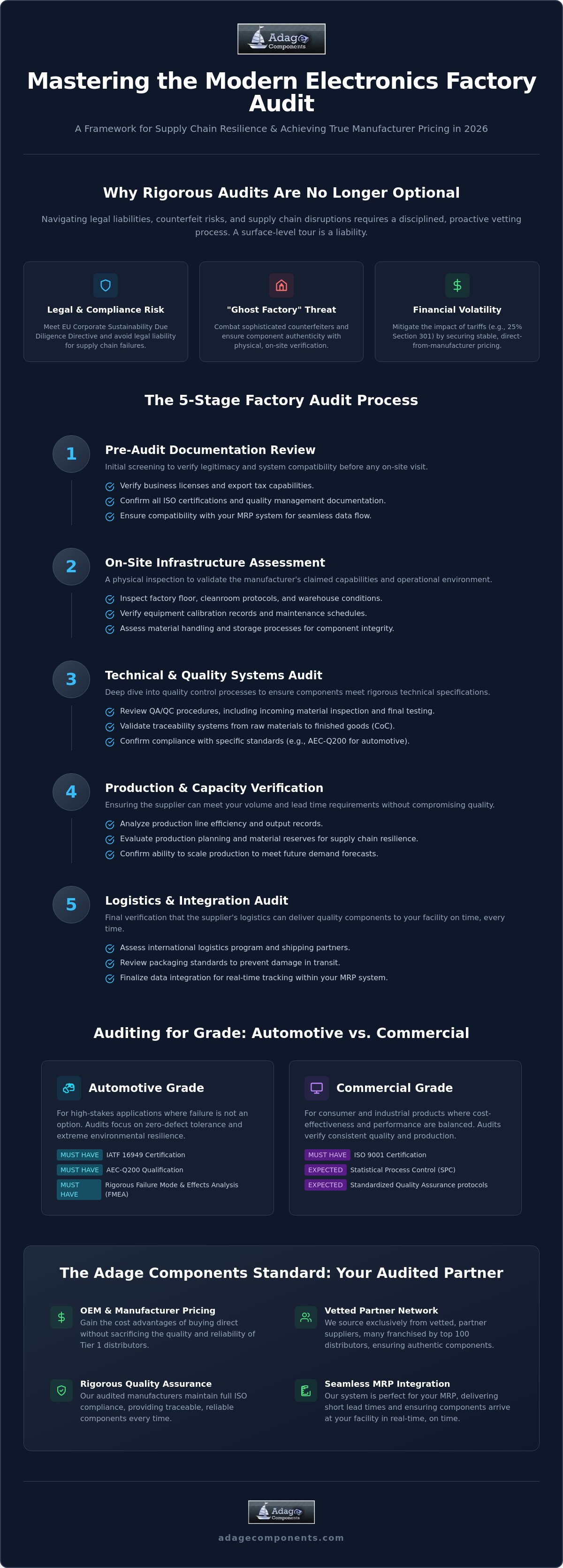
The 5-Stage Factory Audit Process for Electronics Suppliers
Executing a disciplined factory audit process for electronics suppliers is the only way to guarantee that manufacturer pricing doesn't lead to catastrophic line stops. In 2026, the audit has evolved from a simple checklist into a high-stakes technical verification. This five-stage framework ensures that every component, from thick film chip resistors to tantalum capacitors, meets your specific quality and logistical requirements. We focus on a structured approach that prioritizes transparency and risk mitigation at every level of the production cycle.
- Phase 1: Pre-Audit Documentation Review. We begin by verifying business licenses, export tax refund capabilities, and compatibility with your MRP system to ensure data flows seamlessly from the factory floor to your procurement software.
- Phase 2: On-Site Infrastructure Assessment. This involves a physical inspection of the manufacturing facility, focusing on equipment age, maintenance logs, and environmental controls.
- Phase 3: QMS and ISO Compliance. We verify that the supplier's Quality Management System is active and effective, checking for ISO 9001:2015 adherence and risk-based thinking protocols.
- Phase 4: Production Line Observation. Real-time sampling using AQL standards allows us to detect defects before they reach our state-of-the-art warehouse.
- Phase 5: Corrective Action Plan (CAP). Any non-conformities found during the audit require a formal CAP with clear deadlines before final approval is granted.
Infrastructure and Equipment Calibration
A factory's output is only as reliable as its machinery. During the infrastructure phase, we scrutinize the state-of-the-art equipment used for producing thick film chip resistors and multilayer ceramic capacitors. We verify maintenance logs for automated optical inspection (AOI) tools and ensure that temperature profiling for mass soldering processes adheres to the updated IPC-7530B guidelines. Environmental controls are equally critical. We check that humidity and temperature levels in the production area meet the strict sensitivities required for high-grade electronic components, preventing latent defects that could manifest after the parts arrive at your facility.
Quality Management Systems (QMS) Deep Dive
ISO 9001:2015 is the baseline, but we go deeper. We evaluate the supplier's internal non-conforming material report (NCMR) process to see how they handle production errors. It's essential that your partner suppliers don't just find errors but have a systemic way to prevent their recurrence. We also verify that the factory can issue direct export tax refund invoices under their registered name, a key step in weeding out "Ghost Factories." By auditing these systems, we ensure you get the same advantages as buying from Tier 1 distributors but at OEM pricing. Our vetting process ensures every part is an authentic component, perfectly suited for your technical needs. You can explore our full range of vetted products by viewing our comprehensive electronic components linecard.
Technical Compliance: Auditing for Automotive vs. Commercial Grade
Technical compliance in 2026 isn't a suggestion; it's a mandatory requirement for mission-critical systems. The factory audit process for electronics suppliers must adapt to the specific grade of the component being sourced. While commercial-grade parts are suitable for standard consumer applications, automotive-grade components require a significantly higher level of scrutiny. We ensure that every vetted manufacturer in our network understands these distinctions, providing you with manufacturer pricing without compromising on the technical rigor required for your specific application.
For passive components like resistors and capacitors, auditing for AEC-Q200 qualification is the baseline for automotive reliability. This involves verifying that the supplier performs extensive stress testing, including burn-in testing, thermal shock, and moisture resistance. In January 2026, the EN IEC 60749-21:2026 standard updated solderability test methods for semiconductor devices. Our audit framework confirms that partner suppliers have adopted these latest procedures for both SnPb and lead-free terminations. We also verify IATF 16949 certification, which is essential for any facility producing automotive electronics, ensuring they maintain a robust quality management system that far exceeds standard ISO 9001 requirements.
Environmental compliance and ethical transparency are equally vital. With the EU Corporate Sustainability Due Diligence Directive (CSDDD) in full effect as of 2026, brand owners are legally liable for violations deep within their supply chains. Our audits include a thorough review of RoHS and REACH compliance, alongside conflict mineral transparency. We verify that raw material origin tracking is active and documented, protecting your facility from regulatory risks and ensuring your components are both authentic and ethically sourced.
ESD Control and Cleanroom Standards
Electrostatic Discharge (ESD) is a leading cause of latent defects in high-sensitivity components. We audit Electrostatic Discharge protected areas (EPAs) to ensure they meet stringent requirements for grounding, flooring, and apparel. Verifying IPC-A-610 standards for electronic assembly acceptability is a core part of our on-site inspection. Proper packaging is the final line of defense; our growing state-of-the-art warehouse utilizes specialized handling protocols to ensure that components remain protected from the factory floor to your MRP system. This meticulous attention to detail ensures that products arrive at your facility in real time, on time, and in perfect condition.
Automotive-Grade Rigor
Automotive applications demand a zero-defect mindset. This requires more frequent and intrusive factory audits compared to commercial sourcing. We focus on Statistical Process Control (SPC) to ensure that manufacturing variances are identified and corrected before they result in non-conforming parts. This level of rigor allows us to offer OEM pricing that rivals the advantages of Tier 1 distributors while maintaining the high standards required for vehicle safety and performance. To see our full range of high-reliability parts, you can view our linecard for automotive-grade resistors and other essential components.
Executing the Audit: A Practical Framework for Procurement Teams
Executing a factory audit process for electronics suppliers requires a shift from qualitative observation to quantitative scoring. In the high-stakes 2026 procurement environment, your team can't rely on gut feelings. You need a data-driven framework that translates factory floor observations into actionable risk scores. We recommend a weighted scoring system that prioritizes technical stability, quality assurance, and logistical readiness. This ensures that your choice of partner suppliers is based on rigorous data rather than marketing promises, allowing you to get manufacturer pricing while maintaining the reliability of a Tier 1 distributor.
A successful audit must verify that a manufacturer's infrastructure can support your production volume without compromising on quality. This includes a deep dive into warehouse capacity and "just-in-time" delivery capabilities. We evaluate how a factory manages its raw material inventory to protect against the lead time inflation seen in the 2026 semiconductor market. By vetting these logistical bottlenecks on-site, we ensure that your components, from thick film resistors to schottky diodes, are ready for immediate dispatch from our growing state-of-the-art warehouse. To begin optimizing your current supply chain, you should review our full linecard of vetted electronic components.
MRP System and Logistics Integration
The value of an audit is lost if the data remains trapped in a static PDF. For maximum efficiency, integrate your audit findings directly into your company's MRP system. This allows for real-time risk scoring that informs your purchasing decisions. We verify a supplier's ability to communicate via EDI or API, ensuring that production updates and shipping notices flow seamlessly into your software. This integration is what allows products to arrive at your facility in real time, on time. Adage Components leverages an amazing international logistic program to bridge the gap between global manufacturers and your local production line, ensuring short leading times for every order.
The Corrective Action Process
An audit often reveals areas for improvement, categorized as either "Major" or "Minor" non-conformities. In the electronics sector, a major non-conformity—such as a failure in ESD protection or an expired calibration certificate for AOI tools—requires an immediate corrective action plan (CAP) before any orders are placed. Minor issues, like documentation filing errors, may be resolved within a 30-day window. We maintain strict oversight of these timelines to ensure our partner suppliers remain fully compliant with all ISO certifications. If you're looking to benchmark your current supplier's performance, you can submit your BOM for cost and quality analysis to see how our audited network compares.
Adage Components: Our Rigorous Manufacturer Vetting and Audit Standards
Adage Components operates as your elite partner in a volatile global marketplace. Our factory audit process for electronics suppliers isn't a passive exercise involving third-party checklists. We maintain a disciplined "boots on the ground" presence in key manufacturing hubs to verify every claim made by our partner suppliers. This direct oversight ensures that when we offer OEM pricing, it's backed by a meticulous verification of production capacity and technical precision. We act as the bridge between a fragmented marketplace and your facility's specific requirements, providing composed confidence in every shipment.
The Adage guarantee is built on a foundation of integrity and technologically advanced inspection protocols. We recognize that in 2026, procurement officers value data and rigorous standards over vague marketing promises. To ensure your supply chain remains resilient, we maintain a strict quality assurance framework:
- Authentic Components: We source exclusively from vetted manufacturers to eliminate the risk of counterfeit parts.
- Rigorous Testing: Every batch undergoes multi-stage inspection in our growing state-of-the-art warehouse.
- ISO Compliance: We verify that all partner suppliers adhere to current ISO certifications and automotive-grade standards.
- Traceability: We demand full transparency in raw material origin and "Certificate of Conformance" documentation.
We provide the same advantages as Tier 1 distributors, including international scale and technical reliability, but at manufacturer pricing that significantly reduces your BOM costs. Our infrastructure is designed to handle the massive volume required by global OEMs while retaining the meticulous attention to detail necessary to inspect individual components for authenticity.
Strategic Sourcing and Private Label Excellence
Our private label resistors and capacitors serve as the industry's premier best-cost alternative for high-stakes manufacturing. By leveraging our direct procurement channels, we bypass the traditional distribution markups that typically inflate lead times and costs. We vet partner suppliers who are often franchised by top 100 distributors, ensuring you receive authentic components that are perfect for your MRP system. This strategic approach allows us to maintain short leading times even during periods of global component shortages. You can explore our methods in depth by reading our guide on strategic sourcing for OEMs in 2026.
Partner with Adage for Quality Assurance
Securing your 2026 production schedule requires a partner that thrives on solving difficult sourcing puzzles. We offer custom manufacturing and technical support for complex BOM submissions, ensuring your resistors, capacitors, and diodes arrive at your facility in real time, on time. We invite you to initiate a technical inquiry or request a comprehensive factory audit report to see our standards in action. Our team is perpetually ready for immediate operational engagement to help you capture the financial benefits of OEM pricing without sacrificing quality. Contact Adage today to secure your supply chain with a reliable specialist.
Secure Your 2026 Supply Chain Resilience
Mastering the factory audit process for electronics suppliers is no longer just a quality control measure; it's a strategic imperative for 2026. By shifting from Tier 1 distributor reliance to direct, audited partnerships, your team can capture manufacturer pricing while maintaining absolute technical integrity. This guide has outlined the framework necessary to detect "Ghost Factories" and ensure your resistors and capacitors meet the highest AEC-Q200 automotive-grade standards. Implementing these rigorous standards is the only way to protect your production line from the volatility of the global market.
Adage Components acts as your steady partner in this high-stakes environment. We combine ISO 9001:2015 compliance with a growing state-of-the-art warehouse and an amazing international logistic program. This infrastructure ensures that authentic components arrive at your facility in real time, on time, and perfectly integrated with your MRP system. Don't let supply chain volatility dictate your production schedule when disciplined vetting offers a clear path to cost-effectiveness and reliability.
Optimize your supply chain with Adage's vetted component solutions and secure the OEM pricing your facility deserves. We're ready to help you solve your most difficult sourcing puzzles today.
Frequently Asked Questions
What are the most critical ISO certifications for electronics suppliers in 2026?
ISO 9001:2015 remains the foundational standard for any reliable electronics manufacturer. For those in the automotive sector, IATF 16949 is mandatory to ensure a zero-defect mindset and rigorous risk-based thinking. In 2026, compliance with ISO 14001 for environmental management is also heavily scrutinized to meet the EU's CSDDD requirements. These certifications prove the factory has the infrastructure to maintain consistent batch quality.
How often should a factory audit be performed for high-volume components?
You should perform an audit at least once every 12 months for established high-volume suppliers. If you're working with a new Tier 2 or Tier 3 manufacturer, bi-annual inspections are safer to mitigate risk. This frequency ensures that equipment calibration and production planning remain aligned with your MRP system requirements, preventing long lead times caused by factory-level mismanagement.
What is the difference between a simple QMS audit and a technical process audit?
A QMS audit evaluates the management framework and documentation, while a technical process audit scrutinizes the actual manufacturing steps. The latter focuses on equipment calibration, AOI tool maintenance, and environmental controls like humidity. A technical audit is essential to verify that components like thick film chip resistors meet specific IPC-A-610 standards for assembly acceptability.
How do factory audits help in detecting counterfeit electronic parts?
The factory audit process for electronics suppliers detects counterfeits by verifying the physical origin of raw materials and the authenticity of the Certificate of Conformance. We inspect export tax refund logs to ensure the factory is a registered manufacturer, not a trading company. This "boots on the ground" approach is the most effective way to eliminate "Ghost Factories" from your supply chain.
Can a factory audit improve lead times for resistors and capacitors?
Audits improve lead times by identifying production bottlenecks and verifying raw material reserves on-site. When you vet a manufacturer's production planning directly, you reduce the risk of unexpected delays. This proactive approach allows Adage to offer short leading times and ensures your resistors and capacitors arrive at your facility in real time, on time.
What role does ESD control play in a supplier audit?
ESD control is a primary focus during the infrastructure phase of an audit. We verify that Electrostatic Discharge protected areas (EPAs) meet stringent grounding and apparel requirements. Proper ESD protocols are vital for preventing latent defects in sensitive items like thin film precision resistors, ensuring they survive the journey from the factory floor to our growing state-of-the-art warehouse.
How does Adage Components ensure the quality of its private label products?
We use a rigorous vetting process for our partner suppliers, many of whom are franchised by top 100 distributors. Every component undergoes multi-stage testing to ensure it meets both commercial and automotive grade standards. This allows us to provide manufacturer pricing and OEM pricing that rivals the advantages of tier-1 distributors while maintaining absolute technical reliability for your facility.
Is an on-site audit necessary if the supplier has all required certifications?
On-site audits are indispensable because paper certifications can be falsified or outdated. Physical verification is the only way to confirm that a supplier's equipment is properly calibrated and that their ESD controls are active. With the rise of AI-generated logs in 2026, seeing the factory floor yourself ensures you're receiving authentic components from a legitimate manufacturer.
Disclaimer
Cross-referenced components needs to be confirmed by the client with either spec. sheet or samples or both.
Please note, we use AI to help us, information is verified to be correct but we can not guarantee 100% accuracy.