
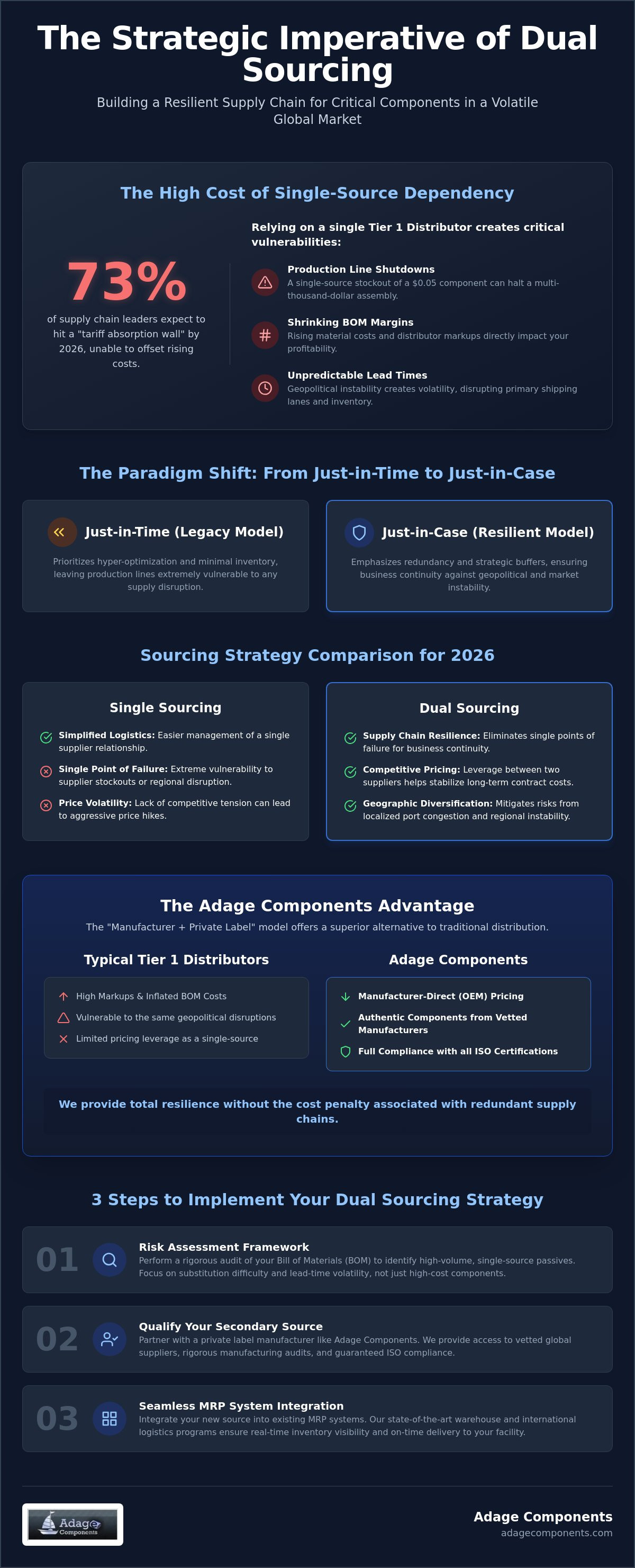
By the end of 2026, 73% of supply chain leaders expect to hit a "tariff absorption wall" where they can no longer offset rising material costs internally. If you're still relying on a single Tier 1 distributor for your essential resistors and capacitors, you aren't just facing unpredictable lead times; you're risking a total production line shutdown. Implementing a dual sourcing strategy for critical components is no longer a luxury for the risk-averse; it's a baseline requirement for any organization that values business continuity and stable BOM costs in a volatile global market.
We understand that the pressure to maintain quality while cutting expenses is higher than ever. It's frustrating to watch margins shrink while geopolitical instability threatens your primary shipping lanes. This guide will teach you how to build a resilient supply chain by integrating a reliable "Source B" that offers manufacturer pricing and guaranteed component authenticity. We'll preview the technical steps to achieve seamless MRP integration and explain how Adage Components helps you bypass high distributor markups. You'll learn how to secure automotive-grade parts from vetted manufacturers while maintaining the logistical speed your facility demands.
Key Takeaways
- Transition from "Just-in-Time" to "Just-in-Case" procurement models to protect your production lines from single-source failures and geopolitical instability.
- Implement a dual sourcing strategy for critical components to secure your supply chain without inflating your BOM costs or sacrificing part quality.
- Bypass high Tier 1 distributor margins by shifting high-volume passives to private label manufacturers that provide authentic parts at manufacturer-direct pricing.
- Identify high-impact dependencies within your Bill of Materials using a risk assessment framework focused on substitution difficulty and lead-time volatility.
- Integrate secondary sources into your existing MRP system to maintain real-time inventory visibility while benefiting from rigorous manufacturing audits and ISO compliance.
What is a Dual Sourcing Strategy for Critical Components?
A dual sourcing strategy for critical components is a disciplined procurement framework where an OEM qualifies two independent suppliers for the exact same part number. In 2026, this approach has evolved from a tactical backup into a core requirement for business continuity. We've observed that 78% of global supply chain leaders now prioritize dual sourcing to mitigate the impact of the 10% US tariffs implemented in February. By qualifying a second source for high-volume passives like thick film chip resistors or MLCCs, you eliminate the single point of failure that often halts production lines during market shifts.
The industry has moved decisively away from "Just-in-Time" models toward a "Just-in-Case" mindset. This shift prioritizes resilience over hyper-optimization. While Tier 1 distributors provide vast inventories, they're often the first to experience lead time spikes during periods of geopolitical instability. We focus on critical components like resistors, capacitors, and diodes because they represent the highest line-item counts in a Bill of Materials. You can review our full range of supported parts on our linecard. A shortage of a single five-cent diode can stop the delivery of a thousand-dollar assembly, making these small parts the most vital candidates for redundancy.
To visualize how these strategies compare in a modern manufacturing environment, watch this helpful breakdown:
The Core Objectives of Redundancy
Redundancy isn't just about having extra stock; it's about strategic geographic diversification. By sourcing from two distinct regions, you bypass localized port congestion and regional instability that frequently disrupts primary shipping lanes. This redundancy ensures your MRP system stays balanced even if a primary franchised distributor faces a sudden stockout. Additionally, maintaining two active sources allows you to leverage competitive tension. This helps stabilize long-term contract pricing and prevents the aggressive price hikes often seen when a supplier knows they're your only option.
Dual Sourcing vs. Single Sourcing: A 2026 Comparison
In the past, single sourcing allowed for maximum volume leverage and simplified logistics. In 2026, that leverage is completely offset by extreme vulnerability to material shortages. Dual sourcing requires more management overhead, but the agility it provides is invaluable. The old "China + 1" strategy has matured into a "Manufacturer + Private Label" model. This is where Adage Components provides a superior alternative. We offer the same reliability and ISO certifications as Tier 1 distributors but at manufacturer-direct pricing. This allows you to achieve total resilience without the typical cost penalty associated with redundant supply chains.
Identifying Candidates for Dual Sourcing: A Risk Assessment Framework
Most procurement officers focus their risk management efforts on high-cost integrated circuits, but the true vulnerability often lies in high-volume passives. We recommend a rigorous audit of your Bill of Materials (BOM) to identify single-source dependencies that could paralyze your operations. Building a supply chain more resilient requires looking beyond the top 10% of your spend. If a $0.05 resistor from a single franchised distributor goes out of stock, your entire production line stops. The financial impact of such a shutdown almost always dwarfs any minor savings gained from single-source volume discounts.
Evaluating "substitution difficulty" is a vital step in this framework. While standard passives are easier to replace than proprietary silicon, lead-time volatility remains a constant threat. We track these market fluctuations in real time to help our partners prioritize which components require an immediate second source. A dual sourcing strategy for critical components must prioritize items with a history of lead-time spikes or those manufactured in geographically concentrated regions. We look for patterns in port congestion and regional trade shifts to predict which parts will become the next bottleneck.
Criticality Mapping for Passive Components
High-volume passives like Thick Film Chip Resistors and MLCCs are the most logical candidates for redundancy. For our clients in the transportation and industrial sectors, we ensure these components meet strict AEC-Q200 standards for automotive grade reliability. It's a mistake to ignore "Long-Tail" components. These are the low-spend, low-frequency items that procurement teams often overlook until a shortage occurs. We've seen entire projects stall because a simple metal film resistor lacked a qualified secondary source during a market squeeze.
The 'Drop-In Replacement' Test
A successful strategy hinges on identifying functional equivalents that require zero PCB redesign. A component passes our "drop-in" test if it shares the exact footprint, electrical specifications, and thermal characteristics of the primary part. You can consult Adage Components' linecard to identify strategic alternatives that match your existing design requirements. Engineering qualification is a mandatory part of this process. We provide the technical data and samples required for your team to verify that our Source B components perform identically to your primary source. This rigorous vetting ensures 100% authenticity and compliance with your internal quality standards. If you're ready to secure your production schedule, review our list of automotive and commercial grade components to find your next strategic alternative.
The Strategic Advantage: Tier 1 Distributors vs. Private Label Manufacturers
Relying exclusively on franchised Tier 1 distributors for high-volume passives creates a margin stack that unnecessarily inflates your Bill of Materials (BOM). While these distributors provide a sense of security, they also introduce significant overhead and layers of sales commissions. A robust dual sourcing strategy for critical components allows you to maintain your Tier 1 relationships while introducing a private label manufacturer as a high-efficiency secondary source. This dual sourcing strategy doesn't just mitigate risk; it actively lowers your total acquisition cost by cutting out the middleman.
Adage Components positions itself as the elite "Source B" for OEMs who need to escape the high-margin environment of traditional distribution. We offer the same reliability as franchised channels but at manufacturer-direct pricing. By diversifying your supply chain, you gain the flexibility to shift volume between sources based on real-time availability and cost shifts. We've seen this work in practice. One of our partners recently achieved a 50% reduction in lead times for their resistor packages by integrating our private label components alongside their existing Tier 1 channel. This diversification ensures they aren't vulnerable when a single distributor faces a stockout.
Bypassing the Middleman: OEM Pricing Strategies
Franchised distributors operate with complex logistical overhead that's passed directly to the buyer. We eliminate these layers by offering OEM pricing through our direct manufacturing channels. Transitioning from a transactional "buy-as-needed" model to a strategic partnership for your volume orders ensures you receive the best cost in the industry. This approach secures a dedicated supply line that integrates perfectly with your existing MRP system, allowing for seamless inventory management without the price volatility of the open market.
Quality Assurance in Private Label Sourcing
There's a common misconception that private label components imply lower quality. We dismantle this myth by adhering to the same rigorous standards as the industry's biggest names. Every batch of Thick Film Chip Resistors or MLCCs undergoes a multi-stage inspection process in our state-of-the-art warehouse. We maintain full compliance with all ISO certifications to guarantee that every part is authentic and reliable. Our vetted manufacturer network ensures that whether you need commercial or automotive grade components, the quality remains uncompromising. We act as a bridge between the fragmented global market and your specific production needs, ensuring authenticity and safety at every step.
Implementing the Strategy: Logistics, Audits, and MRP Integration
Executing a dual sourcing strategy for critical components requires more than just signing a second vendor; it demands deep operational integration. We recommend implementing a split-award contract, such as a 70/30 or 60/40 volume split. This keeps both supply lines active and ensures your secondary source remains ready for immediate scaling if your primary distributor fails. Managing this through your existing MRP system allows for real-time inventory adjustments and prevents the "bullwhip effect" in your procurement cycle. With 73% of supply chain leaders hitting a tariff absorption wall in late 2026, efficient logistics and contract management are now non-negotiable for maintaining healthy margins.
Our team acts as a bridge between the complexities of international trade and your production floor. We navigate the intricacies of cross-border component transit and customs, ensuring that the 10% US tariffs implemented in February don't disrupt your delivery schedule. By aligning our delivery cycles with your specific production milestones, we guarantee that parts arrive at your facility in real time, on time. This proactive approach to logistics reduces the administrative burden of managing a dual-vendor environment, allowing your procurement team to focus on higher-level strategy.
Manufacturing Audits and Technical Support
Many competitors treat dual sourcing as a simple logistics puzzle, but we address the technical reality of the factory floor. Our vetting process involves rigorous on-site manufacturing audits of our partner suppliers. We verify state-of-the-art production equipment, multi-stage QC processes, and strict labor standards. This ensures that every Thick Film Chip Resistor or Zener Diode meets your exact technical specifications. Our engineering team provides dedicated technical support to resolve any queries regarding Source B parts. We maintain all necessary compliance documentation, ensuring your commercial and automotive grade components meet every ISO certification requirement without exception.
Seamless MRP Integration and Stocking Programs
Administrative friction can often undermine the benefits of redundancy. We solve this through our global stocking programs. By holding dedicated inventory in our state-of-the-art warehouse, we act as a vital buffer against market volatility and port congestion. We automate the replenishment process to match your MRP demand, ensuring a seamless flow of authentic parts. This eliminates "just-in-time" failures and provides the stability needed for long-term manufacturing success. If you're ready to diversify your supply chain with a partner that values precision as much as you do, explore our full linecard of authentic electronic components today.
Conclusion: Securing Your Supply Chain with Adage Components
The global supply chain landscape of 2026 has fundamentally changed the rules of procurement. With 73% of industry leaders facing a tariff absorption wall by year's end, the risk of remaining single-sourced is a liability your bottom line can't afford. Implementing a dual sourcing strategy for critical components provides the agility needed to bypass port congestion and regional instability. We've demonstrated that redundancy isn't a cost center; it's a strategic lever for securing business continuity. By qualifying a secondary manufacturer, you ensure that a single distributor stockout never results in a production line stoppage.
Adage Components offers a superior alternative to traditional Tier 1 distributors. We provide the same rigorous quality standards and ISO certifications you expect from franchised channels, but we deliver them at manufacturer pricing. This approach allows you to reduce your total BOM costs while maintaining the technical integrity of your designs. Whether you're sourcing commercial or automotive grade components, our state-of-the-art warehouse and amazing international logistics program ensure your parts arrive on time, in real time. We act as the bridge between a fragmented global market and your facility's specific needs.
Transitioning from a single-source model to a resilient, dual-sourced framework requires a partner that understands the high stakes of industrial manufacturing. We provide the infrastructure and technical expertise to vet every part for authenticity, ensuring your secondary supply line is as reliable as your primary one. Our commitment to quality and precision means you don't have to choose between cost savings and component safety. We're ready to help you move from vulnerability to strategic redundancy with the efficiency your production schedule demands.
Your Partner for Strategic Sourcing
We don't view ourselves as a mere vendor. Adage Components acts as a direct extension of your procurement team. Our headquarters in Canada manages a global network of vetted manufacturers to provide 100% authentic resistors, capacitors, and diodes. We understand the pressure of managing complex MRP systems and the need for short lead times. Our goal is to make the transition from single-source vulnerability to strategic redundancy as seamless as possible.
Moving forward requires a data-driven approach to your current supply chain risks. We invite you to initiate a transactional inquiry by submitting your current Bill of Materials for a comprehensive review. We'll perform an electronic components BOM cost analysis to identify where you can achieve the best cost in the industry without sacrificing safety or performance. Contact us today to discuss your BOM submission and begin building a more resilient supply chain. Our specialists are ready to help you solve your most difficult sourcing puzzles with disciplined expertise and meticulous attention to detail.
Future-Proof Your Procurement Operations
As the 2026 landscape continues to challenge global logistics, a dual sourcing strategy for critical components remains your most effective tool for maintaining production uptime. You've seen how identifying single-source vulnerabilities in your BOM and qualifying a reliable "Source B" can prevent the catastrophic impact of distributor stockouts. By choosing Adage Components, you benefit from industry-leading OEM pricing and comprehensive ISO-certified quality audits that franchised distributors simply can't match.
Our amazing international logistics program and state-of-the-art warehouse operations ensure that your resistors, capacitors, and diodes arrive in real time, on time. We've built our infrastructure to act as a seamless extension of your procurement team; we provide the safety of multi-stage testing with the speed of manufacturer-direct fulfillment. Don't leave your production schedule to chance. Shift from reactive sourcing to strategic resilience and maintain your competitive edge in a volatile market.
Request a Quote and Secure Your Supply Chain Today. We look forward to helping you achieve the best cost in the industry while guaranteeing 100% component authenticity.
Frequently Asked Questions
Is dual sourcing more expensive than single sourcing?
Dual sourcing often reduces your total acquisition costs by bypassing high Tier 1 distributor margins. While management overhead increases slightly, Adage Components offers manufacturer pricing that offsets these administrative expenses. Implementing a dual sourcing strategy for critical components allows you to leverage competitive tension between suppliers to stabilize long-term contract pricing and prevent aggressive price hikes during market shortages.
How do I qualify a second source for a critical component?
Qualification requires a technical drop-in replacement test to ensure identical footprints and electrical specifications. You must verify that the secondary part meets your internal engineering standards and regulatory requirements. We provide full technical data and samples to facilitate this process. This ensures our commercial and automotive grade components integrate seamlessly into your existing designs without requiring a PCB redesign.
What is the difference between dual sourcing and multi-sourcing?
Dual sourcing involves exactly two independent suppliers for a specific part, whereas multi-sourcing utilizes three or more. In an OEM context, dual sourcing is usually preferred because it balances risk mitigation with manageable administrative overhead. It allows you to maintain deeper partner relationships and higher volume leverage than you would achieve by fragmenting your spend across a wider vendor base.
Can private label components really replace Tier 1 brand parts?
Yes, our private label components serve as direct replacements for standard industry parts. We use the same vetted manufacturer network and rigorous QC processes as the major brands. Because we offer OEM pricing, you receive the same technical performance and ISO-certified reliability as Tier 1 distributors but at a significantly lower BOM cost. Every part is guaranteed authentic and reliable.
What are the risks of a single-source supply chain in 2026?
Single sourcing leaves you vulnerable to 10% US tariffs, port congestion, and regional geopolitical instability. If your primary franchised distributor faces a sudden stockout, your production line halts immediately. Implementing a dual sourcing strategy for critical components is essential to avoid these bottlenecks and protect your business continuity. It provides the agility needed to navigate a volatile global market successfully.
How does Adage Components ensure the quality of its alternative parts?
We maintain a state-of-the-art warehouse and follow a multi-stage inspection process for every batch. All parts are sourced from vetted manufacturers and partner suppliers who comply with all ISO certifications. This rigorous vetting ensures that every component is authentic. Our disciplined expertise guarantees that alternative parts meet the technical requirements for both commercial and automotive grade applications without compromise.
Does dual sourcing require changes to my MRP system?
Dual sourcing requires configuration changes rather than fundamental software updates. You must set up your MRP system to manage split-award contracts and maintain real-time inventory visibility across two vendors. Our international logistics program is designed to integrate seamlessly with these systems. This provides the data needed to automate replenishment and keep parts arriving at your facility on time, in real time.
How quickly can a secondary source be scaled up during a shortage?
Scaling speed depends on your initial stocking program and contract structure. By maintaining a 70/30 or 60/40 volume split, your secondary source is already qualified and active in your supply chain. This allows for rapid scaling because the logistical and technical hurdles are already cleared. We maintain dedicated inventory in our warehouse to help our partners scale up immediately when shortages occur.
Disclaimer
Cross-referenced components needs to be confirmed by the client with either spec. sheet or samples or both.
Please note, we use AI to help us, information is verified to be correct but we can not guarantee 100% accuracy.