

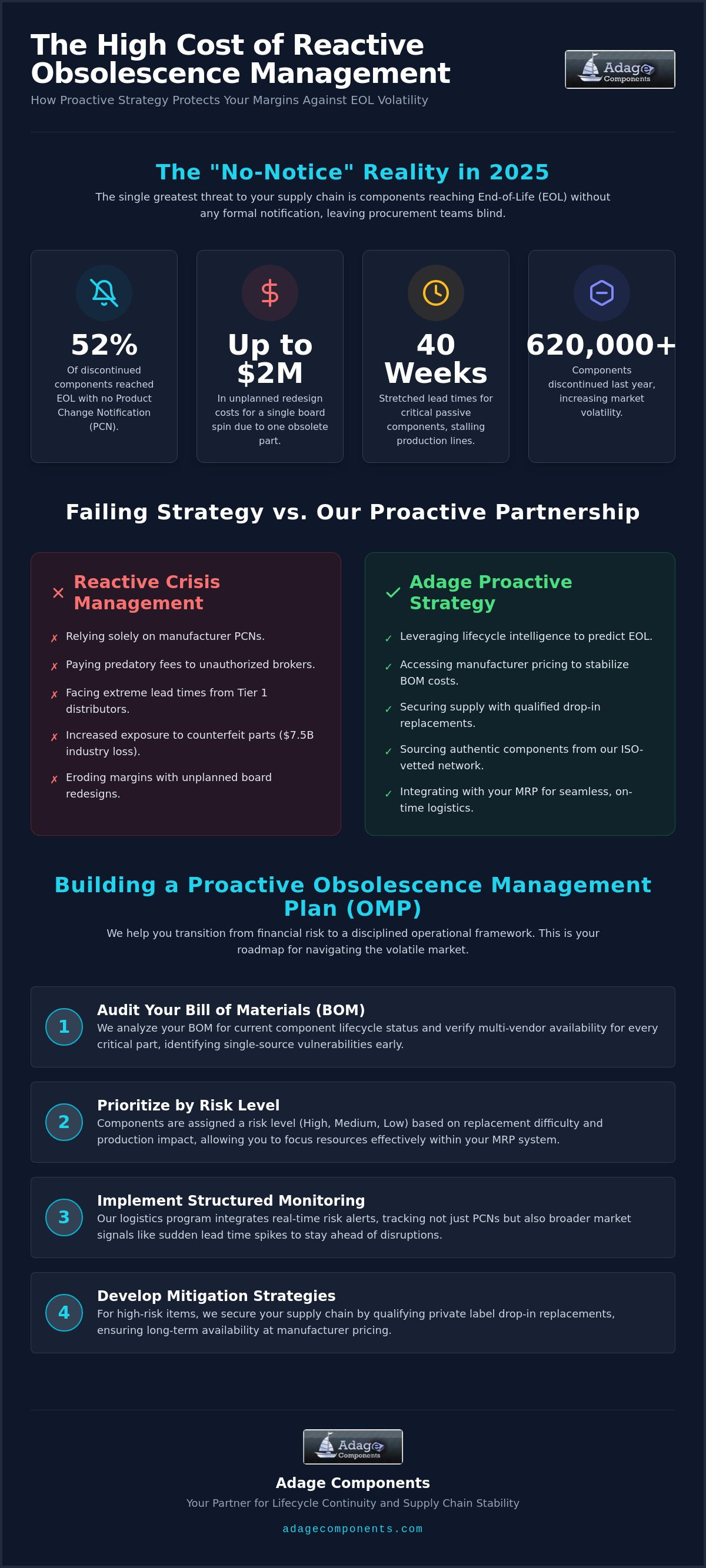
Did you know that in 2025, over 52% of discontinued components reached their end-of-life without a single formal notification from the manufacturer? For OEMs, this "no-notice" volatility often results in unplanned redesign costs that can soar to $2 million for a single board spin. You're likely exhausted by paying predatory broker fees and watching production lines stall because lead times for critical passives have stretched to 40 weeks. Managing component obsolescence proactively is no longer a luxury for procurement teams; it is the only way to protect your margins against a market that saw over 620,000 parts discontinued last year alone.
Adage Components understands that you need reliability and manufacturer pricing to maintain a competitive edge. We promise to show you how to move away from reactive crisis management toward a lifecycle strategy that secures your supply chain against EOL volatility. This guide explores how to achieve long-term stability through seamless MRP integration and strategic sourcing that bypasses the friction of Tier 1 distributors. We will outline the exact steps to lower your BOM costs and ensure your components arrive at your facility in real time, on time, and fully authenticated.
Key Takeaways
- Transition from reactive crisis management to a predictive strategy by managing component obsolescence proactively to protect your production margins.
- Audit your Bill of Materials (BOM) for lifecycle status and multi-vendor availability to prioritize high-risk components within your MRP system.
- Leverage private label drop-in replacements to secure stable, long-term supply chains that bypass the volatility and high costs of Tier 1 distributors.
- Integrate real-time risk alerts into your logistics program to find the optimal balance between JIT delivery and strategic safety stock for EOL parts.
- Access manufacturer pricing and rigorous quality assurance through ISO-vetted partners to ensure all passive components meet strict automotive and commercial standards.
The High Cost of Reactive Obsolescence Management
Proactive obsolescence management is the systematic prediction and mitigation of component end-of-life (EOL) risks before they disrupt your production schedule. In the high-stakes environment of industrial procurement, managing component obsolescence proactively is the only way to safeguard your facility from sudden market shifts. We define obsolescence as the transition of a component from available to unavailable, often driven by rapid technological shifts or regulatory changes like REACH and RoHS compliance.
The "no-notice" reality is the most significant threat to your supply chain in 2026. Data from 2025 reveals that 52% of discontinued components reached EOL without a Product Change Notification (PCN). This lack of transparency leaves procurement teams blind. When a critical passive component suddenly vanishes, the hidden costs are staggering. You face expensive redesigns, rigorous requalification processes, and the necessity of paying high premiums to unauthorized brokers. Tier 1 distributors often compound this issue; during EOL allocations, they typically prioritize their largest global accounts, leaving mid-sized OEMs to scramble for remaining stock.
To better understand this concept, watch this helpful video:
The Financial Impact on OEM Production
A proactive strategy offers a clear return on investment compared to emergency last-time buys. A single board redesign can cost your team anywhere from $20,000 to nearly $2 million. These unplanned expenses directly erode the margins of your legacy products. Reactive sourcing also increases your exposure to counterfeit electronics, which cost the semiconductor industry over $7.5 billion annually. Adage Components mitigates this risk by providing authentic, commercial and automotive grade components directly from our ISO-vetted manufacturer network. We help you avoid the "broker trap" by offering manufacturer pricing that keeps your BOM costs stable even during market volatility.
Moving Beyond the PCN
Relying solely on manufacturer notices is a failing strategy. In 2026, you must use lifecycle intelligence to flag components with declining availability. We recommend identifying "single-source" vulnerabilities early in the design phase. Adage Components acts as a strategic partner, offering BOM cost analysis to identify high-risk parts before they impact your MRP system. By qualifying drop-in replacements from our state-of-the-art warehouse operations, you secure a secondary supply channel that doesn't depend on the whims of franchised distributors. This disciplined expertise ensures your production remains fluid regardless of global market fluctuations.
Building a Proactive Obsolescence Management Plan (OMP)
Transitioning from the financial risks discussed previously requires a disciplined operational framework. Building a robust OMP ensures that managing component obsolescence proactively becomes a standard procurement protocol rather than an emergency response. This plan serves as your roadmap for navigating the volatile 2026 market. A comprehensive proactive obsolescence management plan isn't just a document; it's a living operational framework that bridges the gap between design and long-term production.
Follow these five essential steps to establish your framework:
- Step 1: Audit your Bill of Materials (BOM) for current lifecycle status and verify multi-vendor availability for every critical part.
- Step 2: Prioritize components by assigning a risk level (High, Medium, or Low) based on the difficulty of finding a replacement and the impact on production.
- Step 3: Implement a structured monitoring process that tracks Product Change Notifications (PCNs) and broader market signals like sudden lead time spikes.
- Step 4: Develop specific mitigation strategies for high-risk items, such as qualifying drop-in replacements or negotiating last-time buys.
- Step 5: Perform a quarterly review of the OMP to ensure it remains synchronized with your MRP system data and current production demands.
Aligning with IEC 62402 Standards
Your OMP should align with the requirements of IEC 62402:2019. This international standard provides the principles for managing obsolescence throughout the entire product lifecycle. Adhering to these guidelines helps you maintain ISO certification compliance and establishes clear cross-functional ownership. Engineering teams must work alongside procurement to ensure that technical specifications for alternatives are vetted before a crisis occurs. This partnership reduces the friction typically found when switching from Tier 1 distributors to more agile, private label manufacturers.
Risk-Prioritizing Your BOM
Focus your initial efforts on "critical-path" components. For example, Thick Film Chip Resistors are often overlooked until a shortage hits, yet they are essential for nearly every assembly. Use historical lead time data to forecast potential bottlenecks; as seen in early 2026, lead times for certain passives have reached 40 weeks. Categorize your parts by an "Ease of Replacement" score to determine which items require immediate secondary sourcing. Adage Components simplifies this by offering a wide range of commercial and automotive grade components that serve as direct, reliable alternatives. By securing manufacturer pricing on these passives, you protect your margins while ensuring lifecycle continuity. This level of logistical precision allows you to integrate our sourcing directly into your MRP system for real-time stability.
The Strategic Advantage of Drop-In Replacements
While digital monitoring tools provide necessary alerts, the actual execution of a supply chain strategy depends on finding physical alternatives. Managing component obsolescence proactively is only effective if you have a qualified second source ready before a Tier 1 manufacturer issues an EOL notice. Private label components serve as a critical bridge here. They offer a stable alternative to the volatile lifecycles typical of franchised distributors. Unlike Tier 1 brands that may discontinue a low-margin passive line to prioritize high-margin AI chips, a private label manufacturer like Adage Components maintains production based on long-term OEM partnerships.
Qualifying these drop-in replacements requires a rigorous technical evaluation. You must ensure total mechanical, electrical, and thermal compatibility. This alignment follows the IEC 62402:2019 standard, which demands a formal process for verifying that alternative parts meet the original design intent. By moving to a private label model, you secure manufacturer pricing. We eliminate the Tier 1 distributor markup, allowing you to reinvest those savings into further supply chain hardening. This approach doesn't just save money; it creates a more predictable cost structure for your entire Bill of Materials.
Qualifying Alternative Manufacturers
A reliable partner must provide more than just a datasheet. You need a supplier that conducts intensive factory audits and offers direct technical support. When we source Thick Film Chip Resistors, we ensure they meet or exceed the original specifications for voltage rating and temperature coefficient. We also verify that all partner suppliers comply with all ISO certifications to ensure the integrity of your supply chain. This level of scrutiny is why our automotive-grade passives are trusted in high-reliability applications. To start this transition, you can submit your BOM for a cost and lifecycle analysis. Our specialists will identify every single-source risk and provide vetted, authentic alternatives that match your performance requirements exactly.
Bypassing Tier 1 Allocation
The 2026 market has proven that Tier 1 allocation is a constant threat to production schedules. When a major brand prioritizes a high-volume client, smaller OEMs are often left with 40-week lead times or zero stock. Private label partnerships solve this by providing dedicated production capacity. We use our state-of-the-art warehouse operations and amazing international logistics program to get products to your facility in real time. This direct procurement channel significantly reduces lead times compared to traditional franchised distributors. It’s a proven method for maintaining production continuity even when brand-name components go EOL without warning. Our solutions integrate seamlessly with your existing MRP system, ensuring that your supply chain remains resilient and cost-effective.
Integrating Obsolescence Strategy with MRP and Logistics
Managing component obsolescence proactively requires more than just a list of alternatives; it demands deep integration with your MRP system. Static spreadsheets are insufficient in a market where lead times shift weekly and 14 major suppliers announced price increases in April 2026 alone. By syncing real-time lifecycle data, your procurement team receives instant alerts when a critical passive component moves toward EOL status. This transparency allows for immediate action before stock vanishes from the open market or broker premiums reach five times the book price.
Balancing Just-In-Time (JIT) delivery with the need for safety stock is a delicate equation for EOL parts. While lean principles discourage excess inventory, the high cost of production delays often justifies a strategic buffer. We help you find this balance by identifying which components are most susceptible to "no-notice" EOL events. Our amazing international logistics program removes the friction of cross-border supply chains. We handle complex customs navigation and specialized warehousing to ensure your components arrive on time, every time. This precision is essential for maintaining production continuity without bloating your balance sheet with unnecessary capital.
Global Stocking Programs
Adage Components manages global inventory specifically to buffer against sudden obsolescence. We offer dedicated warehousing for your most at-risk components, effectively reducing the capital burden of massive last-time buys. Our programs allow you to pull stock as needed, ensuring you never face a line-down situation due to a missing resistor or capacitor. By using our global stocking infrastructure, you gain the stability of Tier 1 distributors without the associated markup. Explore our full range of passives by viewing our comprehensive component linecard.
Real-Time Logistics Execution
We move authentic products from our vetted manufacturers to your facility in real time. Our state-of-the-art warehouse operations serve as a final checkpoint for quality control, verifying that every part meets our rigorous standards before shipment. This seamless flow is a core part of The Strategic Guide to Sourcing Passive Electronic Components for OEMs. We prioritize speed and safety, ensuring that even hard-to-get items pass through multi-stage inspection processes before they reach your assembly line. This disciplined approach mirrors the efficiency promised in our sourcing and delivery processes, providing a bridge between a fragmented marketplace and your specific production needs.
Partnering with Adage Components for Lifecycle Continuity
Choosing the right partner is the final, most critical step in managing component obsolescence proactively. While other distributors focus on transactional volume, Adage Components acts as a strategic extension of your procurement team. We solve sourcing puzzles by providing direct access to manufacturer pricing on a wide range of passives. This eliminates the uncertainty of the open market and the high markups of Tier 1 distributors. Our position as a Canadian private label manufacturer allows us to offer OEM pricing without the typical lead time volatility seen in franchised channels.
Reliability in 2026 requires more than just stock availability; it demands absolute transparency. We ensure all components are authentic and sourced from our strictly vetted manufacturers. This disciplined approach provides the composed confidence you need when a critical part reaches EOL. By integrating our supply chain directly with your MRP system, you gain long-term stability and significant BOM cost savings. We handle the logistical heavy lifting, allowing your engineering team to focus on innovation rather than emergency redesigns.
Our Quality and Compliance Framework
Our commitment to precision is backed by rigorous manufacturing audits. Every part we source must meet specific commercial or automotive grades to ensure it survives the most demanding environments. We provide comprehensive technical support for qualifying drop-in replacements, particularly for high-risk items like Thick Film Chip Resistors. Our team verifies that every alternative part matches the original footprint and performance specs exactly. This meticulous attention to detail is supported by our full compliance with all ISO certifications, ensuring your facility receives only the highest quality passives. You can view our full linecard of passive components to see the breadth of our authenticated offerings.
Getting Started with Proactive Sourcing
Transitioning from the volatility of franchised distributors to a stable private label model is a straightforward process. Adage Components offers a specialized Distributor Affiliated Program designed for strategic supply chain management. This program allows you to bypass Tier 1 allocation issues and secure dedicated production capacity for your legacy products. We help you identify single-source vulnerabilities and replace them with stable, cost-effective alternatives before a shortage occurs. Our international logistics program then ensures these parts arrive at your facility in real time, on time. Don't wait for the next "no-notice" EOL event to disrupt your production. Contact Adage Components today to secure your 2026 supply chain and lock in manufacturer pricing for your entire Bill of Materials.
Secure Your Supply Chain Resilience for 2026
Managing component obsolescence proactively is the only viable strategy to protect your margins from the "no-notice" EOL volatility that defined 2025. We've outlined how a predictive OMP, combined with the strategic use of drop-in replacements, eliminates the 40-week lead times and broker premiums common with Tier 1 distributors. By syncing lifecycle intelligence directly with your MRP system, you transition from reactive crisis management to a disciplined, data-driven procurement model.
Adage Components acts as your elite partner in this effort. From our state-of-the-art Canadian headquarters, we leverage a global logistics reach to ensure your components arrive in real time, on time. Our ISO 9001:2015 compliance and rigorous inspection protocols guarantee that every part is authentic and meets your exact commercial or automotive standards. It's time to leverage manufacturer pricing and secure the long-term stability your production schedule requires.
Submit your BOM today for a comprehensive cost and obsolescence risk analysis and start your transition to a more stable supply chain. We're ready to solve your sourcing puzzles today.
Frequently Asked Questions
What is the difference between reactive and proactive obsolescence management?
Reactive management responds to Product Change Notifications (PCNs) only after they arrive, which often leaves procurement teams facing 40-week lead times or zero stock. Managing component obsolescence proactively involves using lifecycle intelligence to predict EOL events before they impact your production schedule. This shift allows you to qualify drop-in replacements and secure inventory while market prices remain stable, preventing the $2 million costs associated with emergency redesigns.
How does Adage Components ensure the quality of private label drop-in replacements?
We maintain a rigorous quality assurance framework that includes multi-stage manufacturing audits and technical testing. Every component is authentic and sourced from our network of vetted manufacturers and partner suppliers. Our state-of-the-art warehouse operations verify that all passives meet strict commercial or automotive grades. This meticulous attention to detail ensures that our drop-in replacements match the original mechanical and electrical specifications with absolute precision.
What is IEC 62402 and why does it matter for my procurement strategy?
IEC 62402:2019 is the international standard that provides the requirements for managing obsolescence throughout a product's entire lifecycle. It establishes the framework for documenting your OMP and creating cross-functional ownership between your engineering and procurement departments. Aligning with this standard is essential for maintaining ISO certifications and ensuring your facility is prepared for the 52% of components that currently reach EOL without formal notification.
Can Adage Components help with last-time-buy inventory management?
Yes, we offer global stocking programs designed to reduce the capital burden of massive last-time buys. We use our state-of-the-art warehouse infrastructure to manage dedicated inventory for your most at-risk components, allowing you to pull stock in real time. This is a strategic alternative to the limited allocation windows offered by Tier 1 distributors. Our program ensures you have the parts you need without bloating your own balance sheet.
How do I integrate a new supplier into my existing MRP system?
Adage Components facilitates seamless integration by providing real-time data syncs and transparent logistics tracking that matches your existing digital workflows. We provide all necessary technical documentation and certificates of compliance required for new part qualification within your MRP system. Our amazing international logistics program handles the cross-border complexities, ensuring that products reach your facility on time and ready for immediate production use.
Why are thick film chip resistors often the first components to go obsolete?
Tier 1 manufacturers often discontinue thick film chip resistors because they yield lower profit margins compared to the high-demand semiconductors used in the AI sector. When global production capacity is constrained, these high-volume passives are the first to be deprioritized by franchised distributors. We solve this by maintaining dedicated production lines and manufacturer pricing for these essential components, offering you a stable supply chain that isn't subject to Tier 1 volatility.
What certifications should I look for in a proactive component distributor?
You should prioritize partners that maintain ISO 9001:2015 certifications and demonstrate support for both commercial and automotive grade components. A proactive distributor must also verify compliance with REACH and RoHS regulations to prevent "hidden" obsolescence caused by regulatory shifts. Adage Components maintains these high standards while vetting every partner supplier in our network. This ensures that every passive component in your facility is fully authenticated and compliant with global industry standards.
How does manufacturer pricing compare to Tier 1 distributor pricing during EOL events?
Manufacturer pricing is significantly more stable because it bypasses the middleman markups and broker premiums that typically occur during market shortages. Tier 1 distributors often prioritize their largest global accounts during EOL events, leading to predatory spot premiums for other OEMs. We offer the best cost in the industry by providing OEM pricing directly to our partners. This approach keeps your BOM costs predictable even when global market volatility spikes.
Disclaimer
Cross-referenced components needs to be confirmed by the client with either spec. sheet or samples or both.
Please note, we use AI to help us, information is verified to be correct but we can not guarantee 100% accuracy.