

Could a moisture barrier bag protect a thin film resistor for years, or is the bag being asked to solve the wrong problem? Thin film resistor shelf life and moisture barrier bag packaging depend on the manufacturer’s storage guidance, the original packaging, and how the parts are handled after receipt. A universal shelf-life countdown can be misleading when product documents give different instructions.
Moisture can affect packaging, terminals, or solderability, but component shelf life and moisture-sensitive-device floor life are separate controls. Floor-life rules apply only when the specific component has an assigned moisture sensitivity level and its documentation defines handling requirements. A bag label or humidity indicator can inform receiving checks, but neither replaces the manufacturer’s instructions.
This article explains which datasheets, packaging labels, and indicators to review, and how to build a practical, documented storage and receiving process. Adage Components supports OEM and EMS procurement with thin film precision resistors, technical support, and quality processes. Our cost-effective component sourcing, international logistics coordination, and global stocking programs help businesses plan procurement and supply continuity.
Key Takeaways
- Manage thin film resistor shelf life and moisture barrier bag packaging according to the specific manufacturer’s documentation, not a universal storage countdown.
- Separate sealed-package shelf life from handling after opening. Apply moisture-sensitive-device requirements only when the component documentation calls for them.
- Assess packaging by its type, seal condition, indicators, storage instructions, and traceability records. A moisture barrier bag alone doesn’t guarantee indefinite protection.
- Use documented criteria to inspect incoming packaging and labels, record storage conditions, and control when components are opened and issued for use.
- Adage Components supplies thin film precision resistors and supports OEM and EMS procurement with technical support, quality processes, and international logistics coordination.
Thin Film Resistor Shelf Life: What It Means and What Sets It
Thin film resistor shelf life is the storage period supported by the manufacturer’s product and storage documentation. It isn’t a universal countdown that applies to every resistor. Part construction, finish, packaging, and specified storage conditions can differ, so use the guidance for the exact part number and manufacturer rather than assuming all thin film resistors share one duration.
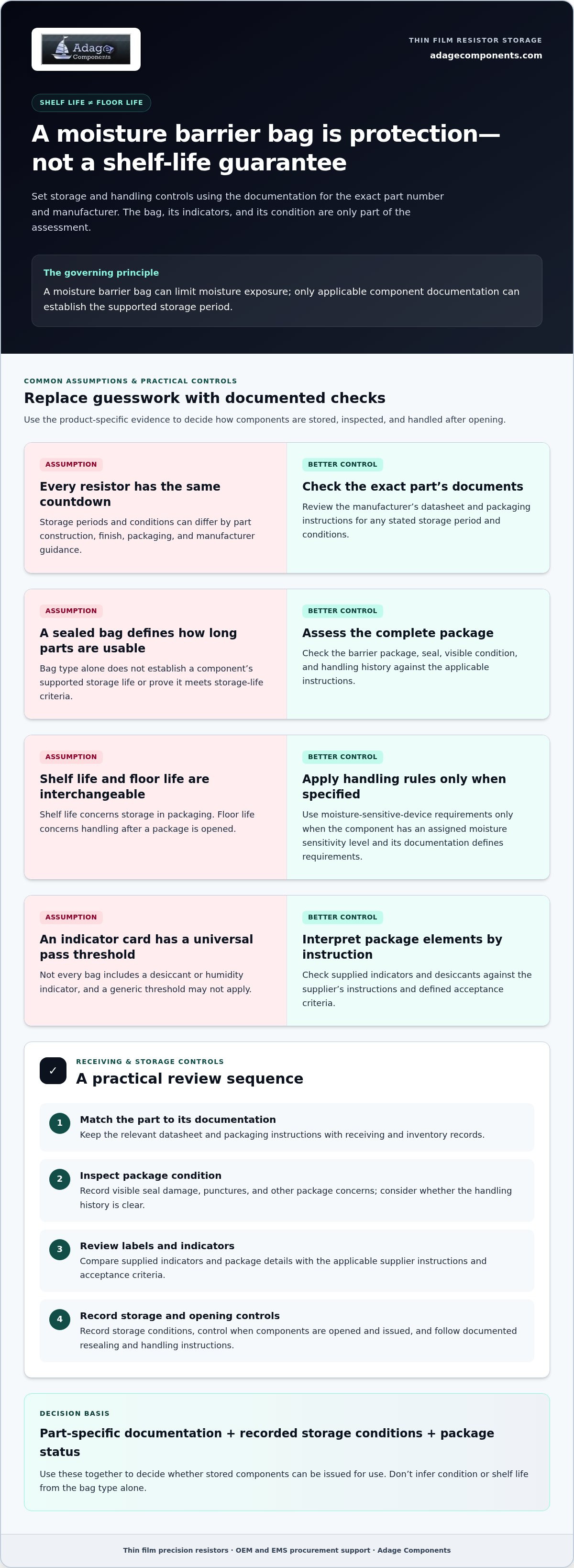
Shelf life covers storage; floor life covers handling after a package is opened. This distinction helps buyers set appropriate controls without automatically treating every resistor as a moisture-sensitive device. For the specific part, review the manufacturer’s datasheet and packaging instructions for any stated storage period, moisture sensitivity classification, and requirements after opening.
Shelf life versus floor life: why the distinction matters
Shelf life concerns whether components remain within the manufacturer’s documented storage conditions while held in their packaging. Floor life concerns handling after a package is opened. Any applicable time limit or handling requirement must come from the component’s documentation. Don’t assign a floor-life rule solely because a part is a surface-mount resistor or arrives in a moisture barrier bag.
Keep the relevant datasheet and packaging instructions with receiving and inventory records. If those documents specify additional handling conditions, include them in the procedure for that part number. This gives procurement and production teams a consistent basis for deciding whether stored components can be issued for use.
Which storage conditions can affect a resistor?
Temperature and humidity matter because the manufacturer’s storage guidance defines the conditions under which any stated shelf life applies. Conditions outside that guidance can also challenge packaging integrity. A puncture, damaged seal, or unclear opening history may make the package’s protective state uncertain, even if the components look unchanged.
Review terminals, protective finishes, and solderability using product-specific evidence. Don’t infer their condition from the package type alone or claim a particular degradation mechanism without supporting manufacturer documentation. The Resistor reference provides background on resistor types, including thin-film designs, but storage acceptance should follow the relevant component documents.
For Thin film resistor shelf life and moisture barrier bag packaging, connect the part number to its documentation, recorded storage conditions, and package status. Adage Components supplies thin film precision resistors and supports OEM and EMS sourcing with technical support and quality processes. This gives procurement teams a way to align component requirements with their sourcing and inventory plans.
How Moisture Barrier Bags Protect Thin Film Resistors in Storage
A moisture barrier bag is designed to reduce moisture ingress into its contents. For thin film resistors, this packaging can support controlled storage, but it doesn’t establish how long the components remain suitable for use. A moisture barrier bag can limit moisture exposure; only the applicable component documentation can establish the supported storage period.
The bag is only one part of the package. Its barrier material may be designed to resist moisture, but protection depends on the complete package remaining intact. A puncture, damaged seal, or poor resealing after opening can compromise the intended barrier. A bag that appears undamaged also doesn’t, by itself, prove the components meet their storage-life criteria.
What a moisture barrier bag does, and doesn’t do
For electronic-component packaging, consider barrier performance alongside the seal and the package’s handling history. This differs from choosing consumer packaging by general measures such as oxygen or moisture transmission rates. Don’t transfer food-packaging requirements into resistor procurement. Use the component and packaging documentation that applies to the specific parts.
Correct Products’ overview of ESD and moisture-barrier bags discusses their role in electronic-component protection. Treat general packaging information as context, not a substitute for manufacturer instructions or documented acceptance criteria for a specific resistor.
Desiccants, humidity indicators, and package integrity
Some package specifications include a desiccant to manage moisture within the package and a humidity indicator card to provide a visible indication of internal conditions. These elements are useful only as part of the specified packaging system. Assess their presence and appearance against the supplier’s instructions. Don’t assume every moisture barrier bag includes them or apply a generic indicator threshold.
At receiving, compare the shipment with its documentation. Record visible seal damage, punctures, or other package concerns, and review supplied indicators against defined acceptance criteria. If a bag has been opened, follow the documented resealing and handling instructions rather than assuming its original barrier protection remains unchanged.
For Thin film resistor shelf life and moisture barrier bag packaging, keep the package specification, inspection records, and component storage guidance connected to the part number. Adage Components supplies thin film precision resistors and provides technical support to help procurement teams align product requirements with component documentation. Review our thin film precision resistor linecard as part of your sourcing documentation.
Moisture Barrier Packaging vs. Standard Packaging: What Should Buyers Compare?
Packaging decisions should follow the component documentation and the conditions the parts will face in storage and transit. A moisture barrier bag may be appropriate when the manufacturer specifies it or when documented supply-chain risks call for additional moisture protection. It isn’t an automatic requirement for every thin film resistor, and the bag alone doesn’t establish shelf life.
Compare the evidence supplied with each packaging option, not just the package’s appearance:
| What to compare | Documented standard packaging | Moisture barrier packaging |
|---|---|---|
| Package type | Identify the package described in the product or supplier documentation. | Confirm that a moisture barrier bag is specified for the component or shipment. |
| Seal condition | Check the closure and package condition against receiving criteria. | Inspect the bag and seal for damage that could compromise the intended barrier. |
| Indicators | Record any indicators included in the documented package. | Review any supplied humidity indicator and desiccant against the package instructions. |
| Storage instructions | Apply the manufacturer’s stated conditions and handling guidance. | Follow the specified storage, opening, and resealing instructions. Don’t assume the bag sets them. |
| Traceability | Retain labels and available component or supplier records. | Record the same traceability details, along with relevant package and indicator observations. |
When is moisture barrier packaging justified?
Start with the manufacturer’s packaging instructions, then consider the receiving environment, planned storage duration, transport exposure, package integrity, and production process. These factors help determine whether the specified packaging provides appropriate protection for the planned supply chain. Moisture-sensitive-device classifications and related handling rules are product-specific. Verify them in the applicable documentation rather than assigning them to all resistors.
Which documents and indicators should procurement review?
Review the datasheet, package label, available certificate or traceability records, and supplier handling instructions as one evidence set. At receiving, document package condition and any humidity indicator reading according to the stated acceptance criteria. If the documentation doesn’t define how to interpret an indicator, don’t create a generic threshold or accept/reject rule.
These checks make Thin film resistor shelf life and moisture barrier bag packaging a controlled procurement decision rather than a blanket packaging preference. Adage Components supports OEM and EMS sourcing with technical support, quality processes, and international logistics coordination. These services help connect component documentation with procurement and supply-chain planning.
A Practical Receiving and Storage Workflow for Thin Film Resistors
A controlled workflow carries the manufacturer’s requirements from the receiving dock to production. Set acceptance decisions against the applicable product documents and your organization’s quality procedures. Don’t create universal temperature, humidity, or opened-package time limits where the documentation provides none.
Receiving and storing unopened packages
Before accepting or opening a shipment, check the package and its records together. Use a consistent sequence:
- Match identification. Compare the part number, manufacturer, lot information, and labels with the purchase order and traceability records.
- Inspect packaging. Look for visible damage, compromised seals, or other conditions covered by your receiving criteria. Review supplied indicators using the documented acceptance criteria.
- Record exceptions. Photograph or document concerns as required by your quality process, then route affected material through the established review procedure rather than making an undocumented acceptance decision.
- Store unopened parts correctly. Follow the manufacturer’s specified environmental conditions and packaging instructions. Keep records linked to the part and lot so storage history remains traceable.
These checks help distinguish a package that meets defined requirements from one that needs review. Appearance alone cannot establish component storage life, so retain the datasheet and applicable packaging instructions with the receiving record.
Opening, resealing, and managing inventory
Opening changes the package state. Capture the opening date or other required information when internal procedures or product documentation call for it. If components will be returned to storage, reseal or transfer them only with the packaging and handling method specified for that product. Don’t assume an opened package retains its original protective condition.
Track inventory movement by part and lot. Apply first-in, first-out discipline where it fits your process, while respecting any manufacturer-defined storage period or handling instruction. If material is split between locations or containers, preserve its identification and traceability through each transfer.
For Thin film resistor shelf life and moisture barrier bag packaging, this workflow makes each decision traceable without imposing unsupported limits. Adage Components supplies thin film precision resistors and supports OEM and EMS procurement with technical support and quality processes. Review component categories and sourcing options to support your procurement planning.
Turn Resistor Shelf-Life Requirements into a Sourcing and Quality Plan
A dependable shelf-life plan connects each resistor part number to the documents, packaging, storage controls, and traceability records that govern its use. Procurement can then communicate consistent requirements across sourcing, receiving, inventory, and production without applying packaging rules the product documentation doesn’t support.
What to include in a resistor packaging specification
Make the specification clear enough that receiving teams can verify shipments and production teams can manage them. Include:
- Part identification: manufacturer, part number, and the lot or date-code information needed for traceability.
- Manufacturer documentation: the applicable datasheet and packaging or handling instructions, including documented storage periods or post-opening controls.
- Package requirements: the expected package type and condition, plus any project-specific moisture barrier requirement and its technical rationale.
- Storage and handling: environmental conditions and procedures referenced to the applicable product documents, rather than generic limits.
- Records: required labels, certificates or traceability documents, and receiving observations such as package condition or supplied indicator readings.
This gives buyers a practical basis for acceptance and keeps requirements tied to documented criteria. It also makes exceptions easier to identify: a missing document, an unreadable label, or a damaged package can be routed for review instead of handled through informal assumptions.
How sourcing support strengthens supply-chain continuity
Adage Components supports OEMs and EMS providers with thin film precision resistors and related electronic components. We provide technical support, manufacturing audits, and quality assurance processes to help connect procurement requirements with component documentation. Our international logistics coordination and global stocking programs support supply-chain planning for businesses sourcing components across borders.
Our wholesale component sales provide cost-effective alternatives and drop-in replacements for standard industry parts. Direct procurement channels and global stocking programs can help businesses manage material costs and lead times. When planning a resistor program, align the part specification, packaging requirements, and traceability needs with the quantities and inventory approach used by your MRP system.
Use Thin film resistor shelf life and moisture barrier bag packaging requirements to strengthen your purchasing specification, not to impose a universal storage rule. Define the part, applicable documents, package condition, storage controls, and traceability expectations before material enters inventory. Explore resistor and component sourcing options with Adage Components.
Set Clear Controls for Reliable Resistor Procurement
Thin film resistor shelf life and moisture barrier bag packaging should be governed by the manufacturer’s documentation, not a universal time limit or packaging assumption. Keep storage shelf life separate from any product-specific handling requirements after opening. At receiving, verify part and lot identification, package condition, supplied indicators, and traceability records against documented criteria.
Adage Components supplies thin film precision resistors and supports OEM and EMS procurement with technical support, manufacturing audits, quality assurance processes, and international logistics coordination. Our global stocking programs and direct procurement channels help businesses plan component sourcing and supply continuity.
Build these controls into your sourcing plan, then align component requirements with cost and continuity priorities. Explore resistor and component sourcing options with Adage Components.
Frequently Asked Questions
Is there a standard shelf life for thin film resistors?
No, there isn’t one shelf-life duration that applies to every thin film resistor. The applicable period depends on the manufacturer’s documentation, packaging, and specified storage conditions. Keep the relevant datasheet and packaging instructions with the lot records so receiving and production teams can apply consistent criteria. If the documents don’t state a duration, don’t invent one. Document the requirement through your organization’s approved quality process.
Do thin film resistors need moisture barrier bag packaging?
Not automatically. A moisture barrier bag may be appropriate if the component documentation, storage environment, transport exposure, or manufacturing process calls for it. Thin film resistor shelf life and moisture barrier bag packaging should be assessed together, but a bag only reduces moisture ingress. It doesn’t establish unlimited shelf life or replace storage instructions. Review the manufacturer’s packaging requirements and inspect package condition before deciding how to receive and store the parts.
Are thin film resistors moisture-sensitive devices?
Don’t assume that every thin film resistor has the same moisture-sensitivity classification or handling requirements. Applicability depends on the specific component and its manufacturer documentation. Floor-life rules for moisture-sensitive devices concern handling after a package is opened, while shelf life concerns storage under documented conditions. Before applying a standard or process, verify that it covers the exact part and package involved.
What should I check on a resistor moisture barrier bag?
Check the part and lot identification, visible package condition, seal integrity, and any included humidity indicator or desiccant against the documented packaging instructions. Record your observations through the receiving process. Don’t apply generic indicator thresholds or acceptance limits unless the product documentation or an approved quality procedure specifies them. If packaging is damaged or its condition is unclear, route it through your established nonconformance process.
Does opening a moisture barrier bag reduce resistor shelf life?
Opening changes the package condition and may affect subsequent storage or handling requirements, but the effect is product-specific. Follow the manufacturer’s instructions for opened packages, resealing, and any applicable floor-life controls. Record when the package is opened if your process requires it. Don’t assume a universal countdown applies to every thin film resistor, or that resealing automatically restores the original package condition.
How should thin film resistors be stored before assembly?
Store resistors in the manufacturer-specified environment and retain their identification and traceability records. Protect packages from damage, and inspect them against your receiving criteria before issuing components to production. If the package includes a humidity indicator or desiccant, follow its accompanying instructions. Apply opened-package handling controls only when the component documentation or your approved process requires them, rather than imposing a general rule on every resistor.
What is the difference between resistor shelf life and floor life?
Shelf life refers to the documented storage period or conditions for a component before use. Floor life generally concerns handling after a package is opened and components are exposed to the production environment. These terms aren’t interchangeable. For thin film resistors, verify which requirements apply to the exact part and package instead of automatically applying handling rules intended for other moisture-sensitive components.
Disclaimer
Cross-referenced components needs to be confirmed by the client with either spec. sheet or samples or both.
Please note, we use AI to help us, information is verified to be correct but we can not guarantee 100% accuracy.


