Your BOM reliability shouldn't be a gamble dictated by a brand name. With major manufacturers implementing significant price hikes as of July 2026, relying solely on Tier 1 distributors is no longer a sustainable procurement strategy. Mastering aluminum electrolytic capacitor lifetime calculation is the only way to transition safely to cost-effective alternatives without risking catastrophic field failures. We know the uncertainty that comes with qualifying new components when your MRP system demands precision and your budget is under fire from rising raw material costs.
We'll provide the technical formulas and strategic factors you need to predict component longevity with absolute confidence. You'll learn how to apply the 10°C rule and Arrhenius equations to your specific thermal loads. We'll also explore how Adage Components delivers manufacturer pricing and short lead times for both commercial and automotive grade parts. This guide breaks down the math behind AEC-Q200 Revision E compliance and shows you how to optimize your supply chain for a volatile global market.
Key Takeaways
- Identify the core "wear-out" mechanisms of electrolyte evaporation to anticipate failure points before they impact your system reliability.
- Master the aluminum electrolytic capacitor lifetime calculation using the 10°C rule and Arrhenius equations to predict field performance accurately.
- Translate technical datasheet variables like ripple current and ambient temperature into actionable data for your MRP system planning.
- Qualify high-quality component alternatives to Tier 1 distributors to maintain performance standards while achieving significant BOM cost savings.
- Leverage manufacturer pricing and rigorous ISO-certified quality audits from Adage Components to secure authentic, high-performance capacitors on time.
Understanding Aluminum Electrolytic Capacitor Wear-out Mechanisms
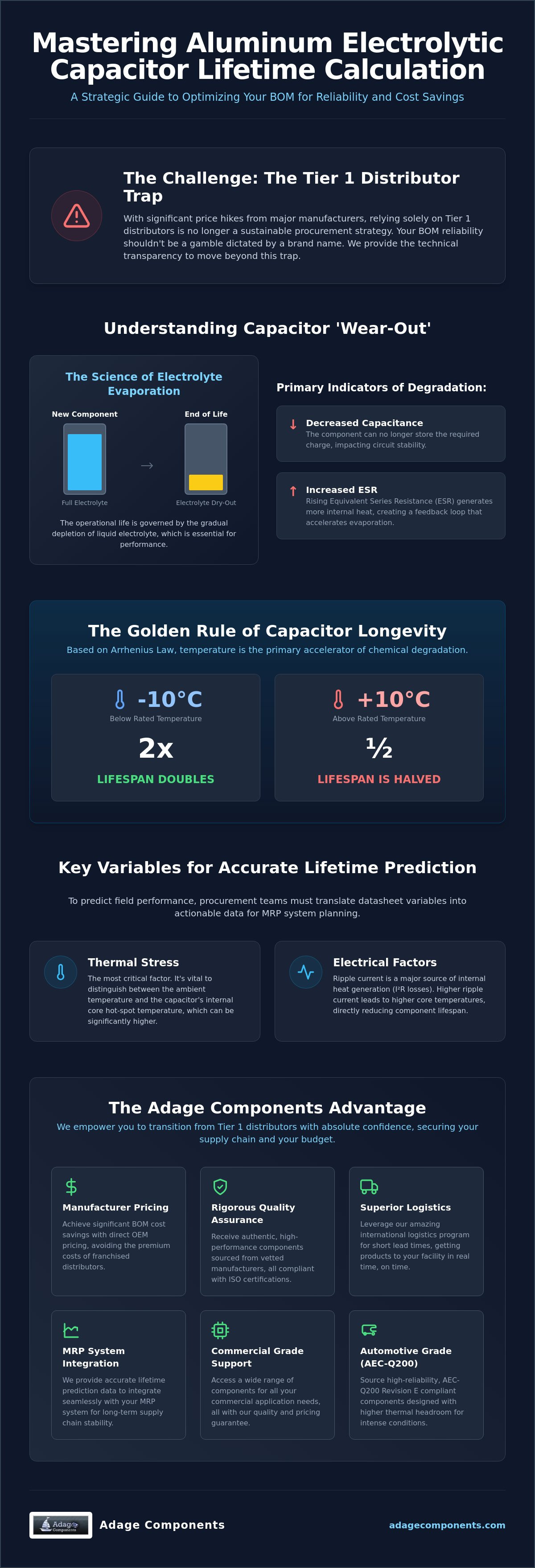
Aluminum electrolytic capacitors are unique among passive components because they possess a predictable, finite lifespan. While most silicon-based parts fail due to electrical overstress or manufacturing defects, these capacitors are categorized as "wear-out" components. Their operational life is governed by the gradual depletion of a liquid electrolyte. This liquid is essential for maintaining the dielectric oxide layer on the aluminum foil. As it evaporates, the component's performance degrades until it no longer meets the circuit's requirements.
The primary indicators of this degradation include a measurable drop in capacitance and a significant increase in Equivalent Series Resistance (ESR). When ESR rises, the capacitor generates more internal heat. This creates a feedback loop that further accelerates the evaporation process. For procurement professionals, recognizing that these parts are essentially chemical timers is the first step in managing system reliability. Failing to account for this wear-out leads to high field-failure rates and compromised OEM warranties.
The Role of Electrolyte Diffusion
Seal integrity is the primary defense against premature failure. Over time, electrolyte molecules diffuse through the rubber end-seal or the aluminum can's seams. High-temperature environments drastically increase this diffusion rate. For every 10°C increase in ambient temperature, the diffusion rate approximately doubles, cutting the component's life in half. Dry-out is the primary end-of-life state for these components, occurring when the electrolyte volume drops below a critical threshold required to maintain the dielectric foil.
Why Lifetime Prediction is Critical for MRP Systems
Integrating aluminum electrolytic capacitor lifetime calculation into your MRP system is a prerequisite for long-term supply chain stability. If your procurement team doesn't account for these wear-out schedules, you risk unexpected production halts. We help our partners move beyond the "Tier 1 trap" by providing accurate life data that aligns with Mean Time Between Failures (MTBF) targets. Accurate data allows you to qualify cost-effective alternatives from vetted manufacturers without sacrificing quality.
By identifying the exact point of degradation, you can plan component lifecycles more effectively. This ensures your facility receives authentic, ISO-certified parts in real time. At Adage Components, we prioritize this technical transparency to help you avoid the premium costs often associated with franchised distributors. Reliable sourcing starts with understanding the physics of the components on your BOM.
Key Variables in Capacitor Life Expectancy Formulas
Accurate aluminum electrolytic capacitor lifetime calculation requires a deep understanding of the variables that accelerate electrolyte depletion. While temperature is the primary driver, electrical stresses and environmental conditions play critical roles in determining the actual field performance of your BOM. Procurement teams must look beyond the standard load life rating found on a datasheet to understand how these factors interact in real-world applications. We classify these variables into thermal, electrical, and environmental categories. Each one represents a potential risk to your system's longevity if not properly managed during the component qualification stage.
Understanding these inputs allows you to transition from expensive Tier 1 distributors to more cost-effective, high-quality alternatives without compromising on safety or performance. By integrating these variables into your procurement strategy, you can ensure that the components you source meet the specific demands of your application. You can find high-performance parts with these exact thermal and electrical profiles in our full product linecard.
Thermal Stress and Arrhenius Law
The chemical degradation of an electrolytic capacitor follows Arrhenius Law. This principle states that the rate of a chemical reaction doubles for every 10°C increase in temperature. In practical terms, operating a capacitor at 10°C below its rated temperature effectively doubles its lifespan. It's vital to distinguish between ambient temperature and the capacitor's core hot-spot temperature. Internal heat generation can make the core significantly hotter than the surrounding air. Automotive-grade components, which must comply with AEC-Q200 Revision E, are designed with higher thermal headroom to withstand these intense conditions.
Electrical Factors: Ripple Current and Applied Voltage
Ripple current is a major contributor to internal power dissipation. Because every capacitor has a specific Equivalent Series Resistance (ESR), the flow of ripple current generates heat through the I²R effect. This self-heating adds to the ambient temperature, further accelerating the drying-out process. Calculating capacitor lifespan requires factoring in this internal temperature rise to avoid premature failure.
Applied voltage also influences the stability of the dielectric oxide layer. While the effect of voltage on life is less dramatic than temperature, operating near the maximum rated voltage increases the risk of dielectric breakdown. Most engineers use a voltage derating strategy, typically operating at 80% or less of the rated voltage, to provide a safety margin. This approach, combined with precise aluminum electrolytic capacitor lifetime calculation, ensures your MRP system planning accounts for the longest possible component lifecycle. Environmental factors like atmospheric pressure and humidity shouldn't be ignored in specialized industrial applications. Low atmospheric pressure at high altitudes can reduce heat dissipation and stress the component seals. Adage Components ensures that every part sourced from our vetted manufacturers meets the rigorous standards required for modern industrial and automotive electronics.
Calculating Projected Life: The 10°C Rule and Practical Equations
While many Tier 1 distributors point you toward proprietary web calculators, we believe procurement professionals should understand the raw math. This transparency is essential for accurate BOM cost analysis and qualifying alternatives. The industry-standard aluminum electrolytic capacitor lifetime calculation relies on the base formula: Lx = Lo * 2^((To-Ta)/10). In this equation, Lx represents the expected life, Lo is the rated life from the datasheet, To is the maximum rated temperature, and Ta is the actual ambient operating temperature.
To execute this calculation effectively, follow these four steps. First, identify the rated life (Lo) and temperature (To) from the component datasheet. Second, measure or estimate the actual ambient operating temperature (Ta) within your system enclosure. Third, apply the 10°C rule to determine the life multiplier based on the difference between the rated and actual temperatures. Finally, adjust for internal heating caused by ripple current. This internal rise, often referred to as Delta T, is added to the ambient temperature to provide a more conservative and accurate prediction. This process ensures your MRP system planning is grounded in physical reality rather than manufacturer estimates.
The 10°C Rule: A Procurement Shortcut
The 10°C rule serves as a powerful procurement shortcut. It dictates that for every 10-degree reduction in operating temperature, the component's life effectively doubles. Consider a practical scenario. If you compare a part rated for 2,000 hours at 85°C with a part rated for 2,000 hours at 105°C, the 105°C part will last four times longer when operated at 85°C. This rule is a reliable industry standard for initial vetting when you're under pressure to find cost-effective alternatives. It allows you to quickly assess if a lower-cost component can meet your warranty requirements.
Accounting for Real-World Operating Conditions
Accounting for variable loads and duty cycles is essential for long-term reliability. Theoretical math only works if the base ratings are authentic. We source all components from vetted manufacturers and partner suppliers to ensure every datasheet value is backed by rigorous testing. Adage Components provides full technical documentation for lifecycle analysis, ensuring your MRP system data is accurate. Our commitment to ISO certifications means you can qualify our manufacturer pricing without the risks associated with unverified supply chains. This precision allows you to get products to your facility in real time, on time, and within budget. Using verified data prevents unexpected field failures and protects your brand reputation.
Strategic Component Selection: Reliability vs. BOM Cost
Many procurement managers fall into the "Tier 1 Trap," assuming that paying a premium to franchised distributors for brand-name capacitors automatically guarantees better system longevity. It doesn't. Reliability is a function of physics and material quality, not marketing budgets. By utilizing aluminum electrolytic capacitor lifetime calculation, you can objectively prove that a high-quality alternative meets or exceeds the Arrhenius requirements of your specific design. This technical approach allows you to move away from inflated Tier 1 pricing while maintaining the total integrity of your product's lifecycle.
Strategic sourcing is about balancing these technical requirements against the bottom line. In many industrial applications, the difference between a commercial-grade part and an automotive-grade component is more than just a price point; it's a matter of AEC-Q200 Revision E compliance and thermal headroom. We help you navigate these choices by providing the data needed to qualify drop-in replacements that fit your existing PCB footprints perfectly. This ensures your MRP system stays on track without the need for expensive engineering redesigns.
Qualifying Private Label Alternatives for Tier 1 Parts
Adage Components offers a direct path to manufacturer pricing without compromising the Arrhenius life curve. We understand that "drop-in" compatibility is non-negotiable for established production lines. Our team ensures that every alternative we suggest matches the electrical and physical specifications of the original part. You can leverage our BOM cost analysis to identify high-saving opportunities where you're currently overpaying for a label rather than actual performance. We act as your strategic partner, sourcing from vetted manufacturers to deliver the same reliability you expect from Tier 1 brands at a significantly lower cost.
Mitigating Parametric Drift in Long-Lifecycle Products
Long-lifecycle products demand components that resist parametric drift over thousands of hours. Selecting capacitors with low ESR is a critical step to minimize self-heating in high-ripple applications. If the electrolyte quality is inferior, the capacitor will dry out prematurely, regardless of the brand name on the sleeve. We prioritize sourcing parts with high-quality electrolytes that prevent this premature failure. For a broader perspective on optimizing your supply chain, see our Strategic Guide to Sourcing Passive Electronic Components.
Risk mitigation is built into every transaction we handle. We maintain strict compliance with all ISO certifications and conduct multi-stage manufacturing audits to ensure every component is authentic. Our state-of-the-art warehouse operations and amazing international logistics program ensure your facility receives these parts on time. Don't let volatile market prices or extended lead times dictate your reliability standards. Review our full linecard to secure high-performance, cost-effective capacitor solutions today.
Sourcing Reliable Capacitors with Adage Components
We bridge the gap between manufacturer pricing and the technical excellence typically associated with Tier 1 distributors. While mastering aluminum electrolytic capacitor lifetime calculation is a prerequisite for engineering, securing the physical components requires a partner who understands the volatility of the global supply chain. Adage Components acts as this strategic link. We provide the same reliability and quality standards as franchised distributors but at a cost structure that respects your OEM budget and long-term financial targets.
Our role as a specialist partner goes beyond simple order fulfillment. We provide the technical transparency required to integrate component data directly into your MRP system. This ensures that your procurement team isn't just buying parts but is instead securing the long-term stability of your product's lifecycle. By eliminating the overhead of traditional intermediaries, we empower you to maintain high reliability standards without the "brand-name tax" that often inflates BOM costs in industrial and automotive sectors.
Vetted Manufacturing and ISO Compliance
We ensure all capacitors are authentic by sourcing exclusively from vetted manufacturers and partner suppliers. Our rigorous manufacturing audit process eliminates the risk of counterfeit parts or substandard electrolytes that could skew your aluminum electrolytic capacitor lifetime calculation results. To maintain component integrity, we operate a state-of-the-art warehouse where environmental controls prevent pre-installation degradation. Trust is established through our unwavering compliance with all ISO certifications, providing the professional credibility your supply chain demands. For companies looking for deeper integration, our distributor affiliated program offers a framework for long-term strategic partnerships that stabilize your component pipeline.
Global Logistics and OEM Pricing Advantages
We achieve the best cost in the industry through direct procurement channels that bypass the markups of traditional franchised distributors. Our amazing international logistics program, managed from our Canadian headquarters, ensures that components reach your facility in real time, on time. We maintain global stocking programs to provide short lead times even when the broader market faces shortages or material price hikes. This logistical excellence allows for a seamless integration with your existing MRP system, ensuring that high-volume procurement doesn't become a bottleneck for your production line.
Reliability shouldn't be a luxury dictated by Tier 1 pricing. We provide the technical documentation and high-performance components needed to keep your systems running for their entire calculated lifespan. Contact Adage Components today for a technical consultation on your capacitor requirements and see how our manufacturer pricing can transform your BOM cost analysis.
Secure Your Supply Chain with Data-Driven Procurement
Accurate aluminum electrolytic capacitor lifetime calculation is more than a technical exercise; it's a strategic shield against the volatility of the global electronics market. By understanding the Arrhenius 10°C rule and the physics of electrolyte diffusion, your team can move beyond brand-name dependency to achieve significant BOM cost savings. We provide the technical transparency and manufacturer-direct OEM pricing you need to qualify high-performance alternatives without risking field failures.
Adage Components acts as your elite partner in risk mitigation. We combine ISO Certified Quality Management with a meticulously vetted global supplier network to ensure every part on your BOM is authentic and reliable. Our state-of-the-art warehouse and amazing international logistics program deliver components to your facility on time, every time. Transitioning from expensive Tier 1 distributors to a more efficient, direct model is the most effective way to protect your margins while maintaining peak system integrity.
Take the first step toward optimizing your component lifecycle and reducing lead times. Submit your BOM for a cost-saving analysis and technical review to see the Adage advantage in action. We're ready to help you build a more resilient, cost-effective supply chain today.
Frequently Asked Questions
What is the Arrhenius equation for capacitor lifetime?
The Arrhenius equation is the chemical principle stating that the rate of a chemical reaction doubles for every 10°C increase in temperature. In the context of capacitors, it's the mathematical foundation for predicting how quickly the liquid electrolyte will evaporate. This formula allows our partners to project component longevity based on the thermal loads within their specific system enclosures.
How does ripple current affect electrolytic capacitor life?
Ripple current reduces operational life by causing internal self-heating through power dissipation. This occurs because every capacitor has an Equivalent Series Resistance (ESR) that generates heat as current flows through it. This internal temperature rise adds to the ambient temperature, which accelerates the drying-out process and shortens the component's effective lifespan.
What is the 10-degree rule in capacitor reliability?
The 10-degree rule is a reliable industry shortcut stating that a 10°C decrease in operating temperature doubles a capacitor's life. It's a vital tool for aluminum electrolytic capacitor lifetime calculation during the initial stages of BOM vetting. This rule helps procurement professionals quickly determine if a part with a higher temperature rating can offer a better lifecycle value for their MRP system planning.
Can I replace a Tier 1 capacitor with a private label alternative safely?
You can safely transition to private label alternatives by verifying technical data and sourcing from vetted manufacturers. Adage Components provides the ISO-certified quality assurance and technical documentation needed to qualify these drop-in replacements. This strategy allows OEMs to secure manufacturer pricing and avoid the high markups typically found at franchised distributors.
What are the signs that an aluminum electrolytic capacitor is failing?
The primary signs of failure are a significant drop in capacitance and a sharp increase in ESR. These shifts indicate that the electrolyte has depleted to a critical level. Physical indicators like bulging safety vents or electrolyte leakage often follow these parametric changes, signaling that the component has reached its end-of-life state.
How does voltage derating extend capacitor life?
Voltage derating extends life by reducing the electrical stress on the dielectric oxide layer. Operating a component at 80% or less of its rated voltage provides a safety margin against dielectric breakdown and leakage currents. While temperature remains the dominant factor, proper derating ensures the capacitor remains stable throughout its intended service life.
Why is ESR important in lifetime calculations?
ESR is critical because it dictates the amount of internal heat generated during operation. A higher ESR leads to greater power dissipation, which directly increases the core temperature of the capacitor. Accurate aluminum electrolytic capacitor lifetime calculation must account for this internal Delta T to prevent premature dry-out in high-ripple applications.
Are automotive-grade capacitors different in their lifetime formulas?
The fundamental physics of the lifetime formula remain the same, but automotive-grade parts are built to withstand harsher environments. These components must meet AEC-Q200 Revision E standards, which involve more rigorous stress testing for vibration and thermal cycling. They often feature enhanced seal integrity to maintain electrolyte volume in the extreme conditions found in automotive power electronics.
Disclaimer
Cross-referenced components needs to be confirmed by the client with either spec. sheet or samples or both.
Please note, we use AI to help us, information is verified to be correct but we can not guarantee 100% accuracy.