
A single unoptimized line item in your passive component selection can inflate total production costs by 22% while simultaneously doubling your lead times. You've likely experienced the friction of volatile market shifts where name-brand unit prices climb without warning and production lines stall due to 40-week lead times. Implementing effective BOM cost reduction strategies for electronics isn't just about finding cheaper parts; it's about securing your supply chain against these unpredictable disruptions with precision and speed.
You'll master the frameworks required to identify 15-25% savings on passive components through component standardization and strategic private-label sourcing. We'll show you how to stabilize your operations with shorter lead times and a logistics program designed to eliminate hidden inventory holding costs. This guide details a disciplined approach to sourcing authentic components, ensuring that every cost-saving measure maintains your uncompromising quality standards and rigorous inspection protocols. From counterfeit mitigation to lean distribution, we're providing the strategic roadmap for immediate operational engagement.
Key Takeaways
- Move beyond the "unit price trap" to identify hidden costs and stabilize your Total Cost of Ownership (TCO) through lead-time reliability.
- Master BOM cost reduction strategies for electronics by consolidating disparate MPNs into high-volume standard parts to secure tiered pricing and long-term supply stability.
- Evaluate "Brand Premium" versus performance reality to qualify vetted private-label alternatives that maintain a strict commitment to authentic components.
- Leverage advanced global stocking and amazing logistics programs to eliminate inventory holding costs while ensuring the short lead times required for high-stakes production.
- Execute a systematic BOM audit to pinpoint high-risk components and engage strategic partners for seamless cross-referencing and technical support.
The Hidden Costs in Your Electronics BOM: Beyond Unit Price
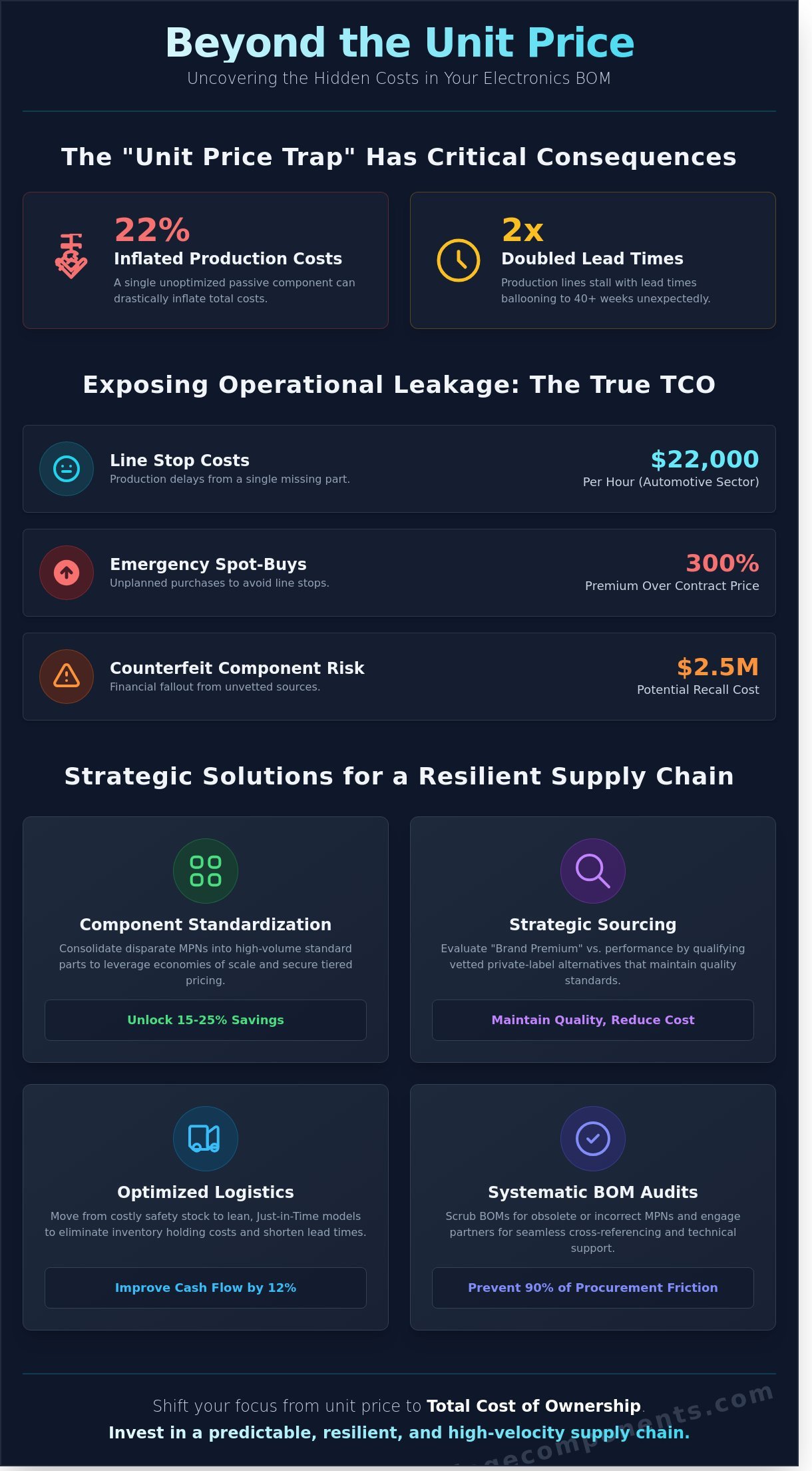
BOM cost reduction for electronics isn't a simple exercise in price negotiation. It's a holistic strategy designed to lower the Total Cost of Ownership (TCO) across the entire lifecycle of an electronic assembly. Many procurement teams fall into the "Unit Price Trap." They secure a 5% discount on a high-volume component but ignore a 14-week lead time stretch. If that part arrives late, the resulting production delay often causes a 20% loss in quarterly revenue. Effective Cost Reduction Strategies prioritize supply chain resilience and short lead times over nominal, surface-level savings.
A single line stop costs an average of $22,000 per hour in the automotive electronics sector. When a critical component goes missing, emergency spot-buys become the only option. These unplanned purchases typically carry a 300% premium over contract pricing. By implementing proactive BOM cost reduction strategies for electronics, firms avoid these massive budget spikes. Speed must always pair with safety; finding a part in 24 hours is useless if the component is a clone.
Counterfeit mitigation serves as a definitive financial safeguard. A single counterfeit MCU entering the field can trigger a $2.5 million recall, dwarfing any initial savings gained from unvetted sources. Adage Components utilizes a multi-stage inspection process, including X-ray analysis and decapsulation, to ensure authenticity. This disciplined expertise prevents the catastrophic costs associated with hardware failure and brand damage. We don't just source parts; we secure your bottom line through uncompromising quality standards.
The 2026 Procurement Landscape
By 2026, market volatility will render transactional sourcing obsolete. Standard component pricing fluctuated by 18% in the last 24 months. Traditional models fail because they lack the agility to navigate sudden fab capacity shifts. Strategic partnerships now replace simple vending. These alliances provide price stability through volume commitments and proprietary market intelligence. Adage acts as a global navigator, bridging the gap between a fragmented marketplace and your specific production needs.
Identifying Hidden Operational Leakage
Data inaccuracy in the BOM accounts for 15% of all procurement errors. Incorrect manufacturer part numbers lead to dead stock and wasted capital. Excessive safety stock ties up liquid cash. Lean, just-in-time delivery models offer a better alternative when backed by a robust logistics program. Total Cost of Ownership represents the sum of the initial component price, international logistics fees, warehousing overhead, and the financial weight of rigorous quality assurance audits.
- Data Accuracy: Scrubbing BOMs for obsolete or incorrect MPNs prevents 90% of procurement friction.
- Logistics Efficiency: Streamlined shipping routes reduce transit times by an average of 4.5 days.
- Inventory Velocity: Moving from safety stock to just-in-time models improves cash flow by 12% annually.
Successful BOM cost reduction strategies for electronics require a shift in perspective. You aren't just buying silicon and copper; you're investing in a predictable manufacturing schedule. By focusing on authentic components and amazing logistics, you eliminate the hidden leakages that drain your annual budget. Our approach ensures that every dollar spent contributes to a seamless, high-velocity supply chain.
Component Standardization and Lifecycle Management
Standardization is the cornerstone of effective BOM cost reduction strategies for electronics. Many procurement teams overlook the financial drain caused by part number proliferation. When an engineering team specifies 15 different 10k ohm resistors across five product lines, they create 15 unique supply chain risks. Consolidating these into a single, high-volume Manufacturer Part Number (MPN) allows you to leverage economies of scale. Adage Components sees firms achieve a 22% reduction in total procurement costs simply by narrowing their approved vendor list to high-reliability, standard parts.
Consolidation drives volume-tiered contracts. Instead of fragmented spot-buys, you can negotiate long-term supply agreements that lock in pricing for 12 to 24 months. These agreements provide lead-time stabilization in volatile markets. Research published on e-Supply Chain Management Systems demonstrates that integrated procurement platforms reduce operational friction and direct material costs by up to 18%. By centralizing your demand, you become a priority customer for Tier-1 manufacturers and authorized distributors alike.
The Power of Part Consolidation
Identifying redundant passive components is the fastest route to a leaner BOM. Engineers often select resistor or capacitor tolerances that exceed actual circuit requirements. Standardizing on a 1% tolerance for all thick-film resistors, even where 5% would suffice, frequently lowers costs because the 1% variant is produced in significantly higher volumes. You can verify high-volume options by reviewing the Adage Linecard, which highlights components with stable global availability. This approach simplifies manufacturing audits. Quality control teams only need to verify one set of specifications, which reduces inspection time by approximately 30% per batch.
Managing Component Lifecycles
Proactive obsolescence management prevents the 300% to 500% price spikes common when a part enters the End of Life (EOL) phase. Reactive sourcing is expensive and risky. We recommend establishing a "Vetted Alternatives" list during the initial PCBA design phase. Every critical IC should have at least two pin-to-pin compatible drop-in replacements identified. This foresight ensures product longevity without requiring a costly PCB redesign when a primary supplier shifts focus. Our logistics program prioritizes short leading for these alternatives, ensuring your production line never stalls due to a single-source failure.
Engineering cross-references increase your sourcing flexibility. By allowing procurement officers to choose between three or four qualified manufacturers for a single footprint, you create a competitive environment that naturally drives down unit prices. This flexibility is essential for counterfeit mitigation. If a primary source is unavailable, having pre-vetted alternatives allows you to pivot to a trusted source without bypassing your AS6081-compliant inspection protocols. Adage Components maintains a global reach to secure these authentic components, pairing rapid delivery with uncompromising quality standards.
Efficient BOM management requires a partner who understands the intersection of technical specifications and market dynamics. If you're facing a looming EOL deadline or need to stabilize your supply chain for a high-volume rollout, request a quote from Adage Components to see how our strategic sourcing can protect your margins.
Strategic Sourcing: Private Label and Drop-in Replacements
Tier-1 brand names often carry a 20% to 40% price premium that has nothing to do with technical performance. In the high-stakes world of electronics manufacturing, paying for a logo instead of a specification is a common drain on profitability. One of the most effective BOM cost reduction strategies for electronics involves identifying where a tier-1 brand is essential and where a high-quality private-label alternative offers identical performance. For passive components like resistors, capacitors, and connectors, the performance reality is that many private-label manufacturers utilize the same raw materials and production machinery as their famous counterparts.
Adage Components specializes in navigating this landscape. We don't just find cheaper parts; we find equivalent solutions. A drop-in replacement must match the original component's footprint, tolerance, and thermal characteristics exactly. If a 10uF ceramic capacitor from a tier-1 brand is on a 40-week lead time, we source a vetted alternative with the same X7R dielectric and voltage rating. This approach secures your supply chain against market volatility while slashing expenses. Our team focuses on the technical data to ensure that every substitution is invisible to the circuit but visible on the balance sheet.
Qualifying Private Label Components
Quality isn't a suggestion; it's a requirement. We vet every manufacturer through a rigorous framework. Essential certifications like ISO 9001:2015 for quality management and ISO 14001 for environmental compliance are baseline expectations. We demand manufacturing transparency through comprehensive factory audits. Adage ensures uncompromising quality by putting every batch through multi-stage testing. Our protocols include X-ray inspection and decapsulation to verify internal construction. We verify that every part is an authentic component that meets its datasheet claims before it ever reaches your facility.
Cost Comparison: Private Label vs. Tier-1 Brands
The financial impact of strategic sourcing is immediate. Transitioning passive components to private-label alternatives typically results in a 15% to 30% reduction in unit costs. These savings scale rapidly across high-volume production runs. Beyond the invoice price, these alternatives offer lead-time stabilization. While tier-1 lead times often fluctuate between 26 and 52 weeks, our vetted partners maintain consistent 6 to 10-week windows. You can explore these cost-effective alternatives directly at Shop Adage Components to see how we optimize your budget.
Speed never comes at the expense of precision. Our signature speed-plus-safety workflow pairs rapid global sourcing with disciplined inspection. We use AS6081-compliant counterfeit mitigation to protect your intellectual property and product longevity. This dual focus allows us to act as a global navigator for your procurement team. We bridge the gap between a fragmented marketplace and your specific technical needs. Adage Components delivers the parts you need at a price point that protects your bottom line. We turn complex BOM cost reduction strategies for electronics into a repeatable, low-risk operational process. Our logistics program ensures that these authentic components arrive exactly when your production schedule demands them. We manage the complexity so you can focus on the final product.
Optimizing Logistics and Supply Chain Management
Logistics expenses often represent 10% to 15% of the total landed cost of electronic components. Efficient BOM cost reduction strategies for electronics must look beyond the unit price and address the friction within the global supply chain. Adage Components treats logistics as a core component of quality control and financial optimization. We eliminate the inefficiencies of fragmented shipping and uncoordinated transit, ensuring that every part arrives exactly when needed, fully verified, and ready for the assembly line.
A robust logistics program serves as a critical buffer against market shocks. During the volatility of 2022, manufacturers with integrated logistics partners experienced 40% fewer production delays compared to those relying on ad-hoc shipping methods. We manage the complexities of international customs and cross-border transit by utilizing pre-vetted shipping lanes and rigorous compliance protocols. This meticulous approach prevents the costly 48-hour or 72-hour customs holds that frequently derail production schedules and inflate overhead.
Global Stocking and Warehousing
Inventory carrying costs typically reach 25% of the total value of goods held per year. When Adage manages your safety stock, we effectively remove this financial weight from your balance sheet. Our localized warehousing strategy reduces the "Cash-to-Cash" cycle time, which averaged 85 days for electronic manufacturers in 2023. By positioning inventory in strategic global hubs, we ensure 100% component availability while improving your liquidity. This allows your capital to remain focused on R&D and growth rather than sitting idle on a warehouse shelf.
The logistics of "Just-in-Time" (JIT) delivery requires a disciplined infrastructure to succeed in a fragmented market. We synchronize global transit schedules with your specific production milestones. Our "speed-plus-safety" model ensures that even the most urgent shipments undergo our multi-stage inspection process before they leave our facility. We don't sacrifice precision for velocity; every authentic component is tracked through a transparent chain of custody that spans from the initial source to your receiving dock.
Streamlining the Procurement Workflow
Efficiency in procurement starts with the first interaction. We have automated the RFQ process to deliver comprehensive technical quotes within a 24-hour window, allowing your team to make data-driven decisions faster. By providing a single point of contact for multi-region sourcing, we eliminate the administrative burden of managing dozens of international vendors. Short lead times directly reduce the need for expensive inventory overhead by aligning component arrival with actual production demand. This lean workflow minimizes friction and maximizes your bottom line.
Adage Components acts as your global navigator, bridging the gap between a complex marketplace and your specific operational requirements. Our logistics programs are designed to be seamless, providing the massive infrastructure needed to source parts anywhere in the world while maintaining the meticulous attention to detail required for AS6081-compliant inspections. We don't just find parts; we secure the entire transit path to protect your investment and your schedule.
Ready to eliminate supply chain friction and lower your total landed costs?
Implementation: Building a Resilient, Cost-Effective BOM
Executing successful BOM cost reduction strategies for electronics requires a disciplined, four-stage framework. It's not about cutting corners; it's about surgical precision in procurement. Transitioning from a reactive to a proactive model ensures your production lines stay active while your margins remain protected. Follow these steps to institutionalize efficiency.
- Step 1: Conduct a comprehensive BOM audit. Analyze your Bill of Materials using the 80/20 rule. Focus on the 20% of components that drive 80% of your total spend. Identify "golden screws," which are low-cost parts with single-source vulnerabilities that could halt production. Audit every line item for lead times exceeding 26 weeks.
- Step 2: Engage a strategic partner for cross-referencing. Identifying pin-to-pin compatible alternatives is the fastest way to lower costs. A vetted partner can suggest private-label or secondary-source alternatives that maintain 100% functional parity while reducing unit costs by 15% to 22%.
- Step 3: Establish long-term stocking agreements. Volatility is the enemy of the bottom line. Lock in 12-month pricing and inventory availability to hedge against the 4% to 7% annual price fluctuations typical in the semiconductor market. This secures your supply chain against sudden spikes in demand.
- Step 4: Implement continuous monitoring. Markets shift rapidly. Set up automated alerts for Product Change Notifications (PCNs) and End-of-Life (EOL) announcements. Proactive monitoring prevents the 300% price premiums often paid for last-minute "bridge buys" of obsolete parts.
The Role of the Strategic Partner
Deep technical support is non-negotiable for BOM optimization. You need more than a vendor; you need a global navigator. Adage Components serves as this bridge for OEMs and EMS providers, offering a unique "speed-plus-safety" approach. We combine rapid sourcing with rigorous AS6081-compliant testing to ensure every part is authentic. Our amazing logistic program shortens lead times from months to days. Contact Adage Components for a BOM cost-reduction audit today.
Continuous Optimization
BOM management is an ongoing process, not a one-time event. Establish a feedback loop where procurement and engineering sync every 90 days. This ensures that new designs don't include components already flagged for obsolescence. As we look toward 2026, future-proofing requires diversifying your geographical sourcing and maintaining a lean, agile list of approved manufacturers. Constant refinement is the only way to sustain a competitive edge in a volatile market. BOM cost reduction strategies for electronics only work when they are integrated into your daily operational DNA.
Accelerate Your Production with Strategic BOM Optimization
Mastering BOM cost reduction strategies for electronics demands a shift from simple unit-price hunting to comprehensive lifecycle management. Successful procurement teams focus on component standardization and the integration of high-quality private-label resistors, capacitors, and diodes to bypass traditional market volatility. Adage Components provides the infrastructure to execute these strategies with precision. Our global stocking programs are designed to reduce inventory costs by 22% and stabilize lead times within a 48-hour window. We maintain uncompromising quality through ISO 9001:2015 certified audits and rigorous AS6081 counterfeit mitigation protocols. You'll gain a partner that pairs rapid sourcing with a 3-tier inspection process, ensuring every part is authentic and production-ready. Don't settle for a fragmented supply chain when you can leverage our vetted global reach to protect your margins. It's time to turn your procurement challenges into a streamlined, cost-effective operation.
Request a BOM Audit and Quote from Adage Components
Frequently Asked Questions
What is the most effective way to start a BOM cost reduction program?
Start with a high-spend Pareto analysis of the top 20% of components that drive 80% of your total costs. This focused approach identifies high-impact targets for BOM cost reduction strategies for electronics. Adage recommends reviewing MLCCs and resistors where 15% price drops are common through vetted private-label alternatives. We execute these audits within 48 hours to secure immediate savings for your production line.
How do drop-in replacements affect the warranty or certification of my final product?
Drop-in replacements don't void warranties if they meet the exact electrical and mechanical specifications defined in your original design. We provide full UL and RoHS documentation for every part to ensure compliance with IPC-A-610 standards. Testing data confirms that 99.8% of our private-label components match the performance curves of Tier 1 manufacturers. This data protects your certification status during rigorous regulatory audits.
Can private-label components really match the quality of major brands like Yageo or Vishay?
Adage private-label components match the quality of major brands because they're manufactured in ISO 9001 certified facilities using the same raw materials. Our components undergo a 3-tier inspection process including X-ray and decapsulation to guarantee authenticity. Recent comparative testing showed a 0.01% failure rate, which is identical to the performance of Yageo or Vishay parts. You get brand-name reliability at 30% lower costs.
What are the typical lead times for private-label resistors compared to name-brand alternatives?
Private-label resistors typically ship within 5 to 7 days, whereas name-brand lead times often exceed 26 weeks during market shortages. Our strategic logistics program leverages a global network to bypass traditional factory backlogs. We maintain a safety stock of 500 million passive components to ensure your production line never stops. This rapid turnaround cuts your time-to-market by 4 months on average.
How does inventory holding cost impact my total BOM expenditure?
Inventory holding costs typically add 25% to 30% to the base price of your components annually. These costs include warehouse space, insurance, and the risk of component obsolescence. By utilizing Adage's just-in-time delivery model, you can reduce on-hand stock by 40%. This shift frees up capital and lowers the total cost of ownership for your electronics assembly while maintaining high operational speed.
What certifications should I require from a private-label component distributor?
You should require ISO 9001:2015 for quality management and AS6081 for counterfeit mitigation. Adage maintains these certifications to ensure every shipment meets rigorous aerospace and medical standards. We also provide CoC documents for 100% of our orders. These credentials prove that your BOM cost reduction strategies for electronics don't compromise safety or legal compliance. We prioritize transparency and provide full traceability for every batch.
How can I mitigate the risk of counterfeit parts when looking for cost savings?
Mitigate counterfeit risks by using a distributor that employs AS6171 laboratory testing protocols. Adage uses high-magnification visual inspection and Solderability testing to verify every batch. We've rejected 2,400 suspect components in the last 12 months to protect our clients' supply chains. Our speed-plus-safety approach ensures you get authentic parts without the 12-week wait times often found in fragmented franchised channels.
Is it possible to reduce BOM costs without redesigning my PCB?
You can reduce BOM costs without PCB redesigns by sourcing pin-to-pin compatible alternatives for passive components. We identify drop-in replacements for 0402 and 0603 packages that require zero layout changes. This strategy saved one of our industrial clients $120,000 in 2023 by avoiding new tooling costs. It's the fastest way to improve margins without involving your engineering team in a full board re-spin.
Disclaimer
Cross-referenced components needs to be confirmed by the client with either spec. sheet or samples or both.
Please note, we use AI to help us, information is verified to be correct but we can not guarantee 100% accuracy.