

Selecting a diode based solely on its peak inverse voltage is the fastest way to compromise a high-stakes 2026 product launch. As the global diode market expands toward $19.24 billion this year, the margin for error in component selection has effectively vanished. Having diode datasheet parameters explained with absolute precision is no longer just an engineering preference; it's a strategic procurement necessity to avoid the thermal failures and supply chain bottlenecks that derail production schedules.
We recognize the challenge of deciphering inconsistent terminology from Tier 1 distributors or finding reliable drop-in replacements that don't sacrifice quality for cost. Adage Components acts as your steady partner, providing the technical depth required to bridge the gap between rigorous electrical requirements and the need for OEM pricing. By mastering critical specifications like forward voltage, reverse recovery time, and thermal impedance, you can optimize circuit performance while significantly reducing material costs.
This guide provides a disciplined analysis of the parameters that define modern semiconductor reliability, including the new JEP203 short-circuit guidelines and the EN IEC 60749-26:2026 ESD testing standards. You'll gain the expertise to compare manufacturers and align your MRP system with the July 1, 2026 RoHS updates. We're here to ensure your sourcing strategy is as precise as your engineering, leveraging our ISO-certified infrastructure to deliver authentic, high-performance components on time.
Key Takeaways
- Analyze how Forward Voltage (Vf) dictates power dissipation and why matching current ratings to the safe operating area is vital for long-term component reliability.
- Learn to calculate critical safety margins for Peak Inverse Voltage (PIV) to prevent semiconductor failure in high-voltage industrial environments.
- Evaluate the technical trade-offs between Reverse Recovery Time (Trr) and forward voltage drop to optimize efficiency in high-frequency SMPS designs.
- Use our diode datasheet parameters explained to differentiate between Schottky and Zener architectures, ensuring you select the correct transient protection or regulation specs.
- Leverage datasheet insights to identify drop-in replacements for Tier 1 distributors, securing OEM pricing and manufacturer-direct reliability for your BOM.
Decoding the Essentials: Forward Voltage and Current Ratings
Efficiency in high-density OEM designs begins with a granular understanding of forward voltage. When current flows through a semiconductor, a portion of the energy is lost as heat, a loss directly proportional to the Vf value. For procurement officers and engineers, having diode datasheet parameters explained with a focus on power dissipation is essential to prevent system overheating. Selecting a diode with a lower Vf, such as a Schottky variant, can significantly enhance battery life in portable electronics or reduce cooling requirements in industrial power supplies. To understand the foundational mechanics of these components, consult this Semiconductor Diode Overview.
To better understand this concept, watch this helpful video:
Forward Voltage (Vf): The Efficiency Benchmark
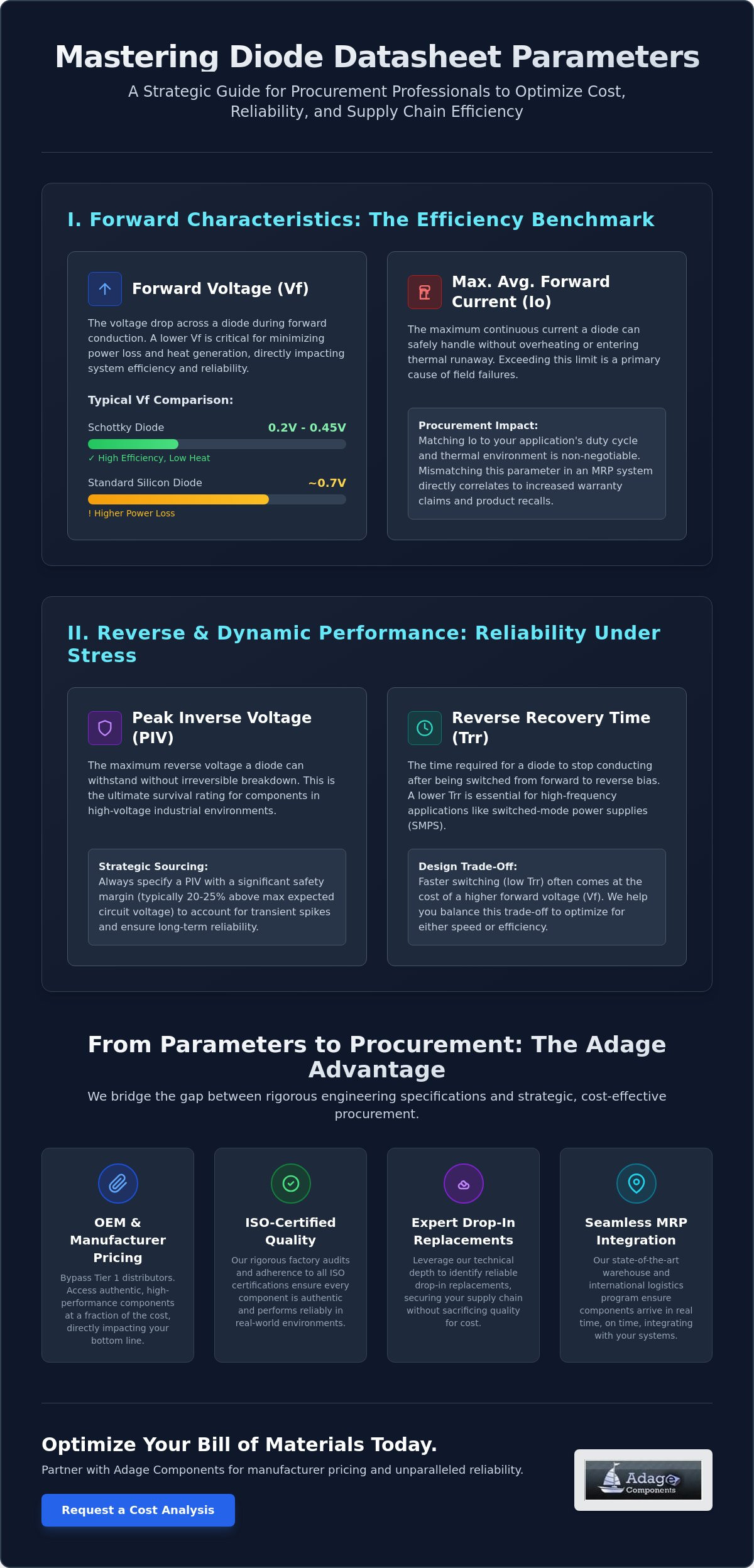
Vf is the potential difference across a diode when current flows in the forward direction. Most standard silicon diodes exhibit a Vf around 0.7V, while Schottky diodes often range between 0.2V and 0.45V. We ensure our technical support team helps you match these specs to your specific application needs. This allows you to secure manufacturer pricing without over-specifying. Adage Components sources from vetted manufacturers to guarantee that Vf remains stable even under pulsed current conditions. This protects your design from unexpected voltage drops that can occur in volatile industrial environments.
Maximum Average Forward Current (Io)
The Maximum Average Forward Current (Io) defines the upper limit of what a diode can handle without entering thermal runaway. This parameter is inseparable from the diode's safe operating area. If your MRP system flags a high failure rate in the field, the culprit is often a mismatched Io rating during high duty cycles. High temperatures in a state-of-the-art warehouse or factory floor can shift the temperature coefficient, causing Vf to drop and current to rise dangerously.
We take quality assurance seriously. Adage Components verifies Io ratings through rigorous factory audits and strict adherence to ISO certifications. This meticulous attention to detail ensures that the commercial and automotive grade components we supply perform reliably in real-world environments. By moving away from Tier 1 distributors and partnering directly with Adage, you gain access to the same high-performance specifications at a fraction of the cost. To streamline your procurement, you can submit your requirements via our BOM submission form. This allows our team to perform a comprehensive cost analysis while ensuring every part meets your thermal and electrical benchmarks. Efficiency isn't just about the component; it's about the logistics and pricing structures that support your production.
Managing Reverse Conditions: PIV and Leakage Current
Reverse bias conditions represent the most significant electrical stress a semiconductor faces. While forward voltage determines power efficiency, Peak Inverse Voltage (PIV) determines the component's survival. If a circuit exceeds this limit, the diode enters a state of irreversible breakdown. Having diode datasheet parameters explained from a risk-mitigation perspective is critical for procurement professionals managing high-voltage industrial BOMs. To master these specifications, engineers must look beyond nominal values and account for transient spikes that can occur in volatile power grids. You can find a detailed breakdown of these diode electrical ratings to better understand the physics of reverse bias.
Peak Inverse Voltage (PIV) and Reverse Breakdown
PIV is the breaking point. In AC rectification, the maximum repetitive reverse voltage (Vrrm) is the standard metric for selection. We recommend a 20-30% safety buffer for PIV in OEM designs to account for inductive kickback and line surges. It is vital to distinguish between PIV and the Reverse Breakdown Voltage, V(BR)R. PIV is the manufacturer's rated safe operating limit, whereas V(BR)R is the actual voltage where avalanche breakdown begins. Rectifier diodes are designed to block current entirely until this point, but Zener diodes are engineered to operate safely within the avalanche region for voltage regulation. Our state-of-the-art warehouse ensures that every batch of rectifier and Zener diodes meets these precise breakdown thresholds through rigorous multi-stage testing.
Reverse Leakage Current (Ir) and Thermal Stability
Reverse Leakage Current (Ir) is often overlooked, yet it represents a hidden cost in battery-powered devices. No diode is a perfect insulator; a small amount of current always flows in reverse. This leakage is highly temperature-dependent. A datasheet might show a negligible Ir at 25°C, but that value can increase by several orders of magnitude at 125°C. In high-density PCB layouts, this cumulative heat can lead to thermal runaway, where increased temperature causes more leakage, which in turn generates more heat.
Adage Components solves this logistical and engineering challenge by sourcing authentic components from vetted manufacturers that prioritize low-leakage architectures. We provide drop-in replacements for Tier 1 distributors that offer superior thermal stability at OEM pricing. This allows you to maintain high quality standards while significantly reducing material costs. To ensure your designs utilize components with optimized leakage specs, you can view our comprehensive linecard for high-performance alternatives. Our international logistics program ensures these parts arrive at your facility in real time, on time, fully compliant with all ISO certifications.
Dynamic Performance: Switching Speed and Thermal Impedance
Dynamic efficiency is the primary differentiator in high-frequency Switch Mode Power Supplies (SMPS). While basic guides list specifications, having diode datasheet parameters explained through the lens of dynamic performance is what separates a reliable industrial design from a frequent failure point. In high-speed switching environments, the transition from a conducting state to a non-conducting state isn't instantaneous. This delay generates switching losses that can exceed conduction losses, directly impacting the thermal profile of your PCB. Adage Components provides the technical support necessary to navigate these trade-offs, ensuring your MRP system isn't disrupted by thermal-related field failures.
Reverse Recovery Time (Trr) and Switching Losses
The physics of charge storage dictates how quickly a diode can turn off. When a diode is forward-biased, minority carriers accumulate in the junction. Trr is the time taken for the reverse current to cease after the forward current is switched off. During this interval, the diode briefly conducts in the reverse direction, creating a spike in power dissipation.
Engineers must balance switching speed against forward voltage drop. Ultra-fast recovery diodes reduce switching losses but often exhibit a higher Vf. Schottky diodes are the preferred solution for high-speed DC-DC converters because they lack minority carrier storage, resulting in near-zero recovery times. We source these high-performance components from vetted manufacturers, offering you OEM pricing that Tier 1 distributors often can't match. This strategic sourcing allows you to maintain peak efficiency without inflating your BOM costs.
Junction-to-Ambient Thermal Resistance (RθJA)
Predicting the junction temperature ($T_j$) is vital for long-term reliability in state-of-the-art warehouses and industrial facilities. Thermal resistance, specifically RθJA, quantifies how effectively heat moves from the semiconductor die to the surrounding air. You can calculate the maximum allowable power dissipation by understanding the delta between the junction and ambient temperatures.
- RθJA (Junction-to-Ambient): The total thermal resistance path, highly dependent on PCB layout.
- Copper Pad Size: For SMD diodes, larger copper pads act as essential heat sinks to lower the effective RθJA.
- Verification: Adage Components ensures all thermal data is verified through rigorous testing, maintaining full compliance with ISO certifications.
Interpreting Parameters Across Different Diode Architectures
Effective component selection requires more than matching basic voltage and current specs. Different diode architectures prioritize specific performance metrics, and having diode datasheet parameters explained across these categories is vital for optimizing your BOM. While a rectifier diode might focus on robustness, a switching diode prioritizes signal integrity. We provide the technical expertise to help you navigate these architectural distinctions. This ensures you don't over-specify and inflate costs when a more efficient alternative exists within our vetted supply chain.
Schottky vs. Standard Rectifiers: A Procurement Perspective
Schottky diodes are indispensable for DC-DC converters because they offer ultra-fast switching and a low forward voltage drop. However, they typically exhibit higher reverse leakage current (Ir) than standard rectifiers. For power entry stages where robustness is paramount and switching speed is secondary, a standard rectifier remains the most cost-effective choice. Adage Components offers manufacturer pricing for both commercial and automotive grade components, allowing you to choose the right performance level without the Tier 1 distributor markup. We also analyze the impact of junction capacitance (Cj) on signal diodes, as high capacitance can degrade signal integrity in high-frequency applications. Our amazing international logistics program ensures these authentic parts arrive at your facility in real time, on time.
Zener Diode Specifications (Vz, Izt, Zzt)
Zener diodes serve a specialized role in voltage regulation and surge protection. The primary parameter is the Zener voltage (Vz), which is measured at a specific test current (Izt). When sourcing Zeners, precision is a major cost driver; choosing 1% tolerance over 5% might be necessary for sensitive reference circuits but unnecessary for general protection. Another critical spec is dynamic impedance (Zzt). A lower Zzt indicates a more stable voltage across varying currents. We source Zeners from partner suppliers to ensure they act as reliable drop-in replacements for Tier 1 brands. This allows you to maintain strict quality standards while achieving the best cost in the industry. Every component undergoes rigorous testing in our state-of-the-art warehouse to guarantee compliance with all ISO certifications.
We act as a strategic partner to help you integrate these specialized components into your existing MRP system seamlessly. By understanding the nuances of each architecture, you can reduce material costs without sacrificing the reliability of your final product. To explore our full range of high-performance semiconductors and find the ideal match for your technical requirements, view our comprehensive linecard for immediate operational engagement.
From Parameters to Procurement: Optimizing Your BOM with Adage
Technical mastery of semiconductor specifications provides a distinct competitive advantage in industrial procurement. Having diode datasheet parameters explained allows your team to look past the brand names of Tier 1 distributors and evaluate components based on their actual performance characteristics. Adage Components functions as an elite partner, translating these technical requirements into significant material cost savings through our private label manufacturing model. We offer the same high-performance specifications you expect from franchised distributors but at OEM pricing that directly improves your bottom line. Our goal is to serve as a bridge between your complex engineering needs and a fragmented global marketplace.
Strategic Sourcing and BOM Cost Analysis
Qualifying Adage Components as a secondary source for standard industry parts mitigates the risk of supply chain volatility. Our engineers analyze your technical requirements to identify drop-in replacements that match or exceed original specifications for forward voltage, switching speed, and thermal impedance. This proactive approach reduces lead times and prevents production halts. Our BOM submission form streamlines the quoting process, allowing our specialists to perform a comprehensive cost analysis in hours, not weeks. We pair this efficiency with an amazing international logistics program designed to support global OEMs. This ensures components reach your facility in real time, on time, according to your specific production schedule.
Quality Assurance and Industry Compliance
Reliability is non-negotiable when sourcing commercial and automotive grade components. We maintain strict compliance with all ISO certifications and source exclusively from vetted manufacturers and partner suppliers. Every component that enters our state-of-the-art warehouse undergoes a multi-stage inspection and manufacturing audit process to ensure authenticity. This rigorous emphasis on quality eliminates the risks associated with the fragmented open marketplace. The Adage guarantee ensures that every diode meets the precise parameters defined in its datasheet. We don't just supply parts; we provide the composed confidence required to manage a high-stakes supply chain.
We invite you to initiate a contact inquiry to discuss your specific technical requirements and experience a seamless integration with your existing MRP system. Our disciplined expertise and technologically advanced infrastructure allow us to solve your most difficult sourcing puzzles while maintaining the best cost in the industry. Let us show you how a strategic partnership can transform your procurement process into a driver of operational excellence.
Securing Your 2026 Supply Chain with Technical Precision
Mastering the technical nuances of semiconductors is the only way to insulate your production from market volatility. We've seen how having diode datasheet parameters explained through the lens of power dissipation and thermal impedance allows engineers to optimize performance while procurement officers secure the best cost in the industry. By prioritizing precise specifications like reverse recovery time and leakage current, you ensure that your design remains robust against the tightening RoHS regulations and updated JEDEC standards of 2026.
Adage Components stands ready as your strategic partner, offering ISO 9001 certified quality management and direct manufacturer pricing for OEMs. Our global stocking programs and state-of-the-art warehouse operations are designed to eliminate the long lead times often associated with Tier 1 distributors. We provide authentic, high-performance components that integrate seamlessly with your existing MRP system, delivered in real time, on time. It's time to move beyond the constraints of traditional sourcing models and embrace the efficiency of a manufacturer-direct partnership.
Submit your BOM for a cost-savings analysis today and discover how our specialized logistics program can streamline your next build. We look forward to optimizing your bill of materials and helping you achieve unprecedented operational excellence.
Frequently Asked Questions
What is the most important parameter in a diode datasheet for power efficiency?
Forward Voltage (Vf) is the primary determinant of power efficiency because it dictates how much energy is lost as heat during conduction. In high-density designs, minimizing this parameter is vital for thermal management and battery longevity. We provide diode datasheet parameters explained with a focus on matching these specs to your specific power budget. Adage Components ensures all Vf ratings are verified through rigorous testing in our state-of-the-art warehouse to guarantee peak performance.
How do I determine if a diode is a suitable drop-in replacement for another brand?
To determine suitability, you must compare the electrical, thermal, and mechanical specifications against the original part. Key metrics include forward voltage, peak inverse voltage, and reverse recovery time. We specialize in identifying drop-in replacements that offer manufacturer pricing without compromising quality. By qualifying Adage Components as a partner, you can maintain your MRP system's stability while bypassing the high markups typical of Tier 1 distributors.
What is the difference between Peak Inverse Voltage (PIV) and Breakdown Voltage?
Peak Inverse Voltage (PIV) is the maximum reverse voltage a manufacturer guarantees the device can withstand safely. Breakdown Voltage is the actual physical point where the diode begins to conduct in reverse, often leading to component failure. Adage Components recommends a 20% safety margin for PIV in industrial designs. We source only authentic parts from vetted manufacturers to ensure these thresholds meet strict ISO certifications and high reliability standards.
Why does the forward voltage (Vf) change with temperature?
Forward voltage decreases as junction temperature rises due to the negative temperature coefficient of semiconductor materials. This thermal sensitivity can lead to thermal runaway if not properly managed in high-power applications. We offer technical support for both commercial and automotive grade components to help you account for these shifts. Our amazing international logistics program ensures you receive thermally stable parts that arrive at your facility real time, on time.
What is Reverse Recovery Time (Trr) and why does it matter in switching power supplies?
Reverse Recovery Time (Trr) is the duration required for a diode to stop conducting after switching from forward to reverse bias. In high-frequency switching power supplies, a long Trr causes significant switching losses and excessive heat generation. Adage Components provides Schottky and fast-recovery diodes with optimized Trr to maximize circuit efficiency. Sourcing these through our partner suppliers allows you to secure OEM pricing while maintaining superior dynamic performance.
Can I use a commercial-grade diode in an automotive application if the specs match?
No, you shouldn't use commercial-grade diodes in automotive applications even if the basic electrical specs match. Automotive grade components must meet AEC-Q101 standards and handle wider temperature ranges and mechanical stress. Adage Components supports the automotive sector with qualified parts that undergo multi-stage inspection. Choosing our automotive grade solutions gives you the reliability of Tier 1 distributors with the bottom-line benefit of manufacturer pricing.
How does junction capacitance affect high-frequency diode performance?
Junction capacitance (Cj) acts as a parasitic element that limits the diode's maximum operating frequency. High capacitance slows down switching transitions and can degrade signal integrity in high-speed data or RF circuits. We help you navigate these diode datasheet parameters explained to select low-capacitance switching diodes for sensitive signal paths. Our state-of-the-art warehouse stocking programs ensure these specialized components are available with short lead times for global OEMs.
What are the benefits of sourcing private label diodes over Tier 1 franchised distributors?
Sourcing private label diodes from Adage Components provides the best cost in the industry by eliminating franchised distributor markups. You gain direct access to OEM pricing and shorter lead times through our amazing international logistics program. Unlike standard vendors, we act as a strategic partner, integrating with your MRP system to provide authentic, ISO-certified components. This approach reduces BOM costs while maintaining the highest levels of quality assurance.
Disclaimer
Cross-referenced components needs to be confirmed by the client with either spec. sheet or samples or both.
Please note, we use AI to help us, information is verified to be correct but we can not guarantee 100% accuracy.