

While the global photoresistor market is projected to reach USD 412.30 million by 2033, many industrial OEMs still lose significant margin to tier-1 distributor markups. You know that securing a reliable light dependent resistor for your light-sensing circuits often involves a frustrating trade-off between lead times and technical authenticity. It's a common challenge in high-stakes procurement where standard passives are frequently subject to volatile supply chains and unknown quality origins.
This guide provides the technical expertise you need to master LDR specifications while optimizing your BOM costs through strategic industrial procurement. We'll show you how to bypass traditional markups to secure manufacturer pricing and OEM pricing that rivals the largest distributors. You'll learn the critical benchmarks for AEC-Q200 Rev. E compliance and how to source from vetted manufacturers. We'll also preview how a state-of-the-art warehouse and international logistics program can deliver authentic components to your facility in real time. This is the blueprint for integrating high-quality sensors into your MRP system on time and under budget.
Key Takeaways
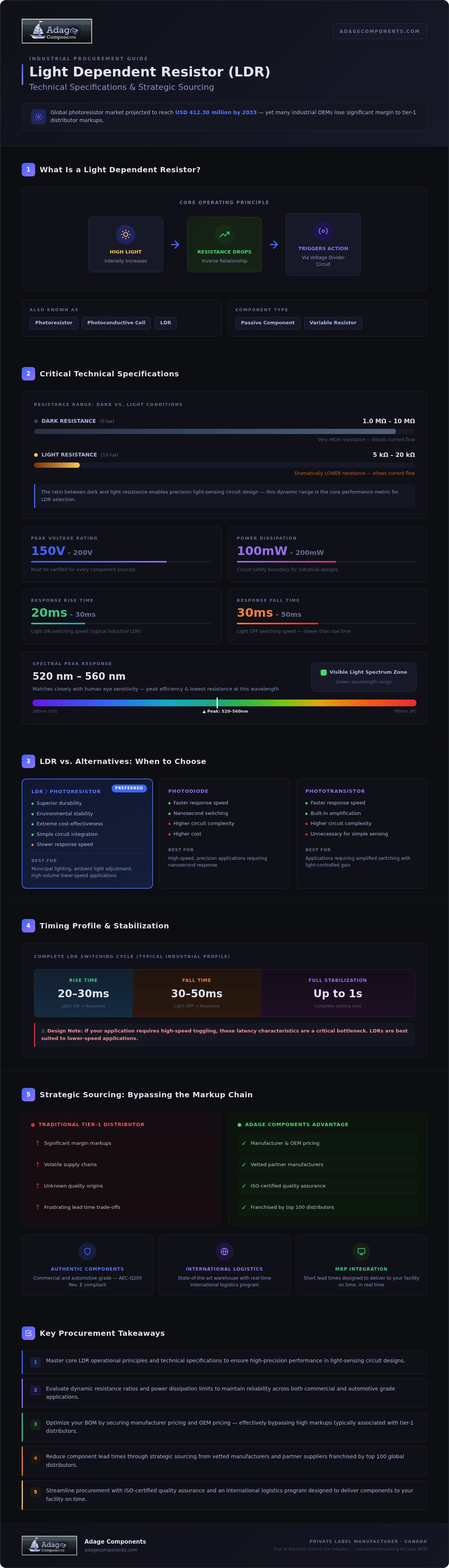
- Master the core operational principles and technical specifications of a light dependent resistor to ensure high-precision performance in your light-sensing circuit designs.
- Identify critical selection criteria, including dynamic resistance ratios and power dissipation limits, to maintain reliability in both commercial and automotive grade applications.
- Optimize your bill of materials by securing manufacturer pricing and OEM pricing, effectively bypassing the high markups typically associated with tier-1 distributors.
- Reduce component lead times through strategic sourcing from vetted manufacturers and partner suppliers franchised by top 100 global distributors.
- Streamline your procurement workflow with ISO-certified quality assurance and an international logistics program designed to deliver components to your facility on time.
Understanding Light Dependent Resistors in Industrial Design
A light dependent resistor (LDR) is a passive component that functions as a variable resistor controlled by incident light intensity. In industrial procurement circles, this device is frequently referred to as a photoresistor or a photoconductive cell. The operational mechanism is direct: as the intensity of light falling on the sensor surface increases, the resistance of the component decreases. This inverse relationship enables engineers to design efficient voltage divider circuits that trigger automated actions based on ambient light levels. Understanding the light-dependent resistor operating principles is a prerequisite for procurement teams tasked with sourcing reliable sensing solutions for high-volume production.
To better understand this concept, watch this helpful video:
Historically, cadmium sulphide (CdS) served as the primary semiconductor material for these sensors because of its high sensitivity in the visible light spectrum. Modern environmental standards have pushed for lead-free alternatives that maintain these performance benchmarks while ensuring compliance with global manufacturing regulations. Despite the emergence of complex digital sensors, LDRs remain a staple in industrial design due to their extreme cost-effectiveness. We leverage our network of vetted manufacturers to provide these components at OEM pricing. This allows you to get manufacturer pricing and optimize your BOM without the markups associated with traditional tier-1 distributors.
LDR vs. Photodiodes and Phototransistors
While photodiodes and phototransistors offer faster response speeds, they often introduce unnecessary circuit complexity and higher costs for applications that don't require nanosecond switching. LDRs are the preferred choice for high-volume, lower-speed applications like municipal lighting or simple ambient light adjustment. They offer superior durability and environmental stability in industrial settings. Sourcing these through our amazing international logistic program ensures that authentic components arrive at your facility in real time. This reliability makes them a perfect fit for your MRP system when balancing performance with budget constraints.
Spectral Response and Material Science
Selecting the right sensor requires matching the component's sensitivity to specific light wavelengths. Most industrial photoresistors exhibit a spectral peak response between 520 nm and 560 nm, which aligns closely with human eye sensitivity. A spectral peak represents the specific wavelength where the sensor achieves its maximum efficiency and lowest resistance. Ambient temperature also influences resistance stability; fluctuations in extreme environments make it critical to select commercial and automotive grade components that have passed rigorous manufacturing audits. Our state-of-the-art warehouse maintains the inventory precision needed to support these technical requirements for your light dependent resistor needs.
Technical Selection Criteria for Industrial LDRs
Securing a light dependent resistor for high-stakes industrial applications requires more than a glance at a basic datasheet. You must establish the dynamic range by evaluating light resistance against dark resistance. Standard industrial units typically exhibit a dark resistance rating of 1.0 MΩ to 10 MΩ at 0 lux, which drops to between 5 kΩ and 20 kΩ under 10 lux of illumination. This modulation is rooted in photoconductive cell technology, where photon absorption directly reduces electrical resistance. For circuit safety, we verify that every component meets peak voltage ratings up to 150V or 200V and maintains power dissipation boundaries between 100 mW and 200 mW.
Switching frequency is another critical bottleneck. Typical industrial LDR switching profiles exhibit a dynamic rise time of 20 ms to 30 ms and a fall time of 30 ms to 50 ms. Total stabilization can take up to a second. If your design requires high-speed toggling, these latency periods must be factored into your logic timing. Reliability also depends on tolerance and repeatability across large manufacturing batches. We mitigate variation by sourcing only from vetted manufacturers, ensuring that the components you integrate into your system perform consistently from the first unit to the last.
Critical Parameters for Design Engineers
Design precision relies on the gamma characteristic, which defines the slope of the resistance-illuminance curve. A consistent gamma ensures that your software calibration remains accurate across different light levels. You should also align the sensor's peak wavelength, typically centered at 540 nm to 550 nm, with your specific light source. For harsh environments, we support both commercial and automotive grade components. Automotive applications require adherence to AEC-Q200 Rev. E standards to ensure moisture resistance and thermal endurance during high-temperature operation.
Environmental and Regulatory Compliance
Global market entry demands strict RoHS and REACH compliance. Beyond chemical safety, you must consider Moisture Sensitivity Levels (MSL) and specific storage requirements to prevent component degradation before assembly. We maintain an extensive linecard of passive components that meet these rigorous standards. Our ISO-certified manufacturing processes and growing state-of-the-art warehouse ensure that you receive authentic components with full lot traceability. By partnering with us, you get manufacturer pricing and the same advantages as buying from tier-1 distributors but at OEM pricing. This infrastructure is perfect for your MRP system, delivering components to your facility in real time and on time to prevent any production delays.
Industrial and Commercial Applications of LDR Technology
Industrial applications for the light dependent resistor extend far beyond simple hobbyist projects. While common DIY guides focus on basic night lamps, municipal energy management systems utilize these sensors for automated street lighting on a massive scale. By implementing photoresistor voltage divider circuits, cities can reduce electricity consumption by ensuring lights only activate when ambient levels fall below precise thresholds. In warehouse environments, LDRs serve as cost-effective components for light curtains and proximity detection, providing an essential layer of industrial safety without the high price tag of complex digital sensors.
Agricultural technology also relies on these devices for automated greenhouse monitoring. Maintaining optimal light levels for specific crops requires reliable, high-volume sensing. Because we source from vetted manufacturers and partner suppliers, we ensure these sensors meet the environmental durability required for humid greenhouse settings. You get manufacturer pricing on these components, allowing for large-scale deployments that remain budget-compliant. This efficiency is critical when your project requires thousands of sensors to maintain a consistent crop yield.
Smart Building and IoT Integration
Large-scale IoT deployments for smart buildings often utilize LDRs for daylight harvesting and occupancy sensing. These systems adjust internal lighting based on natural light availability, significantly lowering operational costs. Integrating these sensors into your MRP system is seamless when you partner with us. Our growing state-of-the-art warehouse and amazing international logistic program ensure that authentic components arrive at your facility in real time. We offer one of the best costs in the industry for high-volume IoT projects, providing the same advantages as buying from tier-1 distributors but at OEM pricing.
Automotive Grade Light Sensing
In the automotive sector, light dependent resistor technology is fundamental for automatic headlight activation and dashboard dimming. These applications require more than standard commercial parts; they demand automotive grade components that withstand extreme thermal cycles and vibrations. We provide sensors that meet rigorous quality standards, ensuring long-term reliability in the field. For a deeper look at how to secure these parts, consult our passive electronic components pillar. Our Canadian-based private label manufacturing infrastructure is designed to provide short leading times and ISO-certified quality for every automotive sensing application.
Strategic Sourcing: Mitigating Supply Chain Risks
Procurement teams face the challenge of short leading in a volatile electronic component market. Relying solely on a single tier-1 distributor often creates a critical bottleneck that stalls production and inflates costs. These traditional channels frequently suffer from extended lead times and significant price markups that erode your project margins. Transitioning to a private label manufacturer allows you to secure a stable supply of every light dependent resistor required for your production line without the unpredictability of retail-based supply chains.
We mitigate these risks by leveraging a network of vetted manufacturers and partner suppliers. Many of these entities are franchised by top 100 distributors, ensuring that you receive only authentic components. Every component we supply complies with all ISO certifications, providing a high-standard alternative to traditional distribution channels. We rarely mention speed without highlighting our multi-stage inspection protocols, creating a consistent link between rapid fulfillment and technical safety. By acting as a strategic bridge between the global marketplace and your facility, we provide the supply chain transparency necessary for high-stakes industrial and automotive grade production.
Reducing BOM Costs through Direct Procurement
Optimizing your bill of materials (BOM) starts with moving away from retail pricing structures. We enable you to get manufacturer pricing and provide the same advantages as buying from tier 1 distributors but at OEM pricing. Industry data indicates that switching to high-quality drop-in replacements for standard sensors can save between 20% and 40% on material costs. This financial advantage allows your organization to remain competitive in an environment of rising production expenses. You can view our Adage Linecard to cross-reference and identify the most cost-effective sensing solutions for your specific application requirements.
Logistics and Warehouse Integration
Efficiency in sourcing is meaningless without precise delivery. Our growing state-of-the-art warehouse is designed for high-velocity throughput, ensuring that your light dependent resistor inventory is managed with meticulous attention to detail. This infrastructure supports an amazing international logistic program that delivers components to your facility in real time and on time. Such integration is perfect for your MRP system, as it reduces local inventory overhead and eliminates the need for excessive safety stock. Our global stocking programs act as an extension of your own supply chain, providing the agility needed to respond to sudden shifts in market demand without compromising on quality or authenticity.
Adage Components: Your Partner for Industrial LDR Sourcing
Adage Components operates as a Canadian-based private label manufacturer specializing in industrial-grade passive components. We position ourselves as an elite partner for OEMs and procurement officers who require high-performance light dependent resistor solutions without the typical tier-1 markups. Our infrastructure allows us to provide manufacturer pricing and OEM pricing on a global scale. This means your facility gains the same advantages as buying from tier 1 distributors but at significantly reduced costs. We don't just supply parts; we provide deep technical support to help you find the perfect drop-in replacement for your existing designs. This ensures your production lines remain active while your material overhead decreases.
Quality Assurance and ISO Compliance
Reliability is non-negotiable in industrial and automotive sectors. We maintain a rigorous commitment to authentic components by sourcing exclusively from vetted manufacturers and partner suppliers. Many of our production partners are franchised by top 100 distributors, ensuring a secure and transparent supply chain. We support both commercial and automotive grade components, ensuring that every light dependent resistor meets the specific durability requirements of its application. All ISO certifications are strictly verified at the factory level through comprehensive manufacturing audits. This meticulous attention to detail eliminates the risks associated with unknown suppliers and ensures that every batch meets the highest industry standards for precision and longevity.
Streamlining Your Procurement Process
Efficiency in the supply chain is a critical resource. We've designed our operations to integrate seamlessly with your existing workflow. You can utilize our BOM submission form to receive a detailed cost analysis and identify immediate savings opportunities. Our custom stocking programs are built to be perfect for your MRP system, utilizing our growing state-of-the-art warehouse to manage inventory levels on your behalf. Through our amazing international logistic program, we ensure that products arrive at your facility in real time and on time. We are perpetually ready for immediate operational engagement. Contact Adage today for a transactional inquiry to secure one of the best costs in the industry for your next production cycle.
Optimize Your Industrial Light-Sensing Supply Chain
Mastering the technical specifications of the light dependent resistor is the first step toward reliable circuit design. Long-term operational success depends on pairing this engineering precision with a strategic procurement model that eliminates middleman markups. By moving toward a private label partner, you secure manufacturer pricing and OEM pricing that rivals the scale of tier-1 distributors. This shift allows you to maintain high-standard quality while bypassing the lead-time bottlenecks that often stall global production lines.
We provide the infrastructure required to scale your projects with composed confidence. Our network of vetted manufacturers, many franchised by top 100 distributors, ensures every component is authentic and ISO-compliant. With our Canadian-based logistics program and state-of-the-art warehouse, we deliver components to your facility in real time and on time. Integrating these logistical advantages into your MRP system is the most effective way to protect your margins in a volatile market.
Get Manufacturer Pricing on Industrial LDRs – Contact Adage Today to streamline your next production cycle with elite sourcing solutions. We are ready to help you solve your most difficult procurement puzzles.
Frequently Asked Questions
What is the typical response time of a light dependent resistor?
Industrial light dependent resistor units typically exhibit a dynamic rise time between 20 ms and 30 ms. The fall or recovery time is generally slower; ranging from 30 ms to 50 ms. Total stabilization can take up to a second or more. This latency makes them ideal for slow-switching applications like dusk-to-dawn sensors but less suitable for high-speed data transmission. We ensure our components meet these technical benchmarks through rigorous multi-stage inspection processes.
Are LDRs RoHS compliant for use in European markets?
Modern light dependent resistor components are available in RoHS-compliant versions for the European market. While traditional sensors used cadmium sulphide; we provide lead-free and cadmium-free alternatives that satisfy strict environmental regulations. Our vetted manufacturers undergo comprehensive audits to ensure all global compliance standards are met. This allows your facility to maintain regulatory integrity while benefiting from manufacturer pricing on high-volume industrial orders that rival tier-1 distributor advantages.
Can I use an LDR as a drop-in replacement for a photodiode?
An LDR cannot serve as a direct drop-in replacement for a photodiode due to fundamental differences in response speed and circuit configuration. Photodiodes operate on nanosecond scales and require different biasing; whereas LDRs are passive variable resistors with millisecond latencies. However; for applications where cost-efficiency is prioritized over speed; we provide technical support to help you evaluate if an LDR-based circuit redesign offers superior BOM cost optimization for your specific system.
What is the difference between cadmium sulphide and lead-free LDRs?
Cadmium sulphide (CdS) LDRs are the traditional industry standard due to their high sensitivity in the visible spectrum. Environmental regulations like RoHS have led to the development of lead-free and cadmium-free alternatives. These newer sensors utilize different semiconductor materials to achieve similar spectral peaks while ensuring global market entry compliance. We source both commercial and automotive grade components that meet these evolving material standards without compromising on technical reliability or performance.
How does temperature affect the resistance of an LDR in industrial settings?
Temperature significantly impacts the resistance stability of an LDR in industrial settings. Most units experience a linear thermal derating above 25°C ambient; which can shift the calibrated light-to-resistance ratio. To mitigate this; we supply components that have passed rigorous thermal shock and high-temperature operating life tests. Our state-of-the-art warehouse ensures that all inventory is stored under controlled conditions to maintain the integrity of these sensitive passive components before delivery.
What are the advantages of sourcing LDRs from a private label manufacturer?
Sourcing from a private label manufacturer like Adage Components provides one of the best costs in the industry. You get manufacturer pricing and OEM pricing that bypasses the high markups of tier-1 distributors. We act as a strategic partner; offering rigorous manufacturing audits and technical support for drop-in replacements. This model ensures you receive authentic components from partner suppliers franchised by top 100 distributors while maintaining ISO-certified quality control.
How can I reduce the lead time for high-volume LDR orders?
You can reduce lead times for high-volume orders by utilizing our amazing international logistic program and global stocking initiatives. We integrate directly with your MRP system to ensure components arrive at your facility in real time and on time. By maintaining a growing state-of-the-art warehouse; we eliminate the typical "short leading" bottlenecks found in fragmented marketplaces. This infrastructure allows us to find hard-to-get items quickly without sacrificing our multi-stage inspection protocols.
Do LDRs require specific quality certifications for automotive use?
Automotive use requires adherence to specific reliability standards like AEC-Q200 Rev. E for passive components and AEC-Q102 for optoelectronic devices. These standards mandate rigorous testing for moisture resistance; vibration; and gas corrosion. We ensure our automotive grade components meet these certifications through comprehensive factory audits. By partnering with us; you secure the same technical advantages as buying from major distributors but with the pricing benefits of a direct manufacturer.
Disclaimer
Cross-referenced components needs to be confirmed by the client with either spec. sheet or samples or both.
Please note, we use AI to help us, information is verified to be correct but we can not guarantee 100% accuracy.


