

A single multilayer ceramic capacitor can stall a million-dollar production line if your tier-1 supplier suddenly quotes a 40-week lead time. In the current market, high-capacitance and automotive-grade MLCCs are facing structural allocation, with some lead times stretching toward 10 months. You're likely managing the stress of these volatile timelines while trying to dodge the hidden costs and counterfeit risks found in traditional distribution. We recognize that industrial procurement isn't just about finding parts; it's about securing a reliable, high-standard alternative that protects your bottom line.
This guide provides the technical expertise needed to master MLCC selection and optimize your supply chain with strategic OEM pricing. You'll learn to identify drop-in replacements for standard parts, leverage manufacturer pricing that rivals tier-1 distributors, and maintain rigorous ISO-certified quality standards. We'll also detail how our international logistics program and state-of-the-art warehouse support your MRP system with short leading and disciplined fulfillment. By the end of this briefing, you'll have a clear roadmap to ensure authentic components arrive at your facility in real time, on time.
Key Takeaways
- Differentiate between Class 1 and Class 2 dielectrics to ensure long-term stability and high volumetric efficiency in your circuit designs.
- Master the technical selection of a multilayer ceramic capacitor by aligning component specifications with AEC-Q200 automotive standards and ISO-certified quality benchmarks.
- Secure manufacturer pricing that rivals tier-1 distributors, allowing your procurement team to capture significant cost savings without compromising on component authenticity.
- Solve volatile lead time issues by leveraging "short leading" schedules and an international logistics program designed to integrate perfectly with your facility’s MRP system.
- Identify high-quality drop-in replacements for major brands through vetted partner suppliers to ensure your production lines remain operational and secure.
Understanding Multilayer Ceramic Capacitors: The Core of Miniaturization
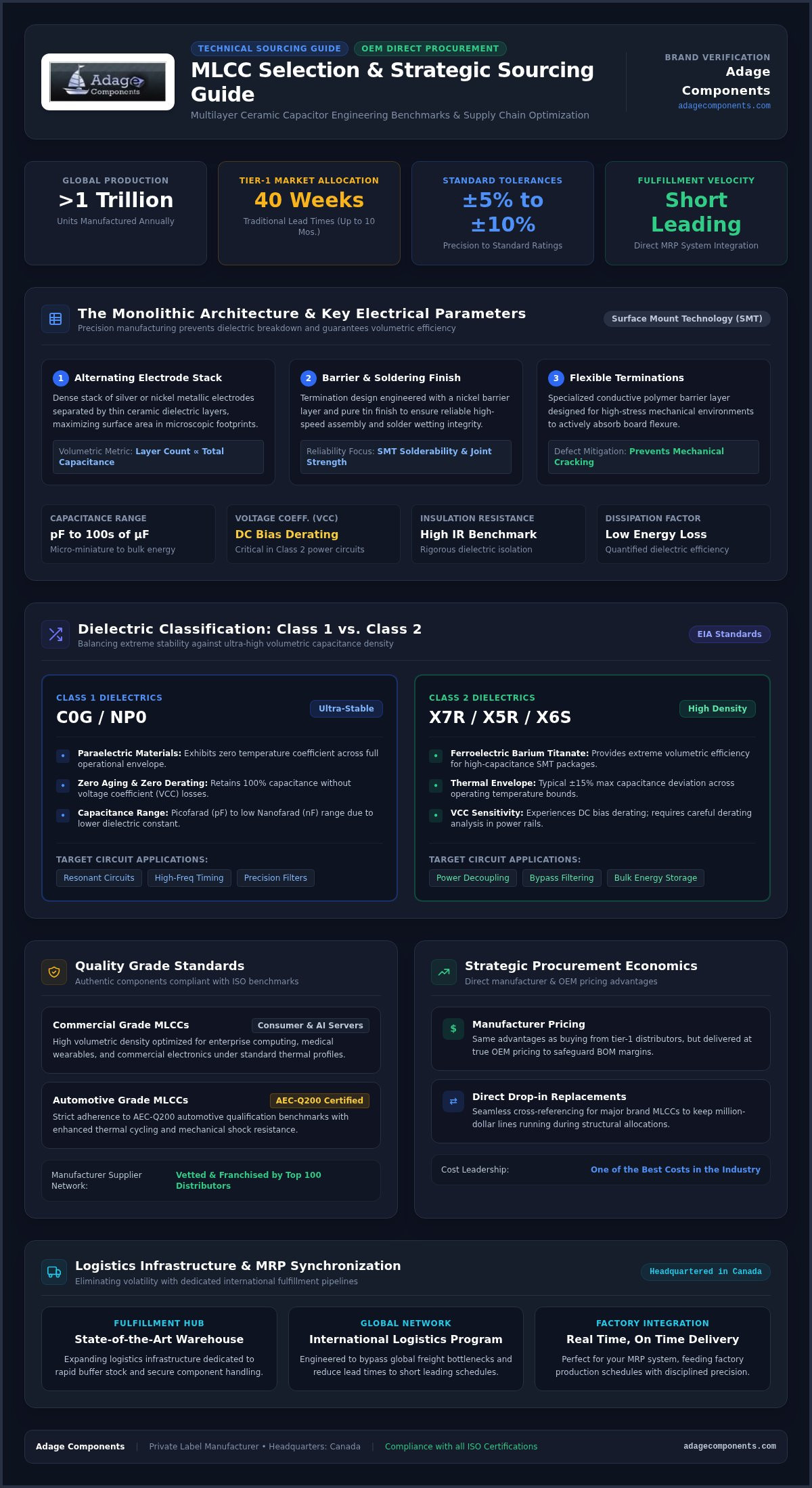
A multilayer ceramic capacitor (MLCC) is a fixed-value component that utilizes ceramic as its dielectric material, acting as the fundamental building block for energy storage and signal filtering in modern electronics. These components are the most produced passive devices in the global market, with industry estimates exceeding one trillion units manufactured annually. Their ubiquity stems from their critical role in Surface Mount Technology (SMT), where they facilitate extreme device miniaturization in everything from AI servers to medical wearables. An MLCC is constructed by stacking alternating layers of ceramic dielectric and metallic electrodes into a monolithic block, achieving exceptional volumetric efficiency.
The Anatomy of an MLCC
The internal structure of an MLCC consists of a dense stack of silver or nickel electrodes separated by thin ceramic layers. This alternating architecture allows for a high surface area within a microscopic footprint, directly correlating the layer count to the total capacitance. Precision in the manufacturing process is vital; even minor deviations in layer thickness can lead to dielectric breakdown. Termination styles, typically involving a barrier layer of nickel and a finish of tin, are engineered to ensure soldering reliability during high-speed assembly. For high-stress environments, we provide components with flexible terminations that mitigate the risk of mechanical cracking.
Key Performance Parameters
Selecting the right component requires a deep understanding of ceramic capacitor classification standards. Capacitance ranges vary from picofarads to hundreds of microfarads, with standard tolerances typically at ±5% or ±10%. Beyond nominal values, engineers must account for the voltage coefficient of capacitance (VCC). This effect causes Class 2 dielectrics to lose a significant portion of their effective capacitance as the applied DC voltage increases. This derating is a critical factor in high-density power applications.
Reliability is further defined by insulation resistance (IR) and the dissipation factor, which measures energy loss within the dielectric. At Adage Components, we ensure all authentic components meet these rigorous benchmarks. Our partner suppliers are vetted to maintain compliance with all ISO certifications, providing you with commercial and automotive grade components that arrive at your facility on time. By sourcing through our growing state-of-the-art warehouse, you secure OEM pricing without the volatility of traditional tier-1 distribution channels. This approach allows your team to get manufacturer pricing while maintaining the same advantages as buying from tier-1 distributors.
MLCC Classification: Class 1 vs. Class 2 Dielectrics
Selecting the correct multilayer ceramic capacitor requires a clear understanding of dielectric classifications, as the material determines how the component behaves under thermal and electrical stress. The industry divides these into two primary categories based on the trade-off between stability and volumetric efficiency. While Class 1 dielectrics offer unparalleled precision, Class 2 materials provide the high capacitance density necessary for modern power management. Balancing these technical nuances is essential for maintaining circuit integrity without over-specifying and inflating your BOM costs.
Class 1 Dielectrics (C0G/NP0)
Class 1 dielectrics, primarily C0G or NP0, are the gold standard for applications requiring high stability and low losses. These capacitors utilize paraelectric materials that exhibit a zero temperature coefficient, meaning their capacitance remains virtually unchanged across their entire operating temperature range. They don't suffer from the aging effects or DC bias derating that plague other ceramic types. You'll typically find Class 1 components in resonant circuits, high-frequency timing modules, and precision filters. However, this stability comes at the cost of density; Class 1 materials have a lower dielectric constant, which limits their capacitance values to the picofarad and low nanofarad range.
Class 2 Dielectrics (X7R, X5R, X6S)
Class 2 dielectrics use ferroelectric materials like barium titanate to achieve the high volumetric efficiency required for decoupling and bypass applications. These are classified by EIA codes that define their performance limits. For instance, X7R indicates a ±15% maximum capacitance change over a temperature range of -55°C to +125°C. X5R offers similar stability but is rated only up to +85°C. These "Hi-Cap" MLCCs are perfect for smoothing power rails, though they're sensitive to voltage stress. When your design moves into high-reliability sectors, it's vital to verify that these parts meet the AEC-Q200 passive component qualification benchmarks for stress resistance.
In industrial circuits, you should prioritize Class 1 whenever timing precision or signal purity is the critical path. Use Class 2 for bulk storage and noise suppression where minor capacitance fluctuations won't compromise the system. Adage Components helps you navigate these choices by providing authentic components from vetted manufacturers. We offer both commercial and automotive grade components that meet all ISO certifications, ensuring you get manufacturer pricing that rivals tier-1 distributors. Our amazing international logistic program ensures these parts reach your facility with short leading times. To see our full range of dielectric options, you can check our linecard and secure OEM pricing for your next production run.
Commercial vs. Automotive Grade: Quality Standards for OEMs
The distinction between commercial and automotive grade components is a critical pivot point for industrial procurement. While commercial grade components are suitable for consumer electronics and general industrial applications with predictable environments, they lack the structural resilience required for high-stress systems. For mission-critical designs, a multilayer ceramic capacitor must meet significantly higher benchmarks for thermal cycling and mechanical durability. Choosing the wrong grade doesn't just risk component failure; it jeopardizes your entire production lifecycle and brand reputation.
The AEC-Q200 Standard
Automotive grade requirements are governed by the AEC-Q200 qualification, which mandates rigorous stress testing to ensure reliability in harsh environments. These components must endure 1,000-hour high-temperature exposure and intensive humidity bias testing. Structural integrity is paramount because even microscopic cracks can lead to catastrophic failure. NASA research on MLCC reliability highlights how thermal and mechanical stress contribute to leakage current degradation, underscoring the need for the rigorous screening benchmarks found in AEC-Q200. We support your facility by providing both commercial and automotive grade components, ensuring every part meets the specific environmental demands of your application.
Authentic Components and Quality Assurance
Maintaining supply chain integrity requires more than just finding a part; it requires a disciplined approach to quality. We utilize a network of vetted manufacturers and partner suppliers, many of whom are franchised by top 100 distributors, to guarantee you receive only authentic components. Our multi-stage inspection processes and adherence to all ISO certifications provide a high-standard alternative to traditional distribution. This rigorous oversight allows you to transition from tier-1 brands to drop-in replacements without sacrificing performance or safety.
By sourcing through Adage Components, you get manufacturer pricing that offers one of the best costs in the industry. Our growing state-of-the-art warehouse and amazing international logistic program are designed to be perfect for your MRP system. We focus on short leading times to ensure that critical passives arrive at your facility in real time, on time. This model provides the same advantages as buying from tier-1 distributors but at OEM pricing, allowing you to optimize your BOM costs while maintaining absolute compliance with global quality standards. Whether you need standard commercial parts or AEC-Q200 qualified solutions, our infrastructure is ready for immediate operational engagement.
Strategic Sourcing: Navigating MLCC Lead Times and Logistics
Traditional procurement models often fail when faced with the 14 to 40-week lead times currently impacting the multilayer ceramic capacitor market. We offer a more resilient path. By utilizing direct procurement channels, you bypass the markups and delays inherent in multi-tiered distribution. This approach allows you to get manufacturer pricing while maintaining the supply chain integrity required for high-stakes industrial applications. Balancing technical precision with procurement agility is the only way to avoid the structural allocation risks facing today’s OEMs.
Overcoming Supply Chain Volatility
Volatility in the passives market requires a decisive shift toward "short leading" strategies. We maintain a robust network of vetted manufacturers and partner suppliers, many of whom are franchised by top 100 distributors. This structure ensures that you receive authentic components without the typical tier-1 price premiums or extended wait times. By working with a private label manufacturer, you gain the same advantages as buying from tier-1 distributors but at OEM pricing, effectively reducing your overall BOM costs while securing your production schedule.
Logistics and Real-Time Fulfillment
Our Canada-based headquarters serves as a strategic hub for North American logistics, offering a level of geographical security that off-shore vendors can't match. We've invested heavily in a growing state-of-the-art warehouse that is perfect for your MRP system, facilitating seamless Just-In-Time (JIT) delivery protocols. This infrastructure ensures that critical components arrive at your facility in real time, on time, effectively eliminating the production bottlenecks caused by standard industry delays. Our comprehensive Adage International Logistics Program mitigates supply chain risks by providing a stabilized bridge between volatile manufacturing cycles and your production floor.
Reliability in logistics is as vital as the dielectric constant in your circuit design. We offer one of the best costs in the industry by stripping away the inefficiencies of traditional distribution while maintaining strict compliance with all ISO certifications. This model ensures you don't have to choose between speed and safety. You get the benefit of authentic components and rigorous testing combined with the pricing power of a direct manufacturer. To optimize your procurement cycle and secure immediate operational advantages, you can view our current linecard to initiate an inquiry and lock in your supply.
Adage Components: Tier-1 Quality at Manufacturer Pricing
The "Adage Advantage" is built on a simple, disciplined premise: providing the exact same technical reliability as tier-1 brands while eliminating the distributor markups that inflate your BOM. We offer a high-standard multilayer ceramic capacitor that serves as a seamless drop-in replacement for major manufacturers such as Yageo, Murata, and TDK. This approach allows your engineering team to maintain design integrity while your procurement department captures one of the best costs in the industry. We don't just supply parts; we provide a sophisticated sourcing model that prioritizes your facility's operational efficiency and financial health.
Manufacturer Pricing for OEMs
Our private label model ensures you receive the same advantages as buying from tier-1 distributors but at OEM pricing. By working directly with our vetted manufacturers and partner suppliers, we bypass the traditional multi-tiered distribution layers that add friction and cost to your supply chain. We offer volume-tiered contracts and long-term supply agreements that provide price stability in a volatile market. These agreements are designed to be perfect for your MRP system, ensuring that your production lines remain moving without the risk of sudden price spikes or allocation. To secure these advantages for your next project, you can Request OEM Pricing on MLCCs and speak with our strategic sourcing experts.
Your Strategic Partner in Passive Components
Our expertise extends beyond the multilayer ceramic capacitor. We act as an elite partner for sourcing a full spectrum of passives, including tantalum, aluminum electrolytic, and film capacitors. Every component we source undergoes rigorous testing and multi-stage inspection processes in our growing state-of-the-art warehouse to ensure authenticity. We also provide technical support and manufacturing audits for clients with custom requirements or those operating in the high-stakes automotive sector. Our amazing international logistic program is engineered to handle the complexities of global trade, ensuring that both commercial and automotive grade components arrive at your facility in real time, on time. You can View Our Full Capacitor Linecard to see the breadth of our ISO-certified offerings.
Procurement managers face constant pressure to reduce material costs without compromising on quality. We solve this puzzle through our comprehensive electronic components BOM cost analysis. Our team evaluates your entire bill of materials to identify opportunities for manufacturer pricing and "short leading" schedules. This analysis provides a clear, data-driven path to optimizing your supply chain and protecting your margins. Don't let volatile lead times or hidden distribution costs stall your growth. Submit your requirements through our BOM submission form today for an immediate, professional cost-saving analysis and experience the reliability of a partner committed to your success.
Secure Your Production with Strategic OEM Pricing
Mastering the technical selection of a multilayer ceramic capacitor is only half the battle; the other half is won through strategic procurement. You've identified how to balance dielectric stability with volumetric efficiency and why AEC-Q200 standards are non-negotiable for automotive applications. Now, it's time to bridge the gap between technical requirements and bottom-line savings. By leveraging Adage Components' infrastructure, you move beyond the constraints of traditional distribution and enter a model defined by precision and speed.
Our Canada-based global logistics support and vetted manufacturer network ensure that you don't have to compromise on quality to achieve cost-effectiveness. We maintain rigorous ISO certified quality management to guarantee component authenticity while providing the same advantages as buying from tier-1 distributors. With our growing warehouse and short leading capabilities, your facility receives the parts it needs in real time, on time. We're ready to act as your strategic partner in optimizing your BOM and securing your production future.
Get Manufacturer Pricing on MLCCs and Submit Your BOM for Analysis. We look forward to streamlining your operations.
Frequently Asked Questions
What is the main advantage of a Multilayer Ceramic Capacitor (MLCC)?
The primary advantage of a multilayer ceramic capacitor is its exceptional volumetric efficiency, which allows for high capacitance values in a microscopic physical footprint. This characteristic is fundamental to modern device miniaturization and Surface Mount Technology (SMT). We provide these essential components at manufacturer pricing, ensuring you get the same technical advantages as tier 1 distributors while capturing one of the best costs in the industry for your high density PCB designs.
How do I choose between X7R and C0G dielectrics for my project?
Choose C0G dielectrics when your circuit requires high stability, zero temperature coefficient, and low energy losses, such as in precision timing or resonant filters. If your application needs higher capacitance density for decoupling or bypass functions, X7R is the better choice. While X7R offers greater volumetric efficiency, it's subject to capacitance derating under DC bias. We offer both dielectric classes through our vetted manufacturers to ensure your specific performance benchmarks are met.
Can I use a commercial grade MLCC in an automotive application?
You shouldn't use a commercial grade multilayer ceramic capacitor in automotive systems because they lack the necessary stress testing. Automotive applications require AEC-Q200 compliance to withstand extreme thermal cycling and mechanical vibration. We support both commercial and automotive grade components, ensuring that your mission critical systems utilize parts that have undergone rigorous qualification. Sourcing through our ISO certified channels guarantees that your automotive passives meet the strict safety standards required for vehicle environments.
What does "short leading" mean in the context of component procurement?
Short leading refers to our ability to deliver components with significantly reduced lead times compared to the 20 to 40 week industry averages. We achieve this through our amazing international logistic program and a growing state-of-the-art warehouse located in Canada. This strategy allows us to bypass traditional supply chain bottlenecks. It ensures that your production lines remain operational by delivering authentic components to your facility in real time, on time, even during global market volatility.
How does Adage ensure the authenticity of its private label MLCCs?
We maintain supply chain integrity through a multi-stage inspection process and a network of vetted manufacturers. Many of our partner suppliers are franchised by top 100 distributors, which provides an additional layer of security. We strictly adhere to all ISO certifications and conduct thorough factory audits to verify component integrity. This disciplined approach ensures that every private label part we supply is an authentic, high-standard alternative to traditional, more expensive distribution channels.
What is a drop-in replacement for standard MLCC brands?
A drop-in replacement is a component that matches the electrical specifications and physical footprint of parts from major brands like Murata or TDK. We specialize in providing these alternatives at OEM pricing, allowing you to switch suppliers without redesigning your PCB. Our technical support team conducts BOM cost analysis to identify these opportunities. This allows your procurement team to secure manufacturer pricing while maintaining the performance levels expected from tier 1 brands.
Does Adage Components support MRP system integration for high-volume orders?
Yes, our logistics infrastructure is specifically designed to be perfect for your MRP system. We focus on seamless integration to support high volume production and Just-In-Time (JIT) delivery protocols. By syncing our state-of-the-art warehouse operations with your internal planning, we reduce the administrative friction of procurement. This coordination ensures that your inventory levels remain optimized and that critical passive components arrive at your facility exactly when they are required for assembly.
Are Adage MLCCs compliant with ISO and RoHS standards?
Every component we supply is fully compliant with all ISO certifications and global environmental standards like RoHS. We prioritize technical reliability and regulatory adherence to ensure that our parts are suitable for global export and high-standard industrial use. Our commitment to quality assurance means that whether you are sourcing commercial or automotive grade components, you receive the full compliance documentation necessary to satisfy your internal audits and maintain your production standards.
Disclaimer
Cross-referenced components needs to be confirmed by the client with either spec. sheet or samples or both.
Please note, we use AI to help us, information is verified to be correct but we can not guarantee 100% accuracy.


