

Can your power stage survive a 50% loss in effective capacitance just as your BOM costs surge by 60%? This is the reality for engineers who need the MLCC DC bias characteristic explained to mitigate the inherent physics of Class II dielectrics. When you apply voltage, the ferroelectric domains in materials like X7R or X5R saturate. This leads to a precipitous drop in actual capacitance that often results in unexpected voltage ripple. In a 2026 market where AI-specific grades have jumped 60% in price and lead times exceed 40 weeks, miscalculating this characteristic is an expensive mistake you can't afford.
You don't have to choose between technical precision and budget integrity. We'll show you how to master the physics of capacitance loss while securing stable, high-performance components at OEM pricing. This guide provides a definitive framework for choosing the right dielectric and outlines a sourcing strategy for cost-effective alternatives. You'll learn how to leverage vetted manufacturers and ISO-certified infrastructure to keep your MRP system running on time without the tier-1 brand markup. We bridge the gap between technical reliability and aggressive procurement goals, ensuring your facility receives authentic components exactly when they're needed.
Key Takeaways
- Master the MLCC DC bias characteristic explained in this guide to accurately predict capacitance loss in Class II dielectrics and ensure power stage stability.
- Identify why larger case sizes and specific dielectric thicknesses offer superior stability compared to miniaturized components under high DC loads.
- Access manufacturer pricing that rivals tier-1 distributors, allowing you to lower total BOM costs while maintaining access to high-performance MLCCs.
- Utilize our international logistics program to ensure your facility receives vetted, authentic components on time and in sync with your MRP system requirements.
- Leverage our rigorous vetting process and ISO-certified infrastructure to bypass long lead times while maintaining the highest standards of technical reliability.
Understanding the MLCC DC Bias Phenomenon
The Molecular Mechanics of Capacitance Loss
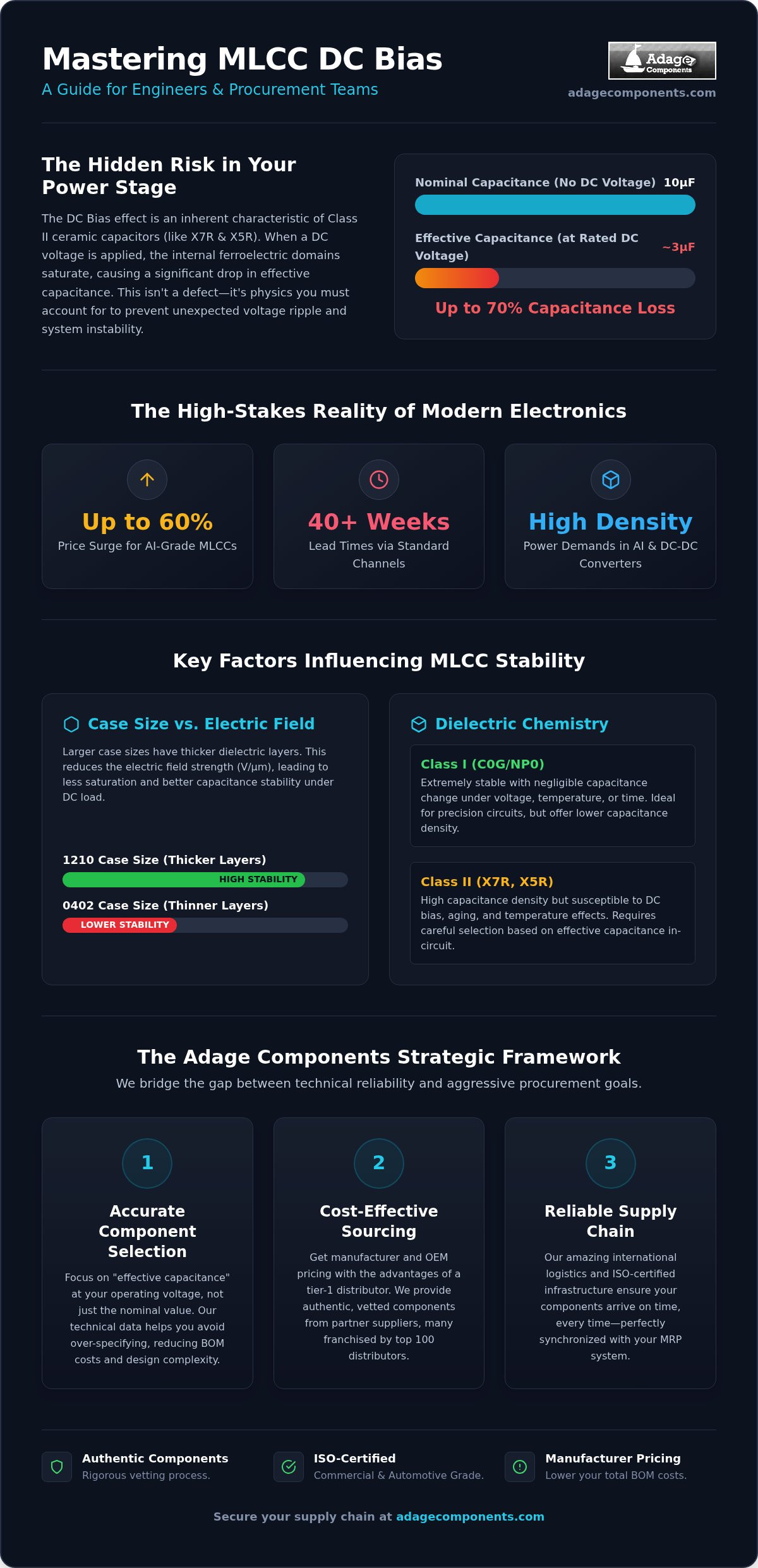
Barium Titanate relies on a ferroelectric crystalline structure to achieve high capacitance in small packages. Within this structure, spontaneous polarization occurs as dipoles align to store charge. However, an external DC field "locks" these dipoles in place, preventing them from responding to the AC signal. This saturation effect effectively lowers the dielectric constant of the material. Different Ceramic capacitor classes exhibit varying levels of sensitivity to this field. While Class I materials remain stable, Class II materials like X7R and X5R are highly susceptible. The Curie point represents the critical temperature threshold where the material shifts from a ferroelectric to a paraelectric state, fundamentally altering its dielectric constant. As the DC voltage increases toward the component's rated limit, the effective capacitance continues to drop, often reaching 50% to 80% loss at nominal voltage.
Why This Matters for 2026 Power Electronics
The 2026 electronics market is defined by extreme miniaturization and the massive buildout of AI server infrastructure. Modern DC-DC converters operate at higher frequencies and higher power densities, leaving little room for error in capacitance margins. With AI-specific MLCC grades seeing price increases of 50-60% and lead times for standard channels exceeding 40 weeks, you can't afford to buy more "nominal" capacitance than you actually need. We help you focus on "effective capacitance" during the design phase to avoid over-specifying. Adage Components provides the technical data required to select the most efficient part for your operating voltage. By utilizing our BOM submission form, you can access OEM pricing on high-performance MLCCs that meet your exact stability requirements. We ensure your facility receives vetted, authentic components that arrive on time, keeping your MRP system synchronized even in a structural shortage.
Key Factors Influencing MLCC Capacitance Stability
Engineering a stable power stage requires more than just selecting a nominal capacitance value from a datasheet. To have the MLCC DC bias characteristic explained in a practical context, we must examine how physical dimensions and layer construction dictate performance. While material chemistry provides the foundation, the geometric constraints of the component often determine the severity of capacitance drop. Procurement teams frequently overlook these variables, leading to field failures or costly redesigns when components don't perform as expected under load.
Case Size vs. Electric Field Strength
The relationship between case size and stability is a matter of pure physics. As case sizes shrink from 1206 to 0603 or 0402, the dielectric layers within the MLCC must become thinner to maintain the same nominal capacitance. Thinner layers result in a significantly higher electric field strength, measured in Volts per Micron (V/µm), for any given applied voltage. This intense field saturates the Barium Titanate dipoles more rapidly, causing a steeper capacitance drop. For example, a 10µF capacitor in a 1210 package typically maintains far more effective capacitance at 12V than the same 10µF value in an 0805 package. When PCB real estate allows, opting for a larger case size is the most effective way to mitigate DC bias loss.
The Rated Voltage Misconception
One of the most persistent errors in component selection is the belief that a higher rated voltage automatically equates to better DC bias stability. This is often false. Manufacturers optimize internal layer counts and dielectric thickness to hit specific targets. In many instances, a 50V rated part in a small package uses thinner dielectric layers or a different grain structure than a 25V part to achieve its rating, which can actually lead to worse bias performance at lower operating voltages. You cannot rely on the voltage rating alone to predict stability. Instead, you must analyze the specific VCC curves provided by vetted manufacturers to understand how the part will behave at your specific operating point.
Managing these technical nuances is critical for maintaining supply chain integrity. At Adage Components, we provide the technical transparency required to navigate these trade-offs. Our comprehensive linecard features high-performance MLCCs from partner suppliers who provide the granular data needed for precise engineering. By sourcing through our state-of-the-art warehouse, you get manufacturer pricing on authentic components that are perfect for your MRP system. We focus on short leading times and rigorous quality assurance, ensuring your facility receives automotive and commercial grade components that arrive in real time, on time. This strategic approach allows you to secure the same advantages as buying from tier 1 distributors but at OEM pricing, protecting both your technical specifications and your bottom line.
Temperature also plays a secondary but vital role. As thermal fluctuations occur, the crystalline structure of Class II dielectrics shifts, often compounding the effects of DC bias. In 2026, where high-density AI server racks generate extreme heat, the interaction between DC load and thermal stress can reduce effective capacitance to dangerous levels. Vetting your suppliers for both thermal and bias stability is no longer optional; it's a requirement for operational continuity.
Dielectric Chemistry: Class I vs. Class II MLCCs
While case size and voltage ratings are critical physical variables, the root of capacitance stability lies in the chemical composition of the dielectric material. To have the MLCC DC bias characteristic explained accurately, we must differentiate between Class I and Class II ceramics. This distinction determines whether a component remains rock-solid under load or loses significant performance. For procurement teams, understanding these material classes is the difference between a reliable design and a supply chain bottleneck caused by over-specifying expensive, high-stability parts where they aren't strictly required.
Class I Dielectrics: C0G and NP0 Characteristics
Class I dielectrics are composed of paraelectric materials, which don't exhibit spontaneous polarization. Because these materials don't rely on the ferroelectric domains found in Barium Titanate, they're immune to the DC saturation effects discussed earlier. C0G and NP0 capacitors offer near-zero capacitance change over voltage and temperature. This makes them the gold standard for high-precision analog circuits, timing applications, and critical filters. You can source a wide range of high-stability MLCCs from Adage Components to ensure your critical signal paths remain within specification regardless of operating conditions.
Class II Dielectrics: X7R and X5R Challenges
Class II dielectrics utilize "High-K" materials to achieve much higher volumetric efficiency. This allows for high capacitance values in tiny packages, which is essential for power supply decoupling and AI infrastructure. However, this density comes at the cost of stability. The EIA codes, such as X7R, X5R, and X6S, define the operating temperature range and the maximum allowable capacitance change over that range, but they don't account for DC bias. In a typical 12V decoupling application, a Class II part might experience a 20% to 80% capacitance drop. We help our partners manage these limitations by providing vetted manufacturers who offer detailed performance data, ensuring you get the performance you need at manufacturer pricing.
The strategic choice between Class I and Class II involves a direct trade-off between cost, size, and electrical integrity. While Class I is superior in stability, it lacks the capacitance density required for modern power stages. Conversely, Class II requires careful engineering to account for the MLCC DC bias characteristic explained in our technical frameworks. We provide commercial and automotive grade components that bridge this gap, offering drop-in replacements for tier-1 brands with short leading times. By utilizing our state-of-the-art warehouse and international logistics program, you can secure the same advantages as buying from tier 1 distributors but at OEM pricing, keeping your MRP system running smoothly without sacrificing quality.
Strategic Mitigation: Engineering and Procurement Frameworks
Mitigating capacitance loss requires a disciplined framework that bridges the gap between the lab and the warehouse. When you have the MLCC DC bias characteristic explained through raw data, it becomes clear that nominal values are essentially placeholders in a high-stakes design. To maintain circuit integrity, engineering and procurement teams must collaborate on a multi-step validation process. This ensures that the components selected not only meet the electrical requirements under load but are also available through a resilient supply chain.
- Step 1: Calculate the actual operating voltage vs. nominal rating to determine the real-world electric field strength.
- Step 2: Utilize manufacturer-provided DC bias curves (VCC curves) rather than relying on generic datasheet summaries.
- Step 3: Oversize nominal capacitance by 20% to 50% to account for predicted saturation losses in Class II dielectrics.
- Step 4: Vet alternative manufacturers early to ensure drop-in compatibility and avoid single-source bottlenecks.
- Step 5: Integrate stability data directly into your MRP system to prevent buyers from substituting "equivalent" parts that lack identical bias performance.
Design-Level Mitigation Strategies
Engineers often employ parallel capacitor configurations to reach effective capacitance targets without relying on a single, high-density component. By spreading the load across multiple MLCCs, you can sometimes use larger case sizes that offer better stability. For bulk storage requirements where MLCCs fail to provide enough effective capacitance, consider Tantalum Capacitors or Aluminum Electrolytic hybrids. These technologies don't suffer from DC bias and provide a stable foundation for power stages. Always validate these configurations using SPICE models that include high-fidelity DC bias data to simulate worst-case ripple and noise scenarios.
Procurement-Level Risk Management
Procurement must focus on qualifying vetted manufacturers who provide transparent performance data. In a market where lead times for tier-1 branded MLCCs often exceed 40 weeks, identifying "short leading" alternative parts is a survival necessity. We help you qualify partner suppliers who maintain strict compliance with all ISO certifications, ensuring that every part is an authentic component. Whether you require commercial or automotive grade components, our growing state-of-the-art warehouse infrastructure is designed to support your production schedule without the overhead of traditional distribution channels.
Adage Components acts as a strategic bridge, providing manufacturer pricing and OEM pricing that allows you to reduce BOM costs while maintaining technical standards. Our amazing international logistic program ensures that products arrive at your facility in real time, on time. This level of integration is perfect for your MRP system, as it removes the volatility typical of the open market. View our full linecard of stable MLCC alternatives to secure the same advantages as buying from tier 1 distributors at a fraction of the cost.
Optimizing Your MLCC Supply Chain with Adage Components
Technical mastery of your passive components is only half the battle in 2026. Now that the MLCC DC bias characteristic explained in previous sections has clarified your engineering targets, the challenge shifts to securing those parts in a volatile market. With AI-specific MLCC grades seeing price increases of 50-60% and lead times through standard channels exceeding 40 weeks, traditional distribution often fails to provide the speed or cost-effectiveness required for high-volume production. Adage Components serves as a strategic partner, offering a direct path to high-performance MLCCs at OEM pricing.
We provide one of the best costs in the industry by offering manufacturer pricing that rivals the advantages of tier-1 distributors. This allows you to maintain the technical integrity of your power stages while significantly reducing your BOM expenses. Every part we supply goes through a rigorous, ISO-certified vetting process. We only work with vetted manufacturers and partner suppliers, many of whom are franchised by top 100 distributors. This ensures that your facility receives authentic components that meet both commercial and automotive grade standards, effectively eliminating the risk of counterfeit or sub-standard parts in your supply chain.
Why Adage is the Strategic Choice for OEMs
Efficiency in procurement is defined by the seamless integration of logistics and data. Our amazing international logistic program is built to handle the complexities of global sourcing, ensuring that your parts arrive in real time, on time. We operate a growing state-of-the-art warehouse that's designed to integrate perfectly with your MRP system. This infrastructure allows us to offer short leading times, even for high-capacitance MLCCs that are currently in structural shortage elsewhere. You get the same advantages as buying from tier 1 distributors but at the direct pricing benefits of a private label manufacturer.
Get Started with Strategic Sourcing
Transitioning to a more resilient supply chain starts with a data-driven cost analysis. You can use our BOM Submission Form to receive a comprehensive review and identify where Adage can provide drop-in replacements for your current tier-1 brands. We encourage you to explore the Adage Linecard to see our full range of passive components, including resistors and diodes that complement our capacitor offerings. If your production schedule requires a more tailored approach, contact us directly to discuss custom stocking programs and JIT delivery schedules. We're ready to solve your most difficult sourcing puzzles with disciplined expertise and a commitment to quality.
Future-Proof Your Power Stage Design
Mastering the technical nuances of capacitor stability is no longer just an engineering requirement; it's a procurement mandate. Having the MLCC DC bias characteristic explained provides the foundation for selecting dielectrics that maintain integrity under load. By shifting focus from nominal values to effective capacitance and moving beyond tier-1 brand reliance, you protect your designs from both voltage ripple and supply chain volatility. The structural shortages of 2026 demand a partner that combines technical precision with massive logistical scale.
Adage Components bridges this gap by providing vetted manufacturers and ISO-certified quality at one of the best costs in the industry. We ensure your facility receives authentic, high-performance components through our amazing international logistic program. You can secure the same advantages as buying from tier 1 distributors but at OEM pricing, keeping your MRP system synchronized and your BOM costs under control. It's time to leverage manufacturer-direct pricing without sacrificing the technical standards your automotive and commercial grade projects require.
Get OEM Pricing on Vetted MLCCs – Submit Your BOM Today
Frequently Asked Questions
What exactly is MLCC DC bias?
MLCC DC bias is the reduction in a capacitor's effective capacitance caused by the application of a DC voltage. This phenomenon occurs because the electric field saturates the ferroelectric domains within Class II dielectrics. To have the MLCC DC bias characteristic explained simply; the more DC voltage you apply, the less charge the component can actually store, regardless of its nominal rating on the datasheet.
Do all ceramic capacitors have a DC bias characteristic?
Not all ceramic capacitors exhibit this behavior. Class I dielectrics, such as C0G and NP0, are paraelectric and maintain near-constant capacitance across their entire voltage range. Only Class II and Class III high-dielectric materials, like X7R and X5R, suffer from significant DC bias effects. Choosing Class I is the most effective way to eliminate this technical risk in sensitive analog signal paths or timing circuits.
How much capacitance can an MLCC lose under load?
A Class II MLCC can lose between 20% and 80% of its rated capacitance once it reaches its nominal operating voltage. The exact loss depends on the dielectric material and the case size. Smaller packages, like 0402, typically experience more severe drops than larger 1206 or 1210 packages. This makes calculating the effective capacitance critical for power supply decoupling and high-density AI infrastructure designs.
Does a higher voltage rating reduce DC bias?
A higher voltage rating doesn't automatically reduce DC bias. In many instances, a 50V part in a small package uses thinner dielectric layers than a 25V part to hit its rating, which can actually increase dipole saturation. You should always consult the specific VCC curves provided by your supplier rather than assuming a higher voltage headroom will solve stability issues in your power stage.
Which dielectric type is best for stable capacitance?
Class I dielectrics like C0G or NP0 are the gold standard for absolute capacitance stability. They offer zero DC bias and excellent temperature coefficients. For power stages where high density is required, X7R is often the preferred Class II choice. It provides a better balance of volumetric efficiency and stability compared to X5R or Y5V dielectrics, which are more prone to significant fluctuations.
How do I find the DC bias data for a specific capacitor?
You can find this data by requesting the manufacturer's VCC curves or bias characteristic plots. Adage Components provides comprehensive technical data for all authentic components we supply. Our team helps you integrate this data into your MRP system to ensure that every part selected meets the actual electrical requirements. We provide the same advantages as buying from tier 1 distributors but at OEM pricing.
Can I use Class II MLCCs in precision timing circuits?
How does Adage Components ensure the quality of their MLCCs?
We maintain supply chain integrity through a rigorous vetting process. Every component is sourced from vetted manufacturers who comply with all ISO certifications. Our state-of-the-art warehouse infrastructure and amazing international logistic program ensure that you receive automotive and commercial grade components that are 100% authentic. This guarantees that your parts arrive at your facility in real time and on time, every time.
Disclaimer
Cross-referenced components needs to be confirmed by the client with either spec. sheet or samples or both.
Please note, we use AI to help us, information is verified to be correct but we can not guarantee 100% accuracy.


