

What if the unexplained field failures plaguing your latest product line aren't design flaws at all, but the result of a compromised supply chain? It's frustrating to watch warranty claims climb while your production schedule slips because of component reliability issues. You've likely spent hours questioning your engineering team when the real culprit is often hidden deep within the resistor's material composition or a lack of rigorous manufacturer vetting. In a 2026 market where surging raw material costs have driven resistor prices up by 20 percent, you don't have the margin to waste on substandard parts. Troubleshooting common resistor failures requires a shift from reactive repairs to proactive, high-standard procurement.
This guide provides a clear diagnostic framework for identifying the root causes of degradation and demonstrates how to secure high-reliability components that safeguard your MRP system. We'll examine technical failure triggers and show you how to access OEM pricing through a strategic, ISO-certified sourcing model. By leveraging vetted manufacturers and our state-of-the-art warehousing, you can ensure your facility receives authentic components with short lead times. You'll learn how to reduce failure rates while maintaining the same cost advantages as buying from tier 1 distributors at manufacturer pricing.
Key Takeaways
- Master the diagnostic procedures for troubleshooting common resistor failures, including the use of IR thermography to detect thermal anomalies before they cause production downtime.
- Identify how environmental stressors and thermal overloads trigger open-circuit states in film and wirewound resistors, allowing you to refine your design specifications.
- Learn why manufacturing audits and ISO-certified vetted manufacturers are essential for eliminating counterfeit risks and ensuring long-term component integrity.
- Discover how to leverage OEM pricing and drop-in replacements to maintain your production timelines without the markups associated with traditional tier-1 distribution.
- Understand how an integrated international logistics program ensures your facility receives automotive-grade components in real time to support your MRP system requirements.
The Anatomy of Failure: Identifying Common Resistor Faults
In the high-stakes environment of industrial procurement, defining resistor failure requires more than just identifying a dead circuit. We define failure as any deviation from specified tolerance that impacts circuit performance or system stability. When troubleshooting common resistor failures, you'll find that faults range from subtle drift to catastrophic termination. Understanding these mechanisms is the first step toward securing high-reliability, authentic components for your MRP system.
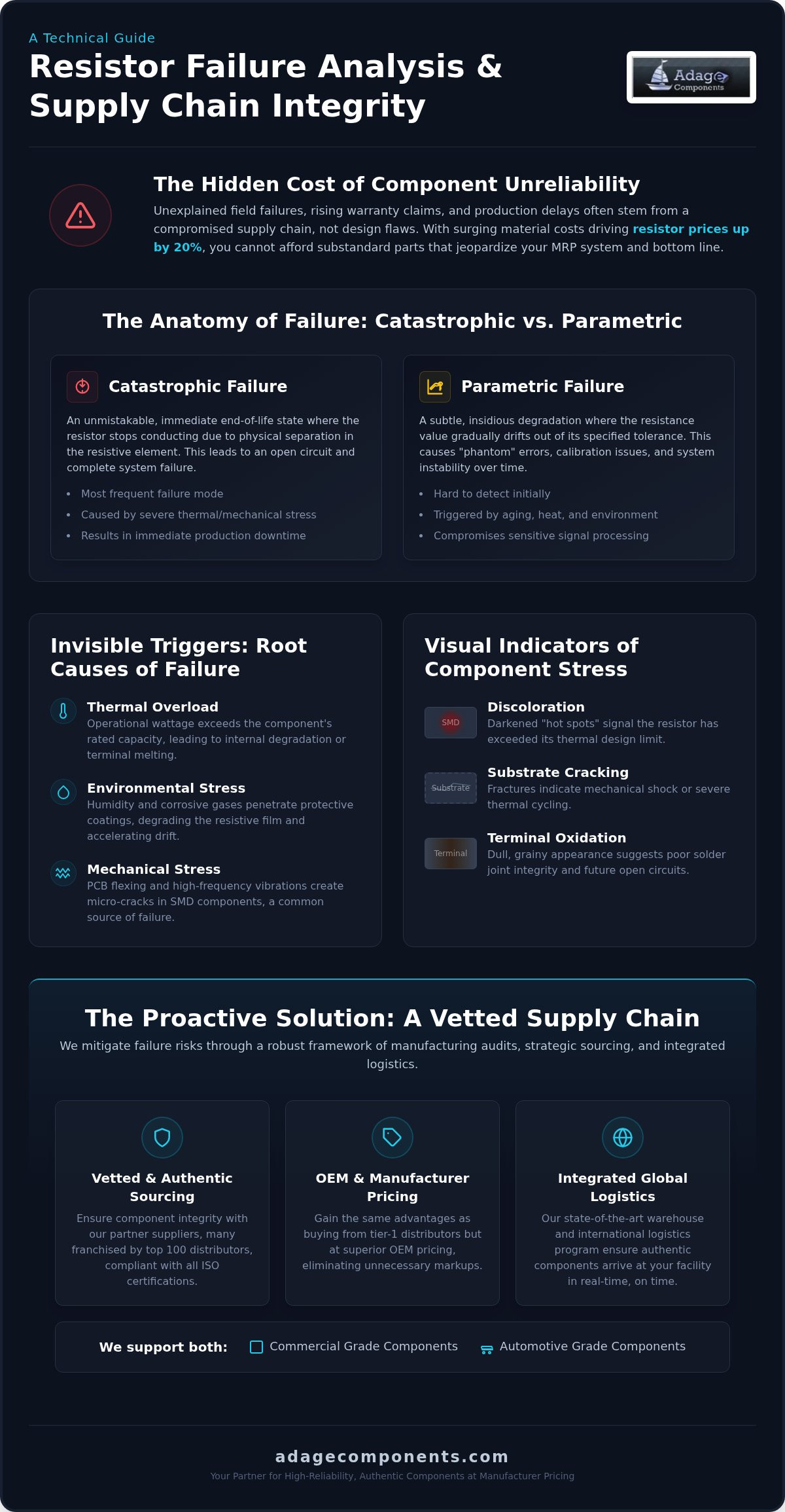
Open circuit failures represent the most frequent end-of-life state for film and wirewound resistors. This often occurs when the resistive element suffers physical separation due to excessive thermal stress or mechanical vibration. Conversely, resistance value drift is a parametric failure where aging, sustained heat, and environmental factors cause "out-of-spec" readings. While short circuits are rare, they occur through dielectric breakdown or external bridging, particularly in high-density layouts where Thick Film Chip Resistors are utilized. A comprehensive understanding of the Failure of electronic components reveals that these faults are often preventable through rigorous manufacturing audits and sourcing from vetted manufacturers.
Catastrophic vs. Parametric Failure
Procurement officers must distinguish between immediate circuit death and subtle performance degradation. Catastrophic failure is unmistakable; the resistor stops conducting, and the system fails immediately. However, parametric failure is more insidious. It involves a gradual shift in resistance that leads to system-wide calibration errors. In applications using Thin Film Precision Resistors, even a minor drift can compromise sensitive signal processing units. This is why we prioritize partner suppliers who provide commercial and automotive grade components with stable long-term performance. Ensuring your facility receives parts that maintain their tolerance prevents the "phantom" errors that lead to unexplained field failures and warranty claims.
Visual Indicators of Component Stress
Before deploying advanced diagnostics, a non-destructive visual inspection can reveal critical stress markers. Our state-of-the-art warehouse infrastructure allows for meticulous inspection for these defects before components reach your facility. Key indicators include:
- Discoloration: Darkened spots on the protective coating signal "hot spots" where the resistor has exceeded its thermal design limit.
- Substrate Cracking: Fractures in ceramic substrates often indicate mechanical shock or severe thermal cycling, a known issue in MELF resistors.
- Terminal Oxidation: A dull or grainy appearance on terminals suggests poor solder joint integrity; this eventually leads to intermittent open circuits.
Identifying these signs early allows you to pivot to reliable alternatives and get manufacturer pricing without sacrificing supply chain integrity. By sourcing from franchised partner suppliers, you mitigate the risks of sub-standard materials that cause these visual stress markers. This proactive approach ensures your production stays on time, every time.
Root Cause Analysis: Why Resistors Fail in Industrial Applications
Troubleshooting common resistor failures requires a forensic approach to the industrial environment. While visual defects provide clues, the root causes are often invisible to the naked eye. Thermal overload occurs when operational wattage exceeds the component's rated capacity, leading to internal carbonization or terminal melting. Environmental stress also plays a major role; humidity and corrosive gases penetrate the protective coating to degrade the resistive film. Technical research on Resistor Failure Modes highlights how these external factors accelerate resistance drift. Mechanical stress is equally critical. PCB flexing and high-frequency vibration during operation create micro-cracks in Surface Mount Device (SMD) components. These cracks often remain dormant until a thermal cycle causes an intermittent open circuit, disrupting your production timelines and triggering warranty claims.
Sulfuration in Thick Film Chip Resistors
Standard thick film components are vulnerable in sulfur-rich environments typical of industrial and automotive sectors. Sulfuration is a chemical reaction between atmospheric sulfur and the resistor's silver internal electrodes. This process forms silver sulfide, a non-conductive material that eventually severs the electrical path. To prevent these field failures, we provide specialized anti-sulfur components through our partner suppliers. By utilizing vetted manufacturers, we ensure your facility receives authentic components designed for harsh environments. This level of quality assurance is essential for maintaining the integrity of your MRP system and preventing the "phantom" failures that arise in polluted or high-humidity settings.
Thermal Management and Derating Curves
Effective procurement involves more than matching resistance values; it requires understanding derating curves to ensure operational longevity. A derating curve dictates the maximum power a component can handle as ambient temperatures rise. Exceeding these limits increases power density and shortens the component's lifespan significantly. In Thick Film Chip Resistors, proper thermal management is the difference between a reliable product and a costly recall. Automotive-grade components offer superior resistance to thermal cycling, making them a high-standard alternative for rigorous industrial applications.
Adage Components offers one of the best costs in the industry by providing manufacturer pricing on these high-reliability parts. Our growing state-of-the-art warehouse and amazing international logistic program ensure that even with 2026 lead times for specialty resistors extending toward 28 weeks, your parts arrive in real time, on time. You get the same advantages as buying from tier 1 distributors but at OEM pricing. We support both commercial and automotive grade components to match your specific reliability requirements. If you're experiencing unexplained failures, it's time to audit your supply chain and browse our comprehensive linecard for vetted solutions that safeguard your production.
Diagnostic Procedures for Troubleshooting Resistors on PCBs
Effective troubleshooting common resistor failures requires moving beyond the basic multimeter. High-stakes production environments demand a multi-stage diagnostic approach to prevent unnecessary scrap and schedule delays. Start with a non-destructive visual inspection under high magnification microscopy. This identifies the micro-cracks and terminal oxidation discussed in previous sections. Next, utilize Infrared (IR) Thermography. This tool allows you to identify resistors operating above their thermal design limit in real time. If a component glows significantly hotter than its neighbors, it's likely a victim of electrical overstress or poor thermal design.
For electrical verification, In-Circuit Testing (ICT) provides a rapid assessment, yet it has limitations. You must account for parallel resistance paths within the network, which often mask a failing component by providing alternative current routes. For a definitive precision measurement, isolate the component through desoldering. This step's essential when verifying the tolerance of high-precision parts before submitting a failure report to your procurement team. Only by measuring the isolated part can you confirm if it's truly out-of-spec or if surrounding circuitry is influencing the reading.
Advanced Testing with LCR Meters and Curve Tracers
When standard measurements fail, specialized tools provide deeper insights. Use LCR meters to detect parasitic inductance or capacitance, particularly in failed wirewound resistors that have suffered internal insulation breakdown. For semiconductor-based resistors, curve tracing identifies non-linear behavior that suggests internal damage. Testing at various frequencies is critical for high-speed circuit applications. It ensures the resistor's impedance remains stable, preventing signal integrity issues that lead to intermittent system crashes.
Interpreting Troubleshooting Data
The final diagnostic step is determining if the failure stems from a component defect or a design error. If multiple resistors of the same wattage fail in identical positions, the circuit may be undersized for the application's power demands. Conversely, batch-specific issues suggest a lapse in manufacturer quality control. Track these incidents by integrating failure data into your MRP system. This data allows us to perform a technical audit of your BOM and suggest reliable, automotive-grade alternatives from our vetted manufacturers. By identifying systemic issues early, you can leverage our OEM pricing to secure higher-standard components that arrive at your facility in real time, on time. Our state-of-the-art warehouse ensures that every replacement part is an authentic component, protecting your production from the risks of unverified sourcing.
Mitigating Failure Risks through Manufacturing Audits and Vetted Sourcing
Troubleshooting common resistor failures often leads back to a single systemic issue: inconsistent manufacturing standards. While bench testing identifies the symptoms, a rigorous audit of your supply chain addresses the cause. We prioritize manufacturers who maintain ISO 9001 and IATF 16949 certifications. These standards aren't just badges; they're operational guarantees of process control and material purity. By vetting every partner supplier in our network, we eliminate the variables that lead to the thermal overstress and sulfuration discussed earlier in this guide. This shift from a reactive "buy-as-needed" mindset to a Strategic Sourcing Guide model is what separates high-reliability production from constant field failures.
Our manufacturing audit process goes beyond surface-level documentation. We examine the raw material sourcing of our partner suppliers, many of whom are franchised by top 100 distributors. This ensures that the resistive films and ceramic substrates meet the strict tolerances required for your MRP system. We offer one of the best costs in the industry by providing manufacturer pricing directly to your facility, bypassing the markups of traditional channels while maintaining superior quality control. Every component we source undergoes a multi-stage inspection process in our growing state-of-the-art warehouse to verify authenticity before it reaches your production line.
Authentic Components and Traceability
Gray market components are a primary driver of unexplained field failures. These parts often lack proper storage history, leading to terminal oxidation or moisture-related degradation that bench testing might miss. We ensure 100% authenticity by sourcing only through franchised partner suppliers. This commitment to supply chain integrity includes providing a full Certificate of Conformance (CoC) and lot traceability for every order. Having a clear audit trail is essential for troubleshooting common resistor failures that appear only after thousands of hours in the field. If a batch-specific issue arises, lot traceability allows you to isolate the affected units instantly, protecting your brand from widespread warranty claims.
Vetting Suppliers for High-Stakes Industrial Use
Qualifying a private label manufacturer as a drop-in replacement partner requires more than matching a datasheet. We evaluate every supplier based on their ability to provide both commercial and automotive grade components that comply with RoHS, REACH, and conflict mineral regulations. Our affiliated programs are designed to rival the security of tier-1 distributors while providing you with OEM pricing. This dual focus on compliance and cost-effectiveness ensures that your production stays on time, every time. Our amazing international logistic program integrates directly with your facility's requirements, delivering high-standard components in real time. Secure your production schedule and reduce your BOM costs by exploring our vetted component linecard today.
Strategic Component Replacement: Securing Reliable Alternatives
Successful troubleshooting common resistor failures provides more than a repair path; it offers a strategic opening to optimize your supply chain. Simply replacing a failed part with the same SKU often ignores the root cause, such as insufficient wattage or environmental vulnerability. We recommend evaluating drop-in replacements that exceed original specifications, such as upgrading from commercial to automotive-grade components. By performing a comprehensive electronic components BOM cost analysis, you can identify these high-reliability alternatives while simultaneously reducing overall spend. Our approach ensures your production timelines remain secure through short leading times and a robust international logistic program.
Working with a Private Label Resistors Manufacturer allows for granular control over component lifecycles. This partnership ensures that the parts arriving at your facility are not just authentic but are vetted manufacturers' products that meet 2026's rigorous standards. Our amazing international logistic program delivers these components in real time, on time, directly to your facility. This level of integration is perfect for your MRP system, as it eliminates the unpredictability of fragmented marketplaces. You gain the specialized expertise of a technical partner who bridges the gap between engineering requirements and procurement realities.
Transitioning to OEM Pricing for Volume Orders
We offer one of the best costs in the industry by providing direct manufacturer pricing. By bypassing the traditional distribution markups, your facility gains the same advantages as buying from tier 1 distributors but at OEM pricing. This financial efficiency doesn't come at the expense of quality. Every Thick Film Chip Resistor or Thin Film Precision Resistor is sourced from partner suppliers franchised by top 100 distributors. Integrating these high-standard components into your MRP system provides significant lead-time flexibility, which is critical when specialty resistor lead times are extending toward 28 weeks in the current market.
Future-Proofing Your Supply Chain
Reliability in 2026 requires more than just finding parts; it requires a sophisticated infrastructure. Our growing state-of-the-art warehouse supports just-in-time inventory management, reducing the burden on your local storage while ensuring part availability. We act as a meticulous partner, inspecting individual components for authenticity and compliance with ISO certifications. This disciplined expertise protects your production from the risks of sub-standard materials and unexplained field failures. Don't wait for the next circuit disruption to audit your component quality. Submit your BOM for a cost and reliability analysis today to secure your production future with high-reliability, vetted components.
Securing Your 2026 Production with High-Reliability Components
Diagnostic excellence is only half the battle. While troubleshooting common resistor failures identifies immediate technical faults, long-term reliability depends on a disciplined procurement strategy. By transitioning to automotive-grade components and vetting every partner supplier, you eliminate the risks associated with the gray market. We ensure your facility receives only authentic components through our ISO 9001:2015 certified processes and state-of-the-art warehousing infrastructure.
Adage Components provides one of the best costs in the industry. We bridge the gap between fragmented global supply chains and your specific MRP system requirements. With our IATA/C-TPAT logistics integration and AEC-Q200 automotive grade support, we deliver precision-engineered parts in real time, on time. You don't have to choose between cost and quality. You can get manufacturer pricing and the same advantages as buying from tier 1 distributors but at OEM pricing.
Take control of your component lifecycle today. Request a Technical Consultation or Quote for OEM Pricing to safeguard your production timelines and reduce warranty claims. We're ready to solve your most difficult sourcing puzzles with disciplined expertise.
Frequently Asked Questions
What is the most common cause of resistor failure in consumer electronics?
Thermal overstress resulting from poor power management or environmental humidity is the primary cause of failure. In consumer devices, thick film elements often suffer from moisture penetration that causes the resistive layer to oxidize or delaminate. This is why we emphasize using authentic components from vetted manufacturers who utilize superior protective coatings to prevent premature failure in high-humidity environments.
How can I tell if a resistor is 'open' without desoldering it from the PCB?
You can identify an open resistor by measuring it in-circuit with a calibrated multimeter. While parallel circuitry usually lowers the measured resistance, an "open" fault will show a reading significantly higher than the component's rated tolerance. This is a critical step in troubleshooting common resistor failures before committing to the labor-intensive process of desoldering components for bench testing.
Do resistors have a shelf life or do they degrade over time?
Resistors do not have a strict expiration date, but they degrade due to terminal oxidation and moisture absorption. Poor storage conditions lead to solderability issues or "popcorning" during the reflow process. Our state-of-the-art warehouse mitigates these risks through climate-controlled environments, ensuring that parts arrive at your facility in optimal condition for immediate integration into your MRP system.
Is there a difference between commercial and automotive grade resistor failure rates?
Automotive grade components, certified under AEC-Q200, offer substantially lower failure rates than commercial alternatives. These parts are engineered to survive extreme thermal cycling and mechanical vibration that would compromise standard films. When troubleshooting common resistor failures in industrial settings, we often find that commercial-grade parts were used where the application demanded the higher standards of automotive-grade reliability.
What should I do if I find a batch of resistors with inconsistent resistance values?
Halt production immediately and initiate a technical audit of the component batch. Inconsistent values are a major red flag for counterfeit materials or a lapse in the manufacturer's quality control process. We prevent these issues by sourcing from partner suppliers franchised by top 100 distributors, ensuring every lot has a full Certificate of Conformance and complete traceability.
Can a resistor fail and then 'recover' its original value?
A resistor can appear to recover if the failure is caused by a micro-crack in the substrate. Thermal expansion during operation may close the crack and restore electrical contact, while cooling re-opens the circuit. This is not a recovery but an intermittent catastrophic failure. Such components must be replaced with high-reliability alternatives to prevent unpredictable system crashes in the field.
Why do resistors sometimes smell like they are burning even if they haven't failed yet?
The smell usually results from the outgassing of the protective coating or the carbonization of surface dust. This indicates the component is operating near or at its maximum rated temperature. It's a clear signal to check your derating curves and verify that the resistor wattage is correctly sized for the ambient conditions of your specific industrial application.
How do I find a reliable drop-in replacement for a discontinued resistor part?
Finding a reliable replacement requires a technical cross-reference of footprint, power rating, and Temperature Coefficient of Resistance (TCR). We specialize in identifying drop-in replacements that maintain system integrity while providing manufacturer pricing. Our amazing international logistic program ensures these alternatives arrive at your facility in real time, on time, keeping your production schedule on track without the delays of traditional distribution.
Disclaimer
Cross-referenced components needs to be confirmed by the client with either spec. sheet or samples or both.
Please note, we use AI to help us, information is verified to be correct but we can not guarantee 100% accuracy.


