

A component qualification checklist for medical device sub-assemblies should start with risk, not paperwork volume. Classify purchased components by clinical criticality, failure impact, connectivity, access to sensitive data, and replacement difficulty. Then align supplier controls, inspection depth, and traceability with that risk. A part can meet its specification and still create a problem if its approved configuration or lot history cannot be established.
Qualification involves more than checking a certificate or inspecting a delivery. It links supplier evaluation and incoming controls with technical validation, released-build records, production inspection, and post-market monitoring. This chain helps teams identify changes and defects before they affect device performance or patient care.
This guide explains how to assess purchased components, validate released configurations, inspect sub-assemblies, and maintain traceability throughout the product lifecycle. It also shows how risk-based classification focuses controls where component failure matters most, while keeping evidence organized for quality reviews and regulatory audits.
Key Takeaways
- Classify purchased components by clinical criticality, failure impact, and replacement difficulty to focus qualification controls where they matter most.
- Connect supplier evaluation and incoming inspection criteria to technical validation and the released configuration.
- Use pilot builds to assess material control, inspection coverage, traceability, and production readiness before repeat production.
- Link finished assemblies to relevant component, revision, inspection, and test records so evidence can be retrieved for audits and investigations.
- Review supplier and component performance over the product lifecycle, then use findings to guide corrective action and post-market monitoring.
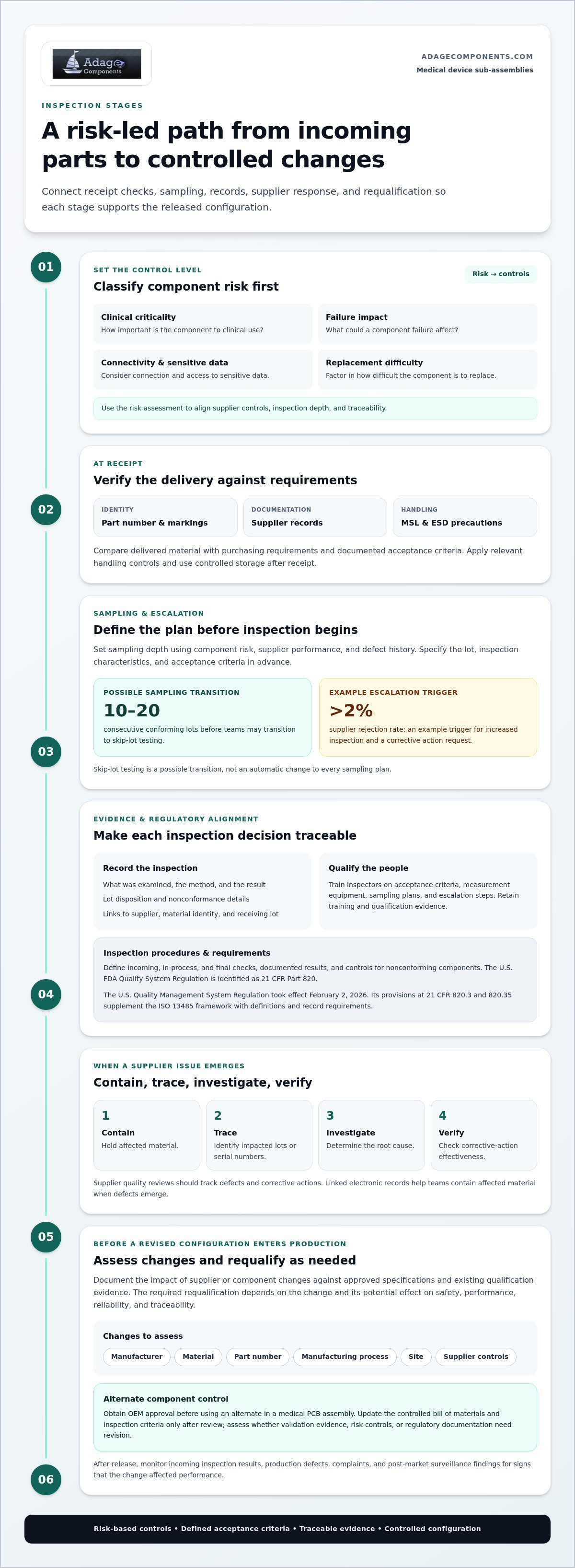
Inspection stages from incoming materials to post-market surveillance
Inspection connects incoming material checks with production controls and post-market review. Each stage needs defined acceptance criteria, trained personnel, and records linked to the controlled configuration.
This video explains how teams distinguish verification from validation and document inspection criteria:
Incoming Inspection and Sampling
Incoming inspection compares delivered material with purchasing requirements and documented acceptance criteria. Verify the part number, markings, and supplier records, and follow applicable handling controls, including moisture sensitivity level (MSL) and electrostatic discharge (ESD) precautions. Controlled storage protects parts after receipt.
Set sampling depth according to component risk, supplier performance, and defect history. A sampling plan defines the lot, inspection characteristics, and acceptance criteria before review begins. After typically 10-20 consecutive conforming lots, teams may transition to skip-lot testing. A supplier rejection rate exceeding 2% is an example trigger for increased inspection and a corrective action request.
Inspection Records and Supplier Quality
Inspection records should state what was examined, the method used, the result, and the lot disposition. Electronic records should link measurements and nonconformance reports to the supplier, material identity, and receiving lot. These links help teams quickly contain affected material when defects emerge.
Train inspectors on acceptance criteria, measurement equipment, sampling plans, and escalation steps. Record training and qualification evidence so staff apply controlled procedures consistently. Supplier quality reviews should track defects and corrective actions. When a supplier identifies a problem, contain affected material, trace impacted lots or serial numbers, determine the root cause, and verify that corrective actions are effective.
Inspection Regulatory Requirements
The U.S. Food and Drug Administration identifies the U.S. FDA Quality System Regulation as 21 CFR Part 820. Inspection procedures should define incoming, in-process, and final checks, with documented results and controls for nonconforming components. These records help demonstrate that inspections follow the established quality system.
The U.S. Quality Management System Regulation took effect on February 2, 2026. Its provisions at 21 CFR 820.3 and 820.35 supplement the ISO 13485 framework with definitions and record requirements. Align inspection procedures, training evidence, and electronic records with the requirements applicable to the device and market.
Requalification After Changes
Supplier or component changes require a documented impact assessment before the revised configuration enters production. Assess changes to the manufacturer, material, part number, manufacturing process, site, or supplier controls against approved specifications and existing qualification evidence. The required requalification depends on what changed and its potential effect on safety, performance, reliability, and traceability.
For a proposed alternate component, obtain OEM approval before using it in a medical PCB assembly. Update the controlled bill of materials and related inspection criteria only after review. Assess whether validation evidence, risk controls, or regulatory documentation need revision. After release, monitor incoming inspection results, production defects, complaints, and post-market surveillance findings for signs that the change affected performance.
Technical validation and released-configuration sampling
Technical validation demonstrates that a defined device configuration meets its acceptance criteria under intended conditions. Sampling and build evidence should identify the exact released revision, test method, and results. This lets teams distinguish qualified configurations from unreviewed changes.
Validate the Released Configuration
Start with the approved bill of materials, drawings, specifications, and applicable test programs. Confirm that each validation record identifies the component and revision tested. Results from one configuration cannot automatically support another if a component, process, or acceptance criterion has changed.
Define test methods before testing begins. Specify the characteristic under review, equipment, sample selection, acceptance criteria, and how failures will be recorded. For example, electrical testing can determine whether a component performs within its specified ratings in the released assembly. Document the tested configuration and link results to the corresponding build.
Sampling plans help make inspection decisions consistent. ANSI/ASQ Z1.4 and ISO 2859-1 are named sampling-plan standards. Use an appropriate plan to set inspection scope and acceptance criteria, considering component risk and the purpose of the test. Sampling supports a controlled decision; it does not replace design validation or justify using unapproved alternatives.
NPI and Pilot-Build Validation
An NPI or pilot build evaluates whether planned controls work on the production line before repeat production. Before the build, review DFM findings, BOM risk, component availability, and the inspection and test plan. During the build, verify material control, first-article inspection, reflow, AOI and X-ray coverage, and nonconformance handling.
Use the build to identify gaps between documented procedures and actual execution. Record defects, rework, test results, and material deviations against the build configuration. Then assign unresolved issues for closure before repeat production. This evidence helps teams assess production readiness rather than relying only on design-stage results.
Process and Biological Validation
Process validation assesses whether a controlled manufacturing process can repeatedly produce outputs that meet defined requirements. Identify the process parameters, equipment, operator steps, and output characteristics that affect acceptance. Retain the protocol, results, deviations, and approval with the relevant configuration records. Where inspection alone cannot establish process consistency, validation evidence is central to the release decision.
For a device with patient contact, ISO 10993-1 helps determine biocompatibility requirements based on the finished device’s contact classification. Microbiological testing and sterility validation should address the device’s intended use and sterilization approach. For devices supplied sterile in the European Union, EU MDR Article 23 addresses applicable sterilization standards. Keep the test rationale, acceptance criteria, and results traceable to the finished-device configuration.
When comparing electronic component categories for a released design, the electronic component line card can support the part review. Tie any selection decision to the approved configuration and its validation evidence.
Production and component traceability
Production traceability links each finished assembly to its approved configuration and manufacturing evidence. This connection helps teams investigate defects, control revisions, and assess production readiness.
Pilot Builds and Production Scaling
A supplier qualification pilot build tests whether production controls work together before repeat manufacturing. Confirm that material identity, component handling, equipment settings, inspection steps, and test records match the planned process. The build should also show whether the supplier can manage the specific PCB construction, component density, inspection requirements, and production volume.
Use pilot results to evaluate scaling risks, not just first-article acceptance. Review defects, rework, throughput constraints, and process deviations against the released requirements. For example, a placement issue may indicate a mismatch between the approved placement file and the machine program. Resolve identified issues and document process changes before scaling output.
Production Records and Configuration Control
Traceability should link finished boards to relevant component, PCB, revision, production, inspection, and test records. A board’s identity should lead to the component lots used and the build records showing how it was made and evaluated. This structure supports focused containment if a component failure affects a particular lot or configuration.
Control changes to the bill of materials, Gerber files, placement files, stencils, SMT programs, and test programs. Keep revision status visible in production to prevent old and new configurations from being mixed. Link each released build to its applicable files and approvals. A revision change without corresponding production records makes it harder to determine which assemblies are affected.
Sanitary No-Touch Product Areas
Some product areas should not contact automated assembly equipment. Syringe needle ends and tubes carrying bodily fluids are examples of sanitary no-touch areas that are unsuitable for automatic assembly. Identify these zones in product drawings and assembly instructions, then define handling and inspection controls to protect them.
Design teams should assess assembly implications before production, especially when integrating custom-extruded tubing or bespoke plastic sections from manufacturers such as Abbey Extrusions. A component’s shape, orientation, or access requirements can affect how operators and equipment handle nearby surfaces. Document permitted contact points and review them during the pilot build. This clarifies the boundary between automated operations and protected areas for production staff.
Repeat-Production Readiness
Before repeat production, compare pilot-build results with the approved process and resolve outstanding technical issues. Confirm that released files, material controls, inspection coverage, equipment programs, and test criteria reflect the same revision. Production planning should also account for component availability and known BOM risks.
Retain the approval record and supporting evidence with the configuration. A controlled release package helps production teams identify the correct instructions and quality teams trace deviations to the affected build. Reassess readiness after changes to parts, process steps, equipment, or inspection methods, since each can affect assembly performance and failure detection.
Component traceability and records
Traceability records show which components, revisions, and production evidence belong to a device configuration. A useful record system links a component’s origin to its use, inspection, and final assembly. This chain supports focused investigations when a field issue or production defect appears.
Build a Record Chain
Start with a clear identifier for each purchased component and incoming lot. Link it to the supplier, purchasing information, inspection outcome, and approved part revision. Connect that record to the relevant production build and finished device or assembly identifier. For example, an investigation can trace a device record back to the component lot used in its build.
A List of Critical Components (LoCC) captures a device and its components at a specific point in time. Tie each LoCC version to the corresponding design and released configuration. This snapshot helps reviewers distinguish what was approved at release from later component or design changes, and supports clear comparisons during technical or regulatory reviews.
Make Evidence Retrievable
ISO 13485:2016 provides the medical-device quality management system framework. Records should be attributable, versioned, tamper-evident, and retrievable for the device life or required retention period. An electronic quality management system can organize supplier documents, inspection results, approvals, deviations, and corrective-action evidence under consistent identifiers.
Define record ownership and access controls within the quality system. Reviewers should be able to locate relevant records without relying on an individual employee’s memory. Link test data to the tested configuration, method, and result. Preserve prior versions when a controlled document changes so the history shows which instructions governed each build.
Trace Changes and Critical Functions
Configuration history should show when a component or process changed, why the change was assessed, and which released builds used it. Link change records to the affected BOM, supplier evidence, inspection criteria, and validation results. This helps teams determine whether an issue concerns one lot, one revision, or a broader design configuration.
For components that support critical device functions, make the evidence trail especially direct. A machine-readable identifier can link a component record with the production system, but the record still needs to retain its meaning and context. Link the identifier to the approved part, supplier lot, build, and test evidence. This structure supports targeted investigation and documented decisions when failure data or post-market findings emerge.
U.S. FDA quality records must be traceable and available for audits. Organize electronic records so authorized reviewers can retrieve the applicable configuration, supplier, and inspection evidence together. A well-maintained record chain makes it easier to explain what was used, which controls applied, and how the finished device’s functions were evaluated.
Risk-based classification of purchased components
Classify purchased components by the consequences of failure, not by purchase price or part count. Clinical criticality, replacement difficulty, supplier concentration, connectivity, sensitive-data access, and failure impact help determine the appropriate qualification depth and ongoing controls.
Define Requirements Around Risk
How should component requirements, specifications, and critical-to-quality characteristics be defined? Translate the device’s intended function and hazards into measurable requirements, then identify characteristics that could affect safety or performance. Specify approved materials, dimensions, electrical ratings, interfaces, inspection methods, and acceptance criteria in controlled purchasing and design records.
A risk assessment should distinguish components that carry electrical charge in the supply circuit from those essential to safe operation. A LoCC can also identify parts whose failure could expose a patient or operator to mechanical, excessive-temperature, software, or information hazards. This classification links the component to the device-level consequence, not just its standalone specification.
Consider replacement difficulty and supplier concentration alongside technical impact. A readily replaceable part available from several qualified sources presents a different continuity risk from a critical component dependent on one supplier. Connectivity and access to sensitive data add another dimension for networked devices. These factors help quality management teams prioritize supplier evidence, incoming verification, and change assessment.
Scale Controls to the Component
Use defined risk categories to set qualification evidence and inspection intensity. For example, a safety-critical component may need stronger supplier controls and more specific acceptance criteria than a noncritical part. Supplier audits can examine manufacturing controls, change notification, traceability, and corrective-action practices. For critical suppliers, the guide suggests on-site audits every 1-3 years, depending on risk and performance.
Classification should also guide decisions about technical standards. IPC Class 3 should be specified for a medical PCB assembly based on intended use, reliability requirements, risk level, and customer specifications, rather than applied by default. The same principle applies to component requirements: select controls because the device risk calls for them.
Address Failures and Reassess
What are common component qualification failures, risks, and remediation steps? Typical issues include incorrect markings, inconsistent supplier lots, undocumented manufacturing changes, and components that fail defined acceptance criteria. Contain affected material, identify impacted lots, determine the root cause, implement corrective action, and verify its effectiveness before restoring normal controls.
Revisit classification when device use, supplier capability, component availability, or failure evidence changes. A component once considered low risk may need tighter controls if replacement becomes difficult or supplier concentration increases. Post-market findings can also reveal consequences that initial design assessments missed.
For teams assessing electronic parts against these risk controls, review electronic component categories as part of the requirements evaluation.
Adage Components: Thick Film Chip Resistors
Adage Components supplies Thick Film Chip Resistors, Thin Film Precision Resistors, Carbon Film Resistors, and MELF Resistors. For commercial and automotive grade component requirements, align the selected part with your released specifications and qualification controls. Adage connects customers with authentic components through direct, verified procurement and vetted manufacturers. Many partner suppliers are franchised by top 100 distributors.
Manufacturer pricing and OEM pricing support cost-conscious sourcing, while international logistics and short lead times help maintain supply continuity. Supplier quality processes include manufacturing audits; applicable certifications vary by partner. For example, Adage’s Diode OEM Partner holds ISO 9001, IATF 16949, ISO 14001, and QC080000 certifications. Contact Adage Components to discuss your component sourcing requirements.
Keep Qualification Aligned With Every Design Change
Treat a component qualification checklist for medical device sub-assemblies as a living decision framework, not a one-time release document. As designs, suppliers, and production conditions evolve, keep the rationale for each approval linked to the configuration it supports. This gives engineering, quality, and procurement teams a shared basis for future sourcing and design decisions.
For an upcoming BOM review, identify the component categories your team needs and align selection with established specifications and approval processes. Adage Components supplies electronic components, including resistor categories used in device designs. Component sourcing can support procurement planning while your team retains responsibility for qualification, validation, and regulatory controls.
For your next sourcing discussion, contact Adage Components about component requirements. A focused conversation can help your team move forward with sourcing decisions while keeping them aligned with controlled design and production records.
Frequently Asked Questions
What should a medical device sub-assembly component qualification checklist include?
A component qualification checklist for medical device sub-assemblies should document decision ownership as well as technical evidence. Record who reviewed the component, which functions it supports, what criteria govern approval, and how exceptions are resolved. Include a clear route for engineering and quality approval when documentation conflicts, such as a supplier drawing that differs from the released design specification.
Which FDA regulations and ISO standards apply to medical device sub-assembly qualification?
Applicable requirements depend on the device, its intended use, and the markets where it will be supplied. In the United States, consider the FDA Quality System Regulation, identified as 21 CFR Part 820, alongside ISO 13485. ISO 10993-1 may inform biological evaluation based on device contact. Electrical devices may also require assessment against IEC 60601-1 for safety-critical component ratings.
How do ISO 13485 and FDA QMSR requirements affect supplier qualification and component controls?
They make the manufacturer responsible for controlling purchased products and retaining evidence that purchasing requirements were met. In practice, purchasing information should clearly identify the approved component, applicable revision, and any required supplier notifications. If a supplier changes its manufacturing location or process, route the notice through formal change review before affected material enters production.
What documentation is required to qualify a medical device component or sub-assembly?
Build a qualification file that lets reviewers reconstruct the decision without relying on verbal explanations. Alongside the approved specification and test evidence, retain supplier declarations, material or compliance certificates when applicable, review approvals, and the rationale for unresolved deviations. Use consistent identifiers throughout. For example, the component revision in a test report should match the revision in the approved design record.
How should manufacturers assess supplier quality systems, capabilities, and performance?
Assess both the supplier’s controls and its ability to sustain the required production process. Examine process ownership, measurement capability, staff competence, capacity planning, and how supplier changes are communicated to customers. Performance reviews should distinguish isolated defects from recurring trends and track whether corrective actions prevent recurrence. A supplier scorecard can make the review actionable by linking each concern to an owner and follow-up evidence.
What incoming inspection, sampling plans, and acceptance criteria are appropriate for components?
Set acceptance criteria around measurable component characteristics and the risk of accepting a defect. For example, define the marking details needed to establish identity, then specify any dimensional or electrical checks required by the design. Consider measurement repeatability before relying on inspection results. Sampling should reflect the characteristic’s criticality and supplier history, with documented escalation rules for results outside acceptance criteria.
What verification and validation testing is required for medical device sub-assemblies?
Choose tests that answer specific design and use questions for the assembly. For example, assess whether mating parts fit as intended, electrical interfaces remain within design limits, and the assembled unit performs under its specified operating conditions. Set acceptance criteria before testing and retain configuration details with the results. If intended use involves patient contact or sterilization, include those conditions in the evaluation plan.
How should risk management under ISO 14971 be applied to component qualification?
Use ISO 14971 risk management to connect component-related failure scenarios with potential harm and appropriate controls. Consider how the component can fail, whether the failure is detectable before release, and what happens if it reaches the user. For example, a part whose failure could interrupt a critical device function may need tighter design controls and stronger evidence than a cosmetic enclosure feature. Update the assessment when new evidence emerges.
Disclaimer
Cross-referenced components needs to be confirmed by the client with either spec. sheet or samples or both.
Please note, we use AI to help us, information is verified to be correct but we can not guarantee 100% accuracy.


