
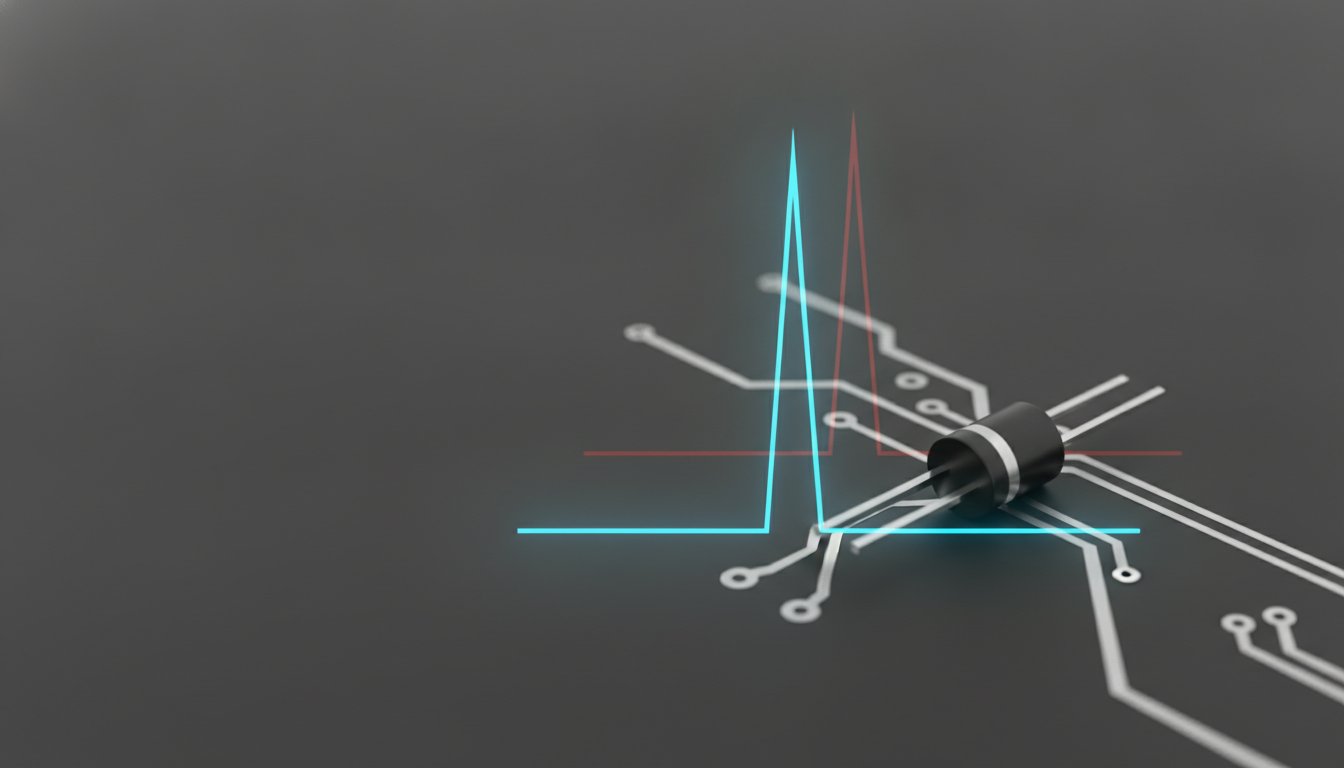
The industry standard reverse recovery metric is essentially a myth when applied to Schottky technology. While traditional PN junction diodes rely on minority carrier recombination, Schottky diodes operate as majority carrier devices, meaning their switching speed is limited only by junction capacitance rather than charge storage. Getting the schottky diode reverse recovery time explained correctly is the difference between a high-efficiency SMPS design and a catastrophic thermal runaway event in high-temperature environments. You likely already know that every nanosecond of delay in your power stage translates directly into heat and wasted energy, impacting your system's total power density.
We understand the pressure to balance high-frequency performance with rising BOM costs, especially as semiconductor prices surged by up to 35 percent in April 2026. This guide provides the technical clarity needed to master majority carrier physics while identifying reliable sourcing strategies for your next production cycle. We will explore how to specify the right diode for your MRP system requirements and why Adage Components offers a strategic advantage over Tier 1 distributors. You'll gain the insights necessary to secure authentic, ISO-certified components at manufacturer pricing, ensuring your logistics program remains resilient and your designs stay ahead of the competition.
Key Takeaways
- Understand how majority carrier physics eliminate minority carrier storage, providing the fundamental reason behind the negligible reverse recovery in metal-semiconductor junctions.
- Get the schottky diode reverse recovery time explained by distinguishing between true charge storage and capacitive displacement current to optimize SMPS thermal management.
- Master the selection framework to choose between Schottky diodes and Fast Recovery Diodes (FRDs) by balancing the 200V threshold against forward voltage drop requirements.
- Discover how to bypass the inflated margins of Tier 1 distributors by sourcing authentic, automotive-grade components directly from Adage Components at OEM pricing.
- Learn to optimize your MRP system with our international logistics program, ensuring ISO-certified diodes reach your facility with short lead times and verified authenticity.
Understanding the Physics: Why Schottky Diodes Have Negligible Reverse Recovery Time
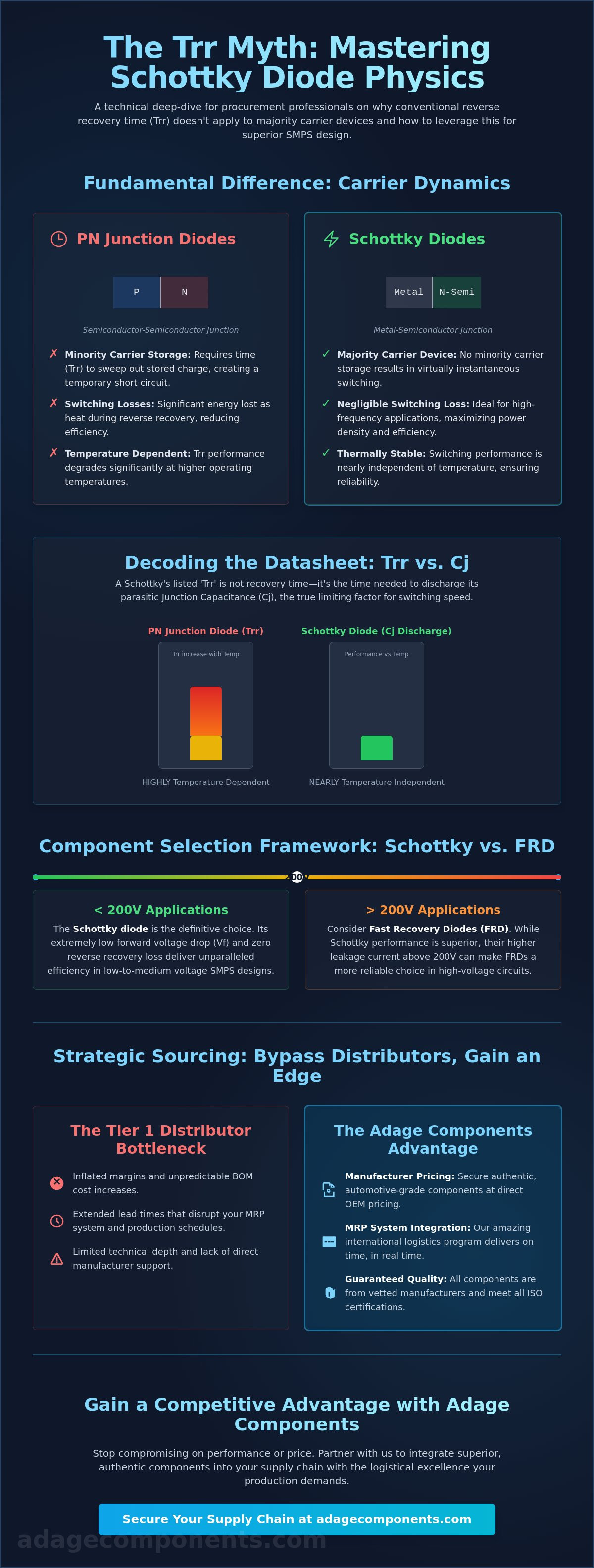
Standard silicon PN junction diodes are defined by their switching latency. When bias reverses, these components don't block current immediately. They require a specific interval, known as reverse recovery time (trr), to sweep out minority carriers from the junction. This lag generates heat and electromagnetic interference (EMI). Having the schottky diode reverse recovery time explained through the lens of physics reveals why this component is the superior choice for high-frequency switching. Unlike PN junctions, the Schottky architecture is a majority carrier device. It utilizes a metal-semiconductor interface rather than a semiconductor-semiconductor junction, fundamentally altering its electrical behavior.
Majority Carriers vs. Minority Carrier Storage
In a standard diode, holes and electrons must recombine or be physically removed before the device can block reverse voltage. This process creates "diffusion capacitance," a storage of charge that acts as a temporary short circuit during every switching cycle. Schottky diodes bypass this bottleneck entirely. Because current is carried exclusively by electrons (majority carriers) moving from the semiconductor into the metal, there is no minority carrier storage. This absence of stored charge means the "recovery" process is nearly instantaneous. For engineers, this translates to zero switching energy losses related to charge recombination. It's a critical factor when optimizing your BOM for high-efficiency power supplies where every milliwatt counts.
Metal-Semiconductor Junction Dynamics
The performance of a Schottky diode is dictated by the barrier height of the metal layer. At Adage Components, we ensure our partner suppliers utilize specific metalizations like titanium, tungsten, or platinum to balance forward voltage drop (Vf) with leakage current. Titanium typically offers the lowest Vf, while platinum provides better stability at higher temperatures. This construction allows for a frequency response reaching up to 100GHz. Because there is no diffusion capacitance to overcome, the only limiting factor is the parasitic junction capacitance (Cj). We provide these technical insights to help procurement officers select the right automotive-grade components that integrate with existing MRP systems.
Our state-of-the-art warehouse operations ensure that these high-performance diodes are available with short lead times. We position Adage Components as a strategic alternative to Tier 1 distributors, offering the same rigorous testing and ISO certifications at manufacturer pricing. By focusing on the physics of the metal-semiconductor junction, we help you mitigate thermal runaway risks in high-stakes industrial environments. Our international logistics program delivers these authentic components in real time, on time. We maintain the integrity of your production schedule without the inflated costs often associated with franchised distributors.
Schottky trr vs. Junction Capacitance: What the Data Sheets Actually Mean
Engineering teams often struggle to reconcile datasheet values with actual circuit performance. While the previous section established that majority carrier physics eliminate stored charge, datasheets still frequently list a reverse recovery time. In reality, this value represents the time required to charge or discharge the parasitic junction capacitance (Cj). Getting the schottky diode reverse recovery time explained requires distinguishing this capacitive displacement current from the minority carrier recombination found in standard silicon diodes. Because Cj is a physical property of the metal-semiconductor interface, it acts as the primary frequency bottleneck. As reverse voltage (VR) increases, the depletion layer widens. This reduces capacitance and improves switching speed. Crucially, this process is nearly independent of temperature. While a standard diode's trr might double at 125°C, a Schottky diode maintains consistent performance, mitigating thermal runaway risks in high-density power modules.
The LC Resonance Factor
High-speed transitions often trigger parasitic ringing that engineers mistake for recovery delay. This phenomenon occurs when the diode's junction capacitance interacts with the parasitic inductance of the PCB traces or component leads. The resulting LC resonance creates an oscillatory waveform during turn-off. You can estimate this resonance frequency using the standard formula: f = 1 / (2π√LC). Minimizing lead length is essential for high-frequency SMPS designs. At Adage Components, we source from vetted manufacturers who ensure tight physical tolerances. This helps you manage parasitic effects without over-engineering your BOM or incurring unnecessary costs.
Data Sheet Interpretation for Engineers
Procurement professionals should look beyond the trr column when evaluating high-stakes designs. The Total Capacitive Charge (Qc) is often a more accurate predictor of switching losses in these devices. For instance, a 10ns Schottky will significantly outperform a 50ns Fast Recovery Diode (FRD) in high-frequency applications. However, a specific trade-off exists: lower forward voltage (Vf) often necessitates a larger die size, which naturally increases junction capacitance. Balancing these parameters is critical for maintaining system efficiency. We provide comprehensive diode sourcing options that allow you to match specific electrical requirements with OEM pricing. By integrating our technical data directly into your MRP system, you can secure authentic, commercial-grade components that meet strict ISO certifications while reducing your total BOM cost.
Adage Components acts as a strategic problem solver by offering manufacturer pricing on both commercial and automotive grade components. Our state-of-the-art warehouse operations ensure that these critical parts reach your facility in real time, on time. We eliminate the friction of fragmented marketplaces by providing a steady supply of authentic parts. This disciplined expertise allows your team to focus on performance rather than supply chain volatility.
Practical Application Impacts: Efficiency, EMI, and Thermal Management
The transition from theoretical physics to benchtop performance is where the schottky diode reverse recovery time explained in earlier sections becomes a competitive advantage. In Switched-Mode Power Supply (SMPS) designs and high-speed DC-DC converters, the negligible reverse recovery charge translates directly into higher conversion efficiency. Because there is no minority carrier recombination, the power dissipated during the turn-off phase is nearly zero. This efficiency is paramount for 2026 power systems, especially as global semiconductor sales hit $88.8 billion in February 2026, driven by high-density AI server requirements. For solar inverters and automotive charging infrastructure, these efficiency gains allow for smaller heat sinks and higher power density, directly impacting your total BOM cost and system footprint.
EMI Mitigation in High-Speed Circuits
Standard diodes produce abrupt current spikes during reverse recovery, which act as significant sources of high-frequency noise. Schottky diodes eliminate these spikes, resulting in much cleaner switching waveforms. This characteristic is a major asset for engineering teams working to pass stringent EMC certification standards without excessive filtering. However, you must still account for the "LC resonance" created by the interaction between junction capacitance and PCB trace inductance. While the recovery is clean, this resonance can still cause high-frequency ringing. In many cases, a simple RC snubber circuit is sufficient to dampen these oscillations. We source automotive-grade Schottky diodes from vetted manufacturers to ensure that your high-speed designs remain stable and compliant under real-world operating conditions.
Thermal Stability and Lifecycle Management
While Schottky diodes excel in switching speed, they present a specific challenge regarding reverse leakage current. As the junction temperature rises, the leakage current increases exponentially. This creates a positive feedback loop: higher leakage leads to more heat, which further increases leakage. Thermal runaway is the critical failure mode to monitor in high-temperature Schottky applications. To mitigate this risk, meticulous heat sink design and precise component selection are mandatory. Adage Components provides deep technical support to help you balance the low forward voltage drop of our diodes with the necessary thermal margins for your specific environment. We offer BOM cost analysis to identify where high-temperature stable Schottky variants are required versus where standard rectifiers might suffice.
Adage Components acts as your strategic partner by bridging the gap between technical requirements and procurement reality. Our state-of-the-art warehouse and international logistics program ensure that you receive authentic, ISO-certified components with short lead times. We offer manufacturer pricing that bypasses the traditional markups of Tier 1 distributors. This allows you to maintain high-performance standards in your SMPS and inverter designs while achieving the best cost in the industry. By integrating our supply chain expertise with your MRP system, we ensure your production lines remain operational and efficient, even in a volatile global market.
Schottky vs. Fast Recovery Diodes (FRD): A Selection Framework
Choosing between Schottky and Fast Recovery Diodes (FRD) requires a rigorous evaluation of your system's voltage and thermal constraints. While we've seen the schottky diode reverse recovery time explained as a function of majority carrier physics, FRDs rely on minority carrier recombination. This fundamental difference creates a performance gap in forward voltage drop (Vf). A typical Schottky diode offers a Vf of approximately 0.3V, whereas an FRD often exceeds 1.0V. This 70 percent reduction in forward loss makes Schottky the default choice for secondary rectification in low-voltage power stages. However, silicon Schottky diodes face a physical barrier around 200V. Above this threshold, reverse leakage current becomes excessive and breakdown risks increase. This is where FRDs or Ultra-fast variants take over, providing the necessary robust blocking capabilities for high-voltage industrial applications.
Adage Components understands that balancing BOM costs with high-frequency performance is a primary pain point for procurement officers. In high-volume manufacturing, the cost difference between a standard FRD and a high-performance Schottky can be significant. We mitigate this by offering manufacturer pricing that bypasses the traditional markups of Tier 1 distributors. Our state-of-the-art warehouse ensures that whether you specify a Schottky for efficiency or an FRD for voltage resilience, you receive authentic, ISO-certified components that integrate seamlessly with your MRP system. We provide the disciplined expertise required to source these parts in a volatile global market where lead times for industrial components can exceed 20 weeks.
When to Specify Schottky Barrier Diodes
Specify these for low-voltage, high-efficiency secondary rectification where thermal margins are tight. They're mandatory for battery-powered devices where every milliwatt saved extends operational life. Their near-instantaneous switching also makes them a natural fit for high-frequency signal detection and clamping. At Adage Components, we ensure these parts reach your facility in real time, on time, through our amazing international logistics program. We focus on providing the best cost in the industry without compromising the rigorous testing standards your automotive and commercial projects demand.
When to Opt for Fast or Ultra-Fast Recovery Diodes
Use FRDs when your application exceeds the 200V limit or when high-temperature reverse leakage poses a prohibitive risk of thermal runaway. These components are essential for high-voltage bridge rectifiers and motor drive circuits where blocking reliability is the priority over forward voltage drop. You can view our full range of specifications on the Adage Components Linecard to find the exact match for your design. We offer drop-in replacements for industry-standard diodes, allowing you to maintain production continuity even when franchised distributors report stock-outs.
Our commitment to quality assurance means every component is sourced from vetted manufacturers and partner suppliers. We don't just act as a vendor; we're an elite partner that thrives on solving difficult sourcing puzzles for your high-stakes projects. Review our comprehensive diode sourcing options to secure the manufacturer pricing and technical reliability your facility requires today.
Sourcing Schottky Diodes: Strategic Procurement for OEMs
Sourcing high-performance Schottky diodes in a volatile market requires more than just technical knowledge. While having the schottky diode reverse recovery time explained helps engineers optimize high-frequency designs, procurement officers must solve the logistical puzzle of availability and cost. Tier 1 distributors often carry heavy overheads that inflate unit prices and complicate lead times. Adage Components operates as a private label manufacturer, offering drop-in replacements for industry-standard diodes at OEM pricing. This approach allows your team to maintain identical performance specifications while significantly reducing total BOM spend. We act as a strategic problem solver, bridging the gap between a fragmented marketplace and your specific production requirements.
BOM Cost Analysis and OEM Pricing
We eliminate the friction of traditional distribution by providing direct manufacturer pricing on both commercial and automotive grade components. By integrating our supply chain data with your existing MRP system, we facilitate a seamless transition that supports just-in-time manufacturing. Our strategic stocking programs are designed to mitigate the volatility seen in mid-2026, where lead times for many discrete semiconductors have surpassed 20 weeks. We invite you to utilize our BOM Submission Form for a comprehensive cost-saving analysis. This tool identifies opportunities to swap high-margin franchised brands for our ISO-certified equivalents without compromising system integrity or switching speed.
Quality Assurance and Authentic Sourcing
Reliability is non-negotiable in the industrial and automotive sectors. Adage Components maintains a state-of-the-art warehouse where every batch undergoes a multi-stage inspection process to ensure 100 percent authentic semiconductors. We only work with vetted manufacturers and partner suppliers who comply with all international ISO certifications. This rigorous focus on quality assurance creates a consistent link between rapid fulfillment and operational safety. Our amazing international logistics program ensures that these verified components reach your facility in real time, on time, regardless of global supply chain constraints.
We don't position ourselves as a mere vendor. Adage Components is an elite partner committed to solving your most difficult sourcing challenges with disciplined expertise. By choosing our private label solutions, you secure the best cost in the industry and a steady supply chain partner that values your time as a critical resource. We are perpetually ready for immediate operational engagement. Contact us today to initiate a transactional inquiry and stabilize your component pipeline for the 2026 production cycle.
Secure Technical Excellence and OEM Pricing
Mastering the technical nuances of metal-semiconductor junctions ensures your high-frequency power systems operate at peak efficiency. Having the schottky diode reverse recovery time explained as a function of junction capacitance rather than minority carrier storage allows you to specify components that mitigate thermal runaway and EMI more effectively. Transitioning from Tier 1 distributors to a strategic private label partner allows you to maintain these rigorous standards while securing the best cost in the industry. Adage Components stands ready as your elite partner in this volatile global market.
We provide ISO certified quality management and a state-of-the-art warehouse infrastructure to ensure your facility receives authentic parts in real time, on time. Our amazing international logistics program and global stocking strategies eliminate the friction of extended lead times. We offer OEM pricing on high-volume component orders to keep your production lines moving without the typical distributor markup. Request a Quote for High-Performance Schottky Diodes and experience the reliability of a disciplined supply chain partner. We look forward to optimizing your BOM and supporting your long-term growth.
Frequently Asked Questions
Does a Schottky diode have a reverse recovery time?
Schottky diodes don't have a reverse recovery time in the traditional sense because they're majority carrier devices. Unlike PN junction diodes, there's no minority carrier recombination required to block reverse current. The recovery seen on datasheets is actually the time required to charge or discharge the parasitic junction capacitance. This makes them ideal for high-speed switching where standard silicon recovery delays would cause unacceptable power loss and heat.
How does temperature affect Schottky diode switching speed?
Temperature has a negligible effect on the switching speed of a Schottky diode. Since their operation relies on majority carriers rather than minority carrier recombination, the switching dynamics remain stable even at elevated temperatures. In contrast, standard recovery diodes see significant trr increases as heat rises. This thermal stability allows Adage Components to provide reliable, automotive-grade parts that maintain performance consistency in high-stakes environments without the volatility of franchised distributors.
Why do Schottky diodes have high reverse leakage current?
High reverse leakage current is a result of the lower barrier height at the metal-semiconductor junction. This lower barrier enables the desirable low forward voltage drop but it also allows more electrons to flow in reverse under bias. This leakage increases exponentially with temperature, making thermal management a critical priority. We help OEMs mitigate this risk by sourcing authentic components from vetted manufacturers that balance efficiency with thermal stability.
What is the difference between Schottky and Fast Recovery Diodes?
The primary difference lies in the junction physics and voltage capabilities. Schottky diodes use a metal-semiconductor junction for near-instantaneous switching and low forward voltage, typically limited to 200V. Fast Recovery Diodes use a PN junction optimized for speed and can handle much higher voltages. Choosing the right component depends on your specific SMPS requirements and MRP system parameters. Adage Components offers both technologies at manufacturer pricing to optimize your BOM.
Can Schottky diodes be used in high-voltage applications?
Standard silicon Schottky diodes are generally limited to applications below 200V due to excessive leakage at higher reverse voltages. For high-voltage requirements, Silicon Carbide (SiC) Schottky diodes are the industry standard, supporting ratings of 650V to 1200V. We provide high-voltage solutions that integrate with your existing logistics program, ensuring you get the best cost in the industry without the inflated markups typical of Tier 1 distributors.
What is junction capacitance in a Schottky diode and why does it matter?
Junction capacitance is the parasitic capacitance formed at the metal-semiconductor interface and it's the primary factor limiting switching speed. While there's no stored charge to remove, this capacitance must be charged and discharged during every cycle. This displacement current can cause ringing and EMI. Having the schottky diode reverse recovery time explained as a capacitive effect helps engineers design snubbers and optimize PCB layouts for maximum high-frequency efficiency.
How does trr impact the efficiency of a power supply?
Reverse recovery time directly dictates the switching losses in a power supply. Every time a diode transitions from conducting to blocking, energy is dissipated as heat during the trr interval. By using Schottky diodes with negligible recovery times, you eliminate these losses, significantly improving overall SMPS efficiency. This reduction in heat allows for smaller thermal solutions, helping you balance BOM costs with the performance requirements of state-of-the-art warehouse and server systems.
Are Schottky diodes better for EMI/EMC compliance?
Schottky diodes are superior for EMI/EMC compliance because they eliminate the abrupt current spikes associated with minority carrier recombination. These spikes are a major source of high-frequency conducted and radiated noise in power circuits. Using Schottky technology leads to cleaner switching waveforms, reducing the need for complex filtering. Adage Components ensures all commercial and automotive grade components meet strict ISO certifications, providing the technical reliability needed to pass stringent regulatory audits.
Disclaimer
Cross-referenced components needs to be confirmed by the client with either spec. sheet or samples or both.
Please note, we use AI to help us, information is verified to be correct but we can not guarantee 100% accuracy.


