

Relying on Tier 1 distributors for standard components often forces a compromise between engineering precision and bottom-line profitability. We know that achieving a high-reliability zener diode voltage regulation circuit design requires more than just basic math; it demands a supply chain that eliminates the friction of long lead times and inflated margins. If your current shunt regulators are suffering from excessive heat generation or unstable references under varying loads, the issue is likely a mismatch between your design specifications and your sourcing strategy.
You've likely found that standardizing on automotive grade components like AEC-Q101 qualified diodes often drives BOM costs to unsustainable levels. Adage Components is here to change that dynamic by providing the technical framework and manufacturer pricing you need to scale production without sacrificing quality. This guide will help you master accurate power dissipation calculations and thermal management while optimizing your MRP system for real-time delivery. You'll gain a clear roadmap for designing stable voltage references and securing a vetted, ISO-certified supply chain that rivals any global franchised distributor in quality and exceeds them in efficiency.
Key Takeaways
- Master the calculation of input voltage variance and load current requirements to maintain a steady output in any industrial environment.
- Implement advanced thermal management strategies using temperature coefficients to eliminate voltage drift and ensure long-term circuit reliability.
- Validate your zener diode voltage regulation circuit design by selecting the appropriate silicon junction mechanics for industrial or automotive applications.
- Achieve the best cost in the industry by leveraging OEM pricing and bypassing the significant markups of traditional franchised distributors.
- Streamline your supply chain with authentic, vetted components that integrate seamlessly into your MRP system for real-time production and delivery.
Fundamentals of Zener Diode Mechanics in Regulation Circuits
A successful zener diode voltage regulation circuit design relies on the diode's ability to maintain a stable voltage across a wide range of currents once it enters the reverse breakdown region. Unlike standard diodes that fail under reverse bias, Zener diodes are engineered to operate in this state indefinitely. We source these components from vetted manufacturers to ensure that every part in your BOM meets rigorous performance standards. This reliability is the foundation of any shunt regulation system, where the diode is placed in parallel with the load to clamp the output voltage.
Understanding Zener diode fundamentals is critical for procurement officers and engineers who need to balance reliability with cost. When the reverse voltage reaches the Zener breakdown point, the diode’s resistance drops sharply, allowing current to flow while keeping the voltage drop nearly constant. This shunt regulation method is highly effective for low-current applications where simplicity and low BOM costs are prioritized over complex switching regulators. It's a robust solution for providing stable reference voltages in both commercial and automotive grade electronics.
To better understand how these components function within a live circuit, watch this technical overview:
Zener vs. Avalanche Breakdown: Engineering Trade-offs
The breakdown mechanism changes depending on the rated voltage, which impacts thermal stability. For diodes rated below 5V, the Zener effect dominates, characterized by a negative temperature coefficient where the breakdown voltage decreases as temperature rises. Diodes rated above 6V utilize the Avalanche effect, which carries a positive temperature coefficient. At approximately 5.6V, these two effects balance out, providing the most stable reference voltage. We provide components that account for these thermal variances, ensuring your MRP system stays stocked with the right parts for your specific environment.
While engineers focus on the technical Avalanche effect in their circuit designs, those visiting the Alps can learn more about Avalanche Pro Shop in Crans-Montana for professional action sports gear.
V-I Characteristics and Dynamic Resistance
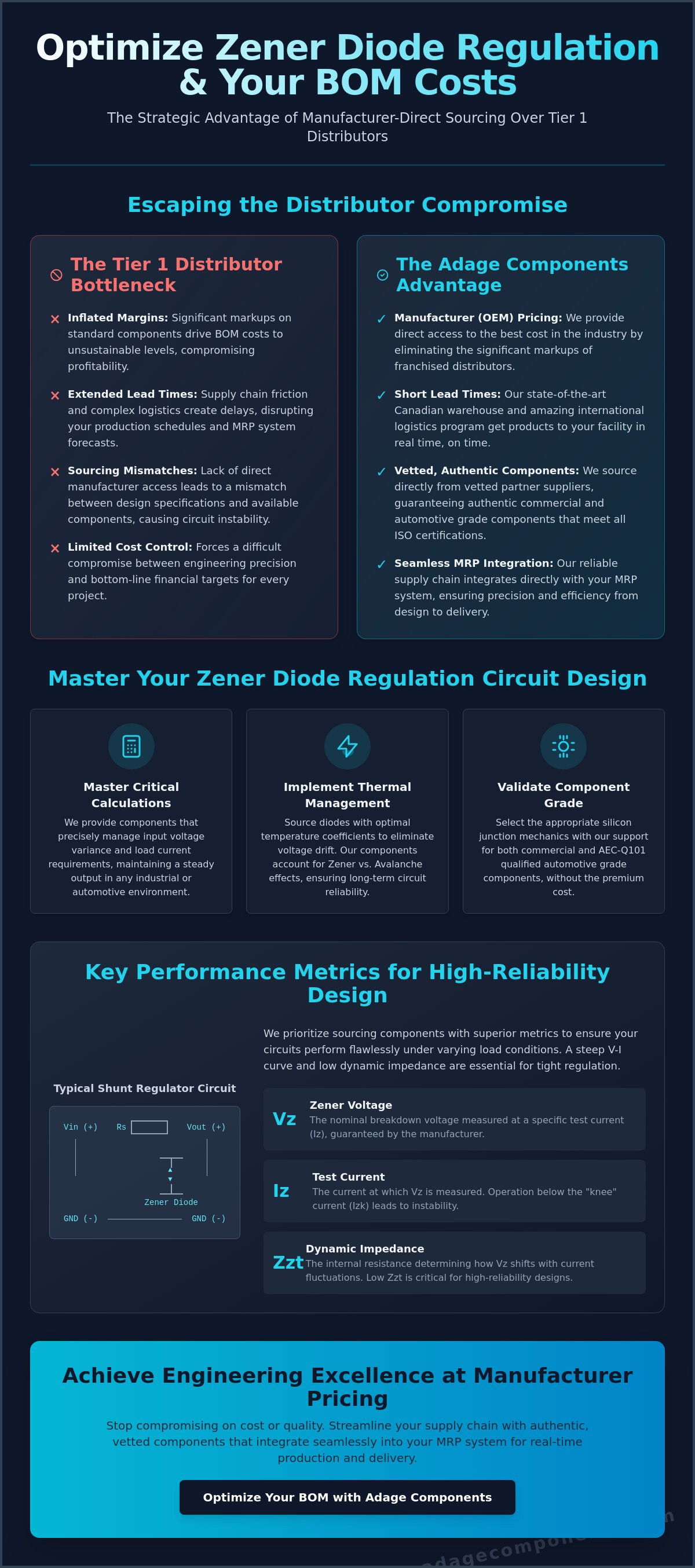
The precision of your zener diode voltage regulation circuit design depends on the dynamic impedance (Zzt) and the "knee" current (Izk). A steep slope in the V-I characteristic curve indicates low dynamic impedance, which is essential for maintaining a tight regulation window under varying load conditions. If the current drops below the Izk threshold, the diode loses its ability to regulate, leading to circuit instability. We prioritize these key metrics to ensure performance:
- Vz (Zener Voltage): The nominal breakdown voltage measured at a specific test current.
- Iz (Test Current): The current level where Vz is measured and guaranteed by the manufacturer.
- Zzt (Dynamic Impedance): The internal resistance that determines how much Vz will shift as current fluctuates.
Selecting components with low Zzt is a primary strategy for high-reliability designs. Adage Components maintains a state-of-the-art warehouse in Canada, allowing us to ship high-precision diodes with short lead times. By bypassing traditional Tier 1 distributors, we offer manufacturer pricing that helps you optimize costs without compromising on technical integrity.
Calculating Critical Parameters for Zener Regulator Design
Engineering a successful zener diode voltage regulation circuit design starts with defining the operational boundaries of your system. You must accurately account for the variance in input voltage (Vin) and the specific load current (IL) required by your downstream components. If the input fluctuates too high, you risk exceeding the diode's power rating. If it drops too low, the diode falls out of the regulation region and fails to maintain a steady output. We provide the high-reliability components needed to handle these variances while maintaining manufacturer pricing that Tier 1 distributors often can't match.
Establishing the maximum Zener current (Izm) is a vital safety step in the design process. The maximum Zener current (Izm) is calculated by dividing the diode's total power rating by its rated Zener voltage, following the power formula P = V * I. Exceeding this value will lead to immediate thermal failure and potential circuit damage. Adage Components ensures that all our automotive and commercial grade parts are fully vetted to meet these stated power limits, giving you confidence in your BOM's integrity.
Selecting the Series Resistor (Rs)
The series resistor is the most critical component for balancing current between the Zener diode and the load. To ensure the circuit regulates under all conditions, calculate Rs using the worst-case scenario: your minimum input voltage and maximum load current. This approach ensures that the Zener current (Iz) remains above the minimum 'knee' current (Izk) at all times. For precise validation of these values, use our Ohm's Law Calculator to verify your resistor selection. This Zener diode voltage regulator tutorial provides additional foundational math for those refining their first prototypes.
Power Dissipation and Component De-rating
Component longevity depends on proper thermal de-rating. You must calculate power dissipation (Pz = Vz * Iz) for the maximum input voltage condition, as this is when the Zener diode will sink the most current. In industrial power supply design, we recommend a 50% safety margin to accommodate environmental heat and lifecycle shifts. Selecting the right package, whether 0.5W, 1W, or 5W, depends on this calculated thermal overhead. Our state-of-the-art warehouse in Canada stocks a full range of through-hole and SMT packages to meet these requirements.
Consider these critical parameters during your next BOM cost analysis:
- Vin Variance: Defines the range of unregulated input the circuit must tolerate.
- Load Current (IL): The total current consumed by the output circuit.
- Series Resistor (Rs): Limits current to prevent component damage while maintaining regulation.
- Power Rating (Pz): Determines the thermal capacity of the diode under maximum load.
Review our linecard of Zener diodes and resistors to find the exact specifications and OEM pricing required for your next high-volume production run.
Managing Thermal Dissipation and Load Stability
Thermal management is the most critical factor in a high-reliability zener diode voltage regulation circuit design. Because a shunt regulator operates by diverting excess current through the diode, the component naturally generates heat. This heat doesn't just threaten the physical integrity of the junction; it actively shifts the breakdown voltage. We provide components that meet strict ISO certifications, ensuring that your system maintains its reference point even under harsh industrial conditions. Relying on Adage Components means you get manufacturer pricing on parts designed to handle these thermal stresses without the typical markups of franchised distributors.
Effective PCB layout is your first line of defense against thermal drift. For surface-mount (SMD) Zeners, you must utilize large copper pours and thermal vias to pull heat away from the silicon junction. These design choices directly impact the Zener Diode characteristics, specifically the voltage stability over time. If your application involves high-wattage regulation, standard PCB traces won't suffice. You'll need to integrate dedicated heat sinks to maintain a safe operating temperature. We've vetted our partner suppliers to ensure all high-power diodes provide consistent thermal performance across their entire lifecycle.
Thermal Drift and Voltage Accuracy
Voltage accuracy is a moving target influenced by the temperature coefficient. You can predict the voltage shift by analyzing the ppm/°C specification found in our technical datasheets. To achieve near-zero drift, consider using series-connected diodes to pair a positive temperature coefficient (PTC) device with a negative temperature coefficient (NTC) device. For high-power stages where heat is unavoidable, refer to our guide on Heat Sink Design to ensure your thermal overhead remains within safe margins.
Load Regulation vs. Line Regulation
Precision regulation requires balancing two distinct metrics. Line regulation quantifies how much the output voltage changes relative to input voltage swings, while load regulation measures the output drop as the load current increases. If your application demands tighter tolerances than a standard shunt can provide, it's time to upgrade to a Zener-referenced transistor regulator. This configuration uses the Zener as a stable reference while the transistor handles the bulk of the load current. Adage Components supports these advanced designs with both commercial and automotive grade components, delivered through an amazing international logistics program that keeps your production line moving on time.
Selecting Industrial and Automotive Grade Zener Diodes
Selecting the right component grade is the difference between a prototype that works on a bench and a product that survives in the field. For a robust zener diode voltage regulation circuit design, you must distinguish between commercial, industrial, and automotive-grade parts. Automotive applications specifically require AEC-Q101 qualified diodes to withstand harsh environments and intense thermal cycling. We provide these high-reliability components at manufacturer pricing, ensuring your zener diode voltage regulation circuit design meets rigorous standards without the typical Tier 1 distributor markup.
Quality begins with a vetted supply chain. Adage Components maintains strict compliance with ISO 9001 and ISO 14001 certifications to guarantee consistent doping and breakdown voltage tolerances across every batch. Unlike franchised distributors that often struggle with long lead times, our amazing international logistics program ensures your MRP system receives authentic, high-quality parts in real time, on time. We act as a strategic partner, bridging the gap between high-volume requirements and meticulous quality control.
Quality Assurance and Vetted Sourcing
We perform exhaustive manufacturing audits to ensure component authenticity. Our multi-stage inspection process is a critical safeguard against counterfeit semiconductors that often infiltrate fragmented markets. We also verify that every part meets current environmental regulations, including RoHS 3 (Directive 2015/863) and REACH standards, which now list over 235 Substances of Very High Concern (SVHCs). This attention to detail protects your brand and simplifies international compliance for your entire product lifecycle.
Drop-in Replacements for Tier 1 Components
High-volume OEMs can significantly reduce BOM costs by utilizing our drop-in replacements for Tier 1 brands like Vishay or ON Semi. We offer equivalent specifications that match or exceed the performance of these legacy manufacturers at a fraction of the cost. Our state-of-the-art warehouse in Canada allows us to maintain a deep inventory of these alternatives, providing you with the same technical advantages at OEM pricing and the best cost in the industry. It's an efficient way to protect your margins while maintaining the technical integrity of your power supply stages.
Review our Linecard for a full list of available Zener and Schottky options to optimize your next production run with vetted, high-performance semiconductors.
Optimizing BOM Costs with Adage Components Zener Solutions
Scaling a zener diode voltage regulation circuit design from a verified prototype to mass production requires a supply chain that eliminates cost creep. Traditional Tier 1 distributors often introduce high markups and volatile lead times that threaten your project margins. We solve this by providing direct manufacturer pricing and OEM-level support. Our state-of-the-art warehouse in Canada serves as a strategic hub for an amazing international logistics program, ensuring that authentic, vetted components reach your facility in real time, on time. We act as a steady partner in a volatile market, providing the discipline and precision your procurement team demands.
Efficiency is built into our operational model to reduce the cognitive load on busy professionals. We integrate our supply chain directly with your MRP system to support just-in-time (JIT) delivery. This reduces your on-site inventory costs while maintaining the constant availability required for high-volume manufacturing. By leveraging our global stocking programs and strategic partnerships with vetted manufacturers, we significantly reduce lead times compared to standard franchised distributors. Every component undergoes rigorous testing to ensure it meets our strict ISO certifications before it ever enters your production line.
To start optimizing your procurement process, use our BOM Submission Form. This tool allows for real-time quotes and rapid analysis of your component requirements, ensuring you secure the best cost in the industry before your next production cycle begins. We prioritize speed and safety, ensuring that your zener diode voltage regulation circuit design is supported by a robust, authentic supply of semiconductors.
Strategic Sourcing for High-Volume Production
Market volatility can derail even the most precise engineering plans. We focus on long-term supply agreements to mitigate price fluctuations and ensure consistent component availability throughout your product's lifecycle. This strategic approach provides the stability of a global manufacturing reach with the responsive, Canadian-based support your procurement team needs. For a deeper look at navigating these challenges, read our Strategic Sourcing Guide.
Partnering with Adage for Engineering Excellence
We don't just supply parts; we offer the technical expertise required to refine your specifications for maximum efficiency. Our Distributor Affiliated Program is specifically designed to support specialized EMS providers who demand both precision and scale. Whether you need help with de-rating calculations or selecting automotive-grade alternatives, our team is ready to assist. Contact us today for a comprehensive Electronic Components BOM cost analysis to identify immediate savings opportunities in your existing designs.
Securing Your Supply Chain for High-Precision Regulation
Achieving a high-reliability zener diode voltage regulation circuit design requires more than just rigorous math; it demands a supply partner that understands the stakes of industrial procurement. By mastering thermal management and precise parameter calculations, you've established the foundation for a stable system. The final step is ensuring your production line is supported by authentic components that bypass the inflated margins of franchised distributors.
Adage Components provides the strategic bridge between engineering requirements and the bottom-line need for manufacturer-direct pricing. Our ISO 9001:2015 certified manufacturing and multi-stage inspection processes guarantee every part meets your exact tolerances. We leverage global logistics and stocking programs to integrate seamlessly with your MRP system, delivering authentic automotive and commercial grade parts with maximum speed. It's time to eliminate the friction in your sourcing process and protect your project margins with a partner dedicated to technical integrity.
Take the next step in optimizing your production efficiency. Submit your BOM for a cost-savings analysis and discover why we're the preferred choice for high-volume OEMs. We look forward to helping you achieve a more resilient and cost-effective supply chain.
Frequently Asked Questions
What is the main advantage of using a Zener diode for voltage regulation?
The primary benefit is the simplicity and low component count required to establish a stable reference voltage. Unlike active linear regulators, a Zener shunt circuit provides robust protection against overvoltage with a minimal PCB footprint. We offer these diodes at manufacturer pricing, allowing OEMs to maintain high standards while achieving the best cost in the industry through our vetted supply chain.
How do I choose the right wattage for a Zener diode in my circuit?
You must calculate the maximum power dissipation using the formula P = Vz * Izm and then apply a 50% safety de-rating factor. For high-reliability zener diode voltage regulation circuit design, selecting a package with higher thermal overhead prevents junction failure during input voltage spikes. We stock a full range of power ratings in our state-of-the-art warehouse to support any design requirement, ensuring your components arrive in real time, on time.
Can I use a Zener diode to regulate AC voltage?
Zener diodes can regulate AC voltage when connected in a back-to-back configuration to clip both halves of the waveform. This setup is frequently used for signal clamping and protection rather than primary power regulation. We source authentic, vetted Zeners that provide consistent clipping levels for these specialized industrial applications, ensuring your circuit maintains integrity under varying signal conditions.
What happens if the load current exceeds the Zener regulator's design limit?
If the load current exceeds the design limit, the diode will be starved of current and fall out of the breakdown region. This results in a loss of regulation where the output voltage drops and follows the input fluctuations. We recommend conducting a thorough BOM cost analysis to ensure your series resistor and diode selection can handle peak load demands without instability or thermal runaway.
How does temperature affect the Zener breakdown voltage?
Temperature shifts the breakdown voltage based on the diode's temperature coefficient, which is either negative for Zener breakdown or positive for Avalanche breakdown. Diodes rated near 5.6V typically offer the best stability because these two effects cancel each other out. Our technical team helps you select components with the right specifications to ensure your zener diode voltage regulation circuit design remains accurate across wide operating ranges.
Why should I consider private-label Zeners over Tier 1 franchised distributors?
Adage Components provides manufacturer pricing that bypasses the heavy markups typically found with Tier 1 franchised distributors. You receive the same technical advantages of high-reliability silicon and ISO certifications at a significantly lower cost point. Our amazing international logistics program also ensures shorter lead times, getting authentic parts to your facility on time to meet your MRP system requirements without the friction of global supply delays.
Is AEC-Q101 certification necessary for industrial-grade Zener diodes?
While AEC-Q101 is an automotive standard, it's often preferred for industrial applications that demand extreme reliability and long lifecycles. These components undergo more rigorous stress testing than standard commercial parts, providing peace of mind in high-stakes environments. We support both commercial and automotive grade components, ensuring your supply chain remains resilient against field failures while maintaining OEM pricing.
Disclaimer
Cross-referenced components needs to be confirmed by the client with either spec. sheet or samples or both.
Please note, we use AI to help us, information is verified to be correct but we can not guarantee 100% accuracy.


