In a market where lead times for name-brand components have fluctuated by over 52 weeks since the 2022 shortages, sticking to a rigid single-source strategy isn't just risky; it's a direct liability to your bottom line. You've likely felt the pressure of volatile pricing and the constant threat of production halts due to scarce inventory. You know that tantalum capacitors are critical for high-reliability power management, yet securing them shouldn't mean compromising your project timeline or your budget.
Discover how to optimize your electronic designs and procurement strategy with high-performance components while mitigating lead-time risks. We'll show you how to identify the right capacitor type for your specific application and find a distribution partner that offers a robust logistics program. You'll learn to secure authentic components through rigorous counterfeit mitigation protocols while reducing your standard lead times by as much as 45%. This briefing outlines the technical and logistical steps required to stabilize your BOM costs and ensure your supply chain remains resilient against global market shifts.
Key Takeaways
- Optimize high-density electronic designs by leveraging the superior volumetric efficiency and performance characteristics of tantalum capacitors.
- Identify precise substitution frameworks to replace MLCCs and aluminum electrolytics, effectively eliminating piezoelectric noise and footprint constraints.
- Mitigate 2026 supply chain volatility through disciplined lead-time stabilization and rigorous, multi-stage counterfeit mitigation protocols.
- Enhance your bottom line by integrating private-label sourcing and strategic logistic programs that prioritize both cost savings and operational speed.
Understanding Tantalum Capacitors: High Volumetric Efficiency and Performance
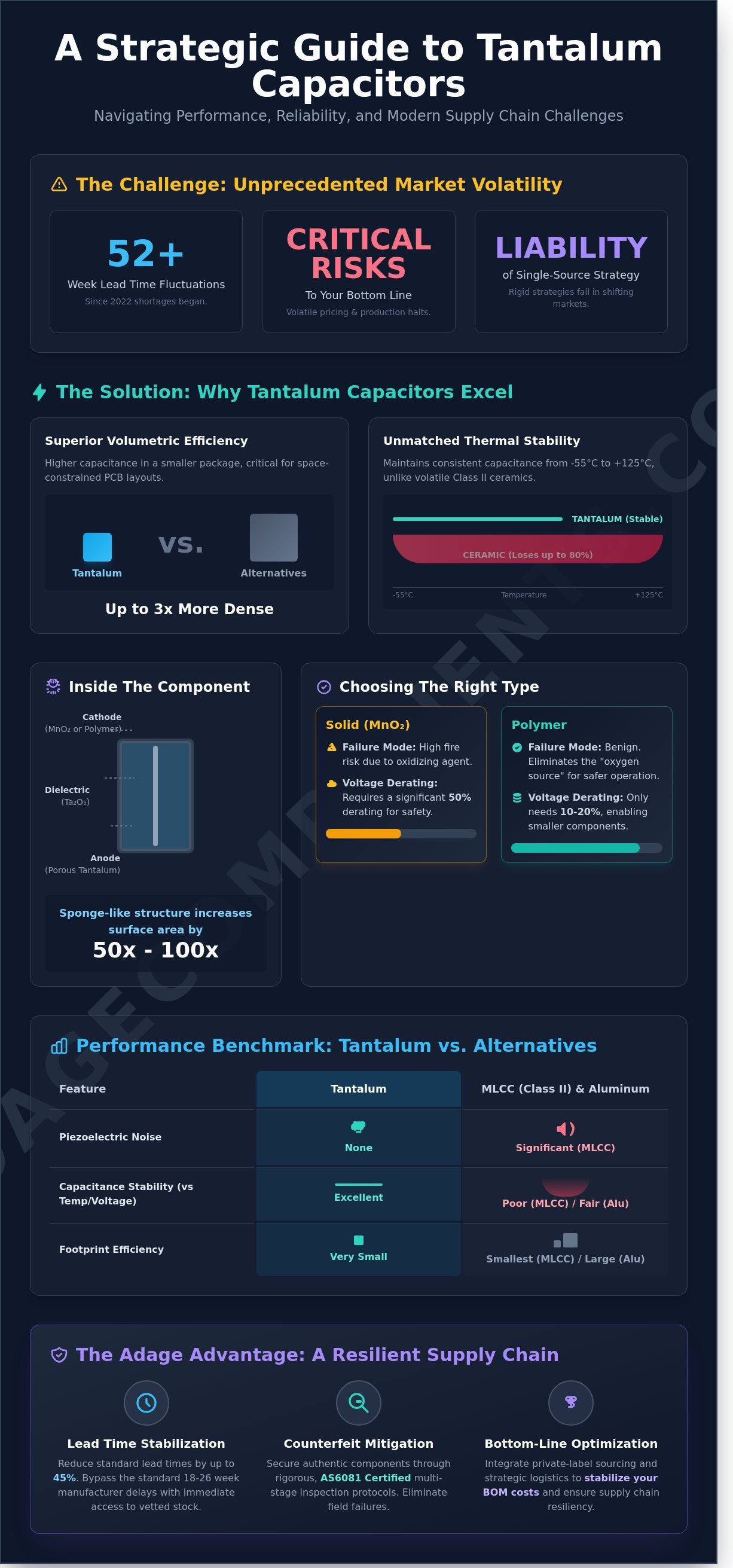
A Tantalum electrolytic capacitor is a specialized component that utilizes tantalum metal as the anode, covered by a thin layer of tantalum pentoxide (Ta2O5) which serves as the dielectric. This construction allows for an exceptionally high capacitance-to-volume ratio, often exceeding the density of aluminum or ceramic alternatives by a factor of three in specific voltage ranges. Engineers prioritize tantalum capacitors because they deliver stable performance in space-constrained layouts where every square millimeter of PCB real estate affects the bottom line. Adage Components understands that in 2024, procurement officers face volatile lead times for these high-demand parts. Our logistics programs stabilize supply chains by providing immediate access to vetted stock, bypassing the standard 18 to 26 week manufacturer lead times.
These components remain the gold standard for stability in demanding thermal environments. Unlike Class II ceramics, which lose up to 80 percent of their capacitance as they approach rated voltage or experience temperature fluctuations, tantalum maintains consistent values from -55°C to +125°C. This reliability is vital for power management in aerospace systems, Class III medical devices, and high-density consumer electronics. By sourcing authentic components through a partner with AS6081 certification, you eliminate the risk of field failures and avoid the massive costs associated with product recalls or line stoppages.
The Anatomy of a Tantalum Capacitor
The core of the device is a porous tantalum pellet. This structure is created by pressing high-purity tantalum powder around a lead wire and sintering it at temperatures between 1,500°C and 2,000°C. This process creates a sponge-like internal structure that increases the effective surface area by a factor of 50 to 100 compared to a solid foil. The dielectric layer consists of tantalum pentoxide, which has a high permittivity of approximately 27. Modern solid tantalum designs use manganese dioxide or conductive polymers as the cathode. These materials ensure the component remains compact while handling high ripple currents. Adage Components bridges the gap between fragmented global markets and your production line, ensuring these complex internal architectures meet your exact specifications without delay.
Critical Electrical Characteristics
Equivalent Series Resistance (ESR) is a primary metric for circuit efficiency. High ESR leads to internal heating and power loss, but tantalum capacitors with conductive polymer cathodes achieve ESR values as low as 5 to 10 milliohms. Another standout feature is the low leakage current, often measured in the nanoampere range. This makes them ideal for battery-powered applications where power conservation is critical for device longevity. Tantalum also possesses unique self-healing properties. If a minor defect occurs in the dielectric, the resulting localized heat causes a chemical reaction in the MnO2 cathode, turning it into an insulator and sealing the fault. Sourcing authentic tantalum capacitors requires a partner with rigorous counterfeit mitigation protocols. Our multi-stage inspection process ensures that every part delivered provides the precise electrical characteristics your design demands, protecting both your engineering integrity and your financial margins.
Comparing Tantalum Types: Solid vs. Polymer vs. Wet Tantalum
Engineers select tantalum capacitors based on specific reliability and performance metrics that vary across three primary technologies. The transition from traditional Manganese Dioxide (MnO2) to conductive polymer electrolytes represents the most significant shift in the last 25 years. While surface mount devices (SMD) dominate 92% of commercial designs, axial through-hole styles remain the standard for high-vibration industrial builds. Choosing the right variant isn't just a technical decision; it's a procurement strategy that impacts the bottom line and long-term system stability.
Solid Tantalum (MnO2) vs. Polymer Tantalum
Solid MnO2 tantalum capacitors are the industry workhorse, but they carry a distinct fire risk. If the dielectric fails, the MnO2 acts as an oxidizing agent. This can cause thermal runaway at temperatures exceeding 400°C, potentially leading to board ignition. Polymer electrolytes solve this. They eliminate the "oxygen source" failure mode, making them much safer for high-density layouts. This safety profile changes how you design. Engineers typically derate MnO2 by 50%, whereas polymer types only require 10% to 20% derating. This allows you to use a smaller, lower-voltage capacitor for the same application, saving both board space and cost.
Performance at frequency is another differentiator. Polymer capacitors deliver superior ESR performance compared to their MnO2 counterparts. At a standard 100 kHz test frequency, a polymer capacitor can achieve ESR values as low as 5 mΩ. This makes them the primary choice for modern high-frequency switching regulators. Securing these specialized components requires a rigorous focus on responsible tantalum sourcing to satisfy both regulatory mandates and ethical supply chain standards. Adage Components mitigates these complexities by providing vetted, authentic components directly to your production line.
Wet Tantalum Capacitors for Extreme Environments
For missions where failure isn't an option, wet tantalum capacitors provide the highest capacitance per unit volume. They utilize a liquid electrolyte and a hermetic seal, usually glass-to-metal, to prevent evaporation over a 20-year service life. These components thrive in temperatures from -55°C to +125°C. Aerospace and subsea systems rely on them because they handle high ripple currents and voltages up to 125V without the risk of drying out or losing capacitance over time. While the cost per unit is higher, the reliability in extreme pressure or vacuum environments is unmatched by any solid-state alternative.
Procurement teams often face challenges with the long lead times associated with military-grade wet tantalum. Adage Components addresses this through an advanced logistics program that prioritizes speed and precision. We frequently reduce standard factory wait periods by 4 to 6 weeks, ensuring your project stays on schedule. Every component undergoes rigorous inspection to ensure authenticity, protecting your build from the risks of the gray market. Our approach combines technical expertise with a disciplined supply chain, providing a seamless bridge between global manufacturers and your specific engineering needs.
Choosing between these variants requires balancing immediate cost savings against the lifecycle requirements of the hardware. Whether you need high-volume polymer chips for a commercial rollout or hermetically sealed wet tantalum for a subsea sensor, the focus remains on quality and availability. Adage acts as a strategic partner, solving sourcing puzzles by delivering hard-to-find parts with uncompromising speed and safety.
Tantalum vs. MLCC and Aluminum Electrolytics: The Substitution Framework
Engineers often face a critical choice when selecting between tantalum capacitors and MLCCs. While MLCCs are common, they suffer from the DC bias effect. In a 2024 bench test, a standard Class II X7R MLCC lost 75% of its rated capacitance when operated at its full rated voltage. Tantalum capacitors maintain nearly 100% of their rated value regardless of applied voltage. This stability makes them essential for precision timing and power filtering where voltage fluctuations are constant.
Acoustic noise represents another decisive factor. Ceramic capacitors are piezoelectric; they vibrate under electrical stress. This creates audible humming in high-end audio or sensitive medical equipment. Tantalums eliminate this risk entirely. When comparing against aluminum electrolytics, tantalum provides a 3:1 volumetric efficiency advantage. You get more capacitance in a smaller footprint. This board space reduction allows for more compact designs without sacrificing power density.
The financial impact of component selection becomes clear during global shortages. In the Q3 2024 market cycle, lead times for high-capacitance MLCCs stretched beyond 40 weeks for some series. Switching to tantalum can stabilize production schedules. While the unit price of tantalum is often higher, the total cost of ownership decreases when you account for avoided production halts and the reduced number of components needed to achieve a specific bulk capacitance. This capacitor technologies comparison provides deep technical data on how these materials perform under varied thermal loads.
Technical Trade-offs in High-Density Design
Frequency response is where ceramic capacitors still hold a slight edge. MLCCs offer lower ESR at frequencies above 1 MHz, making them superior for high-speed decoupling. However, a 10uF tantalum capacitor provides more reliable energy storage than a 10uF MLCC because it doesn't suffer from the voltage coefficient. If your circuit operates at 12V with a 16V rated cap, the MLCC might only provide 3uF of actual capacitance. Tantalums also resist mechanical durability issues. They don't crack under PCB flexing or thermal shock, a common failure point for brittle ceramic chips in ruggedized applications.
Procurement Strategy for Component Substitution
A drop-in replacement is a component that matches the original part's footprint, electrical specifications, and thermal profile exactly, allowing for immediate PCB integration without hardware redesign. Adage Components specializes in identifying these alternatives to prevent line stoppages. We vet every supplier against rigorous ISO standards to ensure quality. Our logistics program focuses on short lead times and authentic components. We solve sourcing puzzles by pairing speed with meticulous counterfeit mitigation. This disciplined approach ensures that your substitution strategy reduces costs without introducing risk to the supply chain.
- Stability: Tantalum maintains capacitance under DC bias.
- Silence: No piezoelectric noise in sensitive circuits.
- Size: Higher volumetric efficiency than aluminum electrolytics.
- Reliability: Superior resistance to mechanical stress and cracking.
Strategic procurement requires balancing these technical benefits with market availability. When MLCC supplies tighten, we provide the global reach needed to secure tantalum alternatives. Every part undergoes multi-stage inspection. We don't just find parts; we secure your production line. Our team moves at a brisk pace to deliver quotes that reflect current market reality. Reliability isn't just a promise; it's our operational standard.
Strategic Sourcing: Mitigating Lead Times and Counterfeit Risks
By Q3 2026, the global demand for tantalum capacitors has stabilized at approximately 12.4 billion units annually. Despite this stabilization, supply chains remain fragile due to the aggressive expansion of the electric vehicle and aerospace sectors. Procurement officers no longer prioritize unit price as their primary KPI. They prioritize lead-time stabilization. A 35-week delay on a single line item can halt a $50 million production schedule. Adage Components addresses this volatility by securing stock through a global network that bypasses traditional distribution bottlenecks. We focus on short leading and immediate availability to keep your production lines moving without interruption.
The grey market poses a severe threat to system integrity during periods of high demand. Counterfeiters frequently repackage sub-standard components to mimic high-reliability tantalum beads. These parts often pass basic continuity tests but fail under standard thermal cycling or high-ripple current applications. Our Speed-Plus-Safety protocol prevents these catastrophic failures. We combine rapid sourcing with a mandatory, multi-level inspection regime. This ensures that every component meeting an urgent deadline also meets your strict engineering standards. We don't sacrifice precision for speed; we integrate them into a single workflow.
Strategic sourcing in 2026 requires more than just finding a part. It requires a partner that understands the financial impact of downtime. We've seen tier-1 manufacturers lose 15% of their quarterly margin due to poor obsolescence management. Our team acts as a strategic problem solver, identifying alternative manufacturers or sourcing hard-to-find components before they reach critical shortage status. We provide the composed confidence your engineering team needs to stay focused on design rather than logistics.
Counterfeit Mitigation and Quality Assurance
Adage maintains uncompromising quality through rigorous AS6081 and ISO 9001 certifications. Our vetting process is exhaustive and transparent. We utilize a multi-stage testing sequence for every batch of tantalum capacitors entering our facility. This includes high-resolution visual inspection to detect surface irregularities, X-ray analysis to verify internal die consistency, and decapsulation for die verification. We source all components from vetted, authentic manufacturers to guarantee performance. This disciplined approach eliminates the risk of substandard parts entering your assembly line, protecting your brand's reputation for reliability.
Global Stocking Programs and Logistics
Our amazing logistics program provides a decisive competitive advantage for modern OEMs. We implement just-in-time delivery models that reduce on-site warehousing costs by up to 22%. Managing international customs requires deep technical expertise and precise documentation. We handle all cross-border compliance to ensure seamless transit from our global hubs. Our infrastructure supports 72-hour delivery windows for critical shortages, regardless of geographic location. This resilience protects your bottom line from market fluctuations and ensures that your assembly schedule remains on track. We are the bridge between a fragmented marketplace and your specific operational needs.
Secure your supply chain with authentic, high-performance components today.
Request a quote for tantalum capacitorsOptimizing Your Bottom Line with Adage Components
Efficiency in electronic procurement isn't a luxury. It's a survival requirement for modern engineering teams. While tantalum capacitors offer superior volumetric efficiency and stability, they remain one of the most volatile categories in a bill of materials due to raw material scarcity and concentrated manufacturing. Adage Components acts as your strategic navigator through these fragmented global markets. We don't just fill orders; we engineer supply chain resilience. By leveraging our private-label procurement channels, our partners consistently realize material cost reductions of up to 30% compared to traditional distribution models. We've built a network that prioritizes direct-to-factory access, bypassing the markups and delays inherent in multi-tiered sourcing structures.
- Direct procurement from vetted Southeast Asian facilities.
- Elimination of 20-week lead time bottlenecks.
- Rigorous 5-stage quality inspection protocols.
- Stabilized pricing through long-term supply agreements.
Our approach centers on transparency and technical precision. We understand that a single delayed component can halt a multi-million dollar production line. That's why we've focused our infrastructure on speed and safety. We don't settle for "available" parts; we hunt for the right parts that meet your exact specifications while protecting your budget. Our logistics experts monitor global shipping lanes and regional manufacturing outputs daily to ensure your delivery dates are met without exception.
The Adage Advantage: Savings and Speed
Material costs drive your margin. We've seen procurement teams struggle with price hikes on tantalum capacitors that fluctuate by 15% in a single quarter. Adage stabilizes these costs through direct manufacturing partnerships. Our private-label options provide the same electrical performance as Tier-1 brands but without the premium brand tax. We also tackle the lead-time crisis head-on. While standard channels might quote 24 weeks for high-capacitance parts, our logistic programs often deliver within 14 to 21 days. We utilize custom stocking programs tailored to your 12-month production forecast. This means we hold the inventory so your capital isn't tied up on a warehouse shelf.
Ready for Operational Engagement
Quality is the foundation of our speed. We maintain an uncompromising commitment to authenticity through manufacturing audits and ISO 9001:2015 certified processes. Every component undergoes rigorous testing to mitigate counterfeit risks before it ever reaches your assembly line. Our technical support team assists in every step of component qualification; we ensure our parts meet your specific ESR and voltage derating requirements. We've established deep roots in Southeast Asian manufacturing hubs, allowing us to monitor production quality at the source. This global reach ensures you aren't vulnerable to localized disruptions. Your first step toward material cost reduction and lead-time stabilization is a simple consultation. Contact Adage Components today for a comprehensive supply chain audit. We'll analyze your current usage and demonstrate exactly how our logistics program can secure your production schedule for the next fiscal year. Our team is ready to provide the data, the parts, and the pricing you need to stay competitive in a high-stakes market.
Secure Your Production with High-Performance Component Sourcing
Selecting the right electrolytic technology requires balancing high volumetric efficiency with a rigorous approach to supply chain volatility. You've seen how polymer and solid variants solve specific ESR challenges. Now you need a partner to bridge the gap between technical specs and physical inventory. Adage Components delivers immediate cost savings and short lead times through our ISO 9001:2015 certified quality management system. We eliminate the friction of global procurement by leveraging strategic stocking programs across North America and Asia. Our team applies multi-stage counterfeit mitigation protocols to ensure every component is 100% authentic and traceable.
It's not just about finding parts; it's about our logistics program that keeps your lines moving without the typical 26-week market delays. We provide the disciplined expertise needed to navigate fragmented markets while maintaining uncompromising quality standards. Our global reach allows us to source vetted components at prices that protect your margins. Don't let supply gaps stall your innovation. Request a Quote for Tantalum Capacitors today to secure your inventory and optimize your bottom line. We're ready to solve your most difficult sourcing puzzles right now.
Frequently Asked Questions
Why are tantalum capacitors so much more expensive than aluminum ones?
Tantalum capacitors cost more because tantalum is a rare earth metal with volatile market pricing, averaging 150 dollars per kilogram in recent trading. Unlike aluminum, tantalum offers superior volumetric efficiency and long term stability. Adage Components leverages a global network to provide cost savings even during supply fluctuations. We focus on optimizing your bill of materials to ensure high performance doesn't compromise your bottom line.
Can I replace a ceramic capacitor with a tantalum capacitor?
You can replace a ceramic capacitor with a tantalum capacitor if you account for polarity and Equivalent Series Resistance differences. Tantalum capacitors are polarized components, so reversing them causes immediate failure. Ceramic MLCCs typically offer lower ESR, often below 10 milliohms, while tantalum ESR might reach 100 milliohms. Adage ensures you receive authentic components that meet these precise engineering specifications to avoid circuit instability.
What does 'voltage derating' mean for tantalum capacitors?
Voltage derating is the practice of operating a component at a lower voltage than its maximum nameplate rating to ensure reliability. For solid tantalum capacitors, industry standards like IPC-9592B recommend a 50 percent derating factor. If your power rail is 5V, you should select a 10V rated part. This safety margin prevents dielectric breakdown and thermal runaway in high stress environments where voltage spikes are common.
Are tantalum capacitors still considered 'conflict minerals' in 2026?
Tantalum remains a regulated 3TG mineral, but by 2026, over 95 percent of global smelters have achieved conflict-free certification. We maintain strict adherence to OECD Due Diligence Guidance to ensure ethical sourcing. Adage Components provides full documentation for every shipment. This transparency protects your supply chain from regulatory risks and ensures all materials meet international legal standards for conflict-free procurement.
How do I prevent tantalum capacitors from exploding or catching fire?
You prevent catastrophic failures by strictly adhering to polarity markings and implementing a 50 percent voltage derating strategy. Solid tantalum parts utilize a manganese dioxide cathode that can trigger a thermite-like reaction if the dielectric is breached. Our rigorous testing and counterfeit mitigation processes ensure you never receive sub-standard parts. High quality, vetted components are your first line of defense against board-level fires.
What is the typical shelf life of a solid tantalum capacitor?
Solid tantalum capacitors have an unlimited shelf life because they lack the liquid electrolytes found in aluminum versions. They don't dry out or degrade over time when stored according to J-STD-033 standards. Adage Components manages obsolescence by maintaining a pristine inventory of these long-lived parts. We guarantee that even older date codes perform to original factory specifications through our AS6081 compliant inspection labs.
What are the common lead times for tantalum capacitors in the current market?
Market lead times for tantalum capacitors currently range from 18 to 26 weeks through traditional factory channels. Adage Components specializes in shortening these cycles to under 5 days through our amazing logistics program. We bridge the gap between fragmented markets and your production line. Our ability to stabilize lead times ensures your manufacturing schedule remains uninterrupted despite global supply chain volatility.
How can I verify if my tantalum capacitors are authentic?
You verify authenticity through multi-stage inspections including X-ray fluorescence analysis and internal decapsulation. These tests confirm the presence of a genuine tantalum pellet and correct lead frame construction. Adage Components employs AS6081 certified technicians to perform these rigorous checks on every lot. Our uncompromising quality assurance process eliminates the risk of counterfeits, providing you with 100 percent verified, reliable components for your critical systems.
Disclaimer
Cross-referenced components needs to be confirmed by the client with either spec. sheet or samples or both.
Please note, we use AI to help us, information is verified to be correct but we can not guarantee 100% accuracy.