
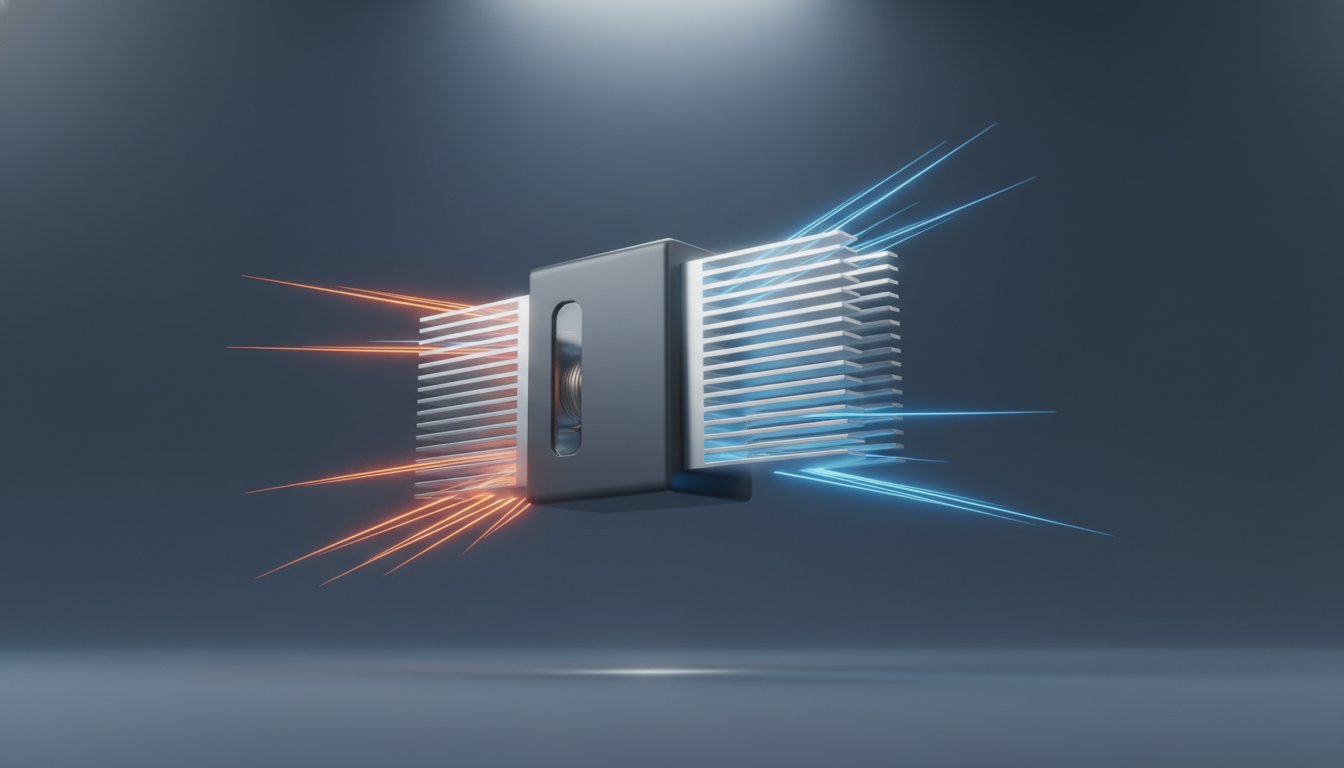
Designing for peak power without a strategic sourcing plan is a recipe for over-engineered, over-budget systems. Effective thermal management for power resistors requires more than just a heat sink; it demands a synergy between precise engineering and manufacturer-direct procurement. You understand that balancing high PCB density with thermal safety margins is a constant struggle, especially when Tier 1 distributors quote lead times that threaten your production schedule. Component failure due to overheating isn't just a technical risk; it's a logistical failure that impacts your bottom line.
We'll show you how to master heat dissipation while securing automotive-grade components at OEM pricing. This guide provides a definitive strategy to reduce lead times and optimize your BOM costs. We'll examine the technical impacts of the new EN IEC 60115-4:2026 standard, published on May 11, 2026, and provide a roadmap for integrating high-performance resistors into your existing MRP system. You'll learn how Adage Components acts as a bridge to vetted manufacturers, ensuring your facility receives authentic, high-power resistors in real time, on time, and with full ISO compliance. It's time to move beyond the constraints of a fragmented marketplace and embrace a disciplined approach to thermal reliability.
Key Takeaways
- Master the thermal resistance model (Rθ) to identify critical heat dissipation paths between resistor junctions and the ambient environment.
- Evaluate the performance trade-offs between Alumina and Aluminum Nitride substrates to optimize thermal management for power resistors in high-density PCB layouts.
- Implement advanced PCB design techniques, including optimized thermal via placement and heavy copper plating, to prevent component failure and ensure long-term system reliability.
- Transition from high-cost Tier 1 distributors to Adage Components to access manufacturer pricing and short lead times for automotive-grade resistors.
- Leverage our international logistics program to integrate high-thermal performance components directly into your MRP system, reducing BOM costs without compromising on ISO-certified quality.
The Critical Role of Thermal Management in Modern Power Electronics
High-density PCB assemblies in 2026 leave no room for thermal error. As power resistors convert electrical energy into heat through the Joule effect, they become the primary heat generators in your system. This heat must be moved away from sensitive silicon to prevent catastrophic failure. Effective thermal management for power resistors is no longer just about cooling; it's about strategic component selection and logistical agility. Implementing a robust strategy for thermal management is essential for maintaining the integrity of your circuit.
With the global resistor market projected to reach $11.2 billion in 2026, the demand for components that handle high power density is surging. Engineers must account for these thermal loads during the initial design phase to avoid costly redesigns. In the current market, 2026 designs require more aggressive thermal strategies because miniaturization trends have pushed power densities to their physical limits. You need a partner that understands these technical demands while offering the logistical infrastructure to keep your production lines moving.
To better understand this concept, watch this helpful video:
Thermal Runaway and Component Reliability
Temperature and Mean Time Between Failures (MTBF) share an inverse relationship. Even a small increase in operating temperature can drastically reduce a component's lifespan. Excessive heat doesn't just cause immediate failure; it affects resistor value stability. High temperatures cause the Temperature Coefficient of Resistance (TCR) to drift, leading to inaccurate readings and circuit instability. In industrial and automotive applications, the financial cost of a single thermal failure can be staggering, often exceeding the total BOM cost by several orders of magnitude. Using authentic, ISO-certified components is the only way to mitigate this risk.
Balancing Power Density and PCB Real Estate
Miniaturization is the dominant trend, yet smaller footprints have lower natural heat dissipation capacity. Many procurement teams make the mistake of over-specifying components, which drives up costs and complicates supply chains. Adage Components solves this by providing high-power density resistors in standard footprints at OEM pricing. We offer authentic, commercial and automotive grade components sourced from vetted manufacturers. By choosing Adage over traditional Tier 1 distributors, you get the same reliability with manufacturer-direct pricing and short lead times. Our amazing international logistics program ensures these critical parts reach your facility on time, integrating seamlessly with your existing MRP system. Check our linecard for high-power options that fit your specific thermal management for power resistors requirements.
Understanding Thermal Resistance (Rθ) and Heat Dissipation Paths
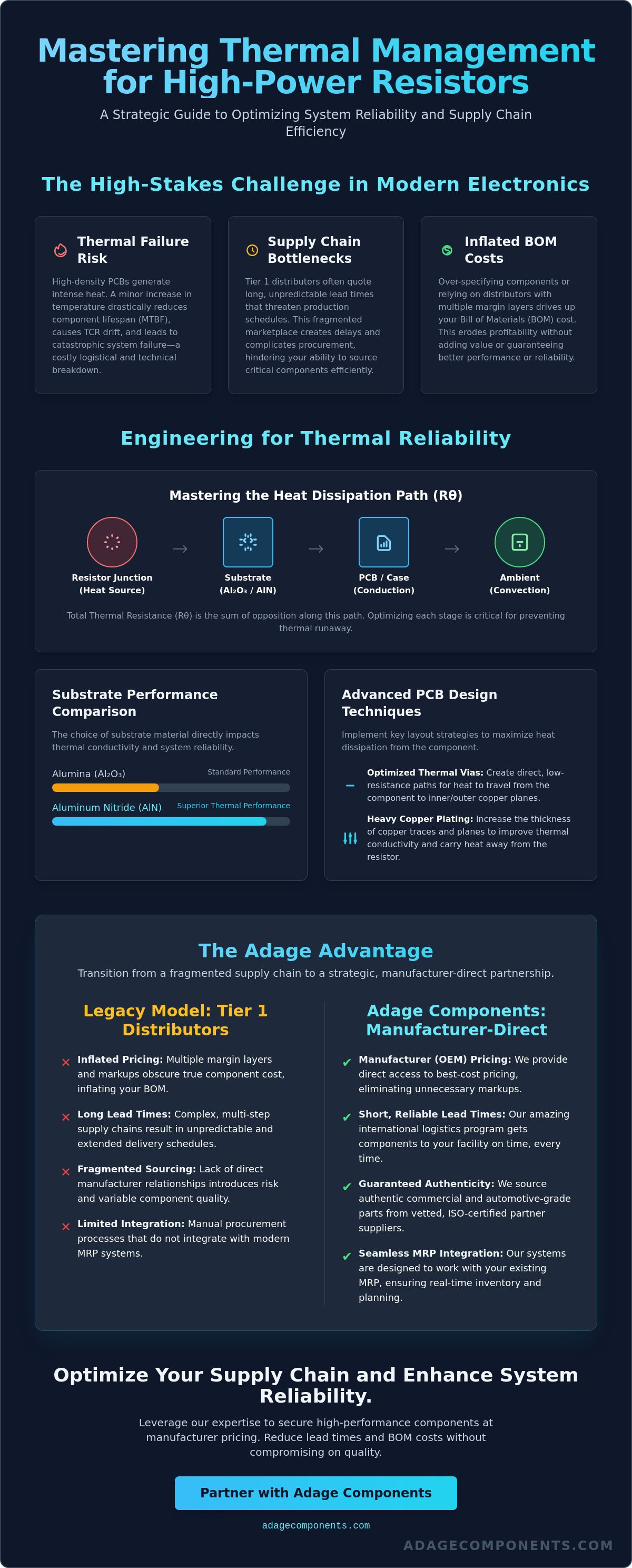
Efficient thermal management for power resistors depends on a clear understanding of thermal resistance, expressed as Rθ. This value represents the component's opposition to heat flow. In a high-power system, heat moves from the resistive element (the junction) through the substrate to the case, and finally into the surrounding environment. We view this process as a series of thermal hurdles. If any part of this path is restricted, the component temperature will spike. This leads to the TCR drift and reliability issues that compromise your system's integrity.
Total thermal resistance is the sum of internal and external factors. While conduction through PCB traces is the most effective path in dense assemblies, convection to the air remains a secondary requirement. Solder joint integrity often acts as a critical thermal bottleneck. A poor solder connection doesn't just threaten electrical continuity; it significantly increases thermal resistance, trapping heat within the resistor body. Adage Components ensures that our thermal management for power resistors solutions feature high-quality terminations to facilitate seamless heat transfer to the PCB.
Internal vs. External Thermal Resistance
Internal thermal resistance, or Rθjc (Junction-to-Case), is the component’s inherent ability to move heat. This is a fixed manufacturer specification determined by the internal architecture and material choice. In contrast, Case-to-Ambient (Rθca) resistance is a variable controlled by your PCB design. Factors like copper weight and trace width are decisive here. Moving from 1oz to 2oz copper can drastically improve heat spreading across the board. We provide the precise technical data sheets required for your MRP system to calculate these margins accurately.
Material Science: Substrates and Terminations
Substrate choice is the primary driver of internal thermal performance. Standard thick film resistors typically use Alumina (Al2O3) substrates. While cost-effective, Alumina has limited thermal conductivity. For high-stress applications, Aluminum Nitride (AlN) offers a superior alternative with significantly higher heat dissipation capabilities. Adage Components acts as a bridge to vetted manufacturers who specialize in these high-performance materials. We audit every partner supplier to verify material purity and thermal performance standards. This ensures you receive authentic, automotive-grade components without the markup of Tier 1 distributors. If you're looking to optimize your BOM, you can explore our high-conductivity options through our comprehensive linecard.
Comparing Resistor Technologies for High-Power Thermal Stability
Selecting the right technology is where engineering theory meets procurement reality. While previous sections detailed the physics of heat flow, the physical architecture of the resistor determines its ultimate threshold. Thick Film Chip Resistors offer a cost-effective power solution for both commercial and automotive grades, making them the standard for high-volume applications. Thin Film Precision Resistors prioritize TCR stability over raw power dissipation. This is critical for precision instrumentation where even minor thermal drift compromises accuracy. Choosing between these isn't just a technical decision; it's a strategic one that affects your total BOM cost.
For extreme conditions, Wirewound Resistors remain the gold standard. Their high thermal mass allows them to absorb significant energy surges without the risk of film vaporization. MELF Resistors provide superior thermal cycling performance in harsh environments. Their cylindrical shape and robust terminations mitigate the stress of expansion and contraction better than flat chip designs. This durability makes MELF a preferred choice for thermal management for power resistors in high-vibration industrial sectors. Adage Components acts as a bridge to these specialized technologies, providing manufacturer pricing that Tier 1 distributors struggle to match.
Thick Film vs. Wirewound: A Thermal Trade-off
The primary difference lies in heat capacity. Wirewound elements handle massive pulse loads, while thick film resistors are optimized for continuous power in smaller footprints. When sourcing for high-volume OEMs, thick film technology often provides the best manufacturer pricing. We help you balance these technical trade-offs with your budget requirements. You can review the specific power ratings and tolerances for our Thick Film Chip Resistors to see how they integrate with your existing design. By sourcing directly through our partner suppliers, you avoid the logistical friction common with franchised distributors.
Automotive Grade vs. Commercial Grade Thermal Specs
Standard commercial components often lack the resilience needed for high-stakes industrial environments. Automotive-grade resistors must meet AEC-Q200 requirements, which involve rigorous testing for thermal shock and power tempering. Adage Components prioritizes these higher standards for industrial MRP systems to ensure long-term reliability. We vet every partner supplier for compliance with ISO certifications, ensuring that the OEM pricing we offer doesn't come at the cost of authenticity. Our amazing international logistics program ensures these authentic components reach your facility in real time, on time. This disciplined approach to sourcing eliminates the risk of component failure due to overheating, securing your supply chain against the volatility of the global market.
Practical Design Strategies: Heat Sinks and PCB Layout
Engineering excellence requires a layout that actively facilitates heat transfer. Once you've selected your resistors, the PCB becomes the primary thermal conduit. Failure to optimize this path results in localized overheating that degrades the entire system. Optimizing thermal vias is your first line of defense. You should prioritize placement directly under the component pad and specify a plating thickness of at least 25μm to maximize vertical conductivity. This disciplined approach to thermal management for power resistors ensures that heat doesn't pool at the junction, protecting the component's integrity.
Heavy copper PCBs, specifically those using 2oz or thicker copper, act as vital heat spreaders. They move thermal energy away from the resistor footprint more efficiently than standard 1oz boards. You must also manage airflow to avoid thermal shadows. Placing a tall component, such as an electrolytic capacitor, upstream of a power resistor can block cooling air. This creates a localized hot zone that simulation might overlook if airflow vectors aren't correctly modeled. Adage Components provides the high-power density parts you need, but your layout must be capable of supporting their performance.
Heat Sink Integration for Surface Mount Components
Integral heat sinks located directly under the resistor element are effective for reducing Rθja. These sinks provide a low-resistance path to the internal copper planes. Choosing the right Thermal Interface Material (TIM) is equally important. A high-performance TIM fills microscopic air gaps between the component and the board, ensuring a seamless thermal connection. For more detailed layout tips and sourcing strategies, refer to our Heat Sink Design Guide. We help you balance these technical requirements with the need for manufacturer pricing and short lead times.
PCB Layout Best Practices for Power Resistors
Proper spacing prevents mutual heating between adjacent power resistors. We recommend maintaining a minimum clearance based on the component's rated power to ensure that one resistor's heat doesn't derate its neighbor. Using large copper planes as sacrificial heat sinks allows the board to absorb and dissipate energy across a wider surface area. Modern engineering teams utilize 2026 simulation tools to predict thermal hotspots before manufacturing, ensuring that board layouts are optimized for heat dissipation from the start. This proactive strategy reduces the risk of rework and ensures your project stays on schedule. Explore our relevant linecard to find components that meet your thermal requirements at the best cost in the industry.
Optimizing Your Supply Chain for High-Power Components with Adage
Effective thermal management for power resistors is a technical requirement, but it shouldn't become a logistical bottleneck. While engineering teams focus on Rθ values and trace widths, procurement professionals must battle the volatility of the global market. Tier 1 distributors often impose long lead times and rigid pricing structures that don't account for your specific margins. Adage Components serves as a superior alternative, offering the same high-performance components at manufacturer pricing. We eliminate the middleman friction, providing a direct bridge to vetted manufacturers who prioritize quality and speed.
By 2026, the global resistor market is projected to reach $11.2 billion. This growth increases competition for high-thermal performance components, making strategic sourcing more critical than ever. We don't just supply parts; we integrate with your existing MRP system to ensure real-time fulfillment. Our disciplined approach to supply chain management means your production line stays active, even when the broader market faces shortages. We provide authentic, ISO-certified resistors that meet the latest EN IEC 60115-4:2026 standards, ensuring your thermal management for power resistors strategy remains compliant and cost-efficient.
BOM Cost Analysis and Drop-In Replacements
Reducing your total BOM cost doesn't require sacrificing reliability. Adage Components provides high-power density drop-in replacements for expensive brand-name resistors. We perform rigorous manufacturing audits on all partner suppliers to ensure every component is authentic and meets automotive-grade standards. Our team specializes in electronic components BOM cost analysis, identifying opportunities where you can achieve significant savings without changing your board layout. It's a precise, data-driven method to improve your bottom line. We invite you to use our BOM submission form for a comprehensive cost-savings audit today.
The Adage Advantage: Speed and Reliability
Our state-of-the-art warehouse and amazing international logistics program are designed for the high-stakes world of industrial procurement. We understand that "on time" is the only metric that matters for mission-critical power electronics. By maintaining strategic global stocking levels, we reduce lead times and bypass the delays common with franchised distributors. Every component undergoes multi-stage inspection processes to guarantee authenticity before it ever reaches your facility. This commitment to quality and speed is why elite partners choose us to secure their supply chains. Don't let logistical delays compromise your thermal design. Contact Adage Components to secure your 2026 supply chain and experience the best cost in the industry.
Securing Your Thermal Design and Supply Chain for 2026
Precision in thermal management for power resistors is the foundation of high-power system reliability. We've established that technical mastery of heat dissipation paths must be matched by a disciplined procurement strategy. Relying on Tier 1 distributors often introduces unnecessary markups and logistical delays that your production schedule can't afford. By partnering with Adage Components, you bypass these obstacles. You gain direct access to manufacturer pricing on authentic, automotive-grade components without the traditional distributor friction.
Our ISO 9001:2015 Certified Quality Management ensures that every resistor in your MRP system meets rigorous performance standards. We act as a steady partner in a volatile market, providing the global logistics support necessary for just-in-time delivery. You don't have to choose between technical excellence and cost-efficiency. It's time to optimize your BOM and eliminate thermal risk from your next design. We're ready to integrate with your operations and provide the reliability your mission-critical electronics demand.
Request an OEM Pricing Quote for Power Resistors and let's secure your facility's operational success today.
Frequently Asked Questions
What is the most important factor in thermal management for power resistors?
The most important factor is the efficiency of the thermal resistance path from the resistive junction to the ambient environment. Minimizing both junction-to-case and case-to-ambient resistance is essential for system stability. Effective thermal management for power resistors relies on using high-conductivity substrates and optimized PCB layouts. We ensure our components utilize superior materials like Aluminum Nitride to facilitate this heat transfer while providing manufacturer pricing.
How does thermal resistance (K/W) affect resistor selection?
Thermal resistance determines exactly how much the component temperature rises for every watt of power dissipated. A lower K/W rating allows for higher power density without exceeding the maximum safe operating temperature. When selecting components, procurement must balance these technical specs with overall budget goals. Adage Components provides high-thermal performance resistors that allow for smaller footprints while maintaining safety margins, ensuring your MRP system targets are met efficiently.
Can I replace a Tier 1 power resistor with an Adage private label component?
Yes, Adage Components specializes in providing high-quality drop-in replacements for parts typically sourced from Tier 1 distributors. Our resistors match or exceed the technical specifications of brand-name components while offering OEM pricing. We source only authentic parts from vetted manufacturers and maintain strict ISO certifications. This allows you to reduce BOM costs significantly without compromising the integrity of your thermal management strategy or your production schedule.
Why is AEC-Q200 certification important for thermal management?
AEC-Q200 certification ensures that a resistor can withstand the rigorous thermal cycling and mechanical stress found in automotive and industrial environments. This certification guarantees that the component's thermal properties remain stable over its entire lifecycle. We emphasize automotive-grade components because they provide the reliability required for mission-critical power electronics. This ensures your facility receives authentic parts built to handle extreme temperature fluctuations without failure.
How do thermal vias improve resistor heat dissipation?
Thermal vias act as vertical conduits that move heat from the surface pads to internal copper layers or the opposite side of the PCB. By increasing the number and plating thickness of these vias, you significantly lower the case-to-ambient thermal resistance. This is a vital design strategy for thermal management for power resistors in high-density assemblies. We provide the technical data sheets needed for your engineers to calculate these dissipation paths accurately.
What are the lead times for high-power resistors in 2026?
While Tier 1 distributors often quote extended lead times due to market volatility, Adage Components maintains short lead times through our state-of-the-art warehouse. We leverage an amazing international logistics program to bypass fragmented supply chains. Our goal is to get authentic components to your facility in real time, on time. This ensures your production remains uninterrupted by the typical delays seen in the 2026 global electronic components market.
Does Adage Components provide technical support for thermal design?
We provide comprehensive technical data and BOM cost analysis to support your thermal design objectives. While we don't offer PCB assembly services, we act as a strategic partner by helping you identify the best-cost components for your heat dissipation requirements. Our team assists procurement officers in finding high-power resistors that integrate seamlessly with existing MRP systems. This ensures technical specifications align perfectly with your logistical and financial goals.
How do I calculate the required power rating for a resistor in a high-temp environment?
You must apply a specific derating curve, which reduces the allowable power dissipation as the ambient temperature rises above a set threshold, typically 70°C. Calculating the operating temperature involves adding the ambient temperature to the product of the power dissipated and the total thermal resistance. We provide precise derating data for all our resistors. This helps you avoid the costly mistake of over-specifying components while ensuring long-term thermal safety.
Disclaimer
Cross-referenced components needs to be confirmed by the client with either spec. sheet or samples or both.
Please note, we use AI to help us, information is verified to be correct but we can not guarantee 100% accuracy.