

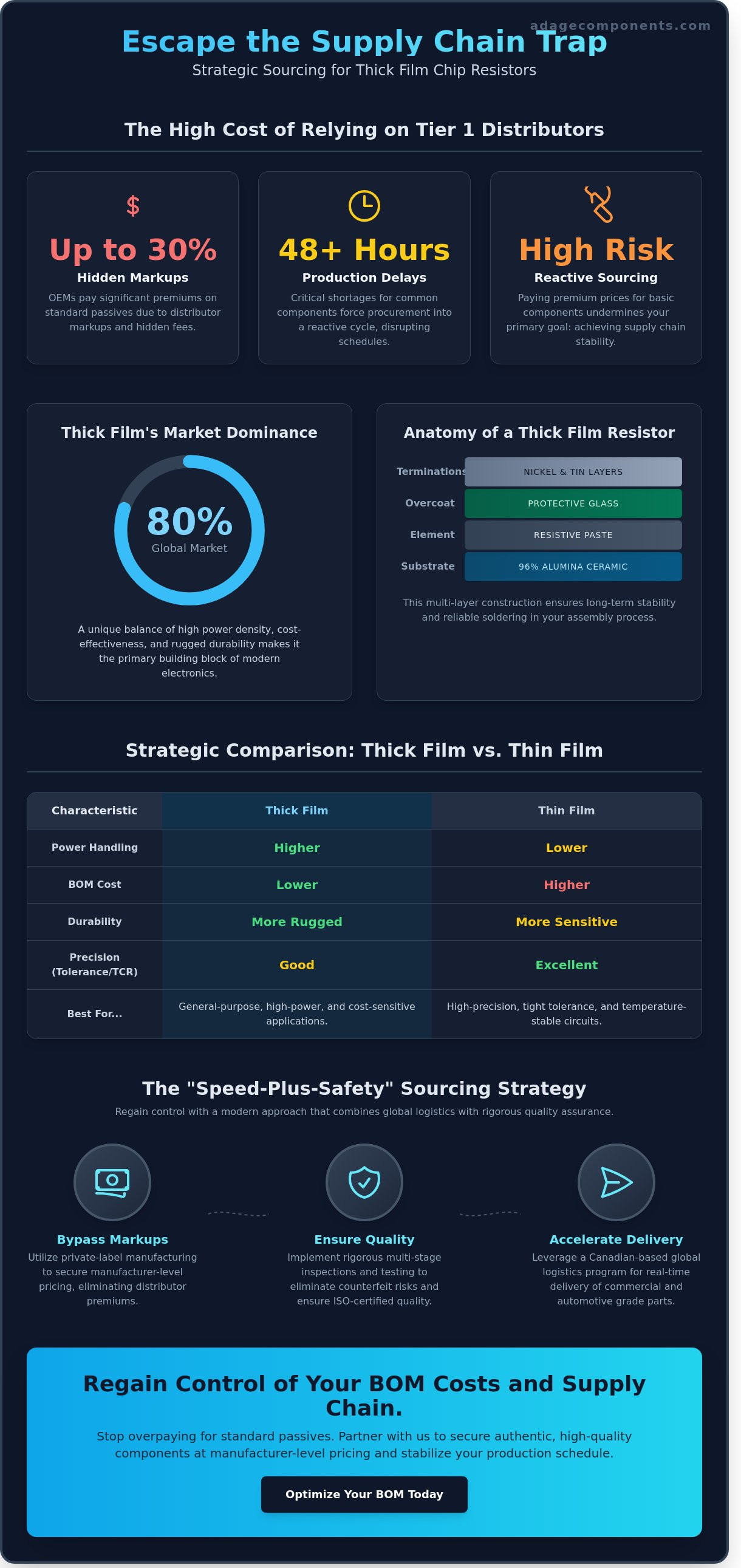
Relying on Tier 1 manufacturers for standard passives often costs OEMs up to 30% more in hidden lead-time penalties and distributor markups. You've likely seen your MRP system flag critical shortages for a component as common as thick film chip resistors, forcing your procurement team into a reactive cycle. We know that in a high-stakes environment, a delay of even 48 hours can disrupt an entire production schedule at your facility. It's frustrating to pay premium prices for basic components when your primary goal is supply chain stability.
We'll help you regain control by mastering technical specifications and strategic sourcing to optimize your BOM costs. This guide details how to bypass traditional distributor premiums and secure manufacturer-level pricing without sacrificing ISO-certified quality. You'll learn our rigorous multi-stage inspection process for authentic components and how our Canadian-based global logistics program delivers commercial and automotive grade parts in real time. We'll examine the qualification of drop-in replacements and the infrastructure of our growing state-of-the-art warehouse to ensure your facility maintains one of the best cost structures in the industry.
Key Takeaways
- Understand why thick film technology dominates 80% of the global market and how to leverage its performance characteristics for your MRP system.
- Analyze the strategic trade-offs between thick film chip resistors and thin film alternatives to optimize both power handling and BOM costs.
- Identify critical technical specifications, including TCR and precision tolerance ranges, to ensure uncompromising circuit stability in commercial and automotive applications.
- Discover how to bypass the markups of Tier 1 distributors by utilizing private-label manufacturing to secure the best cost in the industry.
- Implement a "speed-plus-safety" sourcing strategy that pairs rapid global logistics with rigorous multi-stage testing to eliminate counterfeit risks.
Understanding Thick Film Chip Resistors: Technology and Market Dominance
Thick film chip resistors represent the primary building block of modern surface-mount assemblies. These components are created by screen-printing a resistive paste, typically a mixture of metal oxides and glass binders, onto a ceramic substrate. This Thick-film technology now accounts for over 80% of the global resistor market. Its dominance stems from a unique balance of high power density, cost-effectiveness, and rugged durability. We provide these essential parts at OEM pricing to ensure your facility maintains a competitive edge while meeting strict technical specifications.
To better understand the technical specifications and performance of these components, watch this helpful video:
The role of these components in modern electronics is foundational. You'll find them in everything from consumer smartphones to complex industrial control systems and automotive engine control units. Because they handle higher power levels relative to their size compared to thin film alternatives, they're the preferred choice for general-purpose applications. Adage Components leverages a global reach to source these parts from vetted manufacturers, ensuring your BOM submission is fulfilled with authentic components that meet ISO standards.
The Anatomy of a Thick Film Resistor
The construction begins with a ceramic substrate, usually composed of 96% Alumina. This material provides the necessary thermal conductivity and mechanical strength to withstand high-speed pick-and-place machines. The resistive element is then applied and fired at temperatures exceeding 850 degrees Celsius. A protective glass overcoat is applied to seal the element from moisture and contaminants, while the terminations are finished with nickel and tin layers to ensure reliable soldering during your assembly process. This multi-layer approach guarantees long-term stability in volatile environments.
Commercial vs. Automotive Grade Standards
Selecting the correct grade is vital for your MRP system requirements. Standard commercial grades offer excellent value for consumer electronics, typically providing tolerances between 1% and 5%. However, automotive applications demand AEC-Q200 compliance. This standard requires the components to pass rigorous stress tests, including flame resistance and moisture resistance, to ensure safety in vehicle systems. We maintain a growing state of the art warehouse to supply both grades, providing the same advantages as tier 1 distributors but at manufacturer-level pricing. If you're facing lead-time stabilization issues, contact us to access our international logistic program for real-time delivery solutions.
Performance Characteristics and Technical Specifications
Selecting the right thick film chip resistors involves more than just matching resistance values; it requires a precise analysis of how these components behave under electrical and thermal loads. We focus on providing high-quality parts that balance cost-efficiency with uncompromising performance. Our inventory includes a wide spectrum of tolerances, ranging from standard ±5% options for general-purpose pull-up tasks to precision ±1% variants for sensitive signal conditioning.
Voltage ratings and power dissipation are intrinsically linked to the physical geometry of the component. A standard 0201 package might only support 0.05W, whereas a 2512 package can handle 1W or more. Exceeding the Limiting Element Voltage (LEV) leads to dielectric breakdown, which causes permanent circuit failure. We ensure every part sourced through our global network meets the rigorous voltage thresholds required for your specific application.
Stability Under Environmental Stress
Environmental stressors like high humidity and sulfur exposure can cause silver migration or terminal corrosion in inferior components. We source thick film chip resistors from vetted manufacturers that utilize specialized protective coatings to mitigate these risks. Pulse loading is another critical factor for reliability. Repetitive high-energy surges can degrade the resistive element over 1,000 hours of operation if the part isn't properly rated. TCR is the measure of resistance change per degree Celsius.
Temperature Coefficient of Resistance (TCR) dictates how much the resistance value drifts as your facility's hardware heats up. Standard thick film parts typically exhibit a TCR of ±100 ppm/°C to ±200 ppm/°C. For high-reliability sectors, we provide components that maintain stability across a wide -55°C to +155°C temperature range, ensuring your MRP system requirements are met without compromise.
Case Size Selection for OEM Layouts
Miniaturization continues to drive modern PCB design, but it requires a careful trade-off. Moving from an 0603 footprint to an 0402 size reduces the board area by approximately 50%, yet it significantly limits the component's ability to dissipate heat. We help your engineering team balance these needs by standardizing case sizes across your BOM. This strategy reduces manufacturing friction and simplifies pick-and-place programming during assembly.
Integrating specific case size data and tolerance requirements into your BOM submission form allows us to provide accurate, real-time quoting. By leveraging our tier 1 distributor affiliations, we deliver authentic components with the same speed and safety as the largest global franchises. Our goal is to provide your production line with the most cost-effective solutions while maintaining strict technical compliance. If you need immediate assistance with a difficult-to-source value, you can contact us to secure OEM pricing today.
Thick Film vs. Thin Film: A Strategic Comparison
Choosing between film technologies is a pivotal decision for your engineering team and your procurement department. The core difference lies in the fabrication method. We manufacture thick film chip resistors using a screen-printing process where conductive paste is deposited onto a ceramic substrate and fired at high temperatures. Thin film resistors utilize sputtering, a vacuum deposition process that creates a much thinner, more uniform resistive layer. While sputtering allows for extreme precision, it increases production complexity and lead times. For 85% of general-purpose electronics, thick film provides the most efficient path to market without compromising reliability.
Strategic procurement requires understanding where to deploy each technology. Thick film components excel in power handling and surge resistance. Their robust construction handles high-energy pulses better than the delicate layers found in thin film alternatives. We help our partners identify areas where thick film chip resistors can serve as drop-in replacements for more expensive thin film parts. This substitution often results in a 20% to 40% reduction in BOM costs for high-volume consumer and industrial assemblies.
Precision and Noise Considerations
Precision requirements dictate your film selection. Thin film is the industry standard for 24-bit audio converters and high-precision medical devices because it offers tolerances as tight as 0.01% and TCR values below 5 ppm/K. Thick film structures have an inherent "current noise" caused by the granular nature of the resistive paste. This noise is typically negligible in power supplies or digital logic circuits. However, in sensitive analog signal chains, it can degrade performance. We recommend auditing your circuit to see if it truly requires 0.1% precision. If a 1% tolerance is acceptable, switching to thick film stabilizes your supply chain and lowers your risk of obsolescence.
Cost-Benefit Analysis for High-Volume Production
When your MRP system manages millions of units, small price deltas become massive operational savings. Thin film technology carries a premium due to the expensive vacuum equipment and slower throughput of the sputtering process. By contrast, our vetted manufacturers utilize high-speed screen printing to drive down the per-unit cost. Scaling these savings across a global EMS production run can save your facility thousands of dollars per quarter. We provide the same quality assurance as tier 1 distributors while maintaining one of the best costs in the industry. You can consult our linecard to compare available technologies and find the right balance for your specific application. Our Canadian headquarters coordinates these logistics to ensure your components arrive in real time, on time, every time.
Strategic Sourcing: Navigating the Global Component Supply Chain
Relying on Tier 1 distributors alone creates a single point of failure during periods of market volatility. When allocation strikes, these giants often prioritize their largest marquee accounts, leaving mid-market OEMs with stalled production lines. We bridge this gap by providing manufacturer-level pricing and direct access to global inventories. Our private-label manufacturing model ensures you receive one of the best cost in the industry without compromising on the quality of your thick film chip resistors. We act as a steady partner in a volatile market.
Every component we source undergoes rigorous vetting. We verify manufacturers against ISO 9001:2015 and AS6081 standards to ensure uncompromising quality assurance protocols. Our global stocking programs allow us to manage lead times effectively; we utilize Just-In-Time (JIT) delivery to keep your operations lean. In 2023, when lead times for certain passives spiked beyond 40 weeks, our diversified sourcing network maintained a steady flow for our partners. We prioritize disciplined expertise over frantic market chasing.
Mitigating Supply Chain Risks
Supply chain integrity depends on robust counterfeit mitigation. We utilize franchised partnerships with top 100 distributors to secure the supply chain from the point of origin. This multi-layered approach ensures every part is authentic and traceable. For a deeper analysis of these methodologies, consult The Strategic Guide to Sourcing Passive Electronic Components for OEMs. We maintain a 99.9% accuracy rate in component verification to protect your facility from the risks of substandard parts. It's about speed plus safety.
Optimizing Procurement for MRP Systems
Your facility’s MRP system requires precise data to function correctly. We align our delivery schedules with your production timeline to eliminate inventory bloat. Our Montreal-based logistics hub provides specialized support for North American OEMs, ensuring components arrive in real time, on time. To stabilize long-term pricing and secure inventory for future quarters, many of our partners utilize our distributor affiliated program. This strategic setup allows you to lock in OEM pricing for thick film chip resistors while maintaining the flexibility of a local partner. We handle the logistical puzzles so you can focus on production.
Adage Components: Your Partner for High-Quality Thick Film Resistors
Adage Components acts as a strategic bridge for OEMs and CMs navigating the volatility of the global electronics market. We provide a definitive alternative to tier 1 distributors by eliminating unnecessary markups while maintaining uncompromising quality standards. Our "speed-plus-safety" methodology ensures that we secure thick film chip resistors quickly without compromising technical integrity. Every component passing through our facility undergoes a multi-stage inspection process designed to mitigate counterfeit risks and ensure absolute authenticity.
Our growing state of the art warehouse and amazing international logistics program allow us to manage complex supply chains with precision. We operate from our Canadian headquarters, coordinating shipments that reach your facility in real time and on time. Whether you require standard commercial grade parts or automotive-ready components, our infrastructure supports the most demanding technical compliance requirements. We don't just find parts; we manage the entire lifecycle of the component to protect your production schedule.
- Rigorous counterfeit mitigation and multi-stage testing protocols.
- Direct access to vetted manufacturers and top 100 distributor channels.
- Logistics managed through a centralized Canadian headquarters for global reach.
- Support for both commercial and automotive grade technical standards.
Manufacturer Pricing with Distributor Service
We specialize in direct procurement channels that integrate seamlessly with your existing MRP systems. By sourcing from vetted manufacturers, we offer some of the best costs in the industry without the overhead of traditional Tier 1 entities. Adage provides full technical support and manufacturing audits as part of our core service. This ensures your production line remains active. You get the benefit of OEM pricing paired with the high-touch service typically reserved for elite accounts. We focus on lead-time stabilization to ensure your components arrive exactly when your assembly process requires them.
Start Your BOM Optimization Today
Transitioning your Bill of Materials to Adage is a streamlined, friction-free process. We identify high-performance, drop-in replacement thick film chip resistors that match your exact specifications for tolerance and power rating. Our team excels at solving difficult sourcing puzzles, especially for high-volume production runs that require aggressive cost savings. We provide the data and technical compliance documentation your engineering team needs to approve new sources quickly. Contact us today to get manufacturer pricing for your next production run and secure your supply chain with a partner that values precision as much as you do.
Optimize Your Production with Strategic Component Sourcing
Managing a modern MRP system requires more than just finding parts; it demands a synergy of technical compliance and logistical speed. You've identified that thick film chip resistors remain the backbone of high-stakes electronics due to their superior power density and cost-to-performance ratio. Transitioning from thin film or navigating lead-time stabilization requires a partner that operates with the precision of a tier 1 distributor but offers the financial advantage of direct manufacturer pricing.
Adage Components provides this exact bridge. Our Montreal-based global logistics support and growing state-of-the-art warehouse ensure your facility stays operational without the friction of traditional supply chains. Every component we source undergoes ISO-certified manufacturing audits and is vetted by the industry's top 100 distributors to ensure zero-defect reliability. We don't just supply parts; we provide a disciplined framework for obsolescence management and scale. By choosing a partner that prioritizes speed-plus-safety, you secure a competitive edge in an uncompromising global market.
Get Manufacturer Pricing on Thick Film Resistors
Let's build a more resilient and cost-effective future for your assembly lines today.
Frequently Asked Questions
What is the difference between thick film and thin film chip resistors?
Thick film chip resistors utilize a screen-printing process with resistive paste; thin film versions use vacuum-sputtering for a precision layer. Thick film is the standard for high-power, cost-sensitive OEM applications. Thin film offers 0.01 percent tolerance and 5ppm per degree stability, but costs 5 to 10 times more. We help you evaluate your BOM to ensure you aren't over-specifying and over-paying for precision you don't need.
How do I choose the right case size for my thick film resistor?
Case size selection depends on your PCB surface area and the specific power dissipation requirements of your circuit. Standard sizes like 0603 and 0805 support 0.1W to 0.125W power ratings. For high-density layouts, 0201 or 0402 sizes are essential. If your application requires 1W or higher, specify 2512 packages. Our logistics team ensures these components reach your facility according to your MRP schedule.
Can thick film resistors be used in automotive applications?
Thick film chip resistors are suitable for automotive use if they carry the AEC-Q200 certification. These components endure 1,000 thermal cycles and 1,000 hours of 85/85 humidity testing. Adage Components sources both commercial and automotive grade parts from vetted manufacturers. We maintain a state of the art warehouse in Montreal to keep these critical parts ready for immediate global dispatch.
What are the typical lead times for high-volume resistor orders?
Lead times for high-volume orders range from 24 hours for in-stock items to over 20 weeks during market shortages. We mitigate these fluctuations through our international logistic program and global stocking initiatives. By integrating with your MRP system, we provide real-time visibility into your supply chain. This approach allows us to deliver manufacturer-level pricing while maintaining the speed of tier 1 distributors.
How does Adage ensure the quality of its private-label resistors?
We ensure quality through a multi-stage inspection process and a strict vendor qualification program. Every private-label resistor undergoes visual inspection and electrical testing to verify performance against data sheets. Our facility holds ISO 9001 certifications, ensuring every part is authentic and reliable. You receive high-performance components at the best cost in the industry without compromising on technical compliance or safety.
What is a drop-in replacement in the context of resistors?
A drop-in replacement is a component with the identical footprint, electrical specs, and reliability profile as a part from brands like Yageo or Vishay. This strategy ensures your budget doesn't suffer from unnecessary brand premiums. We provide full technical documentation and samples for engineering validation. Our goal is to serve as your strategic partner, offering seamless alternatives that keep your production lines moving.
Disclaimer
Cross-referenced components needs to be confirmed by the client with either spec. sheet or samples or both.
Please note, we use AI to help us, information is verified to be correct but we can not guarantee 100% accuracy.