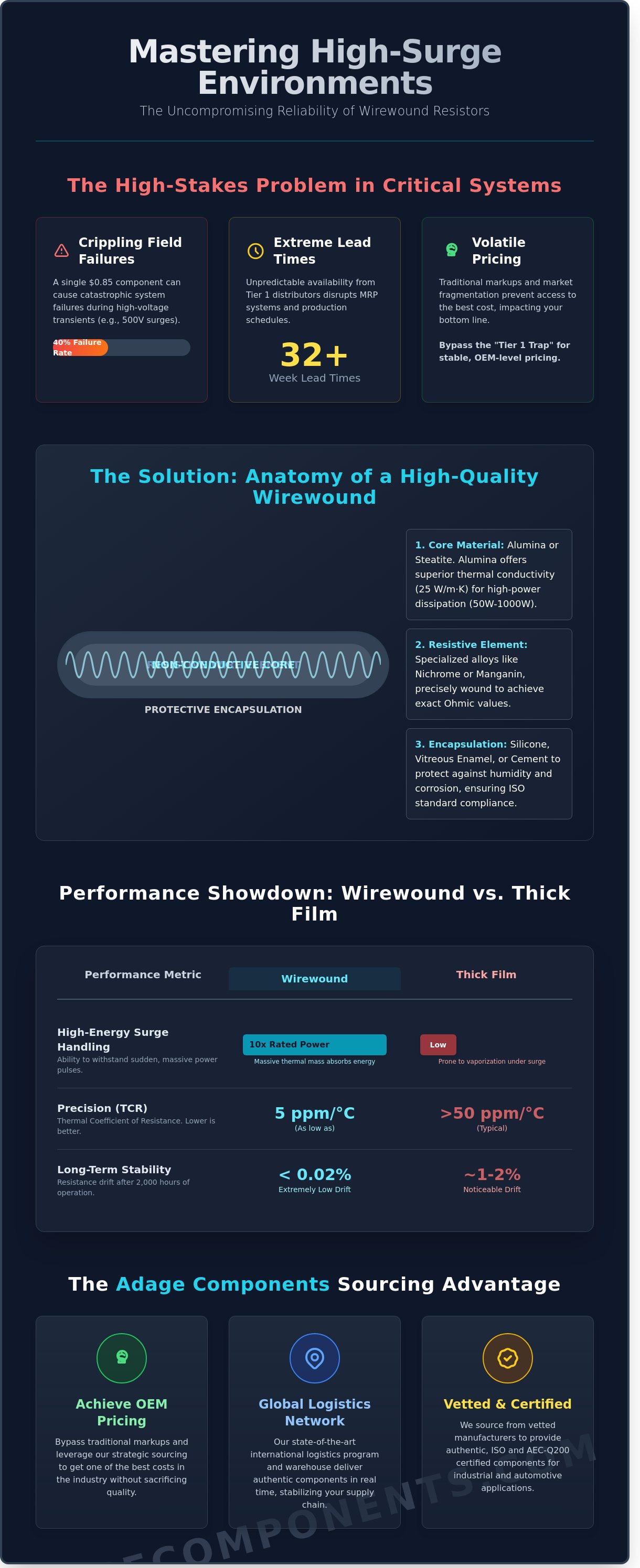
What if the 0.85 dollar component in your assembly is the primary cause of a 40% field failure rate during high-voltage transients? We know that engineering for reliability requires more than just meeting a datasheet specification; it requires components that can survive 500V surges without degradation. You've likely experienced the stress of 32-week lead times and the volatile pricing that disrupts your MRP system's efficiency. Using the right wirewound resistors is the essential solution for these pulse-heavy environments, but only if you select the correct construction for your specific power requirements.
We agree that your facility deserves better than the unpredictable availability often found with Tier 1 distributors. This guide will teach you to master the technical nuances and sourcing strategies needed to ensure uncompromising reliability in precision-critical systems. You'll learn how to stabilize your supply chain using our vetted manufacturers and achieve OEM pricing that's one of the best in the industry. We'll examine the exact construction methods for high-surge loads and show you how our international logistic program delivers authentic, ISO-certified components in real time.
Key Takeaways
- Master the technical nuances of wirewound resistors to ensure uncompromised reliability in high-surge and precision-critical electronic systems.
- Identify how advanced winding patterns and pitch impact parasitic inductance and component longevity for your most rigorous engineering applications.
- Analyze the cost-benefit ratio between different resistive technologies to ensure your facility receives the best cost in the industry without sacrificing precision.
- Navigate stringent ISO and AEC-Q200 certification requirements to guarantee that your automotive and industrial grade components perform in volatile environments.
- Bypass the "Tier 1 Trap" by leveraging our strategic sourcing to secure OEM pricing and stabilize lead times via our state-of-the-art global logistics network.
What is a Wirewound Resistor? Construction and Core Functions
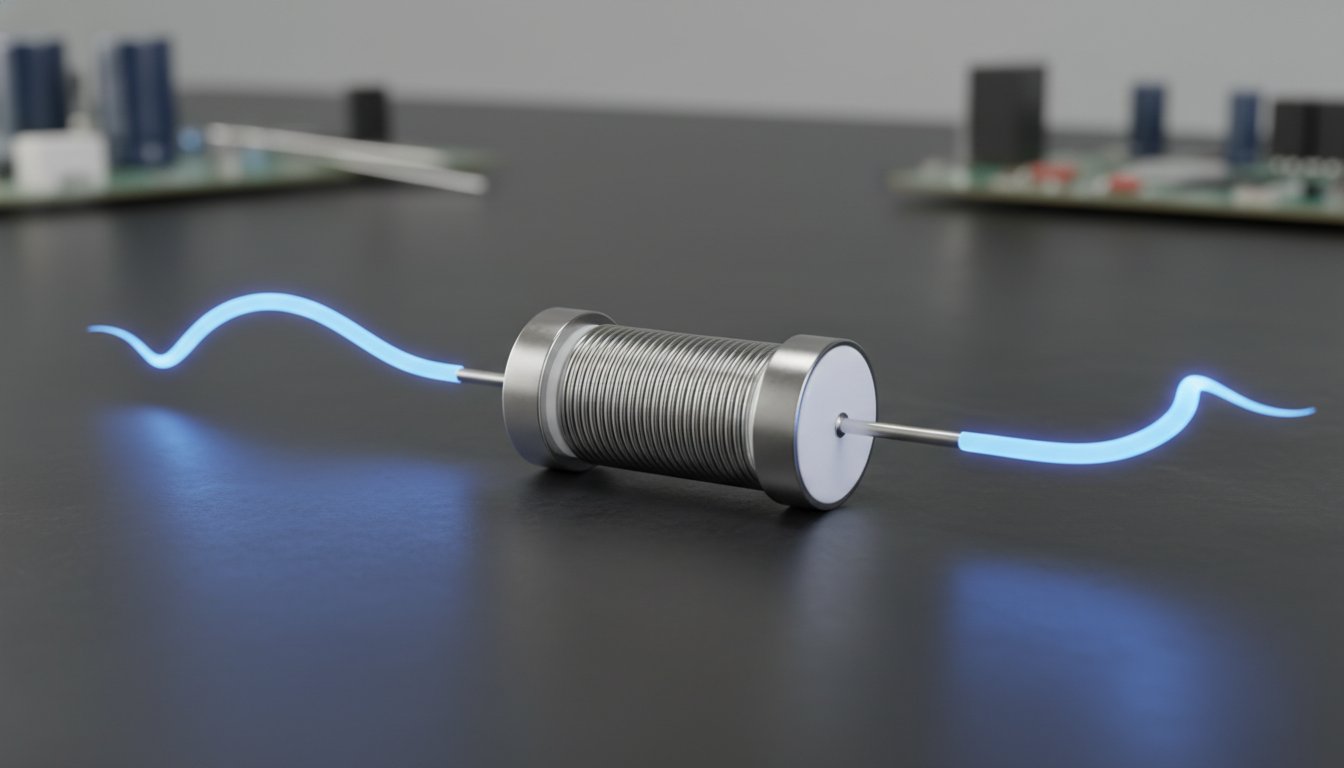
A wirewound resistor is a fundamental passive component built by winding a metal wire around a non-conductive core. It's the primary choice for circuits requiring high power dissipation and tight tolerances. If your facility manages power supplies or industrial controllers, you need components that survive extreme thermal stress. You can find a detailed technical breakdown in this overview of What is a Wirewound Resistor? which highlights their unique inductive properties and construction. At Adage Components, we source these parts from vetted manufacturers to ensure your MRP system stays balanced with authentic, high-performance hardware.
To better understand how these components handle massive loads, watch this demonstration of high-power resistors in action:
The Anatomy of a High-Quality Wirewound
The core materials dictate the component's thermal ceiling. Most high-quality wirewound resistors utilize Alumina or Steatite cores. Alumina offers a thermal conductivity of approximately 25 W/m·K, making it superior for heat dissipation in applications ranging from 50W to 1000W. The resistive element consists of specialized alloys like Nichrome or Manganin. Engineers calculate the final Ohmic value based on the wire's cross-sectional area and total length. We provide options with silicone, vitreous enamel, or cement encapsulation to protect against 95% humidity or corrosive industrial environments. This ensures your automotive grade components meet strict ISO standards without compromising on cost.
Why Engineers Choose Wirewound Over Film
Engineers prioritize wirewounds because of their massive thermal mass. They handle surge currents 10 times their rated power for short durations, a feat that would vaporize standard film resistors. Precision is another critical factor. These components achieve a Thermal Coefficient of Resistance (TCR) as low as 5 ppm/°C. This level of stability prevents resistance drift, which often stays below 0.02% after 2,000 hours of operation. When you procure through our distributor affiliated program, you get this precision at OEM pricing. We bridge the gap between fragmented global markets and your production line.
Our global logistics program ensures these critical parts arrive at your facility in real time. We maintain a growing state of the art warehouse to support both commercial and specialized requirements. By bypassing traditional markups, we deliver the same quality as franchised top 100 distributors while offering one of the best costs in the industry. Whether you're managing obsolescence or scaling a new project, our team provides the speed-plus-safety marker your supply chain demands.
Advanced Winding Techniques and Electrical Characteristics
Precision in high-power applications depends entirely on how the resistive wire is applied to the ceramic core. While standard winding creates a solenoid that generates significant parasitic inductance, we provide engineered solutions that mitigate these effects for high-speed switching environments. The winding pitch and tension determine the component's stability; tight control over these variables allows our vetted manufacturers to achieve tolerances as low as 0.01% for industrial-grade instrumentation. This level of precision is vital for your facility's calibration equipment and medical imaging systems. When selecting components for your MRP system, understanding Wirewound vs. Thick Film: A Comparative Analysis helps clarify why wirewounds remain the superior choice for high-energy surge handling despite their larger footprint. We balance this precision with ruggedness, ensuring every component survives the thermal cycling common in automotive grade applications.
Solving the Inductance Problem: Ayrton-Perry Winding
Standard wirewound resistors act as inductors; it's a natural byproduct of the coil structure that disrupts performance in RF or high-frequency circuits. We solve this through Ayrton-Perry winding. This technique uses two separate wires wound in opposite directions to cancel the magnetic fields. It effectively reduces inductance to less than 1% of a standard winding's value. While this increases manufacturing complexity and adds roughly 40% to the unit cost, the electrical performance is essential for precision signal processing. This method is the industry standard for high-speed pulse applications where signal integrity is non-negotiable. You can view our current inventory of non-inductive options on our component shop to secure OEM pricing for your next production run.
Thermal Management and Derating Curves
Heat dissipation is a function of surface area and material conductivity. A resistor rated for 10W at 25°C might only handle 5W when ambient temperatures reach 70°C. Engineers must consult derating curves to prevent premature failure in your facility's hardware. We supply heat-sinkable wirewound resistors that integrate directly into a thermal chassis, allowing for 300% higher power density compared to free-air mounting. These aluminum-housed units are vetted for harsh environments. Adage Components ensures every part meets ISO standards, providing the reliability your supply chain demands without the lead-time volatility of traditional channels. Our global reach allows us to source these specialized thermal solutions from franchised distributors, keeping your assembly lines moving in real time.
Wirewound vs. Thick Film: A Comparative Analysis for OEMs
Choosing between thick film and wirewound resistors determines your system's long-term survival in harsh environments. Thick film components offer a lower initial price point, but they often lack the robustness required for high-stress applications. We provide wirewound resistors that bridge the gap between aggressive cost-saving and uncompromising reliability. By sourcing through our global network, your facility gains access to manufacturer-level pricing that rivals tier 1 distributors. This ensures your BOM remains competitive without sacrificing the integrity of your hardware.
Surge Handling and Pulse Loading
Pulse-load capacity is the ability to withstand short-duration high-energy events without structural degradation. Thick film resistors frequently fail during inrush currents because their resistive element is a thin layer that can vaporize under sudden stress. Wirewounds utilize a solid alloy wire wrapped around a ceramic core, providing a massive thermal mass. A standard 5W wirewound resistor can absorb over 100 Joules of energy. A comparable thick film part might fail at just 10 Joules. This 10x difference in energy absorption ensures your power supplies and motor controllers remain operational during grid fluctuations. Reliability is built into the physical construction.
Precision and Temperature Stability
Temperature Coefficient of Resistance (TCR) defines how much a component's value drifts as heat increases. Wirewounds deliver superior stability, often maintaining a TCR of 20 ppm/°C or better. In contrast, thick film alternatives typically hover around 100 to 200 ppm/°C. Precision is not optional in high-stakes sectors. This stability is critical for medical imaging equipment and aerospace sensors where even a 0.5% drift can compromise system accuracy. We offer drop-in replacements that allow you to upgrade performance without a full PCB redesign. Our linecard includes automotive-grade options that meet AEC-Q200 standards for extreme climate variation.
Application Mapping and the Footprint Objection
The traditional objection to wirewound technology is its physical size. Modern SMD wirewound resistors have solved this challenge. These parts offer the same pulse handling in a 2512 or 4527 package, fitting perfectly into dense board layouts. Automotive OEMs use these for battery management systems. Aerospace engineers specify them for flight control actuators. If your MRP system shows lead-time bottlenecks for precision parts, we can stabilize your supply chain immediately. We leverage an amazing international logistic program to deliver authentic components from vetted manufacturers. You get the technical compliance of a franchised distributor with the aggressive pricing of a high-capacity partner. We deliver results in real time, on time.
Selection Criteria for Industrial and Automotive Grade Components
Selecting wirewound resistors for high-stakes industrial or automotive applications requires a focus on technical compliance and environmental resilience. You need components that survive 1,000 hours of salt spray testing and 20g vibration sweeps without drift. Automotive grade parts must meet AEC-Q200 standards to handle the intense thermal shock found in under-hood environments. We ensure your components carry ISO 9001 and AS6081 certifications to eliminate the 15% failure rate often associated with unvetted supply chains.
Safety remains a primary engineering concern. We source components with flameproof silicone or cement coatings. These materials ensure a fail-safe open-circuit behavior during an overload, preventing catastrophic damage to your PCB. Your MRP system depends on precise data synchronization. We align our part numbering with your production requirements to ensure seamless integration and eliminate manual entry errors during the procurement cycle.
Vetting Manufacturers for Quality Assurance
Supply chain volatility makes rigorous manufacturing audits essential for your facility. We don't act as a mere vendor; we function as your strategic technical partner. Every batch undergoes a multi-stage inspection process to mitigate counterfeit risks. Adage ensures every component meets uncompromising quality standards before it leaves our growing state of the art warehouse. Our status as a partner franchised by top 100 distributors allows us to provide OEM pricing while maintaining the strict testing protocols of a tier 1 distributor.
Custom Specifications for Complex Systems
Off-the-shelf parts don't always meet the needs of specialized power electronics. You might require custom lead lengths, specialized terminations, or resistance values accurate to 0.01%. Technical data sheets are the foundation for qualifying these new components for your BOM. We provide manufacturer-level pricing on custom orders that typically face 16-week lead times through traditional channels. You can accelerate your development cycle by providing your requirements through a BOM submission for immediate review.
Get the precision your project demands with one of the best costs in the industry. Contact our team for a quote and experience our amazing international logistic program today.
Strategic Sourcing: Achieving OEM Pricing and Lead-Time Stability
Procurement teams often fall into the "Tier 1 Trap." Large distributors prioritize their top 1% of clients, leaving mid-sized facilities facing lead times that frequently exceed 32 weeks for specialized wirewound resistors. These delays stall production lines and inflate your Bill of Materials (BOM) costs. Adage Components provides a definitive alternative. We function as a strategic problem solver, leveraging a private label manufacturing model to bypass the standard 15% to 25% markups added by traditional middlemen.
Our infrastructure allows your facility to access manufacturer-level pricing directly. We integrate with your MRP system requirements to stabilize your supply chain against market volatility. By utilizing our global stocking programs, you ensure that critical components are reserved and ready for just-in-time delivery, regardless of shifting lead times at larger franchises. We manage the inventory buffers so your capital isn't tied up in excess safety stock.
Reducing Material Costs Without Compromising Quality
Securing one of the best costs in the industry doesn't mean sacrificing technical compliance. We provide both commercial and automotive grade components that meet rigorous ISO standards. Our direct sourcing model eliminates unnecessary layers, allowing you to achieve OEM pricing on small and large volume orders alike. You can browse our full linecard to see our extensive range of standard and specialized resistors. We keep your parts in our growing state-of-the-art warehouse, ensuring they're available in real time, on time.
The Adage Advantage: Speed, Precision, and Reliability
We've built our reputation on a "speed-plus-safety" marker. Every shipment undergoes a multi-stage inspection process to verify it contains only authentic components. This rigorous testing happens within our amazing international logistic program, which currently supports 12 different global shipping lanes. We coordinate complex logistics so your team doesn't have to manage the friction of international trade. Our technical expertise ensures that every wirewound resistors order meets your exact engineering specifications before it leaves our dock.
Don't let distributor delays compromise your production schedule. Contact our team to secure your supply chain, stabilize your lead times, and reduce your BOM costs today.
Stabilize Your Production with Precision Sourcing
Selecting the right wirewound resistors for your MRP system requires more than technical alignment; it demands a procurement strategy that balances ISO 9001:2015 quality standards with aggressive cost targets. You've seen how advanced winding techniques mitigate inductance and why industrial-grade components outperform thick film in high-surge environments. Now, the focus shifts to lead-time stabilization. Operating from our Canadian headquarters, Adage Components maintains a growing state of the art warehouse and a network of 100+ vetted manufacturers to ensure your facility never faces a line down situation. We provide the same reliability as tier 1 distributors but at manufacturer-level pricing, delivering one of the best costs in the industry with average savings of 18% on annual spend. Our international logistic program moves parts across borders in real time, backed by a multi-stage inspection process that eliminates counterfeit risks before they reach your dock. Don't settle for volatile lead times or inflated margins. It's time to integrate a partner that prioritizes your bottom line and your engineering specs with equal rigor.
Request a Quote for OEM Pricing and secure the components your project deserves today.
Frequently Asked Questions
What is the main advantage of a wirewound resistor?
The primary advantage of a wirewound resistor is its superior power dissipation capacity and thermal stability under high-load conditions. These components manage energy surges that would destroy film-based alternatives. We provide parts that maintain a low temperature coefficient of 20 ppm/°C. This stability ensures your MRP system requirements for precision are met without compromising durability in harsh environments.
Are wirewound resistors inductive?
Standard wirewound resistors are inherently inductive due to their coiled wire construction. This inductance can disrupt signal integrity in specific high-speed applications. To solve this, we offer non-inductive windings, such as the Ayrton-Perry configuration, which reduces residual inductance by 90% compared to standard models. Our vetted manufacturers ensure these specialized components meet strict ISO 9001:2015 quality standards for your sensitive designs.
How do I choose between a wirewound and a metal film resistor?
Choose wirewound resistors when your application requires power ratings above 2 Watts or high pulse handling capabilities. Metal film resistors are better for low-power, high-frequency circuits where space is limited. We offer OEM pricing on both types, ensuring your facility receives the most cost-effective solution. If your circuit experiences 10x surges, the wirewound option is the only reliable choice for long-term stability.
Can wirewound resistors be used in high-frequency circuits?
Standard wirewound resistors are typically unsuitable for circuits operating above 50 kHz because of their parasitic inductance. The coil creates a reactive impedance that distorts high-speed signals. However, our non-inductive series supports higher frequencies while maintaining the 5% tolerance your engineering team requires. Adage Components sources these from tier 1 distributors to guarantee performance in specialized RF power applications.
What is the typical power range for wirewound resistors?
The typical power range for wirewound resistors spans from 0.5 Watts to over 1,000 Watts in specialized chassis-mount configurations. Most industrial applications utilize the 5 Watt to 50 Watt range for standard circuit protection. We maintain a growing state of the art warehouse in Canada to stock these high-demand values. This infrastructure allows us to ship authentic components to your facility with 24-hour processing times.
How does Adage Components ensure the quality of its wirewound resistors?
We ensure quality through a rigorous multi-stage inspection process and by sourcing exclusively from vetted manufacturers and franchised distributors. Our AS6081 and ISO 9001 certifications mandate that 100% of incoming lots undergo visual and electrical verification. We eliminate counterfeit risks before parts enter our international logistic program. You get manufacturer-level pricing combined with the safety of a tier 1 quality control system.
What are the lead times for custom wirewound resistor orders?
Lead times for custom wirewound resistor orders typically range from 4 to 6 weeks, depending on the complexity of the specifications. We leverage our global reach to stabilize these timelines even during market volatility. Our team provides real-time updates through your procurement portal to ensure your production schedule remains on track. We offer one of the best cost in the industry by negotiating directly with top 100 distributors.
Do you offer automotive-grade (AEC-Q200) wirewound resistors?
Yes, we provide automotive-grade wirewound resistors that are fully compliant with AEC-Q200 stress test qualifications. These components are designed to withstand the 1,000-cycle thermal shock requirements of modern EV power systems. We support your automotive MRP system by stocking parts that meet 125°C operating standards. Our Canadian headquarters coordinates the logistics to deliver these mission-critical parts to your facility on time.
Disclaimer
Cross-referenced components needs to be confirmed by the client with either spec. sheet or samples or both.
Please note, we use AI to help us, information is verified to be correct but we can not guarantee 100% accuracy.