

One character can turn a component search into a costly mismatch. The identifier ba99b alone doesn’t establish an electronic component’s identity; BAV99, by contrast, refers to a high-speed switching diode. Treating the two as interchangeable without checking source documentation risks sourcing a part that doesn’t meet your electrical or mechanical requirements.
That uncertainty is familiar to procurement teams: incomplete identifiers complicate verification, and limited supply details can disrupt planning and MRP workflows. A visual match or loosely similar part number isn’t enough. The manufacturer, complete part number, and application requirements must align before you commit.
This article explains how to determine what ba99b identifies, validate a candidate against documented requirements, and prepare a sourcing request with the information suppliers need. Adage Components supplies electronic components, including resistors, capacitors, and diodes, and supports OEMs and EMS providers with technical support, manufacturing audits, and international logistics. Clear part data and supply information help teams make sourcing decisions and plan production with fewer avoidable uncertainties.
Key Takeaways
- Distinguish a verified manufacturer part number from a model name or internal code before starting procurement.
- Build a ba99b request around source documentation, application requirements, and evidence for each candidate.
- Compare identity, electrical limits, package, grade, and documentation status; similarity alone does not prove drop-in compatibility.
- Give suppliers a clear, documented request to align component quality expectations with supply planning.
- Adage Components supplies resistors, capacitors, and diodes and supports sourcing through manufacturing audits, technical support, and international logistics.
What Does BA99B Identify? Establish the Exact Part Before Sourcing
An identifier alone doesn’t prove a component’s manufacturer, type, or specifications. The same string may appear in different product categories, while a partial code may omit the characters that distinguish one part from another. A lookup result can provide a lead, but it isn’t sufficient evidence for a purchasing decision.
A verified manufacturer part number is the complete identifier assigned by a component maker to a specific item or variant, matched to that maker’s primary documentation. An equipment model number identifies a larger product, such as an appliance. An internal code may be used by a manufacturer, repair organization, or inventory system, and a distributor reference may identify an entry in a seller’s catalogue. Don’t treat either as the component’s manufacturer part number without supporting documentation.
Establish the component’s identity before procurement or substitution. A similar code is not evidence of equivalent function, fit, or performance.
Part number, model number, and marking: how they differ
A package marking is useful, but it may be abbreviated to fit the component’s surface. It might identify a family, production code, or other information rather than uniquely identify a full part number. Compare the marking with the manufacturer’s official datasheet or product documentation, and check that the package, description, and identifier agree. If the code came from equipment records, keep it separate from the component identity. For appliance-related context, a general overview of refrigerator technology and components may help describe the equipment, but it cannot verify a specific part.
What evidence helps resolve a BA99B lookup
For a ba99b inquiry, assemble the available evidence before assigning a component category. Treat the equipment or circuit context as a clue, not proof: knowing where a part was found doesn’t establish its manufacturer or electrical characteristics.
- Manufacturer name: Record the name shown on original documentation or packaging.
- Full marking: Transcribe all visible characters, including suffixes, and note any uncertain characters.
- Packaging label: Capture the complete product identifier and any manufacturer details shown on the label.
- Identifier source: Note whether the code came from a datasheet, bill of materials, equipment manual, distributor listing, or internal record.
- Application context: Record the equipment or circuit location to support later comparison, without treating it as confirmation.
Then compare the collected information with primary manufacturer documentation. If a label, marking, and record conflict, flag the discrepancy rather than selecting the most familiar interpretation. Keep unknown specifications blank until a source supports them. This creates a traceable starting point for the next checks and helps prevent an ambiguous identifier from entering procurement records as a confirmed component.
How to Validate a BA99B Component Request in Four Steps
Once you have gathered the available identifier evidence, turn it into a controlled sourcing check. Keep every technical value tied to the manufacturer’s documentation for the exact part number and variant. Don’t fill gaps with typical values from a similar component, even if the package or marking looks familiar.
A complete component request combines verified identity, application requirements, and traceability evidence. This gives engineering and procurement a shared basis for evaluating candidates and recording decisions. A structured approach also aligns with broader component sourcing strategies and quality control.
Four checks to complete before sourcing
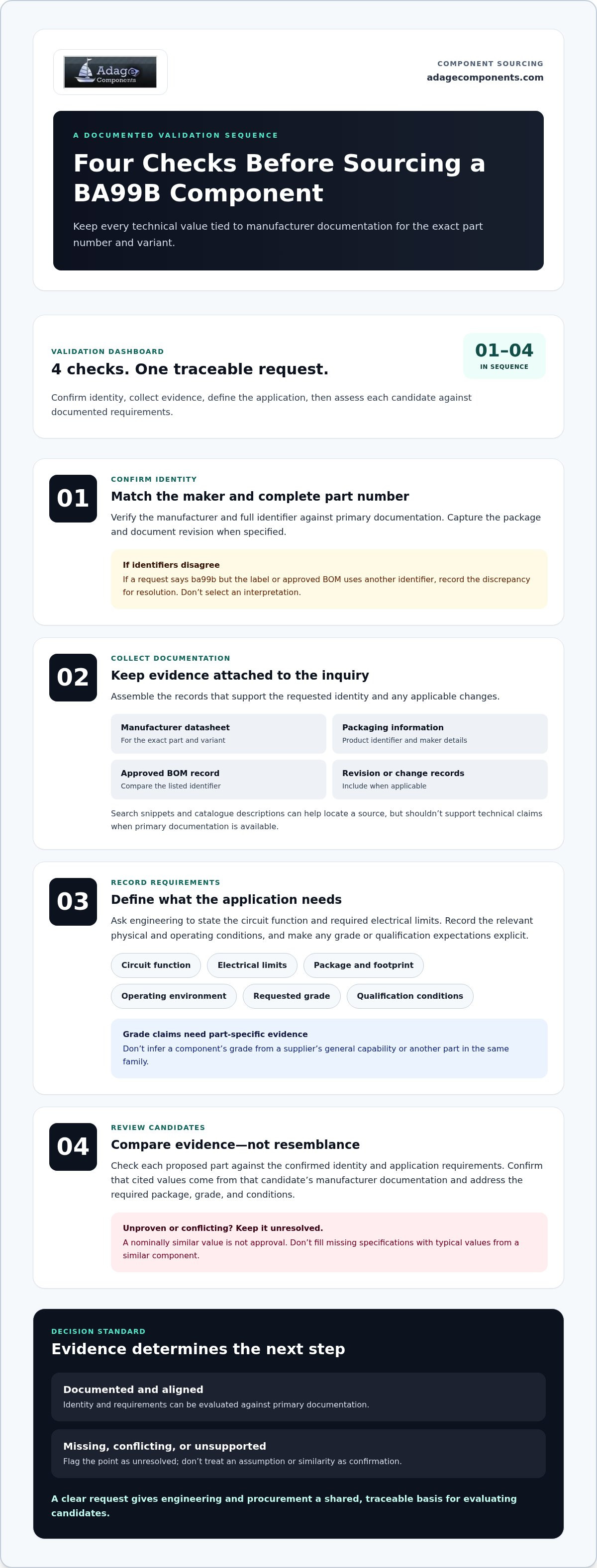
- Confirm identity. Match the manufacturer and complete part number to primary documentation. Capture the package and document revision when specified. If the request says ba99b but the label or approved BOM uses a different identifier, record the discrepancy for resolution instead of choosing an interpretation.
- Collect documentation. Assemble the manufacturer datasheet, packaging information, approved BOM record, and any applicable revision or change documentation. Search snippets and catalogue descriptions can help locate a source, but shouldn’t support technical claims when primary documentation is available. Keep files or references tied to the inquiry.
- Record application requirements. Ask engineering to state the circuit function and required electrical limits, then record package, footprint, and operating environment as applicable. List any requested commercial or automotive grade and relevant qualification conditions explicitly. A grade claim must be documented for the specific requested component, not inferred from a supplier’s general capability or another part in the same family.
- Review candidate evidence. Compare each proposed part against the confirmed identity and application requirements. Check that cited values come from the candidate’s own manufacturer documentation and that the evidence addresses the required package, grade, and conditions. Mark any unsupported or conflicting point as unresolved; don’t treat a nominally similar value as approval.
Build an identity record from primary documentation
Maintain a concise record with manufacturer, full part number, package, and applicable document revision. Use datasheets, labels, and approved BOM records as evidence, and note where each detail came from. If a component marking differs from a document or the BOM, preserve both records and flag the mismatch before requesting a quote or approving a candidate. This simple traceability step keeps an unverified interpretation from becoming a purchasing assumption.
Keep application and qualification needs explicit
Engineering should define the use case and limits; procurement should carry those requirements into the inquiry and BOM. Include specific values only when supported by the applicable manufacturer datasheet or engineering documentation. Once the component category and identity are established, Adage’s electronic component linecard can help connect the request to relevant portfolio categories.
How to Compare BA99B Candidates Without Assuming Drop-In Equivalence
Compare a proposed candidate against the approved part and the application requirements, not against a partial code or a seller’s broad description. A similar marking, package, or nominal value does not establish drop-in compatibility. Each criterion needs evidence from the relevant manufacturer documentation, and unresolved differences should remain visible for technical review.
A valid alternate must meet documented application requirements, not merely resemble the original component. Use a comparison record to separate verified matches from open questions and engineering decisions.
| Criterion | What to compare | Status to record |
|---|---|---|
| Identity | Manufacturer and complete part number for both parts | Confirmed or unresolved |
| Electrical limits | Only characteristics required by the circuit and supported by datasheets | Matched, conflicting, or undocumented |
| Package | Dimensions, termination, footprint, and mounting constraints | Matched or requires design review |
| Grade | Required commercial or automotive grade and evidence specific to the part | Documented or unresolved |
| Documentation | Datasheet, revision, and traceable supporting records | Complete or incomplete |
Don’t collapse these outcomes into a single “equivalent” label. A candidate may match one criterion while failing another or lacking documentation. Keep confirmed matches distinct from unresolved criteria, then reserve final approval for the responsible engineering authority. This makes the comparison useful to procurement without turning an assumption into an approved substitute.
Compare parameters that affect circuit performance
Start with the circuit function and compare only the electrical characteristics engineering identifies as relevant. Check the applicable datasheets for limits and conditions, including tolerances, temperature behavior, and power or voltage limits where required. Don’t copy values from a related part or infer a rating from a family name. Mark each missing or conflicting parameter for technical review, and avoid treating a nominal-value match as proof that the candidate will behave correctly in the circuit.
Check package, grade, and qualification evidence
Mechanical fit needs its own review. Compare documented package dimensions and terminations with the design footprint, mounting method, and any relevant space constraints. A matching package label alone may not establish compatible dimensions or connections. Keep commercial and automotive grade requirements distinct, and tie each requested grade or qualification to supporting documentation for that exact candidate. If any required criterion remains open, record the part as under review rather than equivalent.
For a ba99b candidate comparison, the result should be a traceable decision record: what matches, what remains unverified, and who must approve the engineering fit. That discipline supports procurement without inventing a cross-reference or committing to a substitute prematurely.
What Procurement Should Confirm for BA99B Quality and Supply Continuity
A sound sourcing decision connects three controls: the approved component identity, the quality expectations for the application, and a supply plan that fits production. If these sit in separate records, a quote may move forward with an unclear revision, missing grade requirement, or supply assumption that your MRP system can’t use reliably. Keep them together in the sourcing request and update the record when an approved detail changes.
For an ambiguous identifier such as BA99B, don’t assign a supplier, provenance, or quality status until the requested part is established. Once engineering and procurement have documented the identity and requirements, supplier review can assess evidence against that request. A strategic sourcing guide for electronic component distributors can also offer context for coordinating supplier, quality, and continuity considerations.
Build quality and traceability into the sourcing request
Attach the approved part number, applicable manufacturer documentation, and quality or qualification requirements relevant to the application. Keep supplier responses and supporting records linked to the request so purchasing, engineering, and receiving teams can work from the same approved information. Adage Components supports customers through technical support and manufacturing audits, helping procurement teams assess component requirements and quality processes. Tie supplier and component evidence to the specific sourcing record rather than assuming that a general process establishes the provenance of an unidentified BA99B item.
When reviewing a component, distinguish documentation about the manufacturer’s quality processes from evidence about the specific part. Record the requested grade, applicable qualification, and supporting documents for the exact part number. This gives engineering and procurement a concrete basis for reviewing whether the component meets the application’s requirements, without transferring a claim from another item in the same product family.
Plan logistics around production requirements
Give procurement and suppliers the information needed to plan quantities, required delivery windows, and your facility’s destination details. Adage coordinates international logistics and supports global stocking programs to help businesses manage component supply and production planning. Share target dates and quantities early, and keep confirmed supply details linked to the approved part number so planners can distinguish sourcing assumptions from established information.
Organized component and delivery information can also support your MRP system. Record the approved identifier, sourcing status, quantity, and planned delivery details in the relevant planning records. Treat these as planning inputs, not as a promise of real-time arrival. Confirmed information gives your planners a clearer view of what is approved and what remains open, helping reduce avoidable confusion as requirements move between purchasing and operations.
With the identity and quality expectations established, review Adage’s electronic component linecard to connect an identified requirement with relevant portfolio categories.
Source BA99B Through a Documented OEM Component Inquiry
A clear inquiry turns a difficult part lookup into a structured procurement task. Keep the identifier exactly as received, but don’t classify it as a resistor, capacitor, or diode until manufacturer documentation establishes what it represents. Adage Components supplies resistors, capacitors, and diodes, and can support a request once the component category and requirements are known. Keep an unverified code open as an identification item rather than treating it as a confirmed product specification.
Use a practical sequence to prepare the request:
- Provide the identifier. Include the full marking or code as received, the manufacturer if known, and any alternate or internal references. Flag uncertain characters instead of silently correcting them.
- Attach available documentation. Include datasheets, approved BOM records, packaging labels, or other source documents that help establish identity and requirements.
- Define the application and supply needs. State the approved component category, quantity, target timing, operating requirements, package constraints, grade, and compliance conditions where applicable.
- Submit the request for review. Keep unresolved identity or specification questions visible so a candidate isn’t treated as approved before the evidence supports it.
Prepare a BOM or part inquiry that reduces clarification cycles
A useful inquiry gives procurement and sourcing teams one consistent record to work from. Provide the complete part number and manufacturer when known, quantity, target timing, and approved documentation. State required grade, compliance conditions, and application constraints directly rather than relying on assumptions from a product family or description. For multi-line requests, structured BOM review can help organize component information for sourcing and planning.
Keep the BA99B entry distinct from confirmed line items if its identity remains unresolved. Record what is known, attach the evidence, and describe what engineering still needs to determine. This lets the sourcing discussion proceed without turning a tentative interpretation into a purchasing specification. Clear fields also help connect approved part data and target timing with your MRP workflow.
Use the sourcing model for the confirmed category
After the part has been correctly classified, match the requirement to the relevant resistor, capacitor, or diode category. Adage Components is a private-label manufacturer and distributor of electronic components, and works with OEMs and EMS providers on cost-effective alternatives and drop-in replacements for standard industry parts. Direct procurement channels and global stocking programs can help businesses manage material costs and lead times. Any alternate still needs to be assessed against the approved part and application requirements; a similar category or description alone doesn’t establish equivalence.
Adage coordinates international logistics and provides technical support for component sourcing. With the component category and application needs documented, review the Adage component linecard and sourcing options to begin a relevant sourcing discussion.
Turn a Verified Identifier Into a Stronger Procurement Record
Use the ba99b inquiry as an opportunity to improve how part data moves from engineering into purchasing and production planning. Once the identity is established, preserve the approved reference and its supporting records in the BOM. Assign ownership for updates, and keep any future change or alternate linked to the approval decision. That gives teams a dependable starting point when requirements evolve, rather than forcing them to reconstruct the sourcing history under schedule pressure.
A disciplined record also makes future procurement discussions more efficient. Suppliers can work from clear requirements, engineering can assess proposed changes against the application, and planning teams can use consistent part information in their workflows. The result is a stronger bridge between technical approval and supply execution.
To take the next step, review Adage Components’ electronic component linecard and identify the relevant category for your verified requirement.
Frequently Asked Questions
Is BA99B enough information to identify an electronic component?
No. BA99B by itself doesn’t establish a manufacturer, component type, or exact specification. Search results may connect similar strings to unrelated items, so don’t use a result title as purchasing evidence. Keep the identifier marked as unresolved in your procurement record until primary manufacturer documentation supports a complete part identity. That prevents an uncertain lookup from flowing into a purchase order or approved component record as if it were verified.
Can a component’s top marking serve as its complete part number?
Not necessarily. Space constraints can lead manufacturers to print abbreviated device codes, lot information, or other markings instead of the full orderable number. Photograph the component clearly and record its package and orientation, but don’t treat the image as a complete identity record. Compare the code with manufacturer documentation and the original packaging label. If the marking has several possible interpretations, preserve the alternatives for review rather than selecting one.
What should I send with a BA99B sourcing inquiry?
Send the identifier exactly as recorded, plus the manufacturer and full part number if known, quantity, target timing, and application context. Include the relevant BOM line, datasheet, label image, or approved engineering record. Clearly separate confirmed information from open questions. For example, label an unknown package or grade as “to be determined” instead of leaving a blank that could be mistaken for approval. This gives sourcing teams a usable request without implying missing details.
Does a BA99B search result prove a component is automotive grade?
No. A search result or supplier category label alone doesn’t establish automotive grade for a specific component. Look for manufacturer documentation that identifies the exact part number and supports the required grade or qualification. Check that suffixes and variants match the requested item, since a related family member may have different documented status. Keep the evidence with the approved BOM record so procurement doesn’t transfer a grade claim from one variant to another.
How should I handle conflicting BA99B search results?
Pause any part approval and preserve the conflicting results with their source URLs and dates. Compare each claim against primary manufacturer documents, packaging evidence, and controlled engineering records. Don’t combine details from separate listings into a single assumed component identity. If the records still disagree, route the discrepancy to engineering or quality for disposition and keep the sourcing line on hold until the identity is resolved. This creates a clear audit trail for the decision.
What does a date code on an electronic component tell procurement?
A date code can help trace a component to a manufacturing period or production lot, but its format and meaning depend on the manufacturer. Don’t assume the characters indicate a calendar date without an applicable decoding reference. Record the code as printed and retain its packaging context; use manufacturer or supplier traceability records to interpret it. A date code alone doesn’t establish the component’s identity, authenticity, grade, or functional condition.
Disclaimer
Cross-referenced components needs to be confirmed by the client with either spec. sheet or samples or both.
Please note, we use AI to help us, information is verified to be correct but we can not guarantee 100% accuracy.


