

A reel-volume discount can become an inventory liability when a lower unit price creates excess stock or prompts an unapproved part change. Effective bill of materials passive consolidation to achieve reel volume breaks starts with compatibility, not price alone. Components must meet the same engineering requirements, and the savings must hold up after landed costs, carrying costs, and replenishment needs are considered.
Duplicate or compatible passive-component requirements can be hidden across BOM lines. This guide explains how to find demand that can legitimately be aggregated, assess reel-volume opportunities, and protect quality, production, and MRP workflows. Before changing sourcing or packaging plans, compare potential savings with total inventory costs and confirm that each grouped requirement is supported by the approved part records.
Adage Components supports electronic-components BOM cost analysis and sourcing for passive components, including resistors and capacitors. As a private-label manufacturer and distributor, we provide cost-effective alternatives and drop-in replacements for standard industry parts, with technical support, manufacturing audits, and quality assurance. Our international logistics and global stocking programs support purchasing and replenishment plans, helping OEMs and EMS providers manage material costs and supply needs.
Key Takeaways
- Clean BOM data before grouping demand. Normalize part numbers, approved-vendor records, units, packaging codes, and lifecycle status to avoid false matches.
- Validate specifications and approval status before combining quantities. Similar-looking passive components aren’t automatically interchangeable.
- Use bill of materials passive consolidation to achieve reel volume breaks only when aggregated demand meets the supplier’s applicable order tier.
- Compare unit-price savings with inventory exposure, storage, obsolescence, and cash-flow impact before placing a larger order.
- Coordinate procurement, engineering, quality, planning, and finance, then document approved changes in the systems that control purchasing and MRP.
What Passive BOM Consolidation Means for Reel-Volume Breaks
Passive BOM consolidation means combining demand for technically compatible, approved passive components across active bills of materials or production requirements, then checking whether the total qualifies for a supplier’s order-volume tier. It isn’t simply buying extra inventory. The combined quantity must represent planned consumption and remain manageable under your replenishment and inventory controls.
A Bill of Materials (BOM) identifies the components required to build a product. For consolidation, procurement reviews demand across relevant BOMs while preserving each part’s identity and approval status. The goal of bill of materials passive consolidation to achieve reel volume breaks is to align verified requirements with purchasing tiers, not to treat similar descriptions as permission to substitute.
A reel-volume break is a supplier’s pricing or order-quantity tier associated with a component and its available packaging. The qualifying quantity depends on the supplier’s terms and component data, so confirm the applicable threshold and packaging before comparing costs. A larger order may reduce unit cost, but the benefit matters only if the quantity supports real production demand without creating avoidable stock.
Which passive-component lines may present consolidation opportunities?
Start by scanning active BOMs for repeated resistor, capacitor, and other passive line items. Compare the manufacturer part number, value, tolerance, voltage rating, package, and approval status. Matching identifiers can reveal demand worth reviewing. Differences may signal distinct requirements, even when descriptions look similar.
Treat apparent equivalents as candidates for engineering and quality review, not automatic substitutes. A shared component family or value alone doesn’t establish technical interchangeability. Keep the approved part identity in place unless the responsible teams authorize a change.
Why reel packaging changes the purchasing calculation
Packaging affects how a supplier quotes order quantities and how materials are received and replenished. A volume tier may depend on ordering a specified package quantity, while the production line consumes components according to its build plan. Reconcile purchasing units and consumption units in the planning system before placing an order.
For example, if two approved BOMs use the same exact part, review their planned requirements together against the supplier’s quoted tier. The combined order still needs a delivery and replenishment plan that reflects when each build will consume the material. This keeps a unit-price decision connected to the timing and quantity of actual demand.
For broader sourcing considerations, see The Strategic Guide to Sourcing Passive Electronic Components for OEMs. The immediate task is to establish whether BOM demand is genuinely compatible, then determine whether the packaging-linked order tier fits production needs.
How to Find and Aggregate Compatible Passive Demand Across a BOM
BOM aggregation starts with validated part identity, not a shared description. A resistor or capacitor line may resemble another on a separate assembly, but matching names don’t prove that the parts meet the same electrical, mechanical, quality, and production requirements. Keep candidate demand separate until those requirements and approved-source records align.
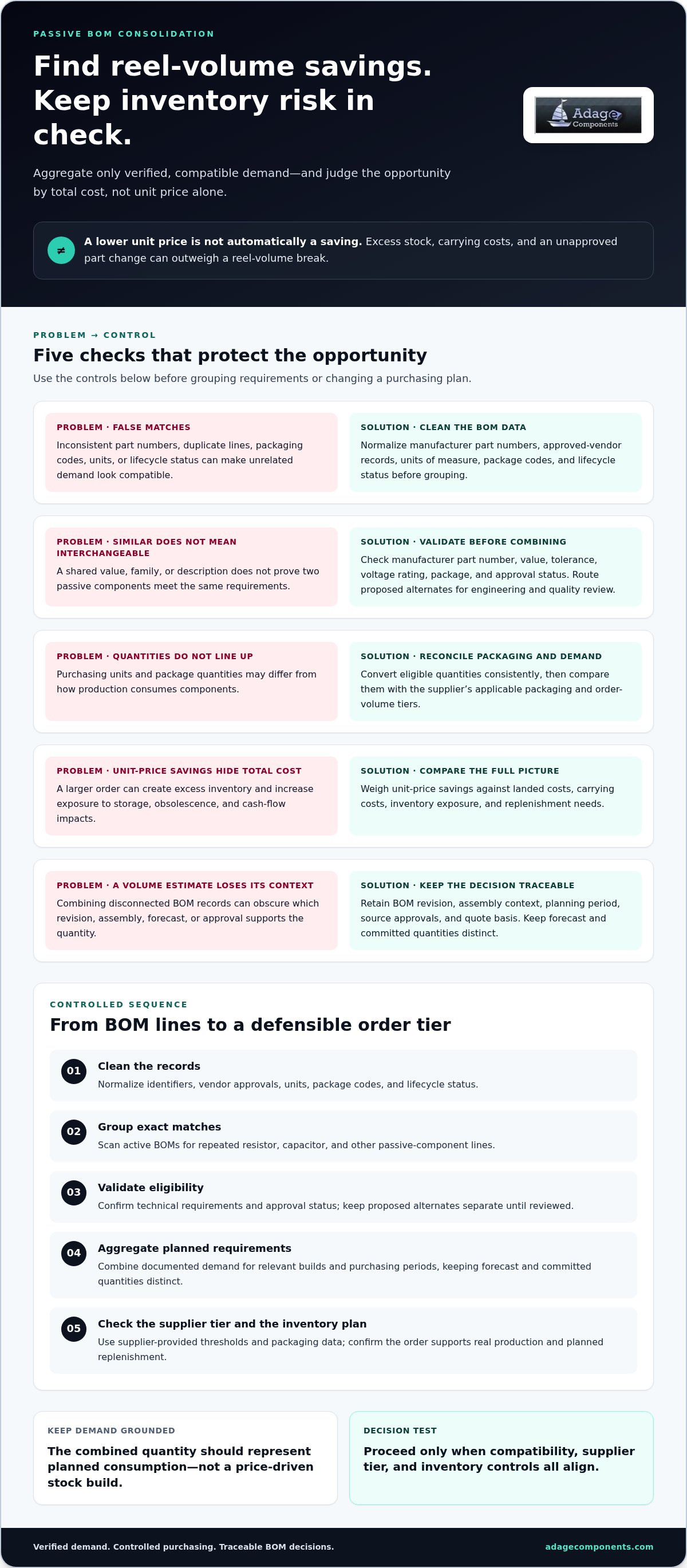
Use a controlled sequence: clean the data, group exact matches, validate candidates, aggregate eligible demand, then compare totals with supplier packaging and order tiers. Retain the BOM revision, assembly context, forecast period, and source approvals throughout the review. This creates a traceable demand basis rather than a volume estimate assembled from disconnected records.
Clean BOM data before grouping candidate parts
First normalize manufacturer part numbers, approved-vendor records, units of measure, package codes, and lifecycle status. Flag duplicate lines, inconsistent formatting, obsolete entries, and conflicting units before calculating demand. Separate exact manufacturer-part-number matches from proposed alternates. The Electronic Components Industry Association (ECIA) provides industry context for component sourcing, but your internal records must establish each part’s approval and applicability.
Preserve the source BOM revision and assembly context so each match remains tied to the correct build. If a possible alternate differs in part identity or approval status, route it for engineering review instead of merging it into the exact-match group.
Calculate demand against supplier packaging and reel tiers
After validation, combine only documented requirements for relevant builds and purchasing periods. Convert quantities consistently, then compare the eligible total with supplier-provided packaging quantities and volume tiers. Don’t assume a reel quantity or threshold from another component. Use the applicable supplier data and retain the quote basis with your calculation.
For example, forecast demand may span multiple assemblies, while released orders cover only part of the planning period. Keep forecast and committed quantities distinct so the total doesn’t imply consumption that production hasn’t scheduled. A BOM submission form can help organize BOM information for a cost review. That review supports bill of materials passive consolidation to achieve reel volume breaks by linking order quantities to validated demand.
Before finalizing a candidate group, record what was combined, the period covered, the approved part identity, and the supplier packaging data used. This gives procurement and planning a reproducible basis for evaluating the opportunity. Adage’s passive component linecard can help teams identify relevant resistor and capacitor categories for sourcing review.
How to Compare Reel-Break Savings With Inventory and Supply Risk
A lower unit price doesn’t by itself prove a lower total cost. A larger order can increase carrying exposure, occupy storage, tie up cash, or leave stock vulnerable to schedule changes and obsolescence. Compare purchasing scenarios against the production plan, forecast confidence, supplier availability, and replenishment cadence before treating a volume break as a saving.
Use buyer-verified quotes, demand forecasts, consumption records, and inventory assumptions. Separate confirmed quote savings from estimated costs so decision-makers can see which figures are firm and which depend on planning assumptions. Make the trade-offs visible rather than hiding risk inside an attractive unit price.
Model total cost instead of headline unit price
Build the comparison using the same component, supplier basis, and planning horizon for each scenario. Include the quoted unit cost and order quantity, then assess the likely inventory position over time. Apply your organization’s approved method for estimating carrying costs rather than inserting generic market figures.
- Current purchasing: Record the existing order quantity, quoted price, expected receipts, and replenishment cadence. This establishes the baseline for cost and supply exposure.
- Consolidated purchasing: Show the proposed quantity and confirmed price tier alongside the resulting inventory profile, storage needs, cash-flow timing, and exposure if demand falls.
- Deferred or phased replenishment: Assess whether dividing purchases over time changes the applicable quote, delivery plan, or risk of a supply gap. Use supplier-specific terms and actual production timing.
Test more than the expected case. Run sensitivity scenarios for demand increases or reductions, schedule shifts, forecast uncertainty, and component lifecycle exposure. If a build moves, an order sized to the original schedule may sit unused. If supplier availability changes, phasing may affect replenishment confidence. Record each scenario’s assumptions so finance, planning, and procurement can compare like with like.
Set decision rules for when consolidation is not justified
Pause a candidate if specifications, qualification status, or approval requirements remain unresolved. Don’t use a price tier to justify treating unapproved parts as interchangeable. Also reject or resize orders that exceed credible production demand or create unacceptable obsolescence exposure.
Decision rule: Proceed only when technical approval is documented and the total-cost review supports the proposed order quantity under realistic demand and schedule scenarios. If the case depends on uncertain demand or unverified savings, retain the current purchasing approach or model a phased option before committing.
This framework keeps bill of materials passive consolidation to achieve reel volume breaks focused on verified value. The final recommendation should state the quote basis, quantity, expected consumption period, inventory assumptions, and decision owner. That record lets teams revisit the choice when forecasts or production schedules change instead of relying on a unit-price comparison made in isolation.
How to Put Passive BOM Consolidation Into Production Without Disruption
A purchasing change should pass through defined internal ownership before it reaches an MRP or purchasing control. Procurement manages quote and order data; engineering reviews any proposed technical change; quality confirms applicable internal controls; planning validates demand and replenishment settings; finance reviews inventory and cash-flow impact. Assign a decision owner so approvals and system updates don’t happen in parallel without coordination.
Make the change record specific to the decision. Document the approved manufacturer part number, BOM revision and assembly context, supplier, packaging or order multiple, demand basis, and authorization in the relevant systems. Link those records so purchasing teams can distinguish a quantity adjustment from a component substitution. Follow your organization’s established procedures for any additional fields or workflow steps.
Protect engineering approval and quality traceability
Route proposed alternates through your established engineering and quality approval process before adding them to purchasing controls. Retain traceable records for the approved part identity, source, revision, and applicable inspection requirements. If an alternate is rejected or approved only for specific assemblies, preserve that disposition and scope in the record. This prevents an approved change for one build from being applied broadly by mistake.
Keep approval status accessible to the teams that release orders and receive material. A clear record helps them act on current authorization without relying on informal notes or assumptions.
Align purchasing changes with MRP and replenishment
Once internal authorization is complete, update approved sourcing records, order multiples, and planning parameters in the relevant systems. Set replenishment around validated consumption and production plans, not a supplier volume tier alone. Review demand signals and inventory status at the cadence used by your MRP system, then confirm that planned receipts align with build timing. Follow organization-specific workflow requirements before activating revised controls.
Use this compact checklist to coordinate the release:
- Procurement: Record the supplier, quote basis, approved order quantity, and purchasing details.
- Engineering and quality: Document the applicable authorization, revision, and quality records.
- Planning: Align replenishment parameters with validated demand and production timing.
- Finance: Review the order against the cost and inventory assumptions used in the decision.
- Process owner: Confirm approvals and system updates are complete before revised controls take effect.
Adage’s electronic-components BOM cost analysis can connect a sourcing review with your component requirements and purchasing plan. Submit a BOM for sourcing review to discuss your passive-component needs.
A controlled release keeps approved changes visible across procurement, planning, and production. With ownership and records in place, teams can implement a sourcing decision while preserving the system controls that support your MRP workflow.
How Adage Supports Cost-Conscious Passive Component Sourcing
A validated BOM review gives procurement a practical basis for evaluating sourcing options. Adage Components connects electronic-components BOM cost analysis with passive-component sourcing for resistors and capacitors. The review can relate approved part identities and demand to supplier quotations, helping teams assess purchasing opportunities without treating every similar BOM description as a match.
For each candidate, keep the component, applicable production requirements, and quote basis connected. This gives procurement and planning a clearer view of which demand supports a potential order tier and which requirements should remain separate. The result is a more disciplined sourcing decision grounded in the BOM rather than a target quantity alone.
Connect reel-volume analysis to supplier and quality controls
Adage’s sourcing approach includes manufacturing audits and quality assurance as part of the broader supplier-quality process. These activities support sourcing integrity, while component approval and acceptance decisions remain within the customer’s established engineering and quality processes.
Keeping the review tied to approved part and source records helps teams assess quotes without obscuring technical requirements. It also gives procurement a clearer basis for comparing available options with documented demand.
Move from BOM review to a sourcing conversation
Once the review establishes which requirements belong together, teams can consider how purchasing quantities fit planned consumption and MRP settings. Adage’s international logistics and global stocking programs support supply planning around customer needs. For broader context on supplier selection and procurement strategy, Electronic Component Distributors: A Strategic Sourcing Guide for 2026 explores related considerations.
Use the component categories in your BOM to focus the next sourcing discussion on relevant requirements and demand. Review Adage’s component line card to identify passive-component options for your plan.
Make the Next BOM Revision a Sourcing Checkpoint
Use the next BOM revision as a prompt to revisit consolidation decisions, especially when design changes or updated forecasts alter expected demand. A previously sound order plan can lose relevance as requirements shift. Reassessing the assumptions keeps bill of materials passive consolidation to achieve reel volume breaks connected to current production needs.
Adage Components can help turn that review into a focused sourcing conversation. Review Adage’s component line card and identify the passive-component categories to consider for your next BOM review.
Frequently Asked Questions
How do you consolidate passive components across multiple BOMs?
Start by matching demand to the exact approved component, then total requirements only for builds and planning periods that belong in the same purchasing decision. For example, separate forecast demand from released production orders so the combined figure doesn’t imply that all material is needed immediately. Keep the originating BOM and revision identifiable in your analysis. This lets teams trace the total back to its source if schedules or product configurations change.
Can different resistor or capacitor part numbers be combined for reel-volume pricing?
Not based on similarity alone. Different part numbers may indicate different construction, specification, approval, or source, even if the listed values appear alike. Keep them as separate demand lines unless engineering and quality approve the alternate for the applicable assemblies. If approved, document the exact replacement relationship and the affected BOM revisions. Never add quantities for distinct part numbers simply to reach a supplier’s volume tier.
What information is needed to evaluate reel-volume breaks on a BOM?
Provide the BOM revision, manufacturer part number, approved source, required quantity, unit of measure, and the period or build the demand covers. Include available inventory and open orders so the review reflects net requirements rather than gross BOM demand alone. Supplier quote details should identify the applicable packaging and order tiers. Distinguishing forecast quantities from firm requirements helps prevent a preliminary estimate from being treated as a purchase commitment.
How do you calculate whether a reel-volume break creates real savings?
Compare the quoted extended purchase amount for each scenario, then account for the buyer’s approved estimates for carrying, storage, obsolescence, and cash-flow effects. Use the same demand horizon and inventory assumptions across scenarios. For bill of materials passive consolidation to achieve reel volume breaks, distinguish confirmed quote savings from modeled costs, and test what happens if demand or schedules change. A lower quoted unit price alone doesn’t establish a lower total cost.
What happens if the consolidated reel quantity exceeds production demand?
The excess becomes inventory, so assess how long it is expected to remain usable and whether later production can consume the same approved component. Check existing stock and open orders before purchase to avoid duplicating supply. If supplier terms and planning needs support it, compare phased replenishment with a single larger order. Don’t assume excess stock can be transferred to another build unless that build uses the same authorized part and source.
Can BOM consolidation change approved components or supplier records?
No. Combining demand for an already approved part is a purchasing analysis, not authorization to substitute a component or add a supplier. Keep existing part and source controls intact until the appropriate internal owners approve a change. If an alternate is proposed, record its technical disposition and update affected BOM or supplier records through established change control. This separation prevents a cost review from unintentionally changing production instructions.
How can passive-component consolidation fit into an MRP system?
Keep the item identity and unit of measure consistent between BOM demand, inventory records, purchase orders, and supplier packaging data. Record order multiples and replenishment settings only after internal approval, then compare planned receipts with the production schedule and actual inventory position. If the system displays forecast and released demand separately, use that distinction in the sourcing review. This helps purchasing act on a valid requirement without obscuring timing or material status.
Disclaimer
Cross-referenced components needs to be confirmed by the client with either spec. sheet or samples or both.
Please note, we use AI to help us, information is verified to be correct but we can not guarantee 100% accuracy.


